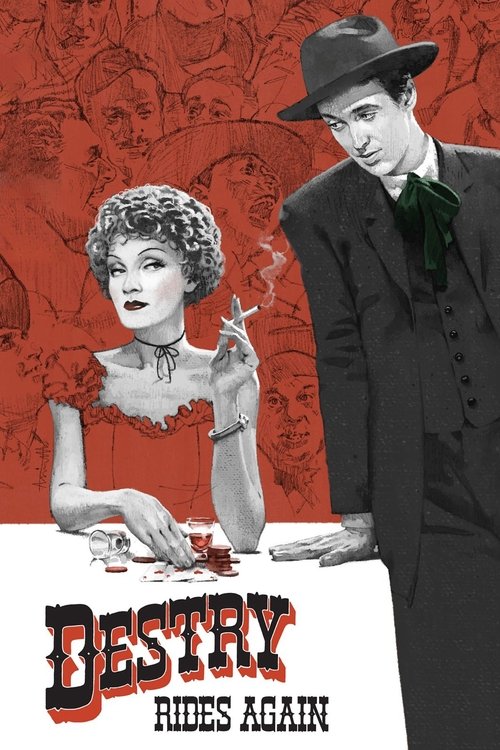
Destry Rides Again
1939 · George Marshall
For when you want an old-movie good time — charming, funny, and satisfying, with just enough grit to keep it from being fluff. An easy pick for a crowd or a rainy Sunday.
What it's about
Bottleneck is a lawless frontier town run by a crooked saloon boss, and its newest deputy, Tom Destry, arrives with a famous lawman's name and a scandalous refusal to carry a gun. The town laughs at him; the saloon's star attraction, the singer Frenchy, toys with him; and Destry, all folksy stories and mild manners, sets about cleaning the place up his own way.
The experience
Breezy, rowdy fun with a surprising backbone — it plays as a comedy full of songs, brawls, and tall tales, then reminds you at key moments that the stakes in a gun town are real. The tonal balance is the trick, and it works beautifully.
Performances
James Stewart, in the role that helped define his gentle-but-immovable persona, is irresistible as Destry, and Marlene Dietrich reinvented herself as the brassy, big-hearted Frenchy — belting saloon songs and throwing herself into one of the most famous knock-down fights ever filmed between two women.
The craft
George Marshall keeps the pace snappy and the tone in constant, expert motion between farce and menace, with musical numbers woven right into the saloon setting. Dietrich's songs, including the much-loved back-room number, are highlights in their own right.
Why it matters
Released in the Western's landmark year of 1939, it proved the genre could be funny without going soft, resurrected Dietrich's career after she'd been branded box-office poison, and shaped the persona Stewart would carry for decades.
Snapshot
Destry Rides Again is the film in which the American Western learned to laugh at itself without ceasing to mean it. Produced at Universal in 1939 — the annus mirabilis that also delivered Stagecoach, Dodge City, Jesse James, Union Pacific, and Frontier Marshal — it belongs to the year the A-Western returned from a decade of Poverty Row exile. But where John Ford's Stagecoach restored the genre's gravity, Marshall's film restored its playfulness, and did so by fusing two stars whose careers were, at that moment, in radically different trouble: James Stewart, on loan from MGM, still being sorted into a persona; and Marlene Dietrich, four years past the end of her collaboration with Josef von Sternberg, publicly branded "box-office poison" by the Independent Theatre Owners of America's notorious 1938 trade advertisement.
The picture's premise is a structural joke that turns serious. Tom Destry Jr., son of a legendary lawman, arrives in the lawless town of Bottleneck carrying a parasol and a birdcage, refuses to wear a gun, and disarms opposition through parable, patience, and whittling. The saloon singer Frenchy — Dietrich, in a role that rebuilt her American career — begins as the crooked boss Kent's instrument and ends as the film's moral pivot. The comedy is genuine, but the film's structure is a slow-tightening screw: the joke of the pacifist deputy is permitted to run until violence arrives in earnest, at which point the film cashes in every laugh it has banked.
It is a remake in name and premise of a 1932 Tom Mix vehicle, itself drawn from Max Brand's novel, though the 1939 version diverges sharply in tone and incident. It would be remade again by Marshall himself in 1954 as Destry, with Audie Murphy — a rare instance of a director revisiting his own hit — and it generated a Broadway musical (Destry Rides Again, 1959, songs by Harold Rome) and a short-lived 1964 television series. Its longest shadow, though, falls on Mel Brooks's Blazing Saddles (1974), which reworks its central conceit — the unlikely lawman in the crooked frontier town, the saloon chanteuse, the barroom brawl — into outright parody.
Industry & production
Universal in 1939 was a studio rebuilding after near-collapse. The Laemmle family had lost control in 1936; the studio survived on Deanna Durbin musicals, horror revivals, and program pictures. Destry Rides Again was produced by Joe Pasternak, the Hungarian-born producer whose Durbin films had been Universal's financial salvation, and it bears the marks of his method: warmth, music integrated as attraction rather than ornament, sentiment handled without embarrassment.
The casting is the production's central industrial fact. Dietrich had left Paramount after The Devil Is a Woman (1935) and her subsequent films — including the expensive British production Knight Without Armour (1937) — had not restored her commercial standing. The "box-office poison" list of May 1938 named her alongside Katharine Hepburn, Joan Crawford, Fred Astaire, and others. Pasternak's decision to cast her as a brawling frontier saloon singer inverted the Sternbergian image comprehensively: where Sternberg had abstracted her into light, veils, and immobility, Marshall put her on a bar top belting a novelty song and, later, rolling on the saloon floor in a hair-pulling fight. Accounts of the production consistently credit Pasternak with pursuing her against studio skepticism; the specific negotiations are documented unevenly, and it is worth saying plainly that much of the anecdotal record around the casting comes from memoirs written decades later.
Stewart was borrowed from MGM, which had not yet found the register that Capra would consolidate later that same year in Mr. Smith Goes to Washington. The two films were released within months of each other, and the pairing is instructive: both depend on an apparently naive man whose stubbornness proves harder than the cynicism around him.
The film was shot on Universal's backlot Western street and standing interiors, with second-unit and location work of a modest scale. It is a studio picture in the most literal sense — Bottleneck is a set, lit and controlled — and the film makes no attempt at the landscape rhetoric Ford was pursuing simultaneously in Monument Valley. This is a deliberate divergence, not a limitation of budget alone: Destry is a town film, an interior film, a film about social space rather than wilderness.
Technology
Shot in black-and-white on 35mm nitrate stock at a moment when the Western's prestige tier was flirting with three-strip Technicolor — Dodge City, Jesse James, and Drums Along the Mohawk all appeared in color in 1939 — Destry Rides Again stays monochrome, consistent with Universal's budget tier and with a visual scheme built on lamp-lit interiors and smoke.
The relevant technological substrate is the mature late-1930s studio sound and lighting apparatus. Faster panchromatic stocks and improved incandescent lighting allowed the deep, contrasty saloon interiors the film relies on without the harsh over-illumination of early sound production. The optical soundtrack handles a demanding mix: overlapping crowd noise, a piano diegetically present in nearly every saloon scene, gunfire, breaking glass, and Dietrich's singing voice — which sits low and close, more speech than aria.
Nothing in the film is technologically innovative in the sense that Stagecoach's stunt work or Gone with the Wind's color management were. Its technology is the invisible, fully industrialized craft of the classical studio at its peak, deployed with unusual sureness.
Technique
Cinematography
Hal Mohr photographed the film. Mohr was among the most technically adventurous cameramen of the period — he had shot A Midsummer Night's Dream (1935), for which he received an Academy Award via write-in campaign, and The Phantom of the Opera (1943) — and his work here is characteristically clean and legible rather than showy.
Two registers govern the look. The saloon interiors are lit for depth and atmosphere: practical-motivated pools of lamplight, layered planes of extras, smoke used as a diffusing medium so that background figures soften and the frame acquires recession. The exteriors of Bottleneck's main street are flatter, more evenly keyed, in the manner of studio Western streets.
Mohr's handling of Dietrich is the pointed technical achievement. He must present the Sternberg face — a face the audience of 1939 knew as an object of near-abstract lighting design — inside a rowdy comic Western. The solution is a compromise the film sustains without visible strain: Dietrich receives careful key and eye light in her performance numbers and in her scenes with Stewart, so that her glamour remains legible, while the coverage around her stays in the ordinary grammar of studio comedy. She is lit as a star inside a film that is not lit as a Sternberg picture, and the seam rarely shows.
Editing
Milton Carruth cut the film. The editing is classical continuity work, unobtrusive in the dialogue scenes, but two sequences show real construction. The Frenchy–Lily Belle fight is built from short, aggressive cuts on movement, with the crowd's reactions used as punctuation and rhythm-setters — a sequence that works because it is edited as slapstick, on beats, rather than as violence. The final assault on Kent's saloon shifts the film's cutting pace decisively: the shot lengths shorten, the geography opens out into street-wide movement, and the accumulated comic rhythm is replaced by something closer to the tempo of an action climax. The tonal transition from farce to fatality in the last reel is largely an editorial accomplishment.
Mise-en-scène / staging
Bottleneck is organized around one dominant space: the Last Chance saloon, which functions as courthouse, bank, marketplace, and battlefield. Property changes hands there through rigged card games; the film's political economy is entirely visible in a single room. The staging repeatedly uses the saloon's verticality — the stairs, the balcony, the bar top — to encode power. Frenchy sings from above and atop; Kent operates from the card table; Destry, tellingly, enters at floor level and stays there.
Costume carries argument. Dietrich's saloon-performer outfits — feathers, sequins, exposed leg — are the standard iconography of the frontier "bad woman," and the film uses them straight before complicating them. Stewart's Destry is dressed plainly and carries, in his introduction, a parasol and a birdcage belonging to a female passenger: the gag is that he is holding a woman's things, and the film's willingness to let its hero be feminized in the first minute is the source of everything that follows. His whittling — the small wooden figures he carves while others posture — is the recurring physical object through which the film stages patience against display.
The town itself is staged as a functioning society rather than a backdrop. Marshall fills frames with townspeople who have continuous business, and the climactic sequence in which the women of Bottleneck march on the saloon to stop the gunfight depends on that groundwork: they are recognizable, not sudden.
Sound
Frank Skinner composed the score, with Universal's music department under Charles Previn. The songs — "See What the Boys in the Back Room Will Have," "You've Got That Look," and "Little Joe, the Wrangler" — were written by Frank Loesser (lyrics) and Frederick Hollaender (music). Hollaender had written "Falling in Love Again" for The Blue Angel, and the reunion is not incidental: the songs are constructed for Dietrich's specific instrument, a low, conversational, slightly frayed voice that half-speaks its way through a melody. "See What the Boys in the Back Room Will Have" became a standard and is the film's most durable single artifact.
The songs are diegetic and functional. They establish Frenchy's occupation, her hold over the room, and — crucially — her irony about both. This is a musical logic inherited from The Blue Angel and from Weimar cabaret more broadly, transplanted to a Western saloon, and it is one of the film's genuinely hybrid gestures.
The non-musical sound design is dense: the saloon is never quiet, and the film's quiet moments acquire their weight by contrast. Skinner's score works largely as connective tissue and dramatic underlining rather than as a thematic system.
Performance
Stewart's Destry is the performance that begins to define the Stewart persona of soft speech masking immovability. He talks slowly, deflects with anecdote — the film's running device of "I knew a fella once who..." stories that arrive as folksy digressions and land as threats or verdicts — and holds physical stillness while others move. It is a performance about withheld capacity: the audience is told his father was a great shot and waits, for most of the running time, for the demonstration.
Dietrich's Frenchy is the more radical piece of work because it is a public self-demolition. The immobility, the hieratic stillness, the strategic passivity of the Sternberg films are all discarded for aggression, physical comedy, and volume. She throws things, brawls, cheats at cards, and sings on a bar. That the film also allows her the standard redemptive arc is conventional; that she plays the earlier three-quarters with such unglamorous energy is not.
The supporting cast operates at a high level of character-actor craft: Brian Donlevy as Kent, playing the villain with businesslike calm rather than snarl; Charles Winninger as the drunken deputy Wash Dimsdale, whose sobering-up is the film's secondary redemption plot; Mischa Auer as the henpecked Russian Boris Callahan, a broad comic turn characteristic of Pasternak's productions; Una Merkel as Lily Belle; and Samuel S. Hinds and Jack Carson in supporting roles.
Narrative & dramatic mode
The film's dramatic mode is comedy operating under a suspended sentence. Structurally, it withholds: the hero refuses the genre's defining action, and the narrative's tension derives from the audience's expectation that he must eventually perform it. Every joke about Destry's pacifism is also a deposit against the climax.
The turn is engineered around the death of Wash Dimsdale. Comedy's protective contract — that no consequence is final — is broken, and the film's register shifts within a single scene. Destry straps on the guns. What makes the sequence more than a genre capitulation is that the film immediately complicates the victory: Frenchy's death, taking the bullet meant for Destry, denies the hero a clean triumph and denies the romance a resolution. The film ends with Destry telling one of his stories to another woman, the town restored, and the person who made the restoration possible dead. That is a considerably darker last movement than the film's reputation as a comic Western suggests.
The screenplay is credited to Felix Jackson, Gertrude Purcell, and Henry Myers, suggested by Max Brand's novel. The dialogue construction — Destry's parables, Frenchy's deflating one-liners, the running Boris gag — is unusually attentive to how speech substitutes for action.
Genre & cycle
Destry Rides Again sits at the intersection of three cycles.
First, the 1939 A-Western revival. After the coming of sound pushed the Western down into B-programmers and singing-cowboy series, 1939 brought the form back to major-studio budgets. Destry participates in that revival while declining its principal strategy: it does not seek epic landscape or national-historical myth.
Second, the town-Western — the strain concerned with law, property, and the establishment of civil order in a settlement rather than with the frontier as wilderness. This lineage runs from the Wyatt Earp films through My Darling Clementine (1946) to High Noon (1952). Destry's specific contribution is to make the crooked land-grab and rigged gambling table, rather than the outlaw gang, the source of disorder.
Third, the comedy-Western, which Destry effectively legitimized at the A level. Prior Western comedy was largely a matter of sidekick relief. Here the comic sensibility governs the whole film, including its hero, which is a structurally different proposition.
There is also a fourth strand, harder to name: the saloon-singer film, in which a woman of ambiguous respectability mediates between the criminal and civic orders. Dietrich's Frenchy is the definitive instance, and the type recurs throughout the 1940s and 1950s — most conspicuously in Rancho Notorious (1952), where Fritz Lang cast Dietrich in an explicit late variation on the role.
Authorship & method
George Marshall was a prolific studio craftsman rather than an auteur in the critical sense — a career spanning silent comedy through television, including work with Laurel and Hardy, W.C. Fields (You Can't Cheat an Honest Man, also 1939), and Bob Hope (The Ghost Breakers, 1940). His method is best described as comic timing applied to genre material: he understood how long to hold a reaction, how to stage a brawl for laughs, and how to let performers work. Auteurist criticism has generally not made large claims for him, and it would be overreaching to construct a Marshall thematics from this film. What can be said is that the tonal control here — the ability to run farce and menace in the same reel and then convert one into the other — is a real directorial achievement, and that Marshall's background in comedy is the plausible source of it.
The collaborative account is the more honest one. Pasternak supplied the conception and the Dietrich gamble, and his signature blend of music, sentiment, and ethnic comic character work is visible throughout. Hollaender and Loesser supplied a song cycle written to a specific voice and a specific persona-inversion. Mohr supplied a photographic scheme that let Dietrich remain a star while the film remained a comedy. Carruth's cutting managed the tonal pivot. Jackson, Purcell, and Myers supplied a script that made talk the hero's weapon. Skinner scored it. It is a producer's picture and an ensemble craft object, and reading it that way explains more than director-centered analysis does.
Movement / national cinema
The film is squarely a product of the Hollywood studio system at its classical height — invisible technique, genre legibility, star-vehicle logic. But it is also a document of European emigration into that system. Pasternak was Hungarian. Hollaender was a German-Jewish composer who had scored The Blue Angel and fled Germany in 1933. Dietrich, who had left Germany and would become a US citizen in 1939, was by this point a prominent anti-Nazi émigré. Mischa Auer was Russian-born.
The consequence is audible. Frenchy's numbers carry the harmonic and rhetorical DNA of Weimar cabaret — the sardonic address to the audience, the transactional sexual comedy, the melody that circles rather than soars — set in a Wyoming saloon. This is one of the clearer instances of the emigration reshaping an indigenous American genre from inside, comparable in kind (if not in tone) to what Wilder, Lang, Siodmak, and Preminger would shortly do to the crime film.
Era / period
Released in December 1939, three months after the German invasion of Poland and at the close of the Depression decade. Both contexts press on the film.
The Depression reading is the more textually supported: Bottleneck's crisis is a property crisis. Kent takes the Claggett ranch through a rigged card game and controls the town's land and water. The film's villain is a monopolist, and its resolution is a community reasserting law over a captured local economy. This is New Deal grammar, and it is common to the period's popular cinema — the same year's Mr. Smith Goes to Washington runs an analogous argument in a Senate chamber.
The war reading is more inferential and should be flagged as such: a film released weeks into the European war, whose hero refuses to take up arms until refusal becomes untenable, and which then depicts the necessity of collective violent resistance to an entrenched local tyranny, invites an isolationism-to-intervention allegory. The film makes no such statement, and the production predates the war's outbreak. But the presence of Dietrich — soon to be one of Hollywood's most visible anti-Nazi figures, and later a tireless USO performer — gives the pacifism plot a resonance that 1939 audiences, and certainly later viewers, could hardly avoid.
Themes
Law versus force. The film's argument is not that violence is wrong but that it is a last resort whose legitimacy depends on having exhausted the alternatives. Destry's method — evidence, procedure, patience, talk — is presented as effective until it collides with an opponent who recognizes no procedure. The film honors the method and then concedes its limit, which is a more difficult position than either pure pacifism or pure gunplay.
Persuasion as weapon. Destry's anecdotes are the film's characteristic formal device. Each is a small parable delivered as small talk, and each does work a gun would otherwise do. The film is unusually interested in speech as instrumental action.
The community as agent. The march of Bottleneck's women on the saloon is the film's most distinctive structural choice: the decisive intervention comes from a collective, and specifically from the group with least formal power. It reframes the climax from individual heroism to civic action.
Reputation and inheritance. Destry lives under his father's legend, and the plot's engine is the gap between what the town expects of the name and what the man delivers. Frenchy's arc is the mirror image: she is defined by a reputation she eventually repudiates at the cost of her life.
The redeemed woman and its price. Frenchy's death is conventional in genre terms — the fallen woman purchases moral standing with her life, a pattern the Production Code environment encouraged. It is worth naming the convention rather than treating the ending as unmotivated pathos. What the film does within the convention is give her the film's most vivid presence and its most consequential act.
Reception, canon & influence
The film was a commercial success and is generally credited with restoring Dietrich's American career — she went on to Seven Sinners (1940) and The Spoilers (1942) in comparable register. Contemporary reviews were broadly favorable, praising the Stewart–Dietrich pairing and the tonal balance; the picture received no Academy Award nominations, which in the crowded field of 1939 says little. Specific box-office figures for Universal releases of this period are inconsistently documented, and I am not going to assign one.
Critical standing has risen over time. The film was selected for the National Film Registry by the Library of Congress in 1996. It is now routinely cited in genre histories as the point at which the comic Western achieved full A-picture legitimacy, and as one of the essential Dietrich performances outside the Sternberg cycle.
Influences on the film (backward). The Max Brand novel supplies the name and the premise of the pacifist son. The 1932 Tom Mix version establishes it as filmable material, though the 1939 film diverges substantially in plot and tone. More important are two non-Western sources: the Weimar cabaret tradition, arriving through Hollaender and Dietrich and carrying The Blue Angel's model of the performing woman who narrates her own commodification; and the American screwball comedy of the mid-1930s, whose rhythms of verbal combat and physical indignity govern the Stewart–Dietrich scenes far more than any Western precedent does. The saloon brawl between two women also draws on the slapstick tradition Marshall knew from silent comedy.
Legacy (forward). Four lines are traceable with confidence.
The first is on the Stewart Western persona. The gentle, verbally circuitous man capable of sudden hardness becomes the foundation on which Anthony Mann built the far darker Stewart of Winchester '73 (1950), Bend of the River (1952), and The Naked Spur (1953) — films that take Destry's withheld violence and make it neurotic. Ford's The Man Who Shot Liberty Valance (1962) is almost a tragic rewriting of Destry's premise: the lawyer who won't carry a gun, in a town owned by a bully, whose apparent triumph is built on a lie.
The second is the comic Western as a viable A-form, running through The Paleface (1948), Cat Ballou (1965), Support Your Local Sheriff! (1969) — which reworks the competent-unlikely-lawman formula closely — and most directly Blazing Saddles (1974), whose Lili Von Shtupp is an explicit Dietrich/Frenchy parody, complete with a Hollaender-style cabaret number, and whose saloon brawl and crooked-boss plot descend visibly from this film.
The third is the saloon-singer archetype, which Destry codifies for two decades of Westerns and which Lang deliberately closes out by casting the aging Dietrich in Rancho Notorious.
The fourth is the town-Western's ethical structure — the question of whether a civil community can defend itself, and what it costs — which reaches its severest form in High Noon (1952). Destry answers optimistically where High Noon answers bitterly, but they are asking the same question, and Destry asked it first.
The film's own remake history — Marshall's Destry (1954), the 1959 Broadway musical, the 1964 television series — indicates a property with unusual durability. But the 1939 version's real afterlife is diffuse rather than proprietary: it lives in every Western that lets its hero be funny before it lets him be dangerous.
A Deleuzian reading
A man steps down off the stagecoach into Bottleneck with his hands full.
The full Deleuzian reading of Destry Rides Again →
Reception
A smash in Hollywood's legendary class of 1939, it single-handedly rescued Marlene Dietrich from her 'box office poison' label — and while it's since been overshadowed by that year's giants, it's now cherished as the comedy-Western that basically invented the genre spoof.
How Destry Rides Again was received, from release to now →
How to watch Destry Rides Again: what to notice on a first viewing
- Watch Destry step off the stage holding a parasol and birdcage. He sets down a woman's parasol and birdcage before saying hello, refusing a gun in his very first moment in town, and the street decides he is nothing. Holding the wrong objects for a Western hero is the joke the entire film is built on.
- Watch Destry whittle small wooden figures while others posture around him. Stewart holds his hands busy with a knife instead of a gun, banking on the town's memory of a father's reputation nobody in this film ever shows firing. The unseen gun is present in every scene it is not in.
- Notice who stands where in the Last Chance saloon. Frenchy sings from the balcony and the bar top, Kent works the card table, and Destry enters at floor level and stays there through the whole film. The room's vertical layout tells you who holds power before anyone speaks a line.
- Listen to what Frenchy's saloon song is actually about. Dietrich sings See What the Boys in the Back Room Will Have to the very men whose money and habits the song describes, with open irony toward the room. She is not pausing the story to perform, she is singing the town's whole economy out loud.
- Notice how the Frenchy and Lily Belle brawl is cut like slapstick. Carruth builds the fight from short, aggressive cuts on movement, with the crowd's reactions used as punctuation, so it plays as comedy on beats rather than violence. The editing decides the fight is funny before the fight itself does.
The whole guide to watching Destry Rides Again, with the keys for a rewatch →
Influences: the films it descends from and the films it influenced
- The Blue Angel (1930) — Supplies the Hollaender-scored number in which the singer stands on a saloon table and sells her own commodification to the men buying her — 'See What the Boys in the Back Room Will Have' is 'Falling in Love Again' rewritten for a mining town, with Hollaender himself carrying the idiom across.
- Morocco (1930) — Establishes the Dietrich lighting protocol Hal Mohr reproduces — high butterfly key, gauze-veiled fill, and the number staged as performer-versus-jeering-crowd with cutaways to reaction — except Mohr shoots it in comedy's flatter cutting rhythm instead of Lee Garmes's fetishistic held frames.
- Destry Rides Again (1932) — The Tom Mix version proves the Max Brand property filmable and fixes the premise of the deputy who refuses the gun, which Marshall retains while converting Mix's athletic hero into Stewart's whittling, anecdote-telling deflection.
- Big Business (1929) — The Laurel and Hardy tit-for-tat escalation — matched shot/countershot on each act of destruction, each cut raising the stakes one increment — is the exact grammar Milton Carruth uses to build the Frenchy–Lily Belle catfight from slap to full demolition.
- The Awful Truth (1937) — McCarey's method of holding on the reaction rather than the joke, and letting performers embarrass each other through timing, is precisely the discipline Marshall imports into a Western: the Stewart–Dietrich scenes are cut for the beat after the line, not the line.
- Barbary Coast (1935) — Codifies the gambling hall as the only functioning civic institution in a lawless town and the hostess who takes a house percentage — the Bella Donna's economics and social geometry are what the Last Chance saloon inherits, including the woman who is both employee and asset.
- Seven Sinners (1940) — The immediate franchise reprint: Joe Pasternak producing, Hollaender and Frank Loesser writing the numbers again, Dietrich again the saloon performer with a house cut, and a naive tall straight man (Wayne for Stewart) played off her sarcasm — plus a climactic brawl staged to the same escalation beats.
- The Paleface (1948) — Takes Destry's structural gag — the man who cannot or will not shoot, surviving on talk while someone else supplies the marksmanship — and inverts it into pure farce, with Jane Russell running the Frenchy function as the competent woman managing the hero's cowardice.
- Winchester '73 (1950) — Mann keeps the Destry cadence intact — the soft voice, the anecdote used to defer a confrontation — and makes it pathological, so the withheld violence Marshall played for charm becomes a symptom; Stewart's rifle-barrel stillness is the same performance with the comedy stripped out.
- High Noon (1952) — Poses Destry's civic question — can a town be made to defend itself, and by what instrument — in its severest form, and retains the diegetic-song device as narrative motor, Tiomkin's ballad doing structurally what the saloon numbers do in Destry: measuring the community against the man asking it for help.
- Rancho Notorious (1952) — Lang deliberately retires the archetype by casting the aging Dietrich as a legendary saloon queen whose numbers survive only as flashback and ballad — the chuck-a-luck wheel and the 'ride the men like horses' turn are cited as history, closing the persona Destry codified for two decades.
- Destry (1954) — Marshall's own remake reproduces his 1939 blocking near-identically — the parasol business, the vertical saloon staging with the boss above the room, the birdcage — while proving how much of the original depended on Dietrich and Hollaender rather than on the shot list.
- The Man Who Shot Liberty Valance (1962) — A tragic rewrite of the same premise — the man who won't carry a gun in a town owned by a bully — that keeps Destry's civic staging but reveals the victory as fraudulent, converting Marshall's optimistic answer about law replacing force into a lie the town agrees to print.
- Support Your Local Sheriff! (1969) — The closest structural rework of the formula: the unlikely lawman who takes an unwinnable job, disarms the town by deadpan competence rather than gunplay, and defeats the crooked boss's family — Kennedy even literalizes Destry's refusal by giving Garner a jail with no bars.
- Blazing Saddles (1974) — Lili Von Shtupp is a direct Frenchy parody down to the Hollaender-pastiche cabaret number staged on the saloon platform to the same jeering-crowd geometry, and the crooked-boss plot plus escalating saloon brawl are lifted from Destry's architecture before being blown through the studio wall.
- Stagecoach (1939) — The other 1939 film that restored the A-budget Western by importing an outside grammar — Ford borrows Murnau's low-ceilinged interior blocking where Marshall borrows screwball's overlapping verbal combat — and both rehabilitate the saloon woman by making her the moral center of a confined ensemble.
- Dodge City (1939) — Curtiz's mass saloon melee — dozens of bodies, breakaway furniture, cutting on impact across the full width of the room — is the maximalist version of the brawl grammar Destry miniaturizes into two women, where the same escalation logic runs on comic rather than spectacular fuel.
- Mr. Smith Goes to Washington (1939) — Released weeks earlier, it forges the same Stewart instrument in parallel — the hesitant tenor, the circuitous verbal stalling, the sudden hardening of a soft voice — so the two films together fix the persona of the gentle man whose resolve is audible before it is visible.
Similar films
- The Man Who Shot Liberty Valance (1962) — influence & lineage
- Stagecoach (1939) — influence & lineage
- Blazing Saddles (1974) — influence & lineage
- Mr. Smith Goes to Washington (1939) — influence & lineage
- Rio Bravo (1959) — shared sensibility
- Some Like It Hot (1959) — shared sensibility
- My Darling Clementine (1946) — shared sensibility
- Midnight (1939) — shared sensibility