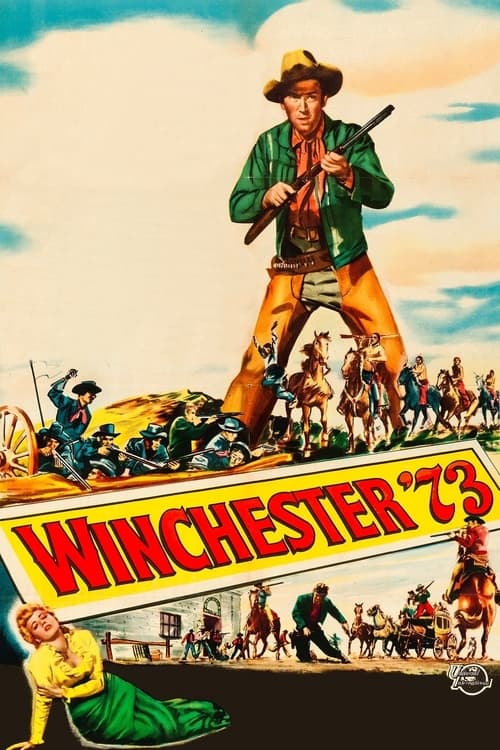
Winchester '73
1950 · Anthony Mann
When you want a classic Western that moves — a tight 90-odd minutes with a hook you can explain in one sentence. Comfort-food genre viewing with a darker aftertaste than you expect.
What it's about
On the Fourth of July, 1876, Lin McAdam rides into Dodge City hunting a man named Dutch Henry Brown — and ends up beating him in a shooting contest for the prize of a one-in-a-thousand Winchester rifle. Dutch steals the gun and runs, and from there the rifle travels — by theft, poker game, trade, and murder — through the hands of one owner after another, while McAdam's pursuit of his old quarrel closes in behind it.
The experience
Lean and driving, with a structure that keeps handing you a new story every twenty minutes while the revenge plot tightens underneath. There's a hardness to it that sneaks up on you — this is a Western where the hero's anger is genuinely unsettling.
Performances
James Stewart, turning his decent-everyman persona into something clenched and obsessive — the pivot point of his whole career, and startling to watch if you only know the Capra films.
The craft
Anthony Mann builds the film as a relay: the rifle passes hand to hand, each owner getting his own episode, while the chase plot braids through them and everything converges on a final shootout among the rocks. Crisp black-and-white location shooting and a structure so clean it feels engineered.
Why it matters
The first of the Stewart–Mann Westerns, the partnership that darkened the genre in the 1950s and remade Stewart as a star capable of playing obsession and rage. Its passed-object structure has been borrowed ever since.
Snapshot
A rifle wins a shooting match in Dodge City on the Fourth of July, 1876, and then travels — by theft, card game, trade, murder, and salvage — through the hands of six men before returning to the one who won it. Winchester '73 is built on that circuit, and the circuit is the point. Anthony Mann's first Western with James Stewart takes the most conventional of Western engines, a revenge chase, and doubles it with a relay structure borrowed from anthology cinema and the picaresque, so that the pursuit of Dutch Henry Brown and the passage of the gun braid together and arrive at the same rock face.
It is also the film in which two histories pivot at once. Stewart's screen persona turns here from Capra's decent hesitant citizen into something clenched, sadistic, and unstable — the register he would work for a decade with Mann and with Hitchcock. And the deal that put him in the picture, negotiated by Lew Wasserman with Universal-International, is routinely cited by industry historians as a hinge in the collapse of the salaried contract system and the rise of the star as equity participant. A modestly budgeted black-and-white Western did both things in the same year the Western itself was turning neurotic.
Industry & production
Universal-International in 1949 was not a strong studio. Under Leo Spitz and William Goetz it had traded on prestige imports and a British distribution arrangement while its domestic program stalled, and the industry as a whole was absorbing the 1948 Paramount consent decrees, which forced the majors to divorce their theater chains and thereby knocked out the guaranteed exhibition that had underwritten the contract system. Television was arriving. Studios were shifting toward the package: assemble talent per picture, share the risk.
Winchester '73 was developed from a story by Stuart N. Lake, the journalist whose 1931 Wyatt Earp: Frontier Marshal had done more than any other single book to install Earp in American myth — which is why Earp turns up in the film's first act, disarming Dodge City with amused authority. The screenplay is credited to Robert L. Richards and Borden Chase. Richards's screen credits effectively stop in the early 1950s in the wake of the blacklist; Chase, who had written Red River (1948) for Howard Hawks, would go on to write Bend of the River and The Far Country for Mann and Stewart, and his preoccupation — the man whose competence is inseparable from his capacity for violence — is the spine of all of them.
The production's origin story is well known and, like most such stories, survives mainly through later interviews rather than contemporaneous documents. Fritz Lang was attached to direct and departed. Stewart, who had been contracted for Harvey and whose agent Wasserman had bundled the two pictures, asked to see work by Anthony Mann — the film screened for him is generally reported to have been Devil's Doorway, Mann's MGM Western then unreleased — and requested him. Aaron Rosenberg produced, and would produce most of the Mann–Stewart Universal pictures.
The financial arrangement is the part with lasting consequence. Rather than a fee, Stewart took a share of the picture's profits. The precise terms and the sums he ultimately received vary considerably across secondary accounts, and specific figures should be treated with caution; what is not in dispute is that the film was a substantial commercial success, that Stewart's participation earned him far more than any salary Universal would have paid, and that the arrangement was widely imitated. Wasserman's MCA built an empire on the model and eventually bought Universal outright. The picture is a standard case study in the transition from the studio system to the package-unit system.
Shooting was done largely on location in and around Tucson, Arizona, including the Old Tucson site, with interiors at Universal. Stewart's rifle handling was coached by a professional exhibition shooter working with Winchester Repeating Arms, which cooperated with the production — the celebrated business of shooting through a washer tossed in the air is presented as a stunt of marksmanship and is staged to look like one.
Technology
The film's premise is an actual artifact. In the mid-1870s Winchester test-fired barrels for its Model 1873 and set aside the exceptionally accurate ones, engraving them "One of One Thousand" and selling them at a considerable premium. The program was brief and the production numbers small. The film opens with a title explaining this, and the entire plot is an argument about what happens to a mass-produced object when one instance of it is singled out as exceptional: it stops being a tool and becomes property, trophy, and curse.
Universal built a promotional campaign around the real rifles, publicizing a nationwide search for surviving "One of One Thousand" specimens. Firearms historians have credited the campaign with bringing a number of authenticated examples out of attics and into the documented record — an unusual case of a studio publicity stunt producing durable material scholarship.
Technologically, the film is conservative by choice. In 1950 the A-Western was overwhelmingly a Technicolor form; Winchester '73 is black-and-white in Academy ratio. That decision aligns it with the noir cycle Mann had just left rather than with the pageant Western, and it makes the picture look harder and cheaper and more like a crime film than its competitors. Postwar improvements in film stock sensitivity and lighter location equipment underwrite the film's substantial exterior work, which is not the second-unit-and-process-plate arrangement of the 1930s.
Technique
Cinematography
William H. Daniels shot the film. Daniels had been Greta Garbo's cameraman through the MGM years and had won an Academy Award for The Naked City (1948), a picture whose location realism he brought straight into the Western. His work here is high-contrast and unglamorous, with a preference for deep staging that keeps foreground and background in simultaneous legibility — essential to Mann, whose dramaturgy depends on knowing where every armed man is standing.
The exteriors exploit hard desert sun rather than correcting for it: faces go half-black, rock faces read as texture rather than backdrop. The climactic duel is composed in a way that has become the standard citation for Mann's landscape method — men reduced to small dark shapes distributed across a vertical field of boulders, the camera high enough that the terrain, not the framing, decides who is exposed. Interiors are tighter and lower-key; the Dodge City saloon and the various way stations are lit closer to Daniels's noir practice, with pools of light and heavy shadow.
Editing
Edward Curtiss cut the picture, and the relay structure sets his problem: the film is a chain of largely self-contained episodes that must not feel like an anthology. The solution is the rifle itself, which functions as a connective graphic motif — handed off, laid down, picked up, so that the transfer of the object serves as the transition between narrative units, and the audience's attention rides the gun across scene breaks that would otherwise be discontinuities.
Two set pieces show the cutting logic clearly. The shooting contest is built on a strict rhythm of aim, report, and reaction, with the reaction shots doing the dramatic work — the contest is really about two men reading each other. The final duel is constructed almost entirely from eyeline and sound: shot, echo, ricochet, cut to the man who moved. Position is established and then repeatedly revised, so the audience's spatial knowledge decays at the same rate as the characters'.
Mise-en-scène / staging
Mann's governing principle is that terrain is dramaturgy. Characters do not stand in landscape; they are advantaged or endangered by it. The pattern established here — the ascent, the exposed shooter, the body forced against rock — recurs through the whole Mann–Stewart cycle and reaches its apotheosis in The Man from Laramie and Man of the West.
Interior staging is equally deliberate. Earp's disarming of Dodge City is blocked as a civic ritual: guns surrendered at a threshold, the frontier's violence formally suspended within a boundary. The film then spends ninety minutes outside that boundary. The saloon confrontation between Lin and Waco Johnnie Dean is staged as a compression — Stewart pinning Dan Duryea against the bar, twisting his arm, face bared — with the camera close enough that the audience is trapped in the same small space. Art direction by Bernard Herzbrun and Nathan Juran keeps the towns unromantic: plank, dust, and function.
Sound
Universal's sound department under Leslie I. Carey gives the film a percussive, dry acoustic. The rifle report is the film's principal sound event, and Mann treats it as information rather than punctuation — in the final duel the echo off rock is what tells the characters and the audience where a shooter is. The film is comparatively quiet in its exteriors, which makes each shot register.
The music record is genuinely thin. The picture credits Joseph Gershenson as musical director, which reflects Universal's standing practice of assembling scores from library material and staff arrangement rather than commissioning a single composer; attributing the score to an individual hand is not well supported by the documentary record. The practical effect is a functional, unassertive score that leaves the set pieces to sound effects.
Performance
Stewart's is the performance that changed a career. He plays Lin McAdam as a man holding something down, and the film's most disturbing moments are the ones where he fails: the sudden violence against Duryea, the flat affect with which he discusses killing. Stewart had flown combat missions in the war and had returned to a screen persona that no longer fit; Mann found the crack in it. Everything Stewart does with Hitchcock through Vertigo is legible from here.
Dan Duryea's Waco Johnnie Dean is a giggling sadist, a role type he had refined in Fritz Lang's and Robert Siodmak's noirs, and his lightness is the film's most unnerving element. Stephen McNally plays Dutch Henry Brown with a resentful hardness appropriate to the late revelation that he is Lin's brother and their father's murderer. Shelley Winters, as Lola, holds a role the script keeps subordinate but does not treat as decorative; the film's most uncomfortable convention — the single cartridge pressed on her during the Sioux siege, against capture — is played straight and without comment. Millard Mitchell's High-Spade Frankie Wilson supplies the moral commentary the film otherwise withholds. Will Geer's Earp is genially bureaucratic. John McIntire and Jay C. Flippen fill out the character bench, and Universal contract players Rock Hudson and Tony Curtis appear early in their careers — Hudson as the Sioux chief Young Bull, in redface, a casting practice standard for the period and worth naming as such.
Narrative & dramatic mode
The film runs two plots on one track. The first is a revenge quest with a withheld premise: Lin is hunting Dutch Henry, and the reason is not disclosed until late, when the fratricidal and patricidal structure clicks into place. The second is the rifle's itinerary, an object-relay in which each new owner is characterized by how he acquires the gun and punished by what he does with it. Neither plot could carry the film alone; the relay would be an anthology, and the chase would be routine.
The relay form has real lineage. Circulating-object narratives run from eighteenth-century "it-narratives" — novels narrated by coins and coaches — through Duvivier's Tales of Manhattan (1942) and, in the same year as this film, Ophüls's La Ronde. What Mann and his writers add is moral consequence: the gun is not a neutral observer passing through lives but a corrupting incentive, and the film's episodes are a taxonomy of the ways men degrade themselves to hold it.
The dramatic mode is classical in construction and modern in temperature. The revelation is properly planted, the climax resolves both plots simultaneously, and the ending is formally circular — the rifle back in the hands that won it. But the affect is closer to noir: fatalism, family rot, a hero whose competence is indistinguishable from pathology.
Genre & cycle
1950 is the Western's inflection year. Within twelve months: Winchester '73, Mann's own Devil's Doorway and The Furies, Delmer Daves's Broken Arrow, Henry King's The Gunfighter, Ford's Rio Grande and Wagon Master. Two cycles start at once — the "pro-Indian" revision and the psychological or "adult" Western, in which the gunman's interior life becomes the subject. Winchester '73 belongs squarely to the second and glances at the first without committing to it.
Its immediate antecedents are Walsh's Pursued (1947), the first fully Freudian Western, and Hawks's Red River (1948), which gave Borden Chase the template of two men bound by something like kinship and separated by something like murder. Mann's contribution is the physicalization: where Pursued dramatizes trauma through flashback, Mann dramatizes it through what a landscape does to a body.
The cycle it launches is the Mann–Stewart series proper — Bend of the River (1952), The Naked Spur (1953), The Far Country (1954), The Man from Laramie (1955) — five films that constitute, with Ford's and Boetticher's, one of the three great Western authorships of the decade.
Authorship & method
Mann came to the Western from the bottom of the industry and by way of crime film. After apprentice years at Republic and Eagle-Lion he made T-Men (1947), Raw Deal (1948), and Border Incident (1949) with cinematographer John Alton, pictures whose extreme chiaroscuro and casual brutality are among the defining artifacts of American noir. He crossed into the Western in 1950 and brought the noir sensibility intact: the hero is compromised, violence is ugly rather than balletic, and the frame is used to trap people.
His working method was location-first and physically demanding, and his relationship with Stewart was famously a matter of pushing the actor past his established range. He was, in the following decade, adopted as a central figure by French auteurist criticism — Godard's 1959 Cahiers notice of Man of the West is the most cited instance — and by Andrew Sarris in The American Cinema, which secured his English-language reputation.
The collaborators matter. Borden Chase supplied the moral architecture. William H. Daniels supplied a photographic idiom that could hold both a Garbo close-up and a sun-blasted arroyo. Edward Curtiss solved the structural problem. Aaron Rosenberg protected the unit and kept it working. Joseph Gershenson supervised a score whose anonymity is, in this case, a virtue.
Movement / national cinema
The film is late classical Hollywood at the precise moment the system that produced it was dissolving — made under a studio's roof by a studio's staff, financed on a model that pointed past studios entirely. It also documents a distinctively American generic migration: the personnel, lighting, and fatalism of urban noir moving wholesale into the Western, producing a hybrid that had no equivalent in other national cinemas and that Europe would eventually reimport, transformed, as the Italian Western.
Era / period
1950 in America: the Korean War beginning in June, HUAC's second wave running through the industry and taking one of this film's credited writers with it, the consent decrees restructuring exhibition, television spreading. The Western's turn toward damaged heroes is not separable from a national mood in which competence and violence had recently been demonstrated to be the same thing.
The film's own period setting is pointed. It opens on July 4, 1876 — the centennial — and the cavalry sequence takes place in the immediate aftermath of the Little Bighorn. The frontier is being closed and commemorated at the same moment, and the rifle, a factory product singled out for excellence, is exactly the artifact of an industrializing nation mythologizing its own wilderness.
Themes
Inheritance. The father is murdered before the film begins, and everything that follows is a dispute over what passes down: the rifle, the marksmanship, the capacity for killing. Lin inherits his father's skill from the same source as his brother inherits the crime.
Fratricide. The Cain and Abel structure is explicit once revealed, and it converts a genre revenge plot into a family tragedy in which the resolution is also a repetition.
Property and circulation. The rifle is stolen, gambled, traded, looted, and stolen again. It is never once bought. The film's West is an economy of dispossession, and the object's value rises with each illegitimate transfer.
Law and its boundary. Earp's disarming of Dodge City establishes a line; the film's action occurs almost entirely outside it. Civilization is presented not as a moral condition but as a jurisdiction, geographically limited and easily left.
Competence as pathology. Lin's virtue and Lin's sickness are the same faculty. Mann's Westerns return to this constantly, and Stewart's performance is the first and clearest statement of it.
Reception, canon & influence
Contemporary notices were strong, and the picture performed well enough commercially to reset several careers at once: it re-established Stewart as a leading box-office draw after a soft postwar stretch, it moved Mann permanently into A-pictures, and it pushed Universal toward the Stewart–Mann–Rosenberg unit that anchored the studio's next five years. Specific grosses are reported inconsistently in secondary sources and are best left unquoted.
The film's critical stature was built later, largely by auteurist criticism. Sarris's placement of Mann among the significant American directors, Jim Kitses's chapter on Mann in Horizons West (1969), and Jeanine Basinger's monograph Anthony Mann (first published 1979) constitute the core scholarly account, with subsequent essays by Douglas Pye, Edward Gallafent, and others extending it. The film was selected for the Library of Congress's National Film Registry in 2015.
Backward. The film inherits Stuart Lake's Earp mythography, Borden Chase's Red River dyad, the Freudian Western opened by Pursued, the relay structure of anthology cinema, and — most consequentially — the visual and moral grammar Mann had developed across four years of crime pictures.
Forward. Its influence runs on three lines. Generically, it is the founding text of the 1950s psychological Western and a direct ancestor of Boetticher's Ranown cycle, Peckinpah's Ride the High Country, Leone's fetishization of weaponry, and Eastwood's Unforgiven, which returns to the idea of a gun as a character with a provenance. Structurally, the circulating-object film remains a live form, from The Yellow Rolls-Royce to The Red Violin, and Winchester '73 is the version that made the device carry moral weight rather than merely provide connective tissue. Industrially, the Wasserman profit-participation deal is a standard citation in histories of the studio system's end — the moment a star stopped being an asset on a balance sheet and became a partner.
A 1967 television remake, directed by Herschel Daugherty with Dan Duryea returning in a different role, exists chiefly as evidence of how thoroughly the premise had entered the culture. The original is where Stewart learned to look dangerous, and where the American Western learned that its heroes could be as damaged as its villains.
A Deleuzian reading
A man rides into Dodge City on the Fourth of July, 1876, and leaves his pistol at the edge of town.
The full Deleuzian reading of Winchester '73 →
Reception
A solid hit in 1950, it's since been canonized as the film that kicked off the whole 'psychological western' cycle — and the Mann–Stewart partnership that defined it. What played as a sturdy Universal oater is now taught as the moment the genre grew up.
How Winchester '73 was received, from release to now →
How to watch Winchester '73: what to notice on a first viewing
- Track the rifle every time it changes hands. Edward Curtiss cuts from owner to owner by having the gun handed off, laid down, or picked up, so the object itself carries your attention across each scene break. One object stitches together what would otherwise feel like six separate short stories.
- Notice faces going half black in the exterior sun. William Daniels shoots the exteriors in hard, uncorrected desert light, so faces go half dark and rock faces read as rough texture instead of a soft backdrop. The Western usually glamorizes its landscape, and this one refuses, going for texture over postcard beauty.
- Watch Stewart's face when he talks about killing. Stewart plays Lin McAdam as a man holding something down, and the disturbing moments come when the control slips, a sudden burst of violence or a flat, unbothered tone about death. This performance is the hinge where Stewart's decent screen persona turns into something clenched and unstable.
- Watch the reactions more than the shots in the contest. The shooting match is cut on a strict rhythm of aim, report, and reaction shot, so the real drama is two men reading each other rather than the marksmanship itself. The competition is really a conversation conducted entirely in glances and flinches.
- Listen to how the echo tells you where a shooter stands. Mann treats the rifle's report as information rather than noise; later in the film, echo off rock is how both characters and audience locate an unseen shooter. Sound is doing the job your eyes usually do in a gunfight, telling you where danger actually is.
The whole guide to watching Winchester '73, with the keys for a rewatch →
Influences: the films it descends from and the films it influenced
- Tales of Manhattan (1942) — Supplies the portmanteau relay mechanism — a single traveling object (a tailcoat) as the only connective tissue between otherwise unrelated dramatic units — which Borden Chase and editor Edward Curtiss re-engineer so the rifle's hand-to-hand passage also advances one continuous moral argument instead of merely stitching sketches together.
- My Darling Clementine (1946) — The Dodge City prologue lifts Ford's treatment of the marshal's disarming ordinance as civic ritual staged across the width of a main street, with Will Geer's Wyatt Earp carrying the same Stuart Lake mythography but repurposed as a bureaucratic gatekeeper who confiscates the guns and stages the shooting contest.
- Pursued (1947) — Establishes the Western built on a premise withheld from the audience and only half-possessed by the hero, with James Wong Howe's noir chiaroscuro imported wholesale into the genre — the direct structural template for never stating outright why Lin McAdam is hunting Dutch Henry Brown until the last reel.
- T-Men (1947) — Mann and John Alton's procedural relay — an investigation handed forward from one enclosed set-piece to the next — plus the steam-room murder's matter-of-fact cruelty, which becomes Mann's grammar for violence as ugly manual labor rather than choreographed spectacle.
- Raw Deal (1948) — Raymond Burr's flaming-dessert sadist is the working prototype for Dan Duryea's giggling Waco Johnnie Dean, and Mann's habit of wedging actors between hard foreground objects and the frame edge becomes the compositional trap reused in the saloon and cabin interiors.
- The Naked City (1948) — William H. Daniels' Oscar-winning location photography — available-light exteriors shot by the man who had built Garbo's close-ups — is precisely the hybrid idiom he brings to Mann, letting one negative hold both hard desert sun on rock and modeled studio-soft faces without a visible seam.
- Red River (1948) — Borden Chase's signature moral architecture — two men bound as pseudo-kin who argue the picture's ethics through escalating action rather than dialogue — transplanted here onto literal brothers, with the older man's authority earned and then forfeited by obsession.
- Border Incident (1949) — The first full statement of terrain-as-dramaturgy: night desert location shooting in which landform dictates blocking, and the disking-machine death makes the ground itself the murder weapon — carried directly into the rifle's climactic rock-face duel where cover, not marksmanship, decides the outcome.
- Destry Rides Again (1939) — Mann keeps the Destry cadence intact — the soft voice, the anecdote used to defer a confrontation — and makes it pathological, so the withheld violence Marshall played for charm becomes a symptom; Stewart's rifle-barrel stillness is the same performance with the comedy stripped out.
- Bend of the River (1952) — The second Mann–Stewart–Chase picture makes the withheld-past device literal (Stewart's neckerchief conceals a hanging scar) and reruns the hero/double structure with Arthur Kennedy inheriting Stephen McNally's function as the man the hero could have become.
- The Naked Spur (1953) — Pushes Winchester's method to its limit — five characters, no interior sets, the entire drama blocked on rock faces and river crossings so that nearly every reversal is achieved by a character gaining or losing high ground rather than by dialogue.
- Vertigo (1958) — Hitchcock casts the Stewart that Mann manufactured — the decent man whose face can turn punitive, as in the arm-twisting interrogation of Waco Johnnie Dean — and makes that curdled persona the entire subject rather than one scene's shock.
- Ride Lonesome (1959) — The Ranown cycle distills Mann's terrain dramaturgy into seventy-odd minutes of rock-formation blocking, and adopts the Duryea principle that the antagonist be charming and articulate enough to out-argue the hero, with Burt Kennedy's dialogue doing the work Mann gave to landscape.
- Ride the High Country (1962) — Takes Mann's aging professional whose skill is also his damage, shoots it location-first in the High Sierra, and multiplies Duryea's giggling sadist into the Hammond clan — degeneracy as a family business, played for grotesque comedy right up to the killing.
- Once Upon a Time in the West (1968) — Leone systematizes the premise that a weapon is a character with a biography: the rifle's serial-numbered provenance becomes the harmonica and Frank's pistol, isolated in inserts, granted their own sound signature, and used to withhold and then deliver the film's buried premise.
- Unforgiven (1992) — Returns explicitly to the gun-with-a-provenance conceit — the Schofield Kid's pistol, Munny's borrowed Spencer that he can no longer shoot straight — and to Mann's proposition that the hero's marksmanship is a pathology he has spent years trying to bury.
- The Red Violin (1998) — The purest continuation of the object-relay film, using an instrument's chain of custody to structure episodes across centuries, and inheriting Winchester's specific innovation that the circulating object must indict each successive owner rather than merely link the segments.
- The Man from Laramie (1955) — Launches the Mann-Stewart persona — the affable man whose fury erupts into disproportionate, obsessive violence — the neurotic-hero template that Laramie perfects.
- The Gunfighter (1950) — Released months earlier, it independently installs the psychological Western's central device — a man's reputation as a shooter is the trap that kills him — and requires the same thing of its star that Mann required of Stewart: to look tired, cornered, and unheroic in sustained close-up.
- The Searchers (1956) — Ford answers Mann's proposition that the Western hero can be pathological, giving Wayne an obsession the film declines to explain and disclosing his interior state through doorway framings and refused entrances instead of exposition.
Similar films
- The Gunfighter (1950) — influence & lineage · same viewing thread
- The Naked Spur (1953) — influence & lineage
- The Searchers (1956) — influence & lineage
- Red River (1948) — influence & lineage
- Unforgiven (1992) — influence & lineage
- Pursued (1947) — influence & lineage
- My Darling Clementine (1946) — influence & lineage · same viewing thread
- Ride the High Country (1962) — influence & lineage · same viewing thread
All the films related to Winchester '73 →
Watch it with: curated runs of related films
- Print the Legend — A run of frontier myths and their unmaking — town-taming marshals, aging gunfighters, and the stories the newspapers chose to print instead of the truth.