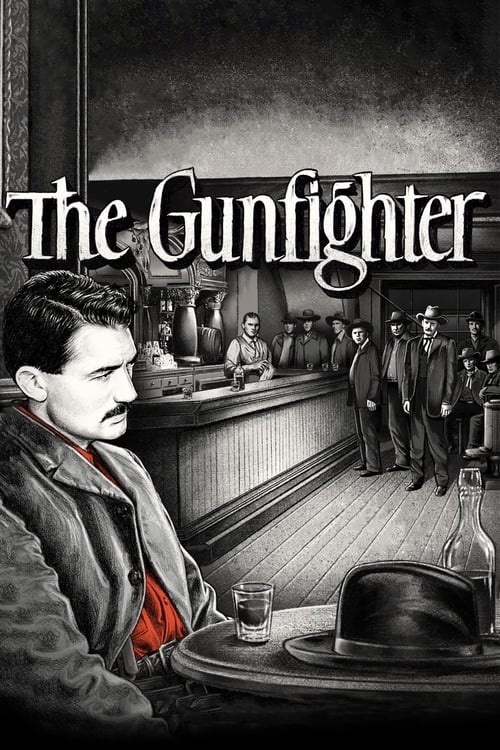
The Gunfighter
1950 · Henry King
When you want a Western with weight — moody, fatalistic, more character study than shootout. Perfect for a night when you're after tension you can feel in your chest rather than spectacle.
What it's about
Jimmy Ringo is the fastest gun in the West, and it's ruined his life. He rides into a small town hoping for one hour with the wife and son who left him — and instead spends the day trapped in a saloon while the whole town gathers to gawk, young hotheads itch to make a name, and the brothers of a man he killed close in.
The experience
A Western that runs on dread instead of action: taut, melancholy, and stripped to about seventy-five minutes of a man waiting while his past catches up. The tension comes from wanting nothing to happen and knowing something will.
Performances
Gregory Peck gives Ringo a weary, haunted gravity — a famous man who wears his reputation like a sentence, played with almost no swagger at all.
The craft
Henry King's direction is a model of economy: nearly the whole film in and around one saloon, the clock always ticking, every entrance a threat. The tight black-and-white framing makes celebrity itself feel like a cage.
Why it matters
Part of the remarkable 1950 wave that turned the Western inward, it helped invent the aging-gunfighter story — the man famous for killing who just wants to stop — that the genre has retold ever since.
Snapshot
The Gunfighter is a lean, seventy-odd-minute Western about a man who cannot put down the thing that has made him famous. Jimmy Ringo (Gregory Peck) rides into the town of Cayenne hoping for an hour with the wife and son who left him, and spends nearly the entire film waiting in a saloon while the town gathers outside to look at him. The film's premise is almost anti-dramatic: its protagonist wants nothing to happen. Everyone around him — the boys who want to prove themselves, the brothers of a man he killed, the townspeople pressing their faces to the window — insists that something must.
Released by Twentieth Century-Fox in the summer of 1950, it belongs to the remarkable cluster of Westerns that year (Anthony Mann's Winchester '73, Delmer Daves's Broken Arrow, John Ford's Wagon Master and Rio Grande) in which the genre visibly turned toward psychological interiority, moral ambivalence, and a self-conscious relation to its own myths. Of that group, The Gunfighter is the most austere and the most claustrophobic. It has almost no landscape, very little riding, and one gunfight at the beginning and one at the end. What lies between is talk, waiting, and the slow accumulation of dread.
The film is best remembered for three things: Peck's performance, played almost entirely in stillness and fatigue; the near-real-time structure that compresses the action into a single afternoon; and Ringo's mustache, which became one of the more durable pieces of Hollywood folklore about studio interference. It is one of the founding texts of what would later be called the adult, or psychological, Western, and its structural DNA is visible in High Noon, The Shootist, Unforgiven, and a long line of films about aging men trapped inside their own legends.
Industry & production
The Gunfighter was produced at Twentieth Century-Fox under Darryl F. Zanuck, and it belongs to a distinct strain in the Fox output of the late 1940s: relatively serious, socially conscious, often semi-documentary or problem-picture in flavor. Zanuck's studio had been making pictures that took contemporary or historical subjects and treated them with a plainness that distinguished Fox from MGM's gloss. A downbeat Western with an unhappy ending and a star willing to look tired fit that house style better than it would have fit almost any other lot.
The screenplay is credited to William Bowers and William Sellers (the latter credited as William Sellers; the story credit is shared by Bowers and André de Toth). De Toth — a director himself, and later a significant maker of Westerns — originated the story, and the project passed through hands before reaching King. The most frequently repeated production anecdote concerns casting: the property was at one point associated with Columbia and with John Wayne, and Wayne's failure to end up in the role has been recounted in various forms over the decades, generally involving studio rivalry between Zanuck and Harry Cohn. The specifics of that story vary considerably between sources and should be treated as industry lore rather than documented fact.
The documented conflict is Zanuck's objection to Peck's appearance. Peck grew a period-accurate handlebar mustache and wore a flat-crowned hat, drawing on nineteenth-century photographs; the intent was to make Ringo look like a real frontier man rather than a movie star. Zanuck reportedly regarded the mustache as commercially damaging and was unhappy that it could not be removed by the time he saw the footage. When the film underperformed relative to expectations, the mustache became the studio's explanation. Whether that diagnosis was correct is unknowable, but the anecdote is well attested in Peck's own later recollections and has become part of the film's permanent critical apparatus — a small, vivid illustration of the gap between star-image maintenance and the demands of a revisionist genre picture.
Financially, the picture was not a major success on release, though it was well reviewed and earned a nomination for its story. It has since been added to the National Film Registry, a fair index of how thoroughly its reputation has been revised upward.
Technology
Technologically, The Gunfighter is deliberately conservative. It was shot in black-and-white, spherical 35mm, at a moment when the Western was increasingly a color genre — Fox itself had released Broken Arrow in Technicolor that same year, and color was becoming a mark of the A-Western's outdoor spectacle. Choosing monochrome for a Western in 1950 was a legible aesthetic statement: it aligned the film with the newspaper photograph, the tintype, and the contemporary crime picture rather than with the picturesque.
That choice has consequences throughout. Black-and-white permitted the deep, hard-edged interiors and the dust-gray exteriors that give the town its worn quality, and it allowed the cinematography to work in the idiom of postwar noir — pooled lamplight, faces half in shadow, windows as bright rectangles behind dark figures. The film was made before CinemaScope (which Fox would introduce three years later), so it retains the roughly 1.37:1 Academy frame, an aspect ratio that suits its vertical, boxed-in compositions and its emphasis on the interior of a single room.
Production was largely studio-based, with backlot and set construction standing in for the town of Cayenne. There is no attempt at the location grandeur that Ford had made a signature. The film's technological modesty is inseparable from its dramatic strategy: it is a Western that has renounced the horizon.
Technique
Cinematography
Arthur C. Miller, one of Fox's most decorated cameramen (an Academy Award winner for How Green Was My Valley, The Song of Bernadette, and Anna and the King of Siam), shot the picture, and it stands as one of the last major credits of his career before ill health ended his active shooting. His work here is notable for its restraint. The images are flat-lit in the exteriors — dusty, overcast, without the sculptural sunlight of the Ford Westerns — and considerably more shaped in the saloon, where light falls from windows and lamps in ways that isolate Ringo within the frame.
Miller's compositions repeatedly place Ringo in enclosures: the frame of a doorway, the rectangle of a window, the space between two vertical posts. The saloon window becomes the film's central visual figure — a proscenium through which the town watches Ringo and through which he watches the town assemble against him. Late in the film, the arrangement of glass, curtain, and street turns the room into something between a stage and a cell.
Camera movement is sparing and functional. Miller favors sustained medium shots and lets performers move within the frame rather than cutting to follow them, which sustains the film's atmosphere of waiting. When the camera does move — a slow reframe as someone crosses a room, a pull back to reveal how many people are now present — the movement registers as an event.
Editing
Barbara McLean, Fox's most senior editor and Zanuck's longtime collaborator, cut the film. Her work is essentially invisible in the classical sense: no montage sequences, no display cutting, no acceleration into the gunfights. The two shootings in the film are handled with startling brevity — they are over before they have registered as scenes, which is precisely the point. The film systematically denies the viewer the pleasure that the genre normally supplies.
The larger editorial achievement is rhythmic rather than local. The Gunfighter runs approximately eighty-five minutes and covers roughly a single day, and McLean's cutting maintains a near-continuous sense of elapsing time. The film cross-cuts between the saloon, the street, the schoolhouse, the marshal's office, and the hotel room where Ringo's wife Peggy debates whether to see him, and these parallel lines converge with the tightening logic of a countdown. The pattern of returning, again and again, to a man sitting at a table while the world outside organizes itself against him is an editorial idea as much as a directorial one.
Mise-en-scène / staging
The film's staging is its most radical element. The bulk of The Gunfighter takes place in the Palace bar, a single interior with a bar, tables, a staircase, and a large front window. King uses this room the way a theater director uses a set: entrances and exits carry weight, the geography stays consistent, and the accumulating population of the room measures the film's rising pressure.
The town outside is staged as a chorus. Men gather in the street; boys press against the glass; women organize a delegation to have Ringo removed; the schoolteacher loses control of a classroom emptying to go look at him. Cayenne is not a place with a sheriff and a villain but a social organism responding to a celebrity in its midst, and King stages that response in widening circles.
Costume and set decoration pursue a plainness unusual for the period. The men wear rumpled, ill-fitting clothes; the town is wooden and unglamorous; Ringo's mustache and flat hat, whatever Zanuck thought of them, place the character in the historical nineteenth century rather than the mythic West. The overall effect anticipates by two decades the "dirty" Westerns of the late 1960s and 1970s.
Sound
Alfred Newman, head of Fox's music department and one of the defining figures of studio scoring, supplied the music, which is used with notable economy. Rather than a continuous symphonic bed, the score marks transitions and lets long stretches of dialogue play unaccompanied. The film's most memorable musical gesture is its use of a plain, ballad-like theme with a folk inflection — a device that would become nearly standard in the Westerns of the following decade, most famously in High Noon's Dimitri Tiomkin/Ned Washington song.
Just as important is what the film does with silence and ambient sound. The saloon's quiet, punctuated by boots on wood, glasses, the murmur outside, does more atmospheric work than the score. The two gunshots that bracket the film are shocking partly because the surrounding soundscape is so ordinary.
Performance
Gregory Peck's Ringo is the film's engine, and it is a performance built on subtraction. Peck plays him with a heaviness in the shoulders and a permanent watchfulness in the eyes; he is courteous, quiet, and almost never raises his voice. The character's fatigue is not stated so much as carried. Peck resists every opportunity to make Ringo charismatic in the conventional star sense — there is no swagger, no relish in the killing, no reassuring competence on display. He looks at the young men trying to provoke him with something close to pity.
The supporting cast works in a naturalistic register that reinforces this. Millard Mitchell, as Marshal Mark Strett — a former riding companion of Ringo's who has crossed over into respectability — provides the film's most important counterweight, a man who represents the possibility Ringo missed. Karl Malden, early in his screen career, plays the bartender Mac; Skip Homeier is the young Hunt Bromley, whose eagerness to become the man who killed Jimmy Ringo makes the film's thesis literal. Helen Westcott plays Peggy, whose scenes with Peck carry the film's small store of tenderness, and Jean Parker appears as Molly.
The overall performance style is quiet and interior, closer to the postwar dramas of urban life than to the declamatory tradition of the Western. This is part of what "adult Western" meant in 1950.
Narrative & dramatic mode
The Gunfighter is structured as a near-unity of time and place — a Western built to the specifications of a chamber tragedy. Ringo arrives, kills a man in self-defense in the opening minutes, rides on to Cayenne, and waits. The film's dramatic mode is anticipatory rather than active: its scenes are about what might happen, and its protagonist's project is refusal.
The narrative deploys three converging clocks. The dead man's three brothers are riding toward Cayenne. Hunt Bromley is circling in the saloon looking for his opening. And Peggy has to decide whether to grant Ringo the hour he has asked for. The film's suspense derives from the collision of these lines, and its tragedy from the fact that Ringo's one moment of hope — Peggy's agreement to consider a future — arrives immediately before its destruction.
Tonally the film is closer to film noir than to the frontier romance. Ringo is a man with a past that determines his future absolutely; the plot has the shape of a doom rather than a quest. His reputation functions as a curse in the classical sense, an inheritance he cannot refuse. The final irony — that Ringo's death makes Hunt Bromley into exactly the man Ringo was, condemned to the same fate — closes the film as a mechanism rather than as an ending. The last images make the cycle explicit.
The film also insists on the gap between reputation and reality. Everyone in Cayenne knows Jimmy Ringo; nobody knows him. The stories circulating about him are more vivid than the tired man drinking coffee at a corner table. This is a structural interest in myth-making that would eventually become the central preoccupation of the Western genre.
Genre & cycle
1950 is the conventional hinge year for the postwar Western. Within a few months, American audiences saw Broken Arrow (a sympathetic treatment of Apache leadership), Winchester '73 (obsession and fratricide), Devil's Doorway (Native American land rights), Wagon Master, Rio Grande, and The Gunfighter. The genre had not stopped making straightforward adventure pictures, but a parallel track had opened in which the Western became a vehicle for psychological and social argument.
The Gunfighter is the purest example of the psychological branch. Its subject is not the settlement of territory or the conflict of cultures but celebrity, aging, and the impossibility of retirement from violence. It essentially invents the "fastest gun" plot as a self-conscious tragedy: the reputation that makes a man untouchable also makes him a target for every ambitious boy in every town he enters.
The film's relationship to the classical Western is critical rather than parodic. It keeps the genre's iconography — the saloon, the marshal, the draw — and empties it of pleasure. There is no comic relief, no romance in the usual sense, no restoration of order. The town does not become better for Ringo having passed through it.
That the film is set in a period when the West is visibly closing (the town has a schoolhouse, a marshal who wants no trouble, respectable women organizing committees) places it in the elegiac tradition that runs through The Man Who Shot Liberty Valance, Ride the High Country, and The Wild Bunch. Ringo is not killed by a rival; he is killed by the future.
Authorship & method
Henry King is one of the great underdiscussed directors of the American studio system. Active from the silent era (Tol'able David, 1921) into the early 1960s, he made more than a hundred films across every genre, and he had a long, productive relationship with Twentieth Century-Fox and a particularly fruitful one with Gregory Peck — Twelve O'Clock High (1949), The Gunfighter (1950), David and Bathsheba (1951), The Snows of Kilimanjaro (1952), and Beloved Infidel (1959) among them.
King's method was one of transparent classicism: careful blocking, restrained camerawork, an insistence on the legibility of performance. He was not a stylist in the manner of Ford or Hawks, and he has consequently been undervalued by auteurist criticism, which had difficulty locating a signature in work this unemphatic. But The Gunfighter and Twelve O'Clock High, made consecutively with the same star, show a consistent and genuine interest: men whose competence in violence has become a burden, and who are slowly consumed by the demands their reputations make on them. Read as a pair, the two films constitute one of the more coherent authorial statements in postwar Hollywood.
The collaborators matter here as much as the director. Arthur C. Miller's monochrome photography establishes the film's visual argument; Barbara McLean's editing sustains its temporal pressure; Alfred Newman's economical score refuses to inflate the drama. William Bowers and William Sellers's screenplay is unusually disciplined about withholding action, and André de Toth's original story supplies the premise that carries the whole. Producer Nunnally Johnson — a major Fox writer-producer — oversaw the picture, and the film's plainness of dialogue is consistent with his own writerly sensibility.
Peck's contribution should also be counted as authorial. His insistence on the period-accurate appearance, against studio preference, is a directorial-level decision about what kind of film this would be.
Movement / national cinema
The Gunfighter is a wholly American film, but it belongs to a postwar American cinema in dialogue with two things at once: the darkening of Hollywood genre filmmaking that criticism would later call film noir, and the postwar interest — visible across Fox's output — in social realism and the problem picture.
The noir connection is stylistic and thematic rather than institutional. The monochrome, the fatalism, the protagonist trapped by his own history, the sense that the past is a machine already running: these are the terms of Out of the Past or Criss Cross transposed to the frontier. Several of the postwar Westerns share this quality, and critics have long noted the migration of noir sensibility into the genre around 1947–1955.
The social-realist connection is subtler. The film's interest in how a community behaves — the gossip, the crowd, the delegation of respectable women, the school emptying — treats Cayenne sociologically. This is closer to the American problem films of the late 1940s than to the frontier romance.
There is no meaningful sense in which The Gunfighter participates in an international movement, though its austerity and its interest in a man waiting have occasionally invited comparison with European cinema of the same years. Such comparisons are retrospective critical constructions rather than documented influence, and should be treated as such.
Era / period
The film arrives at a moment of institutional anxiety in Hollywood. The 1948 Paramount consent decrees had begun the dismantling of studio-owned exhibition; television was expanding rapidly; audiences were fragmenting. Studios responded in part by making pictures that were more adult in subject matter than television could be, and The Gunfighter's bleakness is legible in that context.
The political weather also registers. The film was made during the early years of the Hollywood blacklist and in the shadow of the House Un-American Activities Committee hearings, and much of the era's Western output has been read — sometimes convincingly, sometimes strainingly — as displaced commentary on conformity, denunciation, and communities that turn on individuals. High Noon is the case most often argued, and its screenwriter Carl Foreman's own blacklisting gives that reading documentary support. The Gunfighter has no comparable documented political intent, and it would be an overreach to assign one. What can be said is that its portrait of a town's collective hostility toward a marked man participates in a broader postwar interest in the pressure communities exert on individuals.
Within the history of the Western, 1950 sits at the beginning of the genre's most productive and most self-critical decade — the years of Mann's cycle with James Stewart, Ford's The Searchers, Boetticher's Randolph Scott films, and Shane. The Gunfighter opens that decade with its central question already posed: what does a man do when the skill that defines him has no remaining use?
Themes
Reputation as a trap. Ringo's fame is not an asset but a debt that must be paid to every young man who wants to collect it. The film's most quoted idea — that being the fastest gun means being the target of everyone who wants to be the fastest gun — is stated plainly and dramatized structurally.
The impossibility of a second act. Ringo wants to stop. The film's brutal argument is that stopping is not available. Every institution around him — the law, the family, the town, the code of the gunfighter — refuses him a way out. Mark Strett's successful transition from outlaw to marshal is presented as the exception that measures Ringo's foreclosure.
Celebrity and the crowd. Cayenne's fascination is recognizably modern. People want to look at Ringo, tell stories about him, be near him, and finally to have been present at his death. The film understands celebrity as an appetite the famous person cannot control and does not benefit from.
The unglamorous reality behind the myth. The gap between the Jimmy Ringo of legend and the exhausted man at the table is the film's controlling irony and its clearest revisionist gesture.
Fatherhood and the wish for ordinariness. Ringo's desire is startlingly small — an hour with a wife and a son who does not know him. That the film denies him even this gives the ending its force.
Cyclical violence. The final movement, in which Hunt Bromley inherits Ringo's reputation and its consequences, converts the story from a tragedy about one man into a description of a system.
Reception, canon & influence
Critical reception. The Gunfighter was received respectfully by the American press on release, which recognized its seriousness and Peck's departure from his usual mode, and it earned an Academy Award nomination for Best Motion Picture Story (Bowers and de Toth). Commercially it underperformed relative to Fox's hopes; the mustache became the studio's preferred explanation, though the film's unrelieved bleakness is at least as plausible a cause. Its reputation grew steadily over subsequent decades, and it is now routinely cited in histories of the Western as a founding work of the psychological or adult branch of the genre. It was selected for the National Film Registry by the Library of Congress in recognition of its cultural and historical significance.
Influences on the film (backward). The most important antecedent is the general postwar darkening of Hollywood genre cinema — the noir sensibility of fatalism and entrapment. Within the Western, the film draws on the tradition of the outlaw-in-decline and on the historical figure of the gunfighter as it had been shaped by dime novels and by earlier films; the character's name evokes the historical Johnny Ringo, though the film is not a biography and makes no biographical claims. Structurally, the choice of near-real-time unity owes something to the theater, and King's classical staging draws on a stage tradition of the single-set drama. King's own preceding film with Peck, Twelve O'Clock High, is arguably the film's most direct precursor in theme, if not in setting.
Legacy (forward). The Gunfighter's influence on the Western is difficult to overstate. Its compressed timeframe, its town-as-antagonist structure, and its portrait of a lawman or gunman awaiting an inevitable confrontation are the template that High Noon (1952) elaborated two years later into the most famous version of the same architecture. The "aging gunfighter who cannot escape his reputation" became one of the genre's core narrative units, running through The Left Handed Gun, Ride the High Country, The Shootist (in which the dying John Wayne plays a variation on Ringo's predicament), and, definitively, Unforgiven (1992), whose entire moral argument about the gap between the legend and the killing depends on ground that The Gunfighter broke.
Its influence extends past the Western. The structure of the marked man waiting in a confined space while the outside world organizes his death recurs across genres, and the film's specific insight — that celebrity is a form of exposure that produces its own assassins — has proved unusually durable. Beyond narrative, its visual proposal that a Western might be gray, dusty, and physically unglamorous anticipated the texture of the revisionist Westerns of the late 1960s and 1970s by nearly two decades.
The film's most lasting achievement may be the simplest: it demonstrated that the Western could sustain a protagonist who wanted nothing to happen, and that the genre's most interesting question was not who would win the gunfight but what it cost to have won all the previous ones.
A Deleuzian reading
A boy's face pressed against the glass.
The full Deleuzian reading of The Gunfighter →
Reception
Critics admired it in 1950 but audiences stayed away — it underperformed for a Gregory Peck picture — and it's since been canonized as the great 'adult western' that got there before High Noon, a clear ancestor of everything from Unforgiven to every aging-gunslinger story since.
How The Gunfighter was received, from release to now →
How to watch The Gunfighter: what to notice on a first viewing
- Notice how often Ringo is framed inside doorways or windows. Miller repeatedly boxes him in doorframes, window rectangles, and the gap between two posts. The saloon's front window becomes the main frame the town watches him through. The compositions turn the saloon into something between a stage and a cell, long before anyone says so.
- Watch the crowd outside the window keep growing all day. Boys press against the glass, men gather in the street, women organize a delegation. King stages the town as one body reacting, not as separate individuals with separate opinions. There is no single villain to face. The pressure on Ringo comes from the whole town at once.
- Watch Peck's shoulders and eyes instead of listening for lines. He plays Ringo with a permanent heaviness and watchfulness, never raising his voice, never showing swagger, looking at the young men who provoke him with something close to pity. Fatigue is the whole performance. A tired man sitting at a table carries more dread than any gunfight could.
- Track how often the film returns to the same table. McLean's editing cross-cuts the saloon, the street, and a hotel room, but keeps circling back to Ringo waiting. The film covers roughly one afternoon in something close to real time. The editing measures time passing directly, so the waiting itself builds pressure instead of just filling space.
The whole guide to watching The Gunfighter, with the keys for a rewatch →
Influences: the films it descends from and the films it influenced
- The Petrified Forest (1936) — Establishes the single-set, unity-of-time siege drama imported wholesale from the stage — a doomed man talking in one room while the killers assemble outside — the theatrical chamber architecture King transposes to Cayenne's saloon.
- Stagecoach (1939) — Supplies the Ringo archetype and the technique of confining a Western to interiors and enclosures so that character rather than terrain drives the blocking; King inherits the name and the strategy but strips out the vindicating final shootout.
- High Sierra (1941) — Codifies the outlaw-in-decline structure — the aging professional whose reputation has outlived his usefulness and whose every attempt at retirement recruits new challengers — which King relocates from the crime film to the Western.
- How Green Was My Valley (1941) — Arthur C. Miller's deep-focus lamplit interiors and Alfred Newman's restrained, motif-based scoring — the same Fox craft team and the same practice of lighting a room from a single visible source — are directly carried into The Gunfighter's saloon.
- The Ox-Bow Incident (1943) — Miller again shoots a Fox Western as a claustrophobic chamber piece in which the town functions as a chorus and a collective antagonist, proving the genre could be staged almost entirely in enclosed, unglamorous gray interiors.
- The Killers (1946) — The noir premise of the marked man who declines to run — waiting in a fixed room while assassins converge — plus the fatalistic conviction that a past debt is structurally uncollectable, which King converts into Ringo's reputation.
- Twelve O'Clock High (1949) — King, Peck and editor Barbara McLean's immediately preceding collaboration establishes the interiorized, minimally demonstrative Peck performance — command exhaustion played through stillness — and McLean's habit of cutting away from the emotional peak rather than into it.
- High Noon (1952) — Elaborates The Gunfighter's near-real-time compression and converging-deadline crosscutting into a literal clock-driven structure, retaining the town-as-antagonist premise in which the community's refusal of the protagonist is the film's real conflict.
- Shane (1953) — Takes the boy who idolizes the gunfighter and the concomitant idea of reputation as contagion, and adopts King's truncated-gunfight ethic — violence rendered abrupt, ugly and over in an instant rather than choreographed as spectacle.
- Bad Day at Black Rock (1955) — Transposes the compressed-timeframe, town-conspires-against-the-outsider architecture into the modern-dress thriller, retaining the structure in which the entire population functions as a single hostile organism observing the stranger.
- 3:10 to Yuma (1957) — Rebuilds the film as a two-hander waiting-room drama — a hotel room substituting for the saloon — where the deadline is external and fixed, and the drama is pure duration and talk while the street outside organizes a killing.
- Ride the High Country (1962) — Extends the aging-gunman unit by casting genre veterans against their own iconography, and continues the proposal that the West be photographed as dusty, worn and physically unglamorous rather than monumental.
- The Man Who Shot Liberty Valance (1962) — Formalizes the myth-versus-man argument King dramatized, staging its Western almost entirely in enclosed sets and flat studio light so the gap between the reported legend and the actual killing becomes the film's structuring device.
- The Shootist (1976) — A near-direct restatement of Ringo's predicament — a famous gunman in a town for a limited span, besieged by opportunists seeking the credential of having killed him — with the star's own body used as the film's evidence of expiry.
- Unforgiven (1992) — Builds its entire moral argument on King's insight that the legend and the killing are different objects, and keeps the truncated-gunfight grammar: the decisive shootings are brief, badly lit and denied any climactic build.
- The Assassination of Jesse James by the Coward Robert Ford (2007) — Makes explicit The Gunfighter's specific thesis — that celebrity is a form of exposure which manufactures its own assassin — and adopts the near-real-time attentiveness to waiting, domestic interiors and lamplit enclosure over action.
- Pat Garrett & Billy the Kid (1973) — The elegy-not-suspense template: a famous gunman passively awaiting a foreordained death rather than driving a suspense plot, structuring Garrett's pursuit as fatalistic procession.
- The Death of Robin Hood (2026) — An early revisionist portrait of an aging gunman trapped by and weary of his own legend, awaiting an inevitable death — the proto-elegy for the outlaw undone by his myth.
- The Misfits (1961) — Codifies the elegy of obsolescence: the aging Westerner outlived by his own myth, the melancholy-of-the-anachronistic-frontiersman that Gable's Gay Langland embodies.
- Winchester '73 (1950) — Released the same year, it independently pushes the Western toward neurosis by making the gunfighter's skill a psychological affliction rather than a virtue, and shoots the West in hard, unbeautiful monochrome rather than pictorialist vistas.
- Rio Bravo (1959) — An explicit formal rebuttal from within the same chamber-Western vocabulary: same confined interiors, same siege clock, but professionals who refuse civilian help by choice, inverting the King/Zinnemann premise of the abandoned man.
- My Darling Clementine (1946) — A Fox B&W Western in which Peck performs the same contemplative stillness in the Fonda mode — the man whose lethal reputation outlives his capacity for peace — and the first explicit elaboration of the transitional hero who cannot cross into the civilized world his presence enables; same studio infrastructure, same prestige monochrome house style.
Similar films
- High Noon (1952) — influence & lineage · same viewing thread
- Winchester '73 (1950) — influence & lineage · same viewing thread
- The Man Who Shot Liberty Valance (1962) — influence & lineage · same viewing thread
- Shane (1953) — influence & lineage · same viewing thread
- Ride the High Country (1962) — influence & lineage · same viewing thread
- Rio Bravo (1959) — influence & lineage
- Unforgiven (1992) — influence & lineage
- 3:10 to Yuma (1957) — influence & lineage
All the films related to The Gunfighter →
Watch it with: curated runs of related films
- Print the Legend — A run of frontier myths and their unmaking — town-taming marshals, aging gunfighters, and the stories the newspapers chose to print instead of the truth.