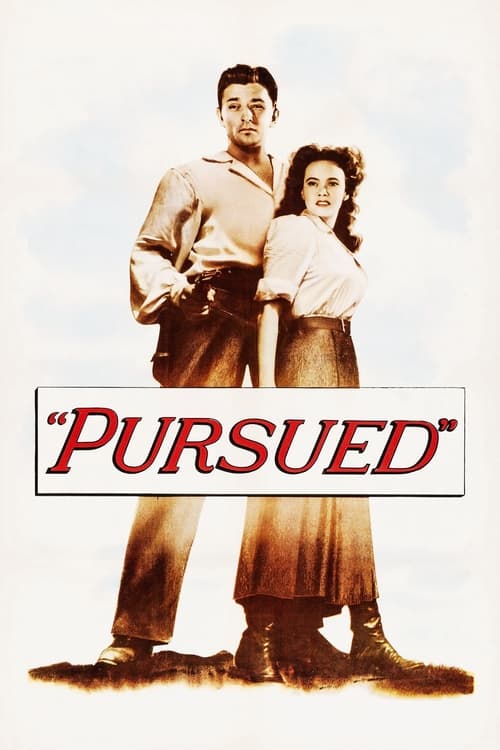
Pursued
1947 · Raoul Walsh
For when you want your Western dark — a moody, psychological slow burn for a late night, best if you like your heroes tormented and your mysteries buried in childhood. More unsettling than rousing.
What it's about
In 1880s New Mexico, Jeb Rand is raised by the neighboring family that took him in the night his own family was slaughtered — a night he can't remember, except in a recurring nightmare of gunfire and a pair of flashing spurs. As he grows up, falls for the adoptive sister he was raised beside, and finds himself hated by men whose reasons he can't fathom, the film becomes a manhunt where the real quarry is a buried memory.
The experience
Brooding and fatalistic in a way Westerns almost never were — it plays like a fever dream in cowboy clothes, with dread pooling in every shadow. Tense, strange, and genuinely haunted, it grips more like a crime picture than a horse opera.
Performances
Robert Mitchum's sleepy-eyed fatalism has rarely been better used — he plays Jeb as a man half-asleep in his own life, waiting for the past to arrive — and Judith Anderson brings fierce, secret-burdened gravity as the woman who raised him.
The craft
James Wong Howe photographs the desert in the deep-shadow, high-contrast style of urban crime films, turning ranches and canyons into noir territory, while Raoul Walsh structures the story around flashbacks and a recurring nightmare that doles the truth out in fragments. It looks extraordinary — worth seeking out a good print.
Why it matters
Routinely cited as the first true noir Western, it opened the door for the psychologically tormented Westerns of the following decade and stands as proof of how flexible the genre could be.
Snapshot
Pursued is the film that is most often cited as the first true "noir Western" — a horse opera reorganized around Freudian dread, a repressed childhood trauma, and a fatalism borrowed wholesale from the crime melodramas Hollywood was making in the same years. Robert Mitchum plays Jeb Rand, a man raised by the family whose patriarch secretly means to kill him, tormented by a recurring nightmare of the night his own family was slaughtered: fragments of gunfire and a pair of flashing spurs glimpsed from a child's hiding place under the floor. The picture wraps a conventional blood-feud plot around a psychoanalytic mystery — the buried memory that Jeb must recover before he can understand why he is hunted — and photographs the whole thing in the high-contrast, deep-shadow register that James Wong Howe was applying to urban noir. Directed by Raoul Walsh at the height of his Warner Bros. period, written by Niven Busch, and scored by Max Steiner, it is a compact, intense, somewhat anomalous film whose reputation has grown steadily since its release, largely on the strength of its formal daring and its status as a genre hybrid ahead of its moment.
Industry & production
Pursued was produced by Milton Sperling's United States Pictures, an independent unit that released through Warner Bros., placing the film squarely within the studio's late-1940s output while giving it a semi-independent production footing. The screenplay was an original by Niven Busch, a novelist and screenwriter then closely associated with a strain of psychologically heated Western melodrama; he had written the novel Duel in the Sun and had a hand in bringing tortured desire and Freudian motive into the genre. Busch's wife at the time, Teresa Wright, plays the female lead, Thorley, a piece of casting that reflects the personal proximity of writer and project.
The production shot substantially on location in New Mexico, in the red-rock country around Gallup, rather than confining itself to the backlot — a choice that gives the film its stark buttes and open-sky exteriors and aligns it with a postwar tendency toward location realism. Robert Mitchum was still on the ascent, a year or so out from the RKO noirs that would fix his star persona; his casting here as a brooding, fatalistic protagonist both drew on and helped consolidate that image. The supporting cast was unusually strong for a Western of its budget class: Judith Anderson as the Callum matriarch, Dean Jagger as the vengeful uncle Grant Callum, and John Rodney as the adoptive brother who turns lethal. Precise budget and box-office figures for the film are not something I can state with confidence, and I will not invent them; contemporary trade reception appears to have been respectable rather than sensational, with the film's larger reputation arriving later.
Technology
The film was made in standard black-and-white on nitrate stock in the Academy ratio, the default technical envelope for a 1947 studio release. What is notable is less any single new device than the way established tools were pushed. James Wong Howe's deep-focus, low-key photography depended on fast lenses, high-intensity arc lighting, and carefully controlled exposure to hold both foreground figures and deep landscape in sharp register while keeping large areas of the frame in near-darkness — the same technical vocabulary being applied to contemporaneous urban noir. The nightmare sequences rely on optical-printing effects — superimposition, distortion, and abrupt tonal shifts — to render Jeb's fractured memory as a visual disturbance rather than a clean flashback. Location shooting in New Mexico required relatively mobile equipment and daylight-exterior discipline, and the film's blend of documentary-feel landscape with expressionistic interior lighting is itself a small technical achievement of tonal control across very different shooting conditions.
Technique
Cinematography
The cinematography, by James Wong Howe, is the film's most celebrated element and the clearest reason for its "noir Western" label. Howe imports the visual grammar of urban film noir — deep, engulfing shadows, hard key lights that carve faces out of black, low camera setups, and compositions that trap figures against oppressive foregrounds — into wide Western landscapes that the genre had traditionally photographed as open and liberating. The result is a persistent tension between the vastness of the New Mexico exteriors and the claustrophobia of the lighting, so that even under open sky the characters seem hemmed in by fate. Howe stages key scenes in genuine low-key darkness, and the recurring nightmare imagery is treated as a formal rupture. This is a Western in which the land offers no relief, and the camera is a principal instrument of that argument.
Editing
The film was cut by Christian Nyby, an editor of considerable standing at Warner Bros. in this period (his work spans other major studio pictures of the late 1940s, and he would later move into direction). The editing's central task is the management of the flashback structure: the story is largely narrated in retrospect, with Jeb recounting his history, and the film must repeatedly break into the fragmentary nightmare — the spurs, the muzzle flashes — as intrusive, incompletely legible bursts. The cutting withholds the full memory until the climax, doling out the traumatic image in pieces so that narrative suspense and psychological revelation resolve together. The pacing elsewhere is tight and forward-driven, in keeping with Walsh's characteristic momentum.
Mise-en-scène / staging
Walsh organizes the drama around a small number of charged spaces: the Callum ranch house, the open range, and above all the ruined family homestead at Bear Paw Butte, where the framing story unfolds and where the climax returns. The homestead — a burned-out shell haunted by the founding murder — functions as the film's psychic center, a physical location that is also the site of the repressed memory. Staging repeatedly places Jeb at thresholds, doorways, and under overhanging darkness, and the recurring motif of the past intruding on the present is built into the geography. Judith Anderson's matriarch and Dean Jagger's uncle are staged as opposed poles of the family's buried secret, and Walsh uses the domestic interiors to make the family itself feel like a trap closing around the hero.
Sound
Max Steiner's score is a constant presence, in the fully scored, motif-driven Warner Bros. manner. Steiner uses recurring musical figures to bind the nightmare, the feud, and the romance, and the score carries much of the film's emotional and fatalistic weight, swelling around the moments of dread and revelation. The film also makes pointed use of a traditional song motif that recurs across the narrative; the interplay of Steiner's orchestral writing with the sparse, wind-and-gunfire sound of the exteriors reinforces the split between the open landscape and the enclosed psychology. Beyond Steiner's contribution, the sound design is conventional for its period.
Performance
Mitchum's performance is a study in weary, watchful passivity — a man who senses he is doomed without understanding why, and whose stillness reads as both stoicism and dread. It is very much of a piece with the noir persona he was building at RKO, and it anchors the film's fatalism. Teresa Wright plays Thorley across a difficult arc, from adoptive-sister affection to the revulsion of a woman who marries a man intending to kill him, and back to love; the role asks for sharp reversals, and Wright grounds them. Judith Anderson brings gravity and ambiguity to the matriarch who holds the family's secret, and Dean Jagger makes the uncle's vendetta quietly implacable rather than melodramatic. The ensemble sustains the film's core conceit — that the family is simultaneously refuge and threat.
Narrative & dramatic mode
The film's dramatic mode is the psychoanalytic mystery grafted onto the revenge Western. Structurally it is a long flashback framed by Jeb and Thorley trapped at the ruined homestead, awaiting the arrival of their pursuers, with Jeb narrating how they came to this point. The engine of the plot is not a simple quest for vengeance but the hero's ignorance of his own history: Jeb, and the audience, must reconstruct the meaning of the childhood trauma — why his family was killed and why he is now hunted — and the film treats that recovery of repressed memory as its central suspense. This aligns Pursued with the era's cycle of Freudian melodramas, in which the past is a buried crime to be excavated. The mode is fatalistic throughout: motifs of chance and predetermination recur, and the narration frames Jeb's life as something closer to a curse than a series of choices.
Genre & cycle
Pursued sits at the intersection of two 1940s currents: the Western and film noir. It is routinely described as the first, or among the first, of the "noir Westerns" or "psychological Westerns" — films that retain the frontier setting and iconography while importing noir's shadowed visual style, doomed protagonists, flashback structure, and Freudian motivation. It belongs to the broader postwar cycle of psychologically overheated Westerns associated with writers and filmmakers reaching beyond the genre's traditional moral clarity, a cycle that includes the desire-driven melodrama of the same moment. It also participates in the wider vogue for on-screen psychoanalysis that ran through late-1940s Hollywood. As such it is a hinge film — using the Western's landscape and feud plot as a container for anxieties and formal strategies that belonged to the crime film.
Authorship & method
The film is a convergence of strong authorial signatures. Raoul Walsh, a veteran of silent and sound cinema and one of Warner Bros.' most reliable makers of muscular, propulsive action drama, directs with his customary momentum but subordinates it here to a more inward, fatalistic design than his adventure pictures usually allow — evidence of his range and of his willingness to serve unusual material. Niven Busch's screenplay supplies the Freudian architecture and the blood-feud secret, and his authorship is central to why the film thinks the way it does; the psychological-Western sensibility is largely his. James Wong Howe's cinematography is arguably the most legible "voice" in the finished film, translating the script's buried trauma into a visual style of engulfing shadow. Max Steiner's score provides the emotional and motific through-line in the Warner house style, and Christian Nyby's editing executes the flashback-and-nightmare structure. The film is best understood as the product of this collaboration rather than of any single controlling author, with Walsh, Busch, and Howe as its three decisive shaping forces.
Movement / national cinema
Pursued is a Hollywood studio product of the classical era, made within the Warner Bros. system, and it belongs to American cinema's late-1940s moment rather than to any avant-garde movement. Its significance in movement terms is its participation in film noir — a stylistic and thematic tendency in American cinema of the 1940s and '50s, itself indebted to German Expressionist lighting and to hardboiled crime fiction — and its transposition of that tendency into the Western. It is thus a document of how noir's influence radiated outward through the studios, colonizing adjacent genres.
Era / period
The film is set in the American West of the 1880s, in the aftermath of a family massacre whose roots reach back further still, and it culminates around the era of the Spanish–American War, into which Jeb's story extends. But its sensibility is thoroughly postwar-1947: a period in which returning veterans, psychiatric discourse, and a darkened national mood fed Hollywood's appetite for troubled, trauma-haunted heroes. The film's preoccupation with buried violence, inescapable fate, and the psychic residue of a founding atrocity reads as much as an expression of its production moment as of its 1880s setting. It is a Western about the past that is legible as a 1940s film about the inescapability of the past.
Themes
The dominant theme is the tyranny of the past — the way a buried event determines a life, and the way trauma, unremembered, continues to act. Closely bound to this is fate versus agency: the film's recurrent motifs of chance and predetermination frame Jeb as a man carried by forces he cannot see, and its fatalism is one of its most noir-ish qualities. The blood feud dramatizes the transmission of guilt across generations, with the sins of the parents — an illicit love affair and the killings it provoked — visited on the children. Family itself is rendered profoundly ambivalent: the household that shelters Jeb also harbors the man sworn to destroy him, so that home and threat are the same place. There is a strong current of psychoanalytic thought — repression, the return of the repressed, and something like an Oedipal charge in the tangle of adoptive kinship, desire, and paternal violence. And running under all of it is the theme of memory as both wound and key: only by remembering the unbearable can the hero survive it.
Reception, canon & influence
Contemporary reception, as best the record supports, was respectable but not epochal; Pursued was received as a well-made, somewhat unusual Western rather than immediately recognized as a landmark, and I will not overstate figures or notices I cannot verify. Its reputation has risen substantially in subsequent decades, driven by film scholarship and by filmmaker advocacy, as critics identified it as a foundational noir Western and singled out James Wong Howe's cinematography and the film's psychological ambition. It has been championed by later admirers of Walsh and of noir; its circulation was also shaped by its passage into the public domain in the United States, which made it widely available but for years often only in poor-quality prints, a fact that complicated its critical rediscovery until better restorations circulated.
Looking backward, the film's influences are legible: the visual language of German Expressionism as filtered through 1940s film noir; the hardboiled fatalism of contemporary crime melodrama; the vogue for cinematic psychoanalysis; and Niven Busch's own strain of Freudian Western writing. Looking forward, Pursued is regularly positioned as an important early instance of the psychological Western that flourished in the 1950s — the cycle of adult, neurosis-driven Westerns in which interior torment matters as much as external action. Its fusion of noir shadow with frontier landscape, its trauma-haunted hero, and its treatment of the Western hero as a site of repression rather than simple virtue anticipate much of what that later cycle would develop. The film's standing today rests on this double identity: as a superbly photographed Walsh melodrama in its own right, and as a genre hinge that showed the Western could carry the weight of the era's darkest psychological preoccupations.
A Deleuzian reading
A boy is under a floor.
The full Deleuzian reading of Pursued →
Reception
A solid but unremarkable earner in 1947, when it just looked like another Mitchum western — decades later it got reclaimed as the founding text of the 'noir western,' the film that smuggled Freud and trauma into cowboy country before the 50s adult western made that fashionable.
How Pursued was received, from release to now →
Influences: the films it descends from and the films it influenced
- The Cabinet of Dr. Caligari (1920) — Its Expressionist externalization of a disturbed psyche through distorted, high-contrast shadow is the root idiom James Wong Howe converts into Pursued's engulfing chiaroscuro.
- Sunrise (1927) — Murnau's atmospheric low-key lighting and landscape-as-emotional-field aesthetic transmitted the German Expressionist toolkit that Howe applies to the frontier homestead.
- Kings Row (1942) — James Wong Howe's own earlier deep-focus, low-key photography of small-town Freudian repression is the direct technical rehearsal for his work on Pursued.
- Citizen Kane (1941) — Gregg Toland's deep-focus staging plus the structure of reconstructing a man's life through fragmentary, investigative flashbacks is the formal template Pursued transposes to a Western.
- Murder, My Sweet (1944) — Its first-person framed-flashback confession and hallucinatory nightmare inserts model the subjective, memory-driven noir structure Christian Nyby cuts into Pursued.
- The Killers (1946) — The fragmentary, multi-witness flashback reconstruction of a fatalistic doomed man's past directly prefigures Pursued's shattered-memory architecture.
- Spellbound (1945) — It codifies the cinematic psychoanalysis Busch adopts — a buried traumatic memory as the mystery's literal solution, recovered through a talking-cure structure.
- Double Indemnity (1944) — Its doomed confessional voiceover framing the entire narrative as retrospective fatalism established the noir flashback grammar Pursued grafts onto the Western.
- High Sierra (1941) — Walsh's own design of a fatalistic protagonist hunted to a death among the rocks supplies the trapped-man momentum he interiorizes and psychologizes in Pursued.
- White Heat (1949) — Walsh extends Pursued's Freudian architecture into noir crime with the overtly Oedipal, mother-fixated Cody Jarrett, again making psychological pathology the engine of action.
- The Furies (1950) — Another Niven Busch adaptation, it carries his psychoanalytic-Western template forward into a father-daughter Oedipal blood feud photographed in noir chiaroscuro.
- Winchester '73 (1950) — It develops the neurosis-driven Western hero Pursued pioneered — a revenge obsession rooted in buried family trauma that drives all external action.
- The Naked Spur (1953) — Mann pushes the psychological Western further by using rugged landscape as the direct externalization of a trauma-wracked bounty hunter's interior torment.
- Rancho Notorious (1952) — It fuses noir shadow with the frontier and binds the obsessive-revenge narrative together with a recurring leitmotif ballad, extending Pursued's motific-score-plus-noir-Western hybrid.
- The Searchers (1956) — Ford's trauma-haunted, repression-driven hero and use of the homestead as the story's psychic center bring Pursued's treatment of the Western hero as a site of buried pathology to its fullest expression.
- Johnny Guitar (1954) — The first Freudian/noir Western, importing James Wong Howe's expressionist low-key lighting and trauma-flashback psychology into the genre, licensing Johnny Guitar's psychological-Western interior.
- The Man from Laramie (1955) — An early psychological Western that imports noir's traumatized, memory-haunted protagonist into the genre, prefiguring Mann's damaged, war-with-himself hero.
- Duel in the Sun (1946) — Adapted from Niven Busch's own novel, it shares his Freudian-Western DNA — blood feud, sexual repression, and frontier melodrama — from the same authorial source in the same moment.
- Out of the Past (1947) — Same year, same star: Mitchum's fatalistic performance and a flashback structure in which the past inescapably determines the present run in exact parallel.
Similar films
- The Searchers (1956) — influence & lineage
- Out of the Past (1947) — influence & lineage
- Murder, My Sweet (1944) — influence & lineage
- Winchester '73 (1950) — influence & lineage
- The Naked Spur (1953) — influence & lineage
- High Sierra (1941) — influence & lineage
- Red River (1948) — shared sensibility
- The Assassination of Jesse James by the Coward Robert Ford (2007) — shared sensibility