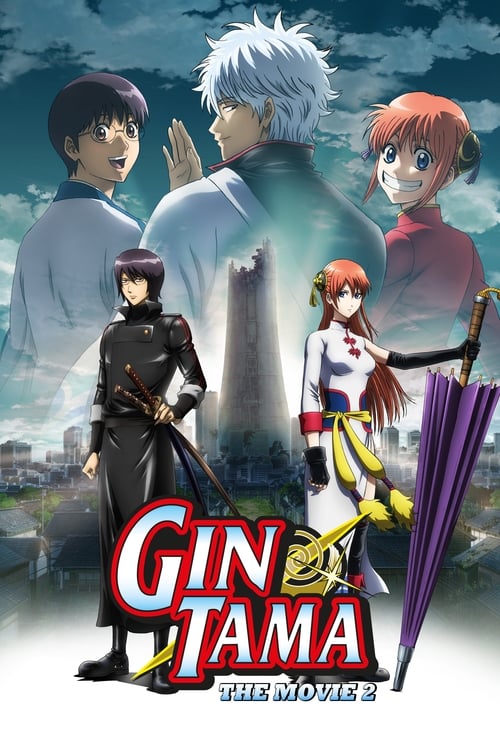
Gintama: The Final Chapter - Be Forever Yorozuya
2013 · Youichi Fujita
For when you want to laugh hard and then get ambushed by feelings — best if you know the series, since half the punch comes from history with these characters. A rowdy night in that turns into a farewell.
What it's about
In an alternate Edo where aliens forced Japan open and samurai scrape by among spaceships and vending machines, freelancer Gintoki suddenly finds himself erased from his own world. Now a ghost of the past, he has to watch what became of his friends without him — and take on the biggest, maybe final, job of his odd-jobs crew to set the future right.
The experience
It opens by mercilessly mocking its own existence, then blindsides you: the gags give way to genuine stakes and real emotion, and the tonal whiplash is the point. Fast, absurd, and unexpectedly moving by the end.
The craft
Director Yoichi Fujita, who steered the TV series through its most anarchic years, knows exactly how far to push the fourth-wall demolition before pivoting to sincerity — and the sincerity lands precisely because the film spends so little time asking for it. The it's-a-wonderful-life-in-reverse premise is played for keeps, not just laughs.
Why it matters
Designed as a grand farewell to one of Japanese comedy's most beloved shape-shifting franchises, it showed how a parody series could earn a genuinely heartfelt sendoff.
Hideaki Sorachi's Gintama is Japanese comedy's great shape-shifter — an alternate Edo where aliens, not black ships, forced the country open, leaving samurai to scrape by amid spaceships and vending machines — and this feature was designed as its grand farewell. The premise is classic science fiction played for keeps: the silver-haired freelancer Gintoki is erased from his own world and must watch, ghostlike, what became of everyone without him. Director Yoichi Fujita, who steered the television series through its most anarchic years, understands the franchise's peculiar physics — that a property built on fourth-wall demolition and shameless parody earns its sincerity precisely because it spends so little time asking for it. The film opens with a gag sequence mocking its own existence, then pivots into genuine melancholy about time, absence, and found family, animated by Sunrise with unusual care. Billed as the final chapter, it was anything but: the fan response was so overwhelming that the supposedly concluded series returned to the air two years later, a resurrection the show itself would happily have written as a joke.
Reception
Sold in 2013 as Gintama's grand farewell — and fans duly wept — only for the anime to return two years later, retroactively turning 'The Final Chapter' into one of the franchise's best-loved jokes. It's now remembered less as an ending than as the moment Gintama proved it could actually be sincere.
How Gintama: The Final Chapter - Be Forever Yorozuya was received, from release to now →
Influences: the films it descends from and the films it influenced
- It's a Wonderful Life (1946) — Supplies the exact narrative armature the film's plot borrows — a despairing hero shown a bleak alternate world in which he never existed, so his absence measures his worth to the 'found family' left behind.
- Back to the Future Part II (1989) — Model for the mechanics of returning to a darkened, dystopian version of one's own home timeline, where familiar side-characters are grotesquely altered by the hero's removal from history.
- Blazing Saddles (1974) — Precedent for sustained fourth-wall demolition staged inside a straight genre pastiche — its characters' awareness of being in a movie prefigures Gintama's cast addressing budget, censors, and the audience mid-scene.
- Airplane! (1980) — Establishes the machine-gun density of deadpan parodic gags layered over an earnest melodramatic through-line, the rhythm Fujita uses to whiplash between spoof and sincerity.
- Urusei Yatsura 2: Beautiful Dreamer (1984) — The founding anime comedy-adaptation that bends its own diegetic reality and interrogates the 'endless everyday,' the meta-temporal move Gintama inherits when it threatens to end its own ongoing world.
- Lupin III: The Castle of Cagliostro (1979) — Template for the rogue-ensemble adventure anime that juggles slapstick with sudden pathos and clockwork action set-pieces — the tonal juggling act Gintama scales up to feature length.
- Sayonara, Zetsubou-Sensei (2007) — Sibling in weaponizing on-screen text, censor-bar jokes, and direct camera address as a comedic engine, sharing Gintama's density of fourth-wall and pop-culture reference gags.
- Excel Saga (1999) — Sibling anime built on constant meta-commentary about its own production, ratings, and genre conventions, the same self-referential parody grammar Gintama runs on.
- Gintama: The Movie: A New Translation - Benizakura Arc (2010) — Direct sibling — the prior Gintama theatrical feature that established the format of reworking a manga arc into cinema scale while keeping the ensemble's comic-to-serious tonal shifts intact.
- Gintama: The Very Final (2021) — Direct descendant — the actual series-capping film that extends this movie's comedy-to-elegy tonal shift and finality-and-farewell payoff for the same found-family cast.
- Gintama (live-action) (2017) — Descendant that ports Gintama's fourth-wall breaking, self-deprecating budget jokes, and parody register into live action, proving the craft survives the medium jump.
- The Girl Who Leapt Through Time (2006) — Heisei-era sibling that repurposes time-travel not as spectacle but as an engine for emotional consequence, absence, and farewell — the same tonal use of time-manipulation this film makes.
Similar films
- Gintama: The Very Final (2021) — influence & lineage
- The Girl Who Leapt Through Time (2006) — influence & lineage
- Neon Genesis Evangelion: The End of Evangelion (1997) — shared sensibility
- Evangelion: 3.0+1.0 Thrice Upon a Time (2021) — shared sensibility
- Kaguya-sama: Love Is War -The First Kiss That Never Ends- (2022) — shared sensibility
- Sanjuro (1962) — shared sensibility
- Demon Slayer: Kimetsu no Yaiba Infinity Castle (2025) — shared sensibility
- Battle Royale (2000) — shared sensibility
All the films related to Gintama: The Final Chapter - Be Forever Yorozuya →