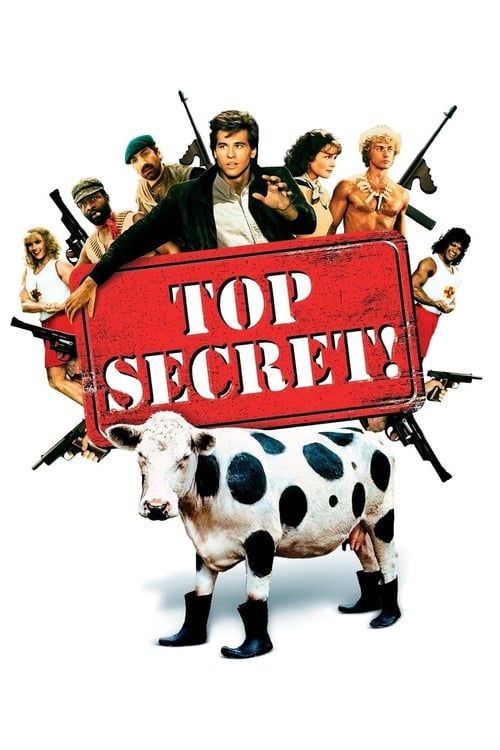
Top Secret!
1984 · Jim Abrahams
For when you need to laugh until it hurts and want zero emotional homework — ideal with friends, snacks, and a willingness to be silly. Total comfort food.
What it's about
American rock-and-roll heartthrob Nick Rivers travels behind the Iron Curtain to sing at an East German cultural festival and promptly falls for Hillary Flammond, whose scientist father is being held by the regime. Before he knows it, Nick is entangled with a French Resistance cell — in East Germany, don't ask — juggling prison breaks, underground missions, and musical numbers. Logic is not this movie's concern; jokes are.
The experience
A joke-a-second absurdist barrage where the background gags are as dense as the foreground ones — sight gags, wordplay, musical numbers, and sequences of pure surreal invention. It's gleefully stupid in the smartest possible way, and rewatching reveals jokes you missed the first three times.
Performances
A startlingly young Val Kilmer, in his screen debut, plays the Elvis-style idol completely straight — and does his own singing — which is exactly why it's so funny; he's a genuine leading man dropped into a lunatic asylum.
The craft
The ZAZ team (Airplane!) mash two incompatible genres — the early-'60s Elvis musical and the WWII resistance thriller — and never explain the collision, committing to deadpan craft so the absurdity plays like a real movie gone wrong. Several set-piece sequences are small marvels of technical ingenuity in service of a single gag.
Why it matters
The cult middle child of the ZAZ spoof dynasty — less famous than Airplane! but treasured by comedy devotees as maybe their densest, weirdest joke machine — and the film that introduced Val Kilmer.
Snapshot
Top Secret! is the second feature directed by the trio of Jim Abrahams, David Zucker, and Jerry Zucker — credited collectively as ZAZ — and it is the strangest object in their filmography. Where Airplane! (1980) had parodied a single, coherent, culturally saturated target (the disaster cycle, and specifically the Airport films and Zero Hour!), Top Secret! aims at two targets simultaneously and refuses to reconcile them: the Elvis Presley musical vehicle of the early 1960s, and the World War II resistance thriller. The result is a film in which an American rock-and-roll idol named Nick Rivers (Val Kilmer, in his screen debut) travels to an East Germany that is administered by Nazis, joins a French Resistance whose members are named after French cuisine, and performs numbers that pastiche Presley while the plot mechanics run on The Guns of Navarone.
The anachronism is not a mistake to be explained away; it is the film's structural principle. Top Secret! proposes a world in which two incompatible genre memories occupy the same space, and it never blinks. This makes it both less accessible than Airplane! — there is no single referent the audience is guaranteed to hold — and, for a certain kind of viewer, more radical. Its gags are less parodic and more surrealist: a bookstore scene played entirely in reverse, an underwater bar fight staged as though it were happening on dry land, a cow in a cow costume. The film performed modestly on release relative to Airplane! and was received as a lesser follow-up, but its reputation has risen steadily, and it is now frequently cited — including by the filmmakers' own subsequent admirers — as the purest expression of the ZAZ method: the sight gag pursued past the point of justification.
Jim Abrahams is credited as director alongside David and Jerry Zucker on the film's directorial card, which lists all three; the film is here filed under Abrahams as the primary attribution, though ZAZ worked as a genuine collective at this stage, writing together and dividing directorial labor on set.
Industry & production
Top Secret! was produced by Paramount Pictures, the studio that had released Airplane! four years earlier to enormous and unexpected profit. Jon Davison, who had produced Airplane!, produced again, with Hunt Lowry. The commercial logic was straightforward: Airplane! had cost little and returned a great deal, and Paramount wanted the same team doing the same thing. What ZAZ delivered instead was a film whose target audience was harder to locate.
The four-year gap between the two features is itself significant. ZAZ had come out of the Kentucky Fried Theater, a Madison, Wisconsin stage revue that relocated to Los Angeles, and out of The Kentucky Fried Movie (1977), directed by John Landis from their sketch material. Their method was accretive and test-driven — jokes were built, performed, discarded, rebuilt. Between Airplane! and Top Secret! they created and produced the ABC series Police Squad! (1982), which ran only six episodes before cancellation but which established the deadpan-procedural register that would later become The Naked Gun (1988). Police Squad! is the direct methodological bridge: it proved the ZAZ approach could survive detachment from a single parodic source, and Top Secret! extends that proof to feature length by attaching itself to two sources at once.
Production was largely British. The film shot at studios in England and on location, with the East German settings realized in the UK and Europe rather than anywhere approaching the actual Eastern Bloc. This is worth noting because the film's Germany is emphatically a studio Germany — a backlot Europe assembled from the visual furniture of earlier war pictures, which is precisely the point. The production design does not attempt authenticity; it attempts genre memory.
Casting Val Kilmer, then a stage actor with no film credits, was a substantial bet. Kilmer performs his own vocals across the film's musical numbers, and the songs were written for the picture rather than licensed from the Presley catalog — a necessity both legal and aesthetic, since the parody needed songs that sounded like the referent without being it. Lucy Gutteridge plays Hillary Flammond; Peter Cushing, Michael Gough, and Omar Sharif appear in supporting roles, and their presence is itself a form of citation, importing the gravity of British genre cinema and international star casting into a film determined to squander it.
Technology
Top Secret! is a conventionally shot 35mm anamorphic-era studio comedy in most respects, and its technical interest lies almost entirely in a handful of set pieces where the gag is inseparable from the apparatus.
The most discussed is the Swedish bookstore sequence, played in reverse. Rather than shooting forward and printing the film backward — which would have produced obviously reversed motion and unusable dialogue — the sequence was staged and performed backwards, with the actors trained to move, gesture, and speak in reverse so that when the footage is reversed in post, the resulting image plays "forward" with an uncanny wrongness. The dialogue is phonetically reversed Swedish. The joke is that nothing in the frame is quite obeying physics, and the audience cannot immediately name why. It is a gag that only exists as a function of the recording medium.
The second is the underwater bar fight, in which a barroom brawl is staged, dressed, and lit as though on land while actually being performed submerged — bubbles rising from mouths, hair floating, punches slowed by water resistance, a body sinking rather than falling. Again the technique is not an effect applied afterward but a production condition adopted wholesale for the length of a scene.
Elsewhere the film uses forced perspective, oversized props, and in-camera scale tricks in the tradition of studio comedy — most memorably a sequence built around a telephone that is not the size a telephone should be. The film's commitment is to practical, in-camera solutions; it belongs to the last generation of studio comedies made before digital compositing offered an easier route to impossible images, and the labor is legible on screen in a way that later equivalents rarely are.
Technique
Cinematography
Christopher Challis photographed the film. Challis was a major figure of postwar British cinema — his credits include work with Michael Powell and Emeric Pressburger and a long career across British genre and prestige production — and his hiring is the single clearest statement of the film's visual strategy. Top Secret! is photographed straight. The lighting on the East German interrogation sequences carries the hard-edged chiaroscuro of the war thriller; the musical numbers are lit with the flat, bright, saturated cheer of the studio pop vehicle; the Resistance material has the woody, low-key warmth of the European partisan picture. Nothing is lit as comedy.
This is the load-bearing decision of the entire film. The ZAZ method depends on absolute stylistic fidelity to the parodied form, because the joke lives in the gap between the seriousness of the presentation and the absurdity of the content. A comedically lit Top Secret! would collapse — the images have to promise a thriller so that the gags can betray the promise. Challis also handles the film's genuine technical showpieces, and the reverse sequence in particular required that the camera behave with total normality while everything in front of it behaved abnormally.
Editing
Bernard Gribble edited. The cutting logic of Top Secret! is inherited from Airplane! but applied to looser material. The core unit is the held shot that pays off a background gag, or the cut that arrives one beat later than expected so the audience has time to notice something absurd it was not directed to notice. ZAZ films are dense with peripheral jokes — signage, extras, props — and the editing must resist the modern comic instinct to cut to the funny thing. Instead the frame is held and the audience does the finding.
The film also relies on the abrupt tonal cut: a scene of genuine menace terminated by a hard transition into a musical number, or a gag concluded without a reaction shot to acknowledge it. Refusing the reaction shot is central to the ZAZ grammar — it denies the audience permission to laugh, which is how the deadpan is enforced at the level of assembly rather than performance.
Where Top Secret! is weaker than Airplane! is in cumulative structure. Airplane! had a borrowed plot skeleton (Zero Hour!) that supplied dramatic momentum for free. Top Secret! has to build its own, and the two genres it is straddling pull the film in different directions — the musical wants numbers, the thriller wants escalation. The editing manages this competently but the seams show, and some sequences run on gag-density alone.
Mise-en-scène / staging
The production design is the film's most consistent achievement: a Europe made of citations. Uniforms, staff cars, checkpoints, and interrogation rooms come from the World War II picture; the East German setting supplies Cold War signage and border apparatus; and the two systems coexist without comment. Nazi officers operate an East German state. Nobody in the film finds this odd.
The staging strategy is deep and wide: information is distributed across the whole frame, with gags placed in the background, at the edges, and in props that the camera does not emphasize. This is the ZAZ signature and it makes the films rewatchable by design — the joke rate on a first viewing is a fraction of what is actually present. The film also stages a number of gags that are purely about the physics of the image (the reverse sequence, the underwater fight, the scale gags), which requires that the mise-en-scène be internally rigorous even when it is absurd, since a sloppily constructed impossible space stops being funny.
The Resistance sequences, with characters named for French dishes, are staged with the earnest, hushed conspiratorial blocking of the partisan film — figures leaning over maps in candlelight — while the dialogue defeats it.
Sound
Maurice Jarre composed the score. Jarre was by 1984 among the most decorated composers in cinema, associated above all with David Lean — Lawrence of Arabia, Doctor Zhivago, A Passage to India — and his presence performs the same function as Challis's and the same function as Cushing's and Sharif's: it imports authentic prestige into a film that will spend it on nonsense. The score plays the thriller straight, with the sweep and menace the genre expects.
The songs are the film's other sonic register. Written for the picture and performed by Kilmer, they pastiche early-1960s Presley vehicle numbers — the surf-adjacent rocker, the syrupy ballad — with enough craft that they function as songs rather than merely as jokes about songs. The tension between Jarre's serious orchestral thriller scoring and the deliberately disposable pop numbers is one of the film's running structural gags.
Sound design elsewhere follows the ZAZ rule of literalism: sound effects are deployed with total sincerity in service of impossible events, which is what makes the events land.
Performance
Val Kilmer's debut performance is the film's engine, and it is a genuinely difficult piece of work. Nick Rivers must be simultaneously a plausible teen idol — handsome, musically competent, sincere — and a comic instrument who never acknowledges the comedy. Kilmer plays him with an open, uncomplicated earnestness that never winks. The performance also has to carry the musical numbers on their own terms, which it does; Kilmer's singing is not parodic in delivery, only in material.
The supporting cast operates on the same principle. Peter Cushing and Michael Gough bring decades of accumulated genre authority and deploy it entirely deadpan. Omar Sharif's presence functions as a citation of the international-star thriller. Lucy Gutteridge plays Hillary as a straight romantic heroine of the resistance-melodrama type, and the film's romance is played, remarkably, without irony — the sincerity of the love plot is one of the reasons the film has aged better than its reputation initially suggested.
The ZAZ casting doctrine — hire dramatic actors, not comedians, and direct them to play it absolutely straight — reaches its logical extreme here, where the imported gravity comes from British horror cinema and Lean-scale international stardom.
Narrative & dramatic mode
The narrative mode is best described as parodic collage governed by dream logic. The film's plot is functional: a rescue mission, a resistance cell, a captured scientist, a naval weapon, a romance, a betrayal, an escape. Every beat is recognizable from the war-adventure template. But the film treats plot as scaffolding for gags rather than as an object of interest in itself, and it repeatedly suspends narrative entirely for extended set pieces that advance nothing — the reverse bookstore, the underwater fight, a full flashback parody of The Blue Lagoon delivered as backstory.
This produces the film's characteristic dramatic rhythm: forward motion, total digression, forward motion. It is less disciplined than Airplane!, and critics at the time read that as a flaw. The more generous reading, which has largely won out, is that Top Secret! is doing something different — it is not parodying a genre so much as inhabiting the condition of having watched too many movies, where genres bleed into one another and the distinction between a 1943 war picture and a 1963 Presley vehicle has dissolved into a single undifferentiated memory of "old movies."
The film is also notable for refusing the ironizing frame. There is no character who knows they are in a comedy, no commentary track, no acknowledgment. The world is internally consistent in its inconsistency.
Genre & cycle
Top Secret! sits at the center of the American parody cycle that ZAZ effectively created with The Kentucky Fried Movie and codified with Airplane!. That cycle — the joke-dense, deadpan, genre-specific spoof — dominated a particular register of American studio comedy from 1980 through roughly the mid-1990s, and its descendants (including the degraded, reference-substituting-for-joke variants of the 2000s) are still with us.
Within the cycle, Top Secret! is the anomaly. The standard ZAZ picture selects one genre and executes it with fidelity. Top Secret! selects two, and the genres it selects are separated by twenty years of film history and by a world war's worth of political meaning. It also leans further toward pure surrealism than any other film in the cycle: a significant proportion of its gags are not parodies of anything, but simply impossible images pursued with a straight face.
Its immediate genre ancestors are the Presley vehicle cycle (Blue Hawaii, Viva Las Vegas, and the assembly-line musicals that followed) and the men-on-a-mission war picture (The Guns of Navarone, Where Eagles Dare), with a strong secondary current of the Cold War Iron Curtain thriller. Its parodic method descends from Airplane! but also, further back, from the anarchic studio comedy of the Marx Brothers and from Mel Brooks's genre pastiches — Blazing Saddles (1974) and Young Frankenstein (1974) in particular established that a studio comedy could be built entirely from another genre's materials.
Authorship & method
ZAZ authorship in this period is genuinely collective. Jim Abrahams, David Zucker, and Jerry Zucker wrote together — with Martyn Burke sharing screenplay credit on Top Secret! — and shared the direction, with the three credited as directors on the film. Their working method, developed in live theater, was empirical: material was tested, and jokes that did not work were removed regardless of how attached anyone was to them. The high joke density of their films is a product of subtraction, not addition.
The method has three articulable rules. First, absolute stylistic fidelity to the parodied form — the film must look, sound, and be paced like the thing it is parodying. Second, deadpan performance from dramatic actors, never comedians. Third, no acknowledgment: no winks, no reaction shots that signal a joke, no character who understands the situation. These rules are why the ZAZ films work and why most of their imitators do not.
The key collaborators are chosen to enforce rule one. Christopher Challis's cinematography brings the authority of a career in serious British filmmaking. Maurice Jarre's score brings Lean-scale gravity. Bernard Gribble's editing enforces the deadpan by withholding the cut that would signal the joke. Jon Davison's production continuity from Airplane! preserved the working method. The casting of Cushing, Gough, and Sharif imports genre credibility to be systematically wasted. Every above-the-line choice is in service of making the film seem like it does not know it is funny.
Val Kilmer's contribution deserves separate mention: the film asked a first-time screen actor to carry a leading man's romantic and musical duties while never registering the comedy around him, and his success at this is a substantial part of why the film survives.
Movement / national cinema
Top Secret! is a Hollywood studio product — Paramount, American writer-directors, American comic tradition — but its physical and creative production is substantially British. The photography, the studio facilities, and a significant portion of the supporting cast come out of the British film industry, and this hybridity is visible on screen: the film's Europe has the texture of British studio filmmaking, of Hammer and of the postwar British war picture, rather than of American backlot Europe.
The film belongs to no movement in the art-historical sense. Its lineage is the American comic-anarchic tradition — vaudeville, the Marx Brothers, Mad magazine, the Kentucky Fried Theater revue — filtered through the New Hollywood generation's saturation in film history. If it has an unexpected affinity, it is with surrealism: the reverse-motion sequence and the underwater fight are closer in spirit to the impossible-image tradition than to conventional parody, and the film's dream logic of collapsed historical periods is a recognizably surrealist procedure applied to popular genre memory.
Era / period
The film arrives in 1984, at a specific and legible cultural moment. The Cold War had re-intensified in the early 1980s, and the Iron Curtain thriller was live again in popular culture. Simultaneously, the home video era was making the entire back catalog of American cinema available in a way it had never been — a generation was watching 1940s war films and 1960s musicals on television and cassette, out of chronological order, flattened into a single continuous archive. Top Secret!'s central conceit — that the war picture and the Elvis vehicle are the same era because they are both simply "old" — is exactly the perceptual condition that video created.
It is also a film made at the height of the 1980s studio comedy boom, when American comedy commanded major budgets and star casting, and made just before the parody cycle began its long decline into reference-comedy.
Themes
Top Secret! is not a thematic film in the conventional sense, and it would be dishonest to load it with meanings it does not pursue. What it does have are consistent preoccupations.
The first is the exhaustion and interchangeability of genre. The film's fundamental gesture — welding the Presley musical to the Nazi resistance thriller — argues that genre conventions are so hollowed out that they can be recombined arbitrarily without loss of function. The plot still works. The romance still moves. The heroism still reads. This is a genuinely melancholy observation buried inside a gag film.
The second is the seriousness of the image. The film is deeply invested in the idea that a well-made image commands belief regardless of content — that lighting, scoring, and staging do the persuading, and that content is almost incidental. This is why it hires Challis and Jarre: to demonstrate that craft can make anything feel true.
The third, less developed, is sincerity. The love story between Nick and Hillary is played without irony and is allowed to work. In a film that mocks everything, the romance is protected. Whether this is a theme or a structural necessity is arguable — the parody needs a stable emotional center — but the effect is that the film is warmer than its method would predict.
Reception, canon & influence
Critical reception in 1984 was mixed and generally measured against Airplane!, to Top Secret!'s disadvantage. The common criticism was that the jokes were hit-and-miss and the film lacked the structural discipline of its predecessor — a fair account of the film's episodic construction. Commercially it did not repeat Airplane!'s success. I don't have reliable box-office figures at hand and won't estimate them, but the film was widely understood at the time as an underperformer relative to expectations.
Its reputation has inverted over four decades, and the mechanism of that inversion is worth naming: Top Secret! is a film that improves on rewatching, and home video, cable, and streaming supplied the rewatches. Gags planted in the background of the frame are invisible on a first pass. The film's reference set — the Presley vehicle in particular — has also receded far enough that younger audiences no longer experience the parody as parody but as pure absurdism, which arguably suits the film better. It now appears regularly on lists of underrated comedies and is cited by comedy filmmakers and performers as a formative influence.
Influences on the film (backward): the Presley musical vehicle cycle of 1960–1968; the World War II resistance and men-on-a-mission picture, The Guns of Navarone and Where Eagles Dare prominent among them; the Cold War Iron Curtain thriller; The Blue Lagoon (1980), directly parodied in a flashback; Mel Brooks's genre-total pastiches, especially Blazing Saddles and Young Frankenstein; the anarchic verbal-and-visual density of the Marx Brothers; and ZAZ's own The Kentucky Fried Movie, Airplane!, and the crucial methodological experiment of Police Squad!.
Legacy (forward): Top Secret! consolidated the ZAZ method that would produce The Naked Gun trilogy (1988–1994) and, through Abrahams, Hot Shots! (1991) and Hot Shots! Part Deux (1993) — the latter of which returns to the war-movie parody territory Top Secret! opened. Val Kilmer's career begins here. More broadly, the film is the clearest available demonstration of the principle that governs the entire deadpan-parody tradition: that the comedy is a function of the sincerity of the craft, not of the material. Later filmmakers working in absurdist registers — where the joke is an impossible image held without comment rather than a reference to a known text — draw on this film's example more than on Airplane!'s, because Top Secret! is where ZAZ let the sight gag off the leash entirely.
Its influence on the degraded parody cycle of the 2000s is real but perverse: those films inherited the form (genre spoof, high gag density, dramatic actors) while discarding the rule that made it work (fidelity to the parodied style), and the contrast is instructive. Top Secret! remains the argument for the discipline.
Reception
Landing in the shadow of Airplane!, it underwhelmed at the 1984 box office and left critics amused but lukewarm; decades on it's been reclaimed as the ZAZ deep cut, with a vocal contingent insisting it's their densest, funniest film.
How Top Secret! was received, from release to now →
How to watch Top Secret!: what to notice on a first viewing
- Watch how differently the musical numbers and interrogation scenes are lit. Interrogations get hard, shadowy war-thriller lighting while the songs get flat, bright, saturated pop-musical light. Nothing is lit like a joke. The seriousness of the lighting is what makes the absurd content land as comedy.
- Watch the edges and background of the frame, not just the center. The film spreads jokes into signage, extras, and props the camera never emphasizes, and holds the shot instead of cutting to the gag. Most of the jokes on a first watch are ones you don't catch yet.
- Notice that the film never cuts to a reaction after a gag. A joke lands and the film moves straight on, denying you a character's laugh or acknowledgment to cue your own. You're left to decide for yourself that something was funny, which is exactly the joke.
- Watch how straight-faced Kilmer and the cast play every absurd line. Kilmer, Cushing, Gough, and Sharif deliver the most ridiculous dialogue with total sincerity, never winking at the audience. Their commitment to sincerity is what makes the absurdity funny instead of just silly.
- Notice the Nazi uniforms and East German signage sharing one world. The production design mixes World War Two war-picture details with Cold War Iron Curtain apparatus, and nobody in the film finds this odd. The film builds a world out of two eras of movie memory folded into one, without ever explaining the seam.
The whole guide to watching Top Secret!, with the keys for a rewatch →
Influences: the films it descends from and the films it influenced
- Airplane! (1980) — Established the casting rule Top Secret! inherits wholesale — dramatic leads (Stack, Graves, Nielsen) delivering absurd dialogue at the exact tempo and inflection of the source genre, with the film cut to the disaster picture's dramatic rhythm rather than to a comic beat.
- Police Squad! (1982) — The methodological lab for Top Secret!'s two signature edits: the held wide master in which the gag plays unremarked in the deep background while the foreground scene proceeds, and the systematic refusal of the reaction shot or cutaway that would flag a joke as a joke.
- The Kentucky Fried Movie (1977) — ZAZ's origin unit — the sketch that mimics a genre's lighting, grading, scoring and title design completely for the duration of a bit — which Top Secret! stretches to feature length as the digressive set piece (the Blue Lagoon flashback, the backwards bookshop) rather than dissolving into plot.
- Blazing Saddles (1974) — Genre-total pastiche shot in the genre's own idiom — studio backlot western street, a Frankie Laine title ballad played entirely straight — and the demonstration that anachronism can be load-bearing structure, not a single gag, which Top Secret! converts into its WWII-resistance-plot-inside-a-1980s-East-Germany premise.
- Young Frankenstein (1974) — Fidelity-as-comedy taken to the production level: period-correct black-and-white photography, iris wipes, and Strickfaden's original 1931 lab apparatus, proving the ZAZ rule that the laugh is a function of the sincerity of the craft — the same logic that puts Challis and Jarre on Top Secret!.
- Duck Soup (1933) — The invented Central European statelet (Freedonia/Sylvania) as a machine for gag density, plus the full-cast mobilization production number 'The Country's Going to War' performed with total musical commitment — the template for Top Secret!'s straight-faced numbers dropped into an espionage plot.
- Jailhouse Rock (1957) — The Presley number as fully choreographed, playback-shot studio set piece on a stylized prison-block set — directly restaged in Top Secret!'s 'Straighten the Rug', which reproduces the camera moves, the cell-tier geography and the cut-on-the-beat editing without inflecting them comically.
- Blue Hawaii (1961) — The Presley touring-vehicle grammar Top Secret! copies at the structural level: wholesome American singer abroad, second-unit travelogue exotica, and an opening beach number ('Skeet Surfin'') staged with the cycle's high-key sunlit lighting and cheerful location coverage.
- Where Eagles Dare (1968) — Supplies the men-on-a-mission architecture beat for beat — resistance contact in an occupied town, the infiltrated-uniform ruse, the double-cross reveal, the fortress raid — staged in Top Secret! with the same wide-lens mission geography and no compression of the genre's plot machinery.
- Arabesque (1966) — Christopher Challis's own glossy Panavision spy-thriller idiom — hard key on interrogators, reflective surfaces, deep-focus chase staging — which he brings unaltered to Top Secret!, so the images never signal parody and the frame stays legible enough to hide background gags in.
- The Train (1964) — The Jarre-scored French-resistance picture whose unironic brass-and-percussion mission cues are the register Maurice Jarre writes in for Top Secret!, scoring the sabotage sequences with full orchestral heroism that gives the nonsense on screen the authority of a real war film.
- The Blue Lagoon (1980) — Parodied directly in the underwater flashback by reproducing Almendros's diffused backlit-water photography and languorous dissolves precisely enough that the sequence reads as the film itself, letting the gag be an image rather than a citation.
- The Naked Gun: From the Files of Police Squad! (1988) — Carries Top Secret!'s consolidated grammar into features — locked-off wides loaded with deep-frame business, no reaction shots, Nielsen playing procedural-cop cadence dead straight — and confirms the method survives detached from any single parodied text.
- Hot Shots! (1991) — Abrahams alone applying rule one to Top Gun: matching the source's silhouetted hangar backlight, canopy-mounted aerial coverage and anthemic scoring, with Charlie Sheen and Cary Elwes performing the romance in unbroken melodramatic sincerity.
- Hot Shots! Part Deux (1993) — Returns to the war-movie territory Top Secret! opened, restaging the Rambo idiom's jungle-extraction lighting and slow-motion carnage while pushing the held-frame absurd image (the on-screen body counter, the passing gunboat) beyond any reference the audience needs to catch.
- Wet Hot American Summer (2001) — Descends from Top Secret! rather than Airplane! precisely as the dossier describes — period-accurate 1981 grain, zooms and needle-drops sustained straight while impossible images (the talking vegetable can, the town-trip montage) are held without comment or reference to any known text.
- Black Dynamite (2009) — Reproduces blaxploitation craft down to its accidents — Super 16 grain, zoom-heavy handheld coverage, visible boom mics kept in frame, a fully sincere period funk score — so the comedy arrives entirely through fidelity, with Michael Jai White playing the lead as straight drama.
- This Is Spinal Tap (1984) — Released the same season and built on the identical discipline from the documentary side: shot and cut in exact rockumentary idiom, songs performed complete and in earnest, and performers who never once acknowledge the absurdity of what they are saying.
- High Anxiety (1977) — Descendant applying Brooks's source-genre-transposition technique, recreating specific Hitchcock/Cold-War-thriller set-pieces with straight-faced staging and reference-dense visual gags.
Similar films
- This Is Spinal Tap (1984) — influence & lineage
- Duck Soup (1933) — influence & lineage
- Where Eagles Dare (1968) — influence & lineage
- Blazing Saddles (1974) — influence & lineage
- Top Gun (1986) — shared sensibility
- Kiss Kiss Bang Bang (2005) — shared sensibility
- Mayday (2026) — shared sensibility
- Full Metal Jacket (1987) — shared sensibility