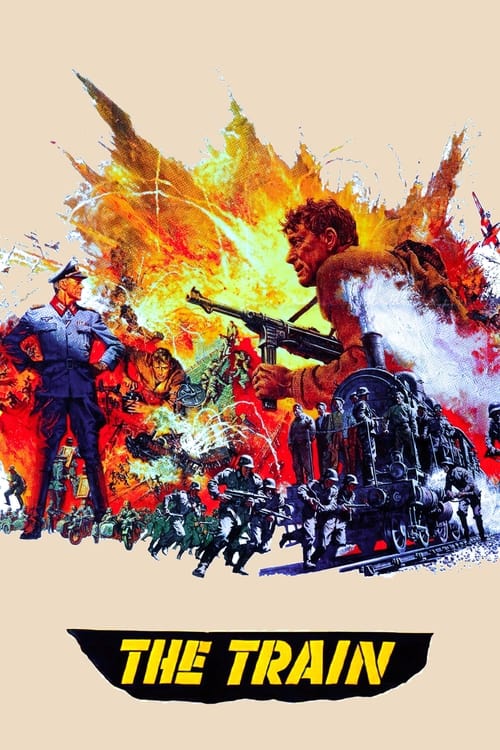
The Train
1964 · John Frankenheimer
For when you want a serious, muscular thriller with something on its mind — tension you can feel in your shoulders plus an argument about art and human life to chew on afterward. More challenge than comfort, and better for it.
What it's about
Paris, August 1944: with the Allies closing in, a cultivated German colonel loads France's greatest paintings onto a train bound for Germany. A French railwayman who can't tell one painter from another is drawn into the Resistance effort to stop him — a duel of sabotage, deception, and rerouted rails, where every delay is bought with lives and the question keeps sharpening: how many men is a boxcar of masterpieces worth?
The experience
Relentless, physical, and heavy with moral weight — a thriller where you feel the tonnage of every locomotive and the cost of every trick. It grips like an action film but leaves you sitting with an unresolved question instead of a cheer.
Performances
Burt Lancaster does his own strikingly physical work as the railwayman — climbing, running, hauling — while Paul Scofield makes the art-loving colonel chillingly persuasive; their opposition is the film's spine.
The craft
Frankenheimer shot with near-documentary commitment to the real thing: actual locomotives, actual marshalling yards, actual derailments and crashes staged full-scale, all in stark black and white. The scale and clarity of the action reward the biggest screen you can find — nothing here is a model or a trick.
Why it matters
A benchmark of practical-effects action filmmaking from Frankenheimer's great 1960s run, and a film that framed the wartime art-looting story long before it became a familiar subject.
Snapshot
The Train is a black-and-white World War II thriller in which a French railwayman, Labiche (Burt Lancaster), is drawn into a lethal contest to keep a trainload of looted French masterpieces from crossing into Germany in the final days of the Occupation. Its antagonist, the cultivated Colonel Von Waldheim (Paul Scofield), embodies the film's central provocation: a man who genuinely loves the paintings he is stealing, matched against a man who cannot read the artists' names stenciled on the crates yet spends lives to save them. Directed by John Frankenheimer at the height of his 1960s run, the picture fuses a "men-on-a-mission" resistance plot with an almost documentary commitment to physical reality — real locomotives, real derailments, real marshalling yards — and closes on a bleakly unresolved moral ledger. It stands today as one of the most admired action films of its decade and a touchstone for practical, in-camera spectacle.
Industry & production
The film was a European-based American production, financed and released through United Artists, and shot largely on location in France with a mixed French and international crew. It descends, loosely, from the historical record of the Nazi looting of French art — in particular the events surrounding the Jeu de Paume, where the art historian Rose Valland secretly documented the objects the Germans plundered and shipped east. Rose Valland's memoir Le front de l'art is the acknowledged source material; the screenplay dramatizes and heavily fictionalizes an actual episode in which a train laden with looted works was delayed by railwaymen and Resistance action and never reached Germany.
The production's most consequential backstage event was a change of directors. Arthur Penn was originally attached and shot briefly before being removed early in production; the standard account holds that Penn favored a more reflective treatment centered on why the art mattered, while Burt Lancaster — a producer-star with decisive power over the project through his own production interests — wanted a more kinetic, action-forward film. Lancaster brought in Frankenheimer, with whom he had already made Birdman of Alcatraz (1962) and Seven Days in May (1964). Frankenheimer, in later interviews, characterized himself as effectively rescuing a troubled shoot, and the picture's escalating scale and practical destruction reflect the direction he pushed it. Precise figures on the budget overrun are not something I can state with confidence, so I won't assign numbers; contemporaneous accounts agree the production grew large and logistically demanding.
The decision to shoot in black and white is usually attributed to studio economics and to the filmmakers' judgment that monochrome suited the newsreel realism of the subject. Lancaster performed a great deal of his own physical work; a well-documented production detail is that a golfing knee injury during the shoot was written into the story, giving Labiche a limp and a leg wound in the later reels.
Technology
The Train is, at bottom, a monument to pre-digital practical effects. Frankenheimer staged genuine train crashes and derailments with real rolling stock, and the film's set-piece destruction of a marshalling yard (the Vaires-style Allied bombing sequence) was executed with large-scale pyrotechnics rather than miniatures or optical trickery. To capture this, the production mounted cameras in unusually aggressive positions — low against the rails, on and around the moving locomotives, and in configurations that let the audience feel the mass and momentum of the machines. The use of multiple simultaneous cameras was a practical necessity: destructive events could be staged only once, so coverage had to be gathered in a single pass. A low-flying aircraft strafing sequence likewise relied on real planes and coordinated camera placement. The film's technological signature is therefore not a new device but a methodology: engineer a real, dangerous, irreversible event and photograph it from as many committed angles as possible.
Technique
Cinematography
The photography is credited to Jean Tournier and Walter Wottitz, working in high-contrast black and white. The visual scheme leans on deep focus and wide-angle lenses — a Frankenheimer hallmark — so that foreground action and deep background remain simultaneously legible, and so that machinery, architecture, and figures share the frame in tense geometric relationships. Rail yards, switch levers, signal gantries, and the ribbing of locomotive cabs become a recurring vocabulary of lines and bars that visually cage the characters. The monochrome grants the film a documentary austerity, flattening the distance between staged drama and archival memory of the Occupation, while the mobile, often low camera converts the trains themselves into looming physical presences.
Editing
The cutting is credited to David Bretherton and Gabriel Rongier. The film's editorial achievement lies in its action architecture: the derailments, the yard bombing, and the extended cat-and-mouse of misrouting the train are built from multi-camera coverage into legible, escalating sequences. The editing sustains a procedural clarity — we generally understand where the train is, what the ruse requires, and what has gone wrong — which is essential to the suspense, since the plot depends on schedules, station names, and deceptions rather than on simple pursuit.
Mise-en-scène / staging
Frankenheimer stages the film around real infrastructure. Stations, roundhouses, water towers, and track junctions are used as functional dramatic space, not backdrop; the mechanics of railroading — coupling, signaling, repainting station signs — become the substance of the plot. The famous ruse, in which the Resistance disguises the train's westward movement as an eastward journey by falsifying station identities, is pure staging as storytelling. Human figures are frequently dwarfed by the equipment, and the final tableau — crates of paintings strewn beside a line of executed hostages — is composed to force the film's moral arithmetic into a single image.
Sound
The film's soundscape is dominated by the industrial reality of steam railroading: the hiss and chuff of locomotives, couplings, whistles, and the percussive violence of the crashes. Maurice Jarre's score is used with restraint relative to the era's norms, leaving much of the tension to be carried by mechanical sound and silence. I don't have reliable detail on the specific mixing techniques used, so I'll note only that the film's realism extends audibly to its emphasis on authentic machine noise.
Performance
Lancaster's Labiche is a study in physical reticence — a competent, unliterary working man who is pulled into the mission less by ideology than by accumulating obligation and grief. He acts largely through movement, labor, and exhaustion rather than speeches. Opposite him, Paul Scofield's Von Waldheim is the film's rhetorical center: cultured, fervent, and self-justifying, a connoisseur who believes his appreciation of the art confers a kind of ownership. The supporting cast deepens the stakes — Michel Simon as the veteran engineer Papa Boule, whose sabotage costs him his life; Jeanne Moreau as a hotelkeeper reluctantly drawn into shelter and complicity; Suzanne Flon as the museum official (the Rose Valland figure) who sets the rescue in motion; with Albert Rémy, Charles Millot, and Wolfgang Preiss among the ensemble. The performances collectively keep the film's abstraction — art versus life — anchored in specific, expendable human beings.
Narrative & dramatic mode
The film operates as a suspense procedural: its tension flows from logistics, deception, and deadlines rather than from conventional combat. The engine of the plot is a ruse — the Resistance must delay and misdirect a scheduled train without destroying it, per orders from London that the paintings be preserved. This constraint is the film's dramatic masterstroke, because it forbids the easy solution (blow it up) and forces the characters into an escalating series of clever, costly improvisations. The mode is tragic rather than triumphant: each delay is purchased with lives, and the narrative steadily strips away Labiche's allies until the "victory," if it is one, arrives amid a field of corpses. The structure repeatedly poses and re-poses a single question rather than resolving it, which is why the film reads as moral inquiry as much as adventure.
Genre & cycle
The Train belongs to the postwar cycle of Resistance and "mission" war films, adjacent to the large-scale international WWII productions of the 1960s (the era of The Longest Day and the ensemble war epic). It is at once an action-suspense thriller and a serious-minded interrogation of that genre's usual heroics. Within the "sabotage mission" subtype, it distinguishes itself by inverting the ticking-clock formula: the objective is preservation, not demolition, and the film treats the mission's cost with a skepticism most entries in the cycle avoid. It also sits within a durable strand of railroad cinema, in which the train functions as both engine of suspense and symbol of implacable historical momentum.
Authorship & method
The film is definitively a Frankenheimer work in method: deep-focus wide-angle compositions, complex staging within real environments, multi-camera capture of dangerous practical action, and a fascination with systems, institutions, and men tested by them — continuous with The Manchurian Candidate, Birdman of Alcatraz, and Seven Days in May. Its authorship is genuinely collaborative and shaped by conflict: Lancaster's insistence on action over contemplation drove Arthur Penn off the project and set the film's kinetic course, making the star a decisive creative force. Cinematographers Jean Tournier and Walter Wottitz realized the stark monochrome and mobile camera; editors David Bretherton and Gabriel Rongier assembled the action; composer Maurice Jarre supplied a restrained score. The screenplay is credited to Franklin Coen and Frank Davis, adapting Rose Valland's account; the era's blacklist history means uncredited or contested contributions to scripts were common, and I won't assert specific unattributed authorship without firmer grounds than I have.
Movement / national cinema
The picture is a transatlantic hybrid rather than a product of any single national movement — American financing and star, an American director, French locations, source, and much of the supporting cast. It participates in the internationalized European production culture of the 1960s, when Hollywood money and talent frequently decamped to Europe for large historical projects. Its French subject and setting, and its casting of major French performers (Simon, Moreau, Flon), give it a distinctly Gallic texture, but it is not a work of the French New Wave or of French national cinema proper; it is best understood as American genre filmmaking realized on French ground and grounded in French historical memory.
Era / period
Released in 1964, the film belongs to a peak stretch of Frankenheimer's career and to a moment when serious American directors were producing muscular, socially aware genre pictures in wide-release formats. Its black-and-white realism runs slightly against the industry's accelerating shift to color, a choice that reads as deliberate austerity. Coming two decades after the events it depicts, it also reflects a mid-1960s willingness to complicate the heroic Occupation-and-Resistance narrative with questions about cost and worth — a more ambivalent register than the immediate postwar cinema of national vindication.
Themes
The film's governing theme is the value of culture measured against human life. It refuses a comfortable answer. Von Waldheim argues, in effect, that the paintings belong to those capable of appreciating them, sublimating theft into stewardship; Labiche, who cannot even name the artists, ultimately spends the lives of friends and strangers to keep the crates in France. The closing juxtaposition of masterpieces and murdered hostages is the thematic thesis rendered visual: the film asks whether a Renoir or a Cézanne is worth a human being, and leaves the audience to sit in the discomfort of not being sure. Around this core cluster further themes — class (working railwaymen against an aristocratic officer-aesthete), national heritage and identity, the moral corrosion of "appreciation" divorced from justice, and the futility and attrition of resistance, in which victory is indistinguishable from exhaustion and loss.
Reception, canon & influence
The Train was well received on release and has grown in stature as one of Frankenheimer's finest films and among the most celebrated train pictures ever made; its original screenplay earned an Academy Award nomination (Franklin Coen and Frank Davis). Beyond specific honors, its enduring reputation rests on the authenticity of its action and the seriousness of its moral argument.
Looking backward, the film draws on the historical record of Nazi art looting and Rose Valland's documentation, on the postwar Resistance-film tradition, and on Frankenheimer's own developing style of institutional suspense forged in The Manchurian Candidate and Seven Days in May. Looking forward, its most tangible legacy is as a benchmark for practical, in-camera spectacle: its real derailments and full-scale destruction are routinely cited by advocates of stunt-driven, non-digital action filmmaking as proof of the visceral weight real physics lends the screen. Its refusal to sentimentalize the mission — its insistence that cultural preservation was paid for in blood — also anticipates later, more morally ambivalent war and heist narratives, and the film remains a reference point in discussions of art restitution on screen. Its DNA is visible wherever filmmakers stage suspense around the mechanics of a moving train and where directors choose to break real things rather than render them. Precise claims about its box-office performance are not something I can reliably verify, so I leave them aside; the surer measure of its influence is the continued esteem of critics and filmmakers for its craft and its unanswered question.
A Deleuzian reading
A man climbs a ladder at a country station with a bucket and a brush, and paints the wrong name on the board.
The full Deleuzian reading of The Train →
Reception
Respectfully received in 1965 (it even snagged an original-screenplay Oscar nod), it's since been upgraded from 'solid WWII thriller' to sacred text — modern action filmmakers routinely cite it as proof of what real trains, real crashes, and zero CGI can do.
How The Train was received, from release to now →
Influences: the films it descends from and the films it influenced
- The Manchurian Candidate (1962) — Established Frankenheimer's deep-focus wide-angle grammar for institutional suspense, staging plots as legible mechanical systems the audience reads spatially — the same procedural clarity Tournier/Wottitz apply to the trainyard.
- Seven Days in May (1964) — Refined Frankenheimer's control of men tested inside institutions via low-angle, foreground-heavy compositions and multi-source blocking, the tense-conference visual logic reapplied to the German rail command in The Train.
- Birdman of Alcatraz (1962) — Frankenheimer's earlier Lancaster collaboration built the star's mode of physical reticence — stillness and withheld emotion within a confining real environment — that becomes Labiche's terse, action-over-speech register.
- La Bataille du rail (1946) — The founding Resistance-railway film, using real locomotives, actual sabotage mechanics and a semi-documentary procedural of derailments — the direct template for staging suspense around railway logistics as authentic labor.
- La Bête Humaine (1938) — Renoir shot from real footplates and engine cabs with the locomotive as a physical co-star, pioneering the industrial-realist sound and mobile on-train camera The Train inherits for its cab and yard sequences.
- Citizen Kane (1941) — Gregg Toland's deep-focus, wide-angle, low-ceiling photography — everything sharp from foreground to background — is the optical foundation Frankenheimer adopts to keep men and machinery simultaneously legible in a single frame.
- The General (1926) — Keaton's insistence on a real full-scale locomotive plunging through a collapsing bridge set the in-camera, break-real-things benchmark for railroad spectacle that The Train's actual derailments extend.
- The Bridge on the River Kwai (1957) — Lean's climax destroyed a genuine full-scale bridge and sent a real train into the river in-camera, modeling the practical-destruction-as-moral-climax that Frankenheimer scales up across an entire railyard.
- Grand Prix (1966) — Frankenheimer immediately reused The Train's multi-camera capture of real, dangerous motion — cameras mounted on and racing alongside actual vehicles — to make speed felt as physical risk rather than staged illusion.
- The Wild Bunch (1969) — Peckinpah staged a real locomotive theft and full-scale bridge demolition in-camera, carrying forward the conviction that visceral weight comes from actual physics and destroyed real infrastructure.
- The French Connection (1971) — Friedkin's elevated-train pursuit chases a real train through real streets with mounted cameras and procedural clarity of geography, descending directly from Frankenheimer's location-shot, physics-driven action.
- Runaway Train (1985) — Built its peril from real locomotives hurtling across actual track with on-engine camera rigs and industrial-realist sound, sustaining The Train's premise that the machine's genuine mass generates the suspense.
- Unstoppable (2010) — Scott ran real full-size trains at speed and captured them with multi-camera, helicopter and trackside rigs rather than CGI, an explicit modern revival of practical railroad-cinema kinetics.
- Ronin (1998) — Frankenheimer late-career reaffirmed his own practical-action doctrine with real high-speed car chases shot on actual European roads using multiple synchronized cameras and minimal fakery, the method he forged on The Train.
- Mad Max: Fury Road (2015) — Miller's near-total reliance on real vehicles, live stunts and in-camera destruction makes it the contemporary standard-bearer for the break-real-things ethos The Train is repeatedly cited to justify.
- Mission: Impossible – Dead Reckoning (2023) — Its climactic sequence destroys a real full-scale locomotive carriage-by-carriage as it derails off a genuine bridge, a direct homage to The Train's proof that practical rail catastrophe outweighs digital rendering.
- Top Secret! (1984) — The Jarre-scored French-resistance picture whose unironic brass-and-percussion mission cues are the register Maurice Jarre writes in for Top Secret!, scoring the sabotage sequences with full orchestral heroism that gives the nonsense on screen the authority of a real war film.
- Von Ryan's Express (1965) — A contemporaneous WWII train-escape thriller built on the same railroad-cinema suspense of switching, coupling and pursuit along real track, extending the resistance-mission-by-locomotive genre The Train crystallized.
Similar films
- The General (1926) — influence & lineage
- Ronin (1998) — influence & lineage
- Seven Days in May (1964) — influence & lineage
- The Great Escape (1963) — shared sensibility
- The Wages of Fear (1953) — shared sensibility
- Le Trou (1960) — shared sensibility
- Grand Illusion (1937) — shared sensibility
- De Gaulle: Liberté (2026) — shared sensibility