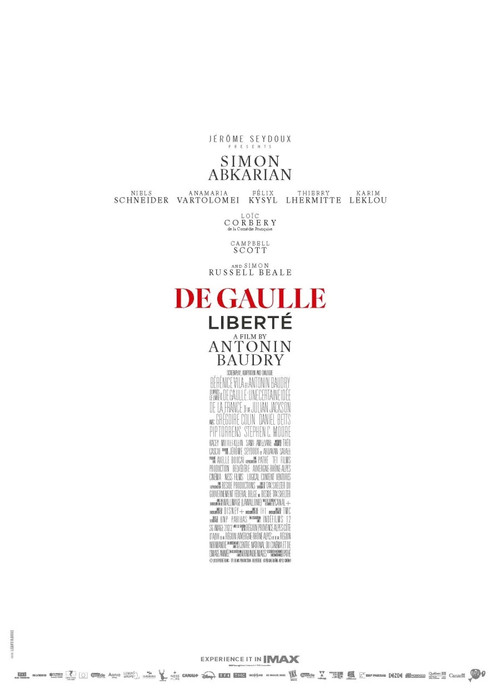
De Gaulle: Liberté
2026 · Antonin Baudry
When you're in the mood for substance — a history lesson that plays as drama, best for an evening when you want to come away knowing more than you did. More engrossing than relaxing; bring your attention.
What it's about
The second half of a two-part portrait of Charles de Gaulle, picking up in 1940 as France falls and following him through the war years to 1945. It traces how a career army officer becomes the voice of Free France — the exile, the broadcasts, the political maneuvering, and the stubborn refusal to accept defeat that turns a soldier into a statesman.
The experience
Weighty and absorbing in the manner of serious historical drama — less about battlefield spectacle than the tension of speeches, alliances, and decisions made under impossible pressure. It asks you to lean in and watch a man carry a country's identity on his back.
The craft
Antonin Baudry stages the war years as political theater as much as military history, building the film around the moments where words and will mattered as much as armies. The period reconstruction of occupied and free France gives it a handsome, big-canvas sweep that rewards a proper screen.
Why it matters
Part of an ambitious two-film undertaking to put de Gaulle's wartime transformation on screen at full scale — a touchstone subject in French cinema, since these years still define how France tells the story of itself.
Snapshot
De Gaulle: Liberté is the second and concluding panel of Antonin Baudry's two-part biographical epic on Charles de Gaulle — released in France under the umbrella title La Bataille de Gaulle — produced by Pathé and adapted from Julian Jackson's acclaimed 2018 biography A Certain Idea of France: The Life of Charles de Gaulle. Where the first installment (French subtitle L'Âge de fer, "The Iron Age"; international title Résistance) dramatized the vertiginous collapse of 1940 and the near-solitary act of self-authorization by which an obscure two-star general appointed himself the voice of a defeated nation, Liberté carries the story through 1942–1945: the consolidation of Free France, the power struggle with General Giraud, the friction with Churchill and Roosevelt, and the fighting of Leclerc's forces and the internal Resistance. Its French subtitle, J'écris ton nom, quotes the refrain of Paul Éluard's clandestine 1942 poem "Liberté" — a literary citation that signals the film's central preoccupation: the writing of a nation's name back into existence. Simon Abkarian plays de Gaulle across both parts. The diptych stands among the largest French productions of its era; Liberté runs 159 minutes and reached French cinemas in the early summer of 2026, roughly a month after Résistance opened on June 3. The two films together drew more than five million admissions in France and arrived to a strikingly warm critical reception, with the second part rated even more highly than the first by French audiences.
Industry & production
The De Gaulle diptych is a flagship Pathé undertaking, produced with TF1 Films Production and Ness Films — a financing structure typical of French heritage cinema at the upper budget tier, where a major distributor and a broadcaster's film arm combine to underwrite a scale rarely attempted domestically. The budget places the two films well above the norm for French drama and into territory usually reserved for internationally facing event cinema. The release architecture — two features in cinemas roughly a month apart in the summer of 2026, rather than a simultaneous double bill or a year's gap — was itself a distribution gambit, betting that the momentum of the first film's reception would pull audiences into the second before word-of-mouth cooled. The bet paid off: Part 1 drew over 2.7 million admissions in France and Part 2 another 2.2 million, with international grosses of $19.4 million and $13.8 million respectively, and staggered international rollouts following through the autumn (the UK and Ireland in August and September; Canada in August and September; the United States set for November 6 and December 4, 2026).
Principal photography ran 150 days, from mid-July 2023 to late July 2024 — an extended schedule consistent with the logistical demands of period reconstruction across multiple territories. Paris was shot first, from July to September 2023, at genuine landmarks including the Place de l'Étoile, the Place du Panthéon, and the Gare de l'Est; Morocco followed in October and November 2023 for the desert battles; and the Bry-sur-Marne studios hosted a final block in February and March 2024, where the London interiors — including Churchill's war room — were rebuilt from scratch. Further work spread across Normandy, Provence, and Auvergne-Rhône-Alpes, taking in the airship hangar at Écausseville and the Salon-de-Provence aerodrome. The producers have said that shooting outside France was effectively impossible: filming in London itself would have cost on the order of a million euros a day, plus extensive digital cleanup, so Britain came to France instead. Part 1 premiered out of competition at the Cannes Film Festival on May 20, 2026, giving the diptych a festival launch two weeks before its commercial run began.
Technology
The production's technological signature is reconstruction at scale. Visual effects were handled by Buf, working out of Paris and Montreal, supporting a shoot that favored real monumental locations in Paris and real desert terrain in Morocco over wholesale digital environments, with studio builds at Bry-sur-Marne supplying the wartime London that could not be filmed on site. The approach — practical foundations, with effects work extending rather than replacing them — matches Baudry's stated ambition to make an adventure film with a contemporary feel rather than a waxwork period piece.
Technique
Cinematography
Liberté is credited to two cinematographers, Pierre Cottereau and Giora Bejach — a pairing that reflects the film's double register. Cottereau shot Baudry's debut feature, the submarine thriller Le Chant du loup (2019), and his return signals continuity of the director's visual sensibility: a taste for enclosed, pressurized spaces and controlled light. Bejach, an Israeli cinematographer known for austere, formally rigorous work in international art cinema, brings a different pole — and the finished film is indeed calibrated between the intimate, chamber-scaled study of a man in exile and command and the wide historical canvas of armies and capitals. The location roster bears this out: the war rooms and corridors of government on one side; on the other, the monumental Parisian architecture of the Étoile, the Panthéon, and the Gare de l'Est, and the Moroccan desert where the battle sequences were staged. French critics singled out the desert and naval battles as genuinely spectacular — scale earned in camera, on real ground.
Editing
Cutting is credited to Rehman Nizar Ali and Katie McQuerrey, and the editorial problem specific to Liberté is structural: unlike the first film, which pivots on a handful of decisive ruptures, the second marshals a choral, multi-front narrative — parallel storylines following Jean Moulin, Leclerc, and others alongside de Gaulle himself, who contends simultaneously with the German enemy, the internal Resistance, his rival General Giraud, and the skepticism of his own Allies. The film's solution is systematic alternation: battle set pieces in the desert and at sea cut against the clashes of ego in London, Algiers, and Washington. Reviewers credited exactly this rhythm for the film's momentum — Herodote.net reported never being bored for a second across either of the two roughly two-hour-forty-minute films, and AVCesar likewise found that the runtime moves quickly, carried by the balance of ambitious battle sequences against political maneuvering and lesser-known historical episodes.
Mise-en-scène / staging
The staging is organized around a recurring opposition between the confined room and the open field — the negotiating table and map room of a government-in-waiting set against the theaters where legitimacy is contested by force, including the desert battle of Ksar Ghilane. Production design is by Benoît Barouh, a three-time César nominee, whose work spans the studio reconstruction of Churchill's war room and the wartime dressing of genuine civic landmarks; the shooting at real Parisian monuments gives the public-facing material documentary solidity rather than backlot gloss. Baudry has said he deliberately avoided the conventional codes of the historical film — no stately pacing, no reverent museum manner — aiming instead for the forward drive of an adventure film.
Sound
The film's sound work centers, fittingly, on the voice. Abkarian has described preparing de Gaulle's speech with Baudry in a mixing auditorium, working through archival recordings — not to imitate the general but to find the music of his delivery, the cadence beneath the timbre. Baudry, for his part, has said he kept de Gaulle's actual words intact in the major speeches while allowing himself liberties elsewhere, and that he condensed several radio addresses into a single scene, since no film could stage every broadcast. The scoring also splits across the diptych: Volker Bertelmann (Hauschka), the Academy Award winner for All Quiet on the Western Front, composed the first part, while Theo Cascio scored Liberté — consistent with Baudry's stated refusal of conventional "historical" music in favor of a contemporary register.
Performance
Simon Abkarian's de Gaulle anchors both films, and the casting is itself an interpretive choice. Abkarian — a French-Armenian actor of stage and screen — is not a physical double for the general in the manner of prosthetic-driven biopic casting; by his own account the performance was built on voice and bearing, with costume, makeup, and hair supplying the silhouette. He has called the role a crossroads of his working life. The ensemble around him is deep and internationally sourced: Niels Schneider plays Philippe Leclerc de Hauteclocque, and his charisma in the role struck AVCesar as unexpectedly compelling; Thierry Lhermitte — a comic institution in French cinema, cast against type — plays the rival General Giraud, a turn Herodote found priceless; Anamaria Vartolomei plays Livia; and for the Allied summitry that structures much of the second film's drama, Simon Russell Beale plays Winston Churchill and Campbell Scott plays Franklin Roosevelt. Mathieu Kassovitz and Benoît Magimel also appear. The presence of Anglophone stage and screen actors of Beale's and Scott's stature marks a film that takes the de Gaulle–Allies confrontation seriously as a two-sided dramatic contest rather than caricature.
Narrative & dramatic mode
Liberté operates in the register of the classical historical epic, but its dramatic engine is as much the negotiating room as the battlefield. Covering 1942 to 1945, it adopts a choral structure — parallel strands following Moulin, Leclerc, and the wider Resistance alongside de Gaulle's own campaign for recognition — rather than a single-protagonist biography. The through-line, drawn from Jackson's biography, is the paradox of a leader with almost no material power insisting on being treated as the sovereign embodiment of France, against the German occupier but also against the reluctance of his American ally. Filmink's reading captures the mode precisely: a character-driven war film built from its figures' present-tense uncertainty, refusing the comfort of hindsight — resistance as desperate moral commitment rather than inevitable triumph. This is a drama of legitimacy, in which battles and conference tables are two fronts of the same war.
Genre & cycle
The film belongs to two overlapping traditions. The first is the French heritage epic — the large-budget, star-dense, monument-anchored national biography, of which recent De Gaulle screen treatments (including the 2020 De Gaulle with Lambert Wilson, focused narrowly on 1940) form an immediate precedent. The second is the international wartime-leader biopic cycle that has flourished around Churchill and other Allied figures, of which Baudry's Roosevelt-and-Churchill-populated summitry is plainly aware. Liberté's distinction within these cycles is twofold: the two-part, month-apart release, which pushes the heritage biopic toward the scale and event status of franchise cinema, and Baudry's deliberate swerve away from the genre's codes toward the tempo of the adventure film.
Authorship & method
Antonin Baudry is among the more unusual auteurs to take on this material. A former French diplomat, he is the author — under the pen name Abel Lanzac — of the celebrated graphic novel Quai d'Orsay, a satirical insider portrait of the French Foreign Ministry later adapted for cinema by Bertrand Tavernier. His directorial debut, Le Chant du loup (2019), was a taut, technically precise submarine thriller. That biography matters: Baudry approaches de Gaulle not as a hagiographer but as someone who has worked inside the machinery of French statecraft, which aligns with Liberté's emphasis on negotiation, recognition, and the theater of sovereignty. He co-wrote both films with Bérénice Vila, adapting Julian Jackson's A Certain Idea of France — itself regarded as the definitive modern English-language biography — and has described consulting some 150 books in preparation, with a historical consultant whose presence, he says, granted him freedom rather than constraint. His stated ambition was a film for the generation of his children's friends rather than for specialists; his stated model, unexpectedly, was Don Quixote — a man forever confronting false versions of himself. He has defended the diptych's five-and-a-half-hour combined length as the shape the story required. The key collaborators reinforce the internationalism: cinematography shared between Cottereau and Bejach, editing by Ali and McQuerrey, scores by Bertelmann and Cascio across the two parts — a crew and cast reaching well beyond the domestic French industry, matching the film's argument that de Gaulle's drama was always played on a world stage.
Movement / national cinema
The film is a landmark instance of contemporary French cinéma du patrimoine — heritage cinema — operating at a budget and with an international outlook that stretch the category. It participates in the long postwar French project of screen memory around the Occupation, Resistance, and the Gaullist founding myth, while complicating that project's reverence: the film honors collective sacrifice over the lone great man. By adapting an English historian's biography and casting Anglophone actors as the Allied leaders, Liberté also positions itself partly outside the purely national frame, addressing de Gaulle as an international historical figure and courting an audience beyond France — national cinema consciously scaled for export, with its staggered Anglophone releases through late 2026 as the proof of intent.
Era / period
Liberté depicts the years 1942 through 1945 (the diptych as a whole begins in 1940), the crucible in which Free France transformed from a rhetorical claim broadcast from London into a provisional government with an army. The period canvas takes in the North African theater and the desert war, the rivalry with Giraud in Algiers, the Allied summitry that would determine France's postwar standing, and the parallel struggle of the internal Resistance. The film's own moment — the mid-2020s — lends the material a contemporary resonance around national sovereignty and a middle power's insistence on independence from a dominant ally, a resonance sharpened by Baudry's refusal to let hindsight soften the characters' uncertainty.
Themes
The governing theme is legitimacy as an act of will — de Gaulle's conviction that France's standing was a premise to be asserted rather than a fact to be demonstrated, and that recognition, once claimed with sufficient stubbornness, becomes real. The Éluard citation in the French title frames the film around language and naming as instruments of liberation: the nation is spoken and written back into being, and the production's care with de Gaulle's actual words in the great speeches makes that theme a method as well as a motif. Resistance itself is treated in the widest sense — against occupation, injustice, and tyranny — with the film honoring collective sacrifice over single heroism and steering clear of pure hagiography. Sovereignty and independence, from the occupier but pointedly also from the Anglo-American allies, form the second major axis, giving the film an argumentative edge unusual for the national biopic. Beneath both runs the solitude of command: the leader who must embody a collective he cannot fully consult.
Reception, canon & influence
The reception has been strikingly favorable. Liberté holds a 100 percent score on Rotten Tomatoes from eleven reviews, and French audiences on AlloCiné rated it 3.9 out of 5 — higher than the first part's 3.5. AVCesar awarded it 8.5 out of 10, praising the ambition of the battle sequences, the balance with the political maneuvering, the attention to lesser-known episodes, and a long runtime that never drags; Herodote.net hailed the diptych as exceptional large-canvas historical filmmaking whose alternation of spectacle and political duel sustains attention across both parts. The broader critical summary credits the films' epic scope and performances while registering reservations about conventional storytelling and length. Commercially, the diptych surpassed five million admissions in France, with the American release still ahead at the time of writing.
On the influence ledger, the backward-facing debts are clear: Jackson's biography for the historiographic spine, the long tradition of French Resistance and Occupation cinema for its iconography, the international leader-biopic cycle for its summit-room dramaturgy, and Baudry's own diplomatic sensibility from Le Chant du loup and Quai d'Orsay for its emphasis on negotiation as combat. Its forward influence will be measured by whether the two-part, month-apart release model is imitated as an industrial strategy, and whether Abkarian's non-mimetic, voice-first de Gaulle becomes the reference performance against which future portrayals are judged.
Sources: De Gaulle (2026 film) — Wikipedia) · Dans les coulisses de La Bataille de Gaulle — CNC · La Bataille de Gaulle : J'écris ton nom — AVCesar · Deux exceptionnels films d'Histoire — Herodote.net · La Bataille de Gaulle — Filmink · Aux origines de La Bataille de Gaulle : Baudry & Jackson — Le Grand Continent · Simon Abkarian parle de De Gaulle — L'Éclaireur Fnac
A Deleuzian reading
Start with the voice.
The full Deleuzian reading of De Gaulle: Liberté →
Reception
Written off as a costly misfire when part one opened soft (~380,000 admissions in week one against a reported €75–100M budget for the diptych), it became summer 2026's word-of-mouth comeback in France — attendance actually climbed week over week, and French media ran with the irresistible headline that De Gaulle was 'resisting' at the box office.
How De Gaulle: Liberté was received, from release to now →
How to watch De Gaulle: Liberté: what to notice on a first viewing
- Watch the film alternate between closed rooms and open ground. Baudry sets the map room and the negotiating table against the desert and the sea, and the two credited cinematographers, Pierre Cottereau and Giora Bejach, calibrate the film between a chamber study and a wide canvas, with battles staged on real ground in Morocco. Battles and conference tables are two fronts of the same war, and the film treats a table as a battlefield.
- Listen for the cadence of de Gaulle's speeches. Abkarian built the voice from archival recordings in a mixing auditorium, after the music of the delivery rather than an imitation. In the major speeches Baudry keeps de Gaulle's actual words; the broadcast lines are only what he said on air. His only real weapon in these years is the voice, so the speeches are the action scenes.
- Watch how Abkarian holds himself at a table. Abkarian is no physical double. He built de Gaulle on bearing and voice and lets costume, makeup, and hair supply the silhouette. Across from him, Simon Russell Beale's Churchill and Campbell Scott's Roosevelt play the summits as a two-sided contest. A man with almost no material power claims to be France, and the posture has to carry the claim before anything proves it.
- Count how many storylines the film cuts between. Editors Rehman Nizar Ali and Katie McQuerrey marshal a choral narrative: de Gaulle in London, Algiers, and Washington, Leclerc's forces in the field, Jean Moulin and the internal Resistance. Battle set pieces alternate with clashes of ego. The alternation is the momentum; Baudry wanted the drive of an adventure film, not the reverent pace of a museum piece.
The whole guide to watching De Gaulle: Liberté, with the keys for a rewatch →
Influences: the films it descends from and the films it influenced
- Quai d'Orsay (2013) — Adapts Baudry's own insider graphic novel and builds its drama from the corridor-and-cabinet procedural of French statecraft — the ministerial-theater dramaturgy Baudry then turns on de Gaulle.
- Le Chant du loup (2019) — Baudry's debut establishes his method of technically precise, low-key thriller staging that privileges protocol, listening, and decision-under-pressure over spectacle, carried directly into the negotiation scenes of Liberté.
- De Gaulle (2020) — The immediate French predecessor biopic covering the 1940 rupture, against whose more conventional patriotic register Baudry defines his diplomatic, recognition-focused reading of the general.
- Diplomatie (2014) — Models the single-room, two-man negotiation-as-suspense over the fate of Paris — the 'theater of sovereignty' chamber dramaturgy Liberté extends to summit rooms.
- Darkest Hour (2017) — The contemporary wartime-leader biopic template of cabinet-room rhetoric and besieged decision-making, the Churchill counterpart-piece to Liberté's de Gaulle.
- The Queen (2006) — Peter Morgan's method of rendering high statecraft as intimate, non-hagiographic character drama built on restraint rather than impersonation, a template for the non-mimetic de Gaulle.
- Lincoln (2012) — Stakes a leader biopic almost entirely on negotiation, persuasion and political maneuver rather than battle — the 'diplomacy over combat' emphasis Baudry foregrounds.
- Bridge of Spies (2015) — Turns Cold War back-channel negotiation into procedural suspense, dramatizing recognition and exchange as the core action — the summit-room grammar Liberté inherits.
- L'Armée des ombres (1969) — Sets the French Resistance's austere, procedural iconography — clandestine method and moral gravity over heroics — that supplies Liberté's Occupation-cinema visual vocabulary.
- Le Chagrin et la pitié (1969) — Reframes the Occupation as contested historiography rather than legend, the serious-source ethic behind Baudry's grounding of the film in Julian Jackson's biography.
- La Bataille du rail (1946) — Foundational Resistance-cinema iconography of collective clandestine action, the documentary-inflected imagery the diptych draws on for its wartime register.
- Paris brûle-t-il? (1966) — The canonical large-canvas staging of the Liberation of Paris and de Gaulle's entry, whose iconography of restored sovereignty Liberté both cites and reworks.
Similar films
- All Quiet on the Western Front (2022) — influence & lineage
- Napoleon (1927) — shared sensibility
- The Count of Monte Cristo (2024) — shared sensibility
- Jean de Florette (1986) — shared sensibility
- The Battle of Algiers (1966) — shared sensibility
- Napoleon (2023) — shared sensibility
- Camp de Thiaroye (1988) — shared sensibility
- The Longest Day (1962) — shared sensibility