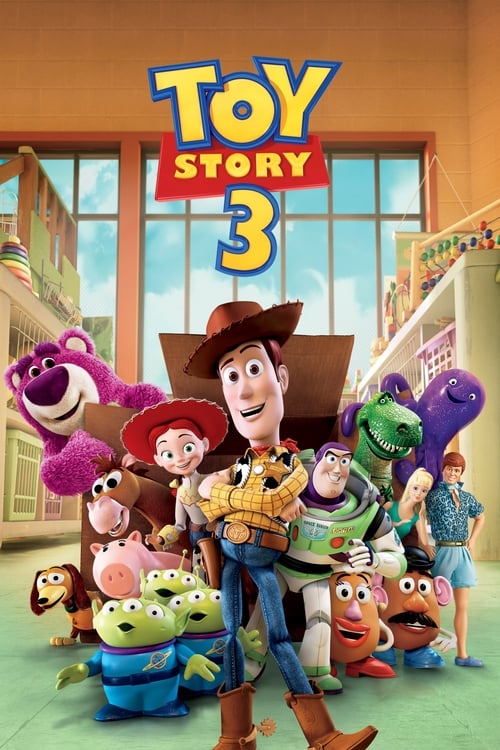
Toy Story 3
2010 · Lee Unkrich
For a family movie night that works on every age in the room, or for anyone who grew up with these characters and needs a good cry about growing up. Total comfort viewing with one of the most emotional endings in mainstream animation.
What it's about
Andy is packing for college, and the toys who've spent years in a chest face the question every toy dreads: what happens when your kid grows up? A donation mix-up lands Woody, Buzz, and the gang at a daycare that looks like paradise and runs like a prison, complete with a strawberry-scented bear warden. What follows is a full-blown escape caper — and, underneath it, a story about letting go.
The experience
A genuinely thrilling prison-break movie that happens to star toys — funny, propulsive, and expertly built — until the final stretch, when it turns quiet and devastates you. Few family films earn tears this honestly; bring tissues even if you think you're immune.
Performances
Tom Hanks and Tim Allen, fifteen years into these roles, carry the finale with voice work that has real weight — and Ned Beatty makes the villainous Lotso genuinely chilling for a bear who smells like strawberries.
The craft
Michael Arndt's screenplay is a machine of remarkable precision — every gag load-bearing, every setup paid off — and Lee Unkrich stages the escape with the fluency of classic prison-break cinema. Its boldest move is tonal: it walks its characters to the edge of annihilation and lets the moment breathe, wordlessly, longer than any family film had dared. Big screen and good speakers make the climax hit even harder.
Why it matters
Released fifteen years after the original so its first audience would be leaving for college themselves, it became a global phenomenon, won the Best Animated Feature Oscar, and proved a threequel could be a franchise's emotional peak.
Pixar closed its imperial decade with a prison-break picture. Andy is leaving for college, the toys are donated in error to a daycare that reveals itself as a gulag with pastel walls, and Lee Unkrich — longtime editor and co-director at the studio, here directing solo for the first time — orchestrates their escape with the genre fluency of a man who has clearly studied The Great Escape and Cool Hand Luke. Michael Arndt's screenplay is a machine of remarkable precision, every gag load-bearing, but the film's real audacity is tonal: it walks its characters, and its audience, to the very edge of annihilation and lets the moment breathe, wordlessly, longer than any family film had dared. Then it does something harder — it says goodbye. Released fifteen years after the first Toy Story, timed so that the children who met Woody and Buzz in 1995 were themselves packing for college, it became only the second animated film ever nominated for the Academy Award for Best Picture, and the rare threequel that completes rather than extends.
Reception
An instant triumph in 2010 — near-perfect reviews, a billion dollars, and a Best Picture nomination — and it's never really needed reappraisal; the only shift is that Toy Story 4's existence now makes some fans retroactively protective of this one as the 'real' ending.
How Toy Story 3 was received, from release to now →
Influences: the films it descends from and the films it influenced
- The Great Escape (1963) — Supplies the ensemble-escape blueprint TS3 restages beat-for-beat — assign each member a specialized job, then cross-cut the parallel escape mechanics building to one synchronized break.
- Cool Hand Luke (1967) — Transposes its prison-camp iconography onto Sunnyside — the charismatic-tyrant warden (Lotso), the confinement 'box,' and the bus-arrival ritual of processing new inmates.
- Stalag 17 (1953) — Models the POW-barracks internal politics — informants, factions, escape-as-heist tone — that TS3 maps onto the toys' rival cliques inside the daycare.
- The Bridge on the River Kwai (1957) — Lean, himself an editor-turned-director, codified the POW-camp-with-institutional-authority drama and its charismatic-tyrant hierarchy that Lotso's regime inherits.
- The Shawshank Redemption (1994) — Its patient, methodical breakout mechanics and the benevolent-vs-corrupt authority axis echo directly in TS3's trash-chute-and-dumpster escape choreography.
- Toy Story (1995) — Establishes the character rigs, the buddy-comedy Woody/Buzz dynamic, and the strict toy-POV rules (freeze when humans look) that TS3 brings to completion.
- Toy Story 2 (1999) — Unkrich co-directed it and it introduced the abandonment/obsolescence mortality theme via Jessie's flashback — the emotional register TS3 escalates to literal annihilation.
- Monsters, Inc. (2001) — Unkrich co-directed; its door-warehouse chase honed the large-scale set-piece geography and spatial editing that structures the daycare escape.
- Finding Nemo (2003) — Unkrich edited it, and its Tank Gang aquarium-escape sequence is the direct editorial rehearsal for the incarceration-and-breakout rhythm he directs in TS3.
- Little Miss Sunshine (2006) — Michael Arndt's screenplay architecture — a precise ensemble racing a deadline toward a climax that earns devastation through comedy — is the same structure he builds for TS3.
- My Neighbor Totoro (1988) — Totoro appears as a plush cameo in explicit homage, marking how John Lasseter's championing institutionalized Miyazaki's atmosphere-and-character-first sensibility inside Pixar.
- Toy Story 4 (2019) — Extends the farewell/letting-go arc and the 'what is a toy's purpose once outgrown' question that TS3's finale opened, again resolving on a deliberate act of release.
- Coco (2017) — Unkrich's solo feature carries forward his TS3 preoccupation with mortality, memory, and being forgotten, once more staged around a climactic, tightly-scripted emotional release.
- Inside Out (2015) — Extends the studio's imperial-decade craft of dramatizing growing-up-as-loss (Bing Bong's fade) — the farewell-and-maturation emotional signature TS3 crystallized for Pixar.
- Toy Story 5 (2026) — Stanton's own screenplay for this entry set the ensemble-jeopardy staging grammar — group blocking where every toy stays legible in a wide, and the wordless hand-clasp that resolves an act on gesture instead of a line — which is the withholding technique ('give them 2 + 2') he carries forward.
- Chicken Run (2000) — Explicitly restages The Great Escape as family animation (a poultry POW camp), performing the exact genre-transposition of prison-break-into-toybox that TS3 executes.
- WALL·E (2008) — Pixar imperial-decade wordless-restraint craft — sustained dialogue-free storytelling trusting image and sound design — that TS3's near-silent incinerator sequence inherits.
- Up (2009) — The 'Married Life' montage's wordless confrontation with mortality is the sibling gesture to TS3's hand-holding incinerator scene, both trusting silence over dialogue.
Similar films
- Toy Story (1995) — influence & lineage · same viewing thread
- Toy Story 2 (1999) — influence & lineage
- Finding Nemo (2003) — influence & lineage
- Monsters, Inc. (2001) — influence & lineage
- Up (2009) — influence & lineage
- Inside Out (2015) — influence & lineage
- WALL·E (2008) — influence & lineage
- Coco (2017) — influence & lineage
All the films related to Toy Story 3 →
Watch it with: curated runs of related films
- Pixar and the Fear of Being Replaced — Watch these together for Pixar's quiet obsession with obsolescence — the toy outgrown, the newer model, the town the highway forgot.