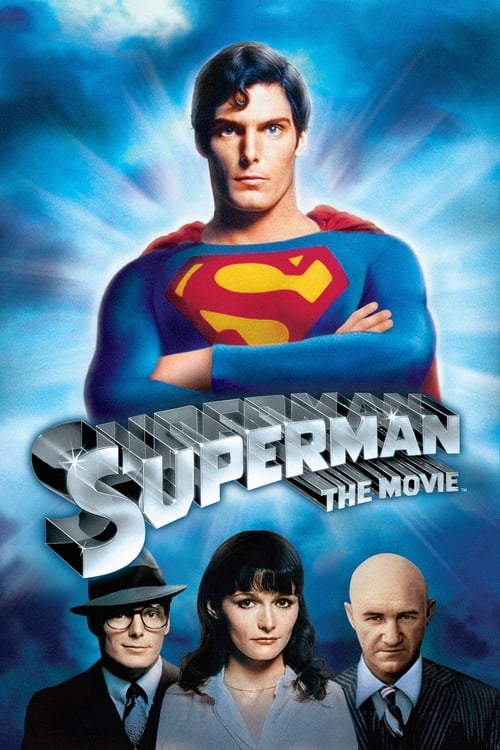
Superman
1978 · Richard Donner
For when you want to feel uncomplicated wonder — a big-hearted classic for family viewing, nostalgia, or restoring your faith in earnest blockbusters. Comfort viewing on the grandest scale.
What it's about
An infant escapes a dying planet and grows up in Kansas as Clark Kent, a farm boy hiding impossible powers. As a mild-mannered reporter at a Metropolis newspaper, he falls for star journalist Lois Lane — while his other self takes to the skies as Superman, just in time to face Lex Luthor, a preening criminal genius with a real-estate scheme that puts millions of lives at stake.
The experience
Grand, sincere, and openly romantic, it plays like three movies in one — a cosmic myth, a Norman Rockwell boyhood, and a screwball newsroom romance — held together by a soaring score and a total refusal to wink. It leaves you feeling lighter than air.
Performances
Christopher Reeve gives one of the defining star performances in popular cinema, playing Clark and Superman as two fully distinct physical beings, while Gene Hackman has a wonderful time as a vain, chatty Lex Luthor and Margot Kidder makes Lois all brass and hidden softness.
The craft
John Williams's main theme is one of the most instantly recognizable pieces of film music ever written, and the flying effects — built to sell a single impossible image — still carry conviction. Richard Donner's insistence on playing it straight, at prestige-picture scale, is the film's masterstroke; it rewards the biggest screen and best speakers you have.
Why it matters
The film that invented the modern superhero movie — the origin-story structure, the sincerity, the theme-as-identity score — and the template every comic-book blockbuster since has honored or rebelled against.
Snapshot
Superman is the film that proved a comic-book character could carry a prestige-scale motion picture without irony, camp, or apology. Produced by Alexander and Ilya Salkind as an international package assembled in the manner of a 1970s all-star disaster picture, directed by a journeyman with one hit behind him, and built around an unknown lead flanked by Marlon Brando and Gene Hackman, it had every structural reason to fail. Instead it established a template — origin story as three-movement symphony, sincerity as the governing tone, a composer's leitmotif as the character's second identity, effects engineering in service of a single impossible image — that the superhero film has been rewriting, honoring, and rebelling against ever since.
Its ambition was declarative. The advertising promised the audience they would believe a man could fly, which was less a slogan than a technical dare: the entire production was organized around solving a problem of physical plausibility that cinema had never adequately solved. That the film also works as pastoral Americana, as newspaper screwball comedy, and as operatic science fiction — often within the same reel — is the more interesting achievement, and the harder one to imitate.
Industry & production
The Salkinds acquired screen rights to the character from DC's parent company in the mid-1970s and financed the picture the way Alexander Salkind financed everything: internationally, opaquely, and on the strength of pre-sales. Their prior Three Musketeers (1973), shot as one production and released as two features, had provoked enough contractual grievance that actors' agreements thereafter commonly specified how many films a shoot could yield — a lasting industry consequence usually attributed to that episode. Superman was conceived the same way: two films shot back-to-back, released sequentially.
The screenplay passed through a long chain. Mario Puzo, hired on the strength of The Godfather, delivered a very long draft covering both pictures; Robert Benton and David and Leslie Newman revised it. Richard Donner, hired after The Omen (1976) when Guy Hamilton's attachment collapsed over his inability to work in Britain for tax reasons, brought in Tom Mankiewicz for a substantial rewrite. Mankiewicz received a "creative consultant" credit rather than a writing credit, the Writers Guild having declined to reallocate authorship — a credit line that remains one of the more visible artifacts of Guild arbitration in a major studio film. Donner and Mankiewicz have both described the inherited material as too jokey; anecdotes about broad gags in early drafts circulate widely in interviews, and while the specifics vary in the retelling, the corrective intent is well documented.
Production relocated from Italy to Britain and settled at Pinewood and Shepperton, with location work in New York (standing in for Metropolis), Alberta (Smallville), and the American Southwest. It ran long and expensive; the negative cost was reported at the time as among the highest yet for a motion picture, though contemporaneous figures for a Salkind production should be treated as approximate. Donner's relationship with producer Pierre Spengler deteriorated badly. Richard Lester was brought aboard the first film in a producer-adjacent capacity and, after Superman was completed and released, took over direction of the second — a rupture that produced, nearly three decades later, the 2006 Richard Donner Cut of Superman II, one of the first high-profile studio-sanctioned director's reconstructions of a completed commercial film.
Casting was itself an industrial event. A publicized worldwide search for the lead ran alongside serious consideration of established stars; the role went to Christopher Reeve, a Juilliard-trained stage actor with a soap opera and a Broadway run opposite Katharine Hepburn behind him. Reeve trained under David Prowse to add the necessary mass. Brando's fee for roughly two weeks' work, and his participation in the gross, were reported as extraordinary and became part of the film's publicity; Hackman's was also substantial. The logic was the disaster-cycle logic of Airport and The Towering Inferno — buy legitimacy at the top of the poster so the unknown in the suit can be carried by it.
Technology
Superman is a landmark of pre-digital effects engineering, and unusually, its innovations were developed in-house in Britain rather than at the newly formed American effects boutiques.
The central problem was flight: not the appearance of hovering, which had been managed since the 1940s, but movement in depth — a figure flying toward or away from the camera while remaining photographically integrated with a background. The solution was Zoran Perisic's Zoptic system, which synchronized zoom lenses on both the front-projection projector and the taking camera. Because the projected background and the camera's field of view scaled in lockstep, the subject on the front-projection stage could appear to grow or recede relative to a fixed environment. It is a genuinely elegant piece of optical reasoning, and it produced the film's signature shots.
Around it sat a battery of other techniques: wire rigs and pole mounts for take-offs and landings, articulated body casts flown on cables for long shots, blue-screen and optical compositing under Roy Field, front-projection supervision by Denys Coop, and Derek Meddings' miniature work for the San Andreas earthquake, the Hoover Dam, and the missile sequences. Colin Chilvers oversaw the physical effects. The Academy responded with a Special Achievement Award for Visual Effects — the category then had no competitive slot — recognizing Chilvers, Field, Coop, Meddings, and Perisic.
The Krypton and Fortress of Solitude sequences depend on a different technology: a crystalline design language, realized through modelwork, projected and reflected light, and optical layering, that renders an alien civilization as geometry rather than architecture. The Phantom Zone's tumbling glass pane is the cheapest and most memorable idea in the film.
The picture was released in Dolby Stereo, then still a recent capability, and its sound work was Oscar-nominated.
Technique
Cinematography
Geoffrey Unsworth shot the film, and his authorship is legible throughout. Unsworth — of 2001: A Space Odyssey, Cabaret, Murder on the Orient Express — worked with heavy diffusion and low-contrast lighting, producing halated highlights and a pearly softness that reads as memory rather than reportage. On Krypton this yields a white-on-white abstraction; in Smallville it produces golden-hour wheat fields whose pictorialism sits close to the American pastoral being explored, entirely independently, by Terrence Malick that same year; in Metropolis it warms and hardens into something closer to a 1940s newspaper picture. Unsworth died in 1978, during production of Tess, and Superman carries a dedication to him. The film's compositional strategy is widescreen and centered: Superman is repeatedly framed as an icon, held in the middle of the frame with sky around him, which is both a comic-panel logic and a way of concealing the mechanics of the rig.
Editing
Stuart Baird, who had cut The Omen for Donner, assembled the picture under severe deadline pressure while the second film's material was still being shot, and earned an Academy Award nomination for it. His most consequential decisions are structural rather than local: the long prologue is allowed to breathe operatically, the Smallville movement is cut slowly and elegiacally, and the shift into Metropolis arrives as a change of tempo and comic register. Baird also solves the film's hardest editorial problem — the helicopter rescue — by delaying the reveal, cutting on reaction, and letting the audience's recognition of the costume do the work that no effects shot could.
Mise-en-scène / staging
Production designer John Barry, coming directly from Star Wars, gives each act its own world with almost no visual overlap: crystalline Krypton, agrarian Kansas, and a Metropolis that is unmistakably New York with a comic-book Daily Planet globe bolted on. Luthor's subterranean lair beneath Grand Central is a witty inversion — the villain lives in the city's basement while the hero lives above its skyline. Yvonne Blake's costume work faced the era's central design question, whether the primary-color suit could survive photographic realism, and answered it by keeping the comic silhouette essentially intact rather than armoring or muting it. Donner's often-quoted working principle was verisimilitude: not realism, but internal consistency rigorous enough that the audience never catches the film winking.
Sound
John Williams' score is the film's second screenplay. Composed immediately after Star Wars and Close Encounters, it supplies a march whose fanfare functions as an identity announcement — the theme arrives before Superman does, and thereafter narrates his moral state. The Krypton material is choral and glacial; the Smallville cue is Coplandesque Americana; the love theme, "Can You Read My Mind" (lyrics by Leslie Bricusse), is performed in the film as interior monologue spoken rather than sung by Margot Kidder, a genuinely odd choice that has divided viewers ever since. The score was Oscar-nominated. Beyond music, the sound design does patient work distinguishing the physics of flight from the physics of falling, and the Dolby release gave the earthquake and missile sequences a scale the image alone could not carry.
Performance
Reeve's performance is the film's most underrated technical accomplishment. He plays two characters with distinct spines — Superman's posture is open, still, and low-voiced; Clark's is collapsed, fussy, and pitched higher — and the transitions are executed on camera without cuts, most famously in Lois's apartment. It is a stage actor's solution to a problem the comics had never had to solve. Kidder's Lois is fast, abrasive, and unglamorous by studio convention, closer to Rosalind Russell in His Girl Friday than to a romantic lead. Hackman and Ned Beatty and Valerie Perrine play in an entirely different key — broad, self-amused, borderline vaudevillian — and the tonal seam between the Luthor material and everything else is the most common critical objection to the film, then and now. Brando, playing Jor-El as a granitic pronouncement machine, is somewhere else again. Glenn Ford's brief Jonathan Kent may be the best acting in the picture.
Narrative & dramatic mode
The structure is tripartite and each part borrows a different genre grammar: science-fiction tragedy (a doomed civilization, a father's failed warning), rural bildungsroman (a boy who must hide his gifts, a father's death that no power can prevent), and urban romantic comedy with a caper attached. The film's most audacious formal move is its opening: an Academy-ratio black-and-white comic panel, a child's narration, a theatrical curtain, and then an explosion into widescreen color and Williams' march. The film tells you it is a comic book and then insists on being cinema, in that order.
Dramatically, the engine is not conflict with Luthor — who is never a physical threat — but the tension between omnipotence and limitation. Jonathan Kent dies of a heart attack while his son watches, and the film's ending, the reversal of Earth's rotation to undo Lois's death, is the direct consequence of that scene: the boy who could not save his father refuses to accept the same lesson twice. The time-reversal has been criticized as an incoherent deus ex machina since release, and it was, by most accounts, an ending repurposed from the second film when the split in production required Superman to conclude on its own. Read as character rather than physics, it is more defensible than its reputation.
Genre & cycle
The film arrives inside three converging cycles. It is a late disaster picture — all-star cast, catastrophe set pieces, celebrity cameos — retrofitted with a hero who can actually stop the catastrophe. It is an early post-Star Wars effects spectacle, greenlit and financed in a window when Jaws and Star Wars had suddenly made large-scale genre viable at the top of the market. And it belongs to the 1970s nostalgia turn — Depression-era Krypton visuals, 1930s newspaper iconography, an unembarrassed Norman Rockwell Kansas — that also produced The Sting, American Graffiti, and Rocky.
What it was not was a superhero film, because that cycle did not yet exist as a commercial category. The 1948 Kirk Alyn serials, the 1952–58 George Reeves television series, and the 1966 Batman had established the character type as juvenile or camp. Superman's claim was that the material could sustain an A-picture budget and A-picture seriousness — and its box-office success, among the largest of 1978, converted that claim into an industrial fact.
Authorship & method
Donner is not an auteur in the Cahiers sense, and the film's authorship is genuinely distributed: Puzo's operatic architecture, Mankiewicz's dialogue and tonal correction, Unsworth's light, Williams' thematic identification of the character, Barry's world-building, Baird's structural pacing, and Perisic's optical engineering. Donner's contribution was governance — the insistence on verisimilitude, the refusal of camp in the Kent and Kryptonian material, and the decision to shoot the reveal sequences for emotional rather than spectacular effect. It is a producer-director's authorship, and the film is a case study in how blockbuster authorship actually distributes.
Movement / national cinema
Nominally American, the film is a British production in every practical sense: British studios, a British crew, British technical departments, financed through the Salkinds' European structures. It sits alongside Star Wars, the Bond series, and Alien in the period when British soundstages and technicians were the physical infrastructure of the American blockbuster — a runaway-production ecology whose consequences for both national industries are still being worked out. The American content (Kansas wheat, Manhattan skyline, Hoover Dam) is location work grafted onto a European industrial base.
Era / period
Superman is a post-Watergate, post-Vietnam film that declines to be cynical, and the decline is conscious. When Superman states his allegiance to truth, justice and the American way, Lois's reply — that he will therefore end up fighting the government — is the film registering the decade's skepticism and then choosing to move past it. Luthor's plot, a real-estate scheme to detonate the San Andreas fault, translates 1970s California anxieties and land speculation into comic-book terms. The film's sincerity was a deliberate counterprogramming gesture against the prevailing New Hollywood temperature, and part of why it landed.
Reception, canon & influence
Contemporary reviews were broadly strong, with the recurring reservations concentrated on the Luthor scenes' tonal mismatch and the ending's logic; Reeve's performance and Williams' score drew near-universal praise. The film received Academy Award nominations for Film Editing, Sound, and Original Score, plus the Special Achievement Award for Visual Effects.
Its backward debts are specific. The Fleischer Studios Superman shorts (1941–42) supply both the art-deco Metropolis and, crucially, the visual logic of powered flight. The Siegel and Shuster comics and their Silver Age elaborations supply the mythology; the George Reeves series supplies the Daily Planet ensemble's rhythm. 2001 stands behind Unsworth's Krypton, The Godfather behind Puzo's dynastic prologue, and the Capra–Ford tradition behind Smallville.
Forward, its influence is close to total. The three-act origin structure it codified — home, awakening, arrival — organizes Batman (1989), Spider-Man (2002), Iron Man (2008), and most of what followed. Its casting logic (a prestige actor as the mythic elder alongside a relative unknown in the suit) became standard. Its scoring logic — a hummable leitmotif that is the character — set the terms for Danny Elfman and Alan Silvestri. Its production logic of shooting sequels back-to-back was later adopted by Back to the Future, The Lord of the Rings, and The Matrix sequels. Superman Returns (2006) is an explicit act of homage, incorporating Brando footage and Williams' themes; Man of Steel (2013) is an equally explicit repudiation of its tone. And the Donner Cut's release established the precedent — a director's version of a taken-away film, recovered under fan pressure — whose most visible descendant is the 2021 restoration of Justice League.
The film's afterlife also runs through Reeve, whose 1995 spinal cord injury and subsequent advocacy retroactively charged every image of him in flight with a meaning the production could not have anticipated. That is not film history in the conventional sense, but it is inseparable from how the film is now watched.
A Deleuzian reading
The film opens on a curtain.
The full Deleuzian reading of Superman →
Reception
A massive hit in 1978 — audiences really did 'believe a man can fly' — it earned a Special Achievement Oscar for its visual effects; today it's revered as the blueprint every superhero origin movie still gets measured against, with Christopher Reeve's dual performance only growing in stature.
How Superman was received, from release to now →
How to watch Superman: what to notice on a first viewing
- Watch how low the horizon sits in the Kansas scenes. Unsworth pins figures to the bottom quarter of an enormous amber frame and diffuses the light until highlights halate. Wheat, sky, a porch. Three quarters of the screen is often empty air. The light makes Kansas look remembered rather than reported. That softness is what the rest of the film flies away from.
- Watch Reeve's shoulders and listen to his pitch as Clark. Superman stands open, still, and low-voiced. Clark collapses the chest, fusses with his hands, and speaks higher. Reeve builds two spines and switches between them on camera without a cut. The disguise is posture and voice, not glasses. Reeve does work no effects shot could do for him.
- Listen for the march to arrive before Superman does. John Williams announces the character with a fanfare, then keeps using it to report his moral state. Krypton gets a glacial choir, Kansas gets Copland-style Americana, and each world is identified by its music. The music is a second identity. You know who has entered the scene before the picture shows you.
- Look at Krypton: white surfaces, white costumes, white light. John Barry designed the planet as geometry rather than architecture, crystal shapes with almost no shadow anywhere. Outlines dissolve into the brightness instead of hardening against it. A whole civilization is built out of light with nothing solid in it. Then it is gone and Kansas is all dirt.
- Count the shots that center Superman with sky all around. Donner and Unsworth hold him in the middle of the widescreen frame, arms forward, nothing else in shot. The composition copies a comic panel and also hides the rig holding him up. The framing does two jobs at once: it gives you the icon and keeps the machinery out of sight.
The whole guide to watching Superman, with the keys for a rewatch →
Influences: the films it descends from and the films it influenced
- Superman (1941) — Established the visual grammar of powered flight that Donner and Zoran Perisic reverse-engineered optically — the rigid arms-forward silhouette, the horizontal takeoff arc, and the Deco skyline scaled to dwarf the figure — alongside the art-deco Metropolis that John Barry's production design reconstructs in three dimensions.
- Superman and the Mole Men (1951) — Set the Daily Planet ensemble's newsroom rhythm — overlapping shouted exposition, Perry White as bark-and-cut authority, the reporter's exit as scene punctuation — which Mankiewicz retools into screwball tempo without altering the blocking logic.
- It's a Wonderful Life (1946) — Supplies the Smallville register: the porch-and-picket-fence two-shot held past the point of plot utility so that moral inheritance registers as physical place, and the Capra device of a death in the family arriving as an unglamorous cut rather than an event.
- The Searchers (1956) — Ford's low-horizon composition — figures pinned to the bottom quarter of the frame under an enormous sky, shot at magic hour so the land reads as amber — is the direct model for Unsworth's Kansas wheat-field pastoral and for the Kent farm's doorway-framed departure.
- 2001: A Space Odyssey (1968) — Unsworth's own prior film: its front-projection Dawn of Man work is the technical parent of Perisic's Zoptic system (a synchronized-zoom front projection that lets the projected background scale with the foreground), and its white-on-white, source-free high-key interiors become the crystalline Krypton.
- Cabaret (1972) — The film where Unsworth's signature netting-and-fog-filter diffusion won its Oscar — practical lights blooming into soft halos around faces — carried wholesale into Superman so that Metropolis interiors and Lois's close-ups glow with the same period-portrait softness.
- The Godfather (1972) — Puzo's dynastic architecture: an operatic prologue in which a patriarch, played by Brando in heavy makeup and a lowered vocal register, delivers a chamber-drama judgment scene that sets the moral terms the son will spend the film inheriting.
- The Omen (1976) — Donner's own rehearsal of the governance method he called verisimilitude — impossible material staged in the flat, prestige-drama grammar of adult melodrama, with a name actor (Peck, then Brando) lending gravity to the premise so the audience never gets permission to laugh.
- Star Wars (1977) — Williams's immediate precedent for restoring the late-Romantic leitmotif — a full symphonic theme welded to a character rather than mood underscore — plus the Dolby Stereo optical release format and the London miniature/optical-effects labor pool that made Superman's shoot economically possible.
- Batman (1989) — Elfman's brass-minor-third motif is built on Williams's premise that the theme *is* the character, and Anton Furst's vertical, forced-perspective Gotham extends John Barry's practice of building a whole city as a single graphic idea rather than a set of locations.
- The Iron Giant (1999) — Rebuilds the delayed reveal — flight withheld, then delivered as a single unbroken silhouette against open sky with the score arriving a beat late — and grafts it onto the Kent-farm pastoral, treating the Superman comic as an in-world object so the debt is stated aloud.
- Spider-Man (2002) — Runs the tripartite origin verbatim — home and adoptive-father death, awakening and power-testing montage, arrival in the city — and translates the flight-envy problem into subjective swinging POV, the same substitution of felt motion for visible mechanics that Zoptic solved optically.
- Superman Returns (2006) — An explicit act of quotation: unused Brando footage cut into a new Fortress scene, Williams's themes retained under Ottman's score, and Newton Thomas Sigel's deliberate emulation of Unsworth's diffusion so the new film's light matches a 1978 negative.
- Iron Man (2008) — Inherits the casting logic — prestige veteran as mythic elder opposite the suit — and rebuilds the first-flight sequence as Donner shot it: staged for the hero's own astonishment, cut to his face rather than to the spectacle, before the film's tempo shifts into arrival.
- Man of Steel (2013) — A point-by-point repudiation of the parent film's craft: long-lens handheld with reactive zooms replacing Unsworth's locked, centered iconography, desaturated ash-gray grading replacing golden hour, and Zimmer's percussive ostinato deliberately refusing a hummable leitmotif.
- Zack Snyder's Justice League (2021) — The Donner Cut's direct structural heir — a director's version of a taken-away film reassembled under fan pressure and released as an alternate authorial text, establishing restoration-by-campaign as a distribution form rather than an archival one.
- Star Trek (2009) — Established the franchise-performance grammar of impressionist embodiment: Reeve plays Superman not as imitation of prior versions but as fresh realization of essential qualities, the exact approach Pine and Quinto use to inhabit Kirk and Spock without caricature.
- Batman Begins (2005) — Established the comic-hero origin as a credible, mythically serious dramatic arc rather than camp — the 'verisimilitude' template Nolan extends by treating the cowl as earned biography.
- The Amazing Spider-Man (2012) — Origin of the subjective soaring-flight camera; TASM's first-person web-swing POV shots that put the viewer at Spider-Man's hands are a stereoscopic-3D descendant of Donner's 'you'll believe a man can fly' aerial subjectivity.
- Masters of the Universe (2026) — Donner's 'verisimilitude' doctrine — pulp material played with total sincerity and no protective irony — plus the structural engine of a lost father who survives as an inherited crystalline object that both instructs and burdens the son, is the template for the returning-exile/inherited-object spine and the unironic performance register.
- Megamind (2010) — Megamind restages the Krypton prologue beat for beat — dying world, infant sealed in a crystalline pod, parental farewell, drift through starfield, Fortress of Solitude — and runs a second pod alongside it in split staging; the joke only works because Donner's sincere framing and Williams-idiom fanfare are quoted intact rather than burlesqued.
- Superman II (1980) — Shot back-to-back on the same Zoptic rigs and standing sets, it inverts the parent film's flight grammar into combat — three flying figures blocked in the same frame — and its production history is what made Donner's authorship legible enough to be recovered as a cut.
- Flash Gordon (1980) — Perisic carried the Zoptic apparatus directly across to De Laurentiis, using the same synchronized-zoom front projection for the rocket-cycle and flying sequences — the clearest evidence that the technique, not the character, was the transferable asset.
Similar films
- Man of Steel (2013) — influence & lineage
- Star Wars (1977) — influence & lineage
- Spider-Man (2002) — influence & lineage
- Zack Snyder's Justice League (2021) — influence & lineage
- 2001: A Space Odyssey (1968) — influence & lineage
- Iron Man (2008) — influence & lineage · same viewing thread
- The Iron Giant (1999) — influence & lineage · same viewing thread
- Superman (2025) — same viewing thread
All the films related to Superman →
Watch it with: curated runs of related films
- You Are Who You Choose to Be — A run of origin stories where the real transformation isn't the powers but the choice to use them well — watch them together and the same good soul keeps getting reborn in steel and cape.