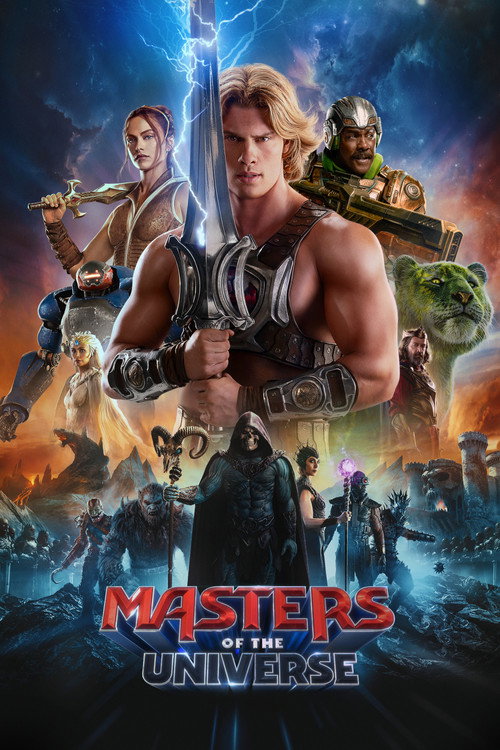
Masters of the Universe
2026 · Travis Knight
For a popcorn night when you want spectacle and Saturday-morning nostalgia played straight — comfort-food fantasy, not a challenge.
What it's about
Prince Adam, separated from his home for fifteen years, is drawn back to the planet Eternia by the Sword of Power — only to find his world crushed under Skeletor's rule. To save his family he joins forces with the warrior Teela and the veteran Man-At-Arms and must accept his destiny as He-Man. A big-canvas sword-and-planet adventure built from the beloved 1980s toy line, with Nicholas Galitzine as Adam and Jared Leto as Skeletor.
The experience
A broad, earnest blockbuster ride: swords, super-powered brawls, alien vistas, and a father-son struggle at its emotional center, pitched more at wonder and nostalgia than at irony.
The craft
Director Travis Knight comes from stop-motion animation, where he made his name on visually inventive, character-driven spectacle, and this is a full-scale effects picture in that tradition — a fantasy world of skeletal villains and glowing swords designed for a big screen and loud speakers.
Why it matters
It's the property's first live-action film in nearly four decades, arriving after some twenty years of abandoned attempts across multiple studios — a test of whether the He-Man mythos can carry a modern blockbuster franchise.
Snapshot
A live-action feature derived from Mattel's 1982 action-figure line, arriving thirty-nine years after the property's only previous live-action film and after roughly two decades of abandoned attempts at three separate studios. Travis Knight — chief executive of the stop-motion house LAIKA, director of Kubo and the Two Strings (2016) and Bumblebee (2018) — was engaged in 2024 to direct for Amazon MGM Studios and Mattel Films, with Nicholas Galitzine as Prince Adam/He-Man, Jared Leto as Skeletor, Camila Mendes as Teela, Idris Elba as Duncan/Man-At-Arms and Alison Brie as Evil-Lyn. The picture was dated for early June 2026.
One point of method must be stated plainly at the outset. The documentary record available to me closes shortly before the film's commercial release. I can speak with confidence about the property's history, the production's long gestation, its personnel and its declared intentions; I cannot speak about the finished film's shot construction, its cutting rhythms, its final credits, its reviews or its commercial performance, and I will not manufacture them. What follows is therefore a dossier of lineage and of the formal problems the material poses, written at the threshold of release rather than after it.
The premise as published departs meaningfully from canon: Adam has been separated from Eternia for fifteen years, and the Sword of Power draws him back to a home already broken under Skeletor. In the 1983 Filmation series and the toy line's own fiction, Adam grows up at the Eternian court, the secret of his transformation hidden in plain sight. Making him a returning exile converts a story about concealment into a story about restoration — and, not incidentally, aligns the property with the structure Knight has now used twice.
Industry & production
Masters of the Universe is a toy property, and its production history is legible only in those terms. Mattel introduced the figures in 1982 into a market reshaped by Star Wars's licensing; the durable trade legend that Mattel had passed on the Star Wars license and built He-Man as compensation is contested and should be treated as folklore rather than fact. The line's fiction was distributed in the packaging itself — mini-comics, several of the earliest written by Donald F. Glut with art by Alfredo Alcala — before Filmation's syndicated series (1983–85) supplied the version most viewers remember. Designer credit for He-Man's look is generally assigned to Mark Taylor, with a long-running counterclaim from Roger Sweet; the dispute is documented and unresolved.
The 1987 film was made by Cannon Films under Menahem Golan and Yoram Globus, directed by Gary Goddard, with Dolph Lundgren as He-Man and Frank Langella as Skeletor. Its production is the cautionary text every subsequent attempt has had to answer: budget pressure forced the story off Eternia and onto a suburban Earth street for most of its length, exchanging a designed alien world for a parking lot. William Stout's production design and Bill Conti's score preserved a Kirby-inflected grandeur the shooting circumstances could not sustain. The film's failure contributed to Cannon's collapse; the aborted sequel's sets and costumes were famously recycled into Albert Pyun's Cyborg (1989).
Between roughly 2007 and 2022 the rights moved through Warner Bros. and Columbia/Sony and finally Netflix, accumulating an unusually long list of attached writers and directors and never reaching a camera. Netflix's version, with the Nee brothers directing, collapsed over budget in 2022 with sets reportedly in preparation. Amazon MGM and Mattel Films revived it in 2023, and Knight came aboard the following year.
The Mattel Films dimension matters. Following Barbie (2023), Mattel under Robbie Brenner assembled a broad slate of toy-derived features; Masters of the Universe is that program's first large-scale genre swing, and the first test of whether the Mattel model extends past ironized self-commentary into sincere myth. Escape Artists — Todd Black, Jason Blumenthal and Steve Tisch — had been attached to the property across multiple studio incarnations. Production was based in the United Kingdom during 2025.
Technology
The film sits inside a specific technical moment. The LED-volume virtual production that dominated 2019–22 had by mid-decade been substantially reconsidered: volumes proved excellent for confined interiors and vehicle work and awkward for the wide, deep, sunlit vistas that a planetary-romance world demands, and a number of large productions in 2024–25 returned to location and built sets with volume work reserved for specific shots. Eternia — a landscape of castles, wastes and floating architecture — is precisely the kind of environment that resists the volume's depth limits.
Two technical questions define the picture. The first is Skeletor. A permanently exposed skull that must act is one of the genuinely hard problems in creature work: full prosthetics restrict the jaw and eyes, full CG severs the performance from the body, and the 1987 film solved it by keeping Langella's face largely intact under makeup and letting the voice do the work. The contemporary solution is hybrid — prosthetic and animatronic construction on set, digitally extended and re-articulated in post — and Amazon's promotional materials emphasized practical construction, though I cannot verify the specific division of labor or name the effects houses involved.
The second is the transformation. "By the power of Grayskull" is the property's single indispensable image, and it is a technological as much as a dramatic problem: a body-scale change that must read as awesome rather than absurd, in an era when audiences have seen a great many of them.
Technique
Cinematography
The material poses a clear photographic dilemma. Sword-and-planet imagery derives from painting — Frazetta above all — and painting's rhetoric is the low horizon, the single dominating figure, the sculpted rim light. Translated literally, that becomes the burnished, digitally graded murk that made much 2010s fantasy interchangeable. Knight's live-action reference point, Bumblebee, went the other way: warm, naturalistic Northern California light, human-scale coverage, comparatively long takes for the genre, and a deliberate refusal of the hyperkinetic style of the Transformers films it followed. Whether that restraint survives contact with an entirely invented world is the central question, and it is one I cannot answer from the available record; nor can I confirm the film's cinematographer.
Editing
Bumblebee is a legible film about legibility — its action was staged and cut so that spatial relations remained readable, an implicit critique of its franchise predecessors. Knight is an animator by training, and animators tend to cut on completed actions rather than through them. The 2026 film's demand is different in kind: an ensemble of costumed principals, a world to establish, and a transformation that must be given room to land. Whether the picture holds to sequence-length coherence or adopts the faster assembly typical of contemporary tentpoles is not something the pre-release record establishes.
Mise-en-scène / staging
Here the property's requirements are unusually explicit. Eternia is a design object before it is a place: Castle Grayskull, Snake Mountain, the Power Sword, and a bestiary of characters whose silhouettes were engineered for recognition at four inches tall. Any adaptation must decide how literally to render designs conceived as plastic. The 1987 film abstracted them toward a unified Kirby-Stout futurism and lost the toys' garish specificity; the Revelation and Revolution animated series (2021, 2024) went the other way and rendered the figures with near-literal fidelity. Knight's Bumblebee is instructive: it restored the boxy, readable Generation One robot designs against a decade of over-detailed alternatives, on the argument that iconography beats plausibility. That is a stated method, and the strongest available basis for predicting this film's approach.
Sound
The property's sonic signature is thin by design — Filmation's limited animation reused cues and effects heavily — which leaves the field open. The one fixed obligation is the transformation, which must be built as a sound event. Dario Marianelli scored both of Knight's previous features, an unusually consistent partnership for a director with two credits; I cannot confirm the composer of the 2026 film. Bill Conti's 1987 score, brass-forward and unembarrassed, remains the property's most substantial musical statement and the obvious point of reference.
Performance
The acting problem is sincerity. He-Man is a hero without irony, introduced by a catchphrase, in a decade whose blockbusters have largely trained performers to undercut. Langella's 1987 Skeletor is the canonical solution and the reason that film retains any critical standing: he played the part as full-blooded theatrical villainy, from inside the makeup, without apology. Leto's casting suggests a comparable bid for a stylized, non-naturalistic register. Elba as Man-At-Arms brings gravity to a role written as mentor-armourer; Mendes's Teela and Brie's Evil-Lyn inherit the two most developed women in the canon, Evil-Lyn in particular having been substantially rewritten as a tragic figure in the recent animated series. Galitzine's task is the hardest and least glamorous: to play earnestness at scale.
Narrative & dramatic mode
The published premise is a homecoming, not a coming-of-age in place. Fifteen years of separation gives the film an outsider protagonist rediscovering a world the audience must also learn — economical exposition, and a structure Knight has used before. Kubo concerns a child pursued by his own inheritance; Bumblebee concerns a grieving girl and a machine, both displaced. Adam returning to a shattered Eternia is the same shape: the orphaned child, the lost parent, the object (sword, memory, shamisen) that carries lineage forward.
The mode is mythic rather than psychological — the destiny plot, the found allies, the usurped throne. Its risk is familiarity; the same skeleton carries Thor, John Carter and a great many others. Its opportunity is that the property's own conceit — a prince who must transform to become himself — is genuinely resonant material about performed and withheld identity, and has rarely been taken seriously on screen.
Genre & cycle
Masters of the Universe belongs to sword-and-planet, or planetary romance: the Burroughs–Barsoom line by way of Flash Gordon, in which swords and sorcery coexist with technology on an alien world. The 1982 toys arrived at the exact intersection of the post-Star Wars licensing boom and the Conan the Barbarian (1982) sword-and-sorcery cycle, and their design vocabulary is a direct blend: Frazetta musculature, Jack Kirby machinery.
The film also belongs to two live cycles. The first is the toy-derived blockbuster, running from Transformers (2007) through G.I. Joe, the instructive failure of Battleship (2012), and Barbie. The second is the legacy-reboot, in which a property that failed on first adaptation is remade with the fidelity the original lacked. Sword-and-planet specifically has one enormous cautionary example — John Carter (2012), which failed commercially despite fidelity to its source — and one demonstration that the mode can still work at scale, in Denis Villeneuve's Dune films, which re-established audience appetite for solemn, designed, non-ironic imagined worlds.
Authorship & method
Knight is the rarest kind of blockbuster director: an animator who rose through a single studio's craft floor. He animated on Coraline, worked through ParaNorman and The Boxtrolls, and directed Kubo and the Two Strings while serving as LAIKA's chief executive. That formation produces identifiable habits — a belief in physical, built objects over simulated ones; patience with a single performance beat; and a conviction that clarity is the precondition of spectacle rather than its opposite. Bumblebee's reputation rests almost entirely on those qualities.
His two features share a thematic core as well: a child separated from a parent, an inherited object that is also a burden, and a monster who turns out to be family. The 2026 premise fits that pattern closely enough that Knight's selection for the job looks less like studio pragmatism than a genuine match of sensibility to material.
On collaborators I must be candid. The screenplay passed through many hands across two decades and three studios, and I cannot responsibly assign final writing credit; nor can I confirm the cinematographer, editor or composer of record. Marianelli's presence on both prior features and Knight's general preference for continuity of crew are the only reliable indicators, and indicators are not credits.
Movement / national cinema
Not a movement film in any useful sense. It is American studio production financed by a streaming-era conglomerate, executed largely in the United Kingdom under that country's production incentives — a now-standard arrangement in which "national cinema" describes a labor and tax geography rather than a cultural one. Its aesthetic ancestry is nonetheless specifically American: pulp magazine illustration, Kirby's cosmic comics, the syndicated afternoon cartoon, the mass-market plastic figure.
Era / period
The film arrives at a moment of exhaustion in franchise cinema and of unusual openness about it. The mid-2020s saw both a contraction in superhero output and a corresponding search for adjacent mythologies — fantasy, space opera, sword-and-planet — that could carry the same scale without the same fatigue. It also arrives inside a specific labor and technological anxiety: the 2023 strikes settled questions about generative tools in writing and performance only provisionally, and the visual effects sector spent 2025 arguing publicly about their use. A film whose entire appeal rests on hand-built creature work and physical world-making enters that argument by implication whether or not it intends to.
Reception, canon & influence
Backward, the influences are unusually well documented for a toy property. Frazetta's Conan paintings supply the body and the light; Jack Kirby's Fourth World supplies the technology, the cosmic scale and the villain's theatrical grandiosity; Burroughs and Flash Gordon supply the structure; Conan the Barbarian (1982) supplies the commercial permission. From within the property: the Filmation series established the characters and the moral register; the mini-comics established a darker, stranger Eternia that recent adaptations have preferred; the 1987 film established, negatively, that the world cannot be abandoned for a budget. Kevin Smith's Masters of the Universe: Revelation (2021) and Revolution (2024), produced with Powerhouse Animation, demonstrated that the material could sustain adult tragedy — particularly in its treatment of Teela and Evil-Lyn — and reframed what a faithful adaptation could mean. Externally, Bumblebee is the direct methodological precedent, and Dune the proof of market.
Forward, I have nothing to report and will not pretend otherwise. The film's release falls outside the record available to me: I cannot state its critical reception, its box-office performance, or its consequences for the Mattel Films slate. What can be said is what is at stake. If it succeeds, it likely does so on the Bumblebee argument — that reverence for an iconography others find embarrassing is a strategy rather than a limitation — and it would validate a sincere, non-ironic register for toy adaptation that Barbie did not test. If it fails, it joins John Carter and the 1987 film as evidence that sword-and-planet resists the modern blockbuster economy, and the property returns to animation, where it has always worked. Either outcome is instructive; neither has yet been recorded here.
Reception
Opened in June 2026 as a box-office casualty — roughly $114M worldwide against a reported $200M budget — but almost immediately picked up a vocal 'wait, this is actually fun?' contingent, the rare flop whose defenders showed up within weeks rather than decades.
How Masters of the Universe was received, from release to now →
Influences: the films it descends from and the films it influenced
- Flash Gordon (1980) — Danilo Donati built his sets and costumes directly from Alex Raymond's comic panels rather than from any plausible engineering logic, and Max von Sydow plays Ming declamatively straight — the exact contract of iconography-over-plausibility plus theatrical villainy that Knight's Eternia and Skeletor operate under.
- Excalibur (1981) — Alex Thomson's signature method — hard backlight through smoke and forest, armor lacquered green-gold so it reads as heraldic ornament under rim light rather than as functional plate — is the live-action template for the Frazetta rim-light treatment of Eternian armor, with dialogue delivered in the same unembarrassed high register.
- Conan the Barbarian (1982) — Duke Callaghan photographs bodies against low raking sun so musculature separates from the ground in a single edge of light — the direct photographic translation of Frazetta's Conan paintings — and Milius holds combat in wide two-shots long enough for a blow to complete before the cut, the same cut-on-completed-action discipline Knight uses to keep sword action legible.
- The Dark Crystal (1982) — Brian Froud's illustrations were used as literal construction drawings, establishing the illustration-to-set pipeline — a painted world built physically and photographed as a place with no Earth referent to cut back to — which is precisely how a Frazetta/Kirby-derived Eternia has to be realized to avoid the 1987 film's failure.
- Fire and Ice (1983) — Frazetta served as co-producer and designer and Bakshi rotoscoped live actors so figures carry Frazetta's specific distribution of weight — hip-cocked, torso-forward, lit by one source against black — making it the only prior film where the Frazetta anatomy-and-rim-light system is the production design rather than an influence on it.
- Krull (1983) — The closest prior sword-and-planet feature grammar: Peter Suschitzky lights forced-perspective interiors with shafted smoke, and the Glaive is introduced as insignia — held, framed, revered — long before it is used as a weapon, the same rhetoric by which the Power Sword must function as heraldry first and prop second.
- Superman (1978) — Donner's 'verisimilitude' doctrine — pulp material played with total sincerity and no protective irony — plus the structural engine of a lost father who survives as an inherited crystalline object that both instructs and burdens the son, is the template for the returning-exile/inherited-object spine and the unironic performance register.
- Masters of the Universe (1987) — A negative craft precedent that the 2026 film is built against — Eternia is abandoned within twenty minutes for a New Jersey backlot because the world could not be afforded — while Frank Langella's Skeletor demonstrates the one transferable technique: full-prosthetic villainy performed operatically straight, with the voice carrying what the frozen face cannot.
- Coraline (2009) — Knight's formation as an animator on this film instilled the LAIKA doctrine he brings to live action — that a physically built object photographs differently from a simulated one, and that a performance beat should be held rather than cut around — alongside its central staging of a monster who is revealed to be family.
- Thor (2011) — The first blockbuster to render Kirby's Fourth World machinery literally as production design — technology as engraved ornament and cosmic architecture rather than plated greebles — and to cast theater-trained actors who play grandiose villainy at full scale, the two things Skeletor and Eternia's Kirby-derived tech require.
- John Carter (2012) — The prior test of the same experiment: an animator-turned-live-action director bringing storyboard-first, previs-driven shot design to Burroughs sword-and-planet, with Daniel Mindel photographing the alien world in flat naturalistic desert light — the naturalistic-restraint strategy, and the cautionary economics attached to it.
- Mad Max: Fury Road (2015) — Margaret Sixel's center-frame axial cutting — the eye parked on one point so that fast cutting never costs the viewer orientation — codified spatial legibility as an achievable blockbuster standard, and is the editorial doctrine behind Knight's insistence that clarity precedes spectacle.
- Barbie (2023) — Sarah Greenwood renders toy artifacts literally — molded-plastic prop scale, painted cycloramas, non-functional handles — the same toy-derived design fidelity, but routed through irony and self-commentary, making it the controlled experiment against which an unironic toy adaptation defines itself.
- Dungeons & Dragons: Honor Among Thieves (2023) — Builds its creatures as animatronics and practical suits augmented in post rather than as full CG, and blocks set-pieces around a stated geography the audience is shown before it is used — the same hybrid-prosthetic pipeline and legibility-first action design, deployed on a comparably 'embarrassing' game property.
- How to Train Your Dragon (2025) — The other animator-turned-live-action director translating animation staging into photography — keyframe-derived silhouette design and held performance beats preserved through a photoreal creature pipeline — testing the same proposition that animation-floor craft habits survive the move to a live-action blockbuster.
Similar films
- How to Train Your Dragon (2025) — influence & lineage
- Superman (1978) — influence & lineage · same viewing thread
- Superman (2025) — same viewing thread
- Transformers One (2024) — same viewing thread
- Man of Steel (2013) — shared sensibility
- The Odyssey (2026) — shared sensibility
- The Lego Movie (2014) — shared sensibility
- Spider-Man: No Way Home (2021) — shared sensibility
All the films related to Masters of the Universe →
Watch it with: curated runs of related films
- You Are Who You Choose to Be — A run of origin stories where the real transformation isn't the powers but the choice to use them well — watch them together and the same good soul keeps getting reborn in steel and cape.