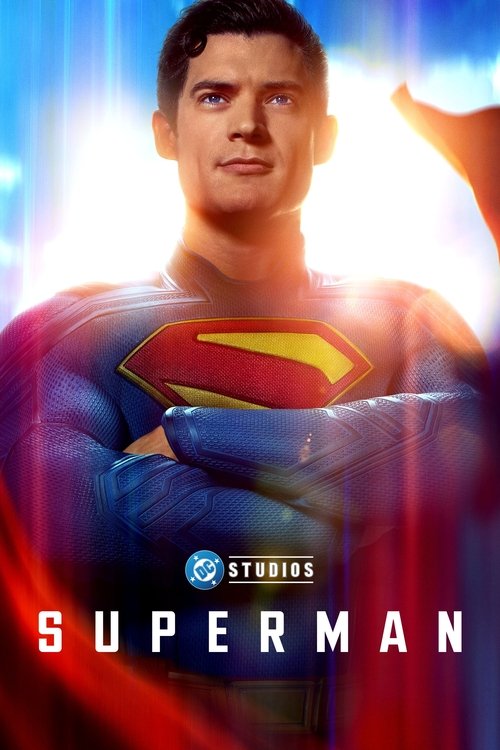
Superman
2025 · James Gunn
For when you want a big, colorful crowd-pleaser that actually leaves you feeling better about people — comfort viewing with real spectacle, great for a group or a family night.
What it's about
Superman has already been on the job for three years when the film opens — no origin story, no crash-landing, just a hero picking himself up after his first real defeat. He's Clark Kent, a Metropolis journalist trying to square his Kryptonian heritage with the Kansas decency he was raised on, while a scheming supervillain works to turn public opinion against him. Around him swirls a city full of gleefully strange comic-book furniture: a superdog with obedience issues, robot valets, pocket universes, a kaiju loose downtown.
The experience
Bright, fast, and openly warm-hearted — a superhero movie that would rather make you grin than brood. It's busy in the best way, tossing off weird ideas at a clip, but its center of gravity is surprisingly gentle: the thrill here is watching someone be kind under pressure.
Performances
David Corenswet plays the earnestness completely straight and makes it magnetic rather than square, and Rachel Brosnahan's Lois Lane is sharp and combative — their apartment interview scene, a rapid-fire argument about journalism and honesty, is the film's best few minutes.
The craft
James Gunn directs with a maximalist's confidence, playing Silver Age comic-book strangeness completely straight instead of apologizing for it, and structuring the whole thing to skip the origin story audiences have seen too many times. The action is huge and legible, the palette saturated, the tone tuned to sincerity over irony — it's built for a big screen and a loud room.
Why it matters
The film that relaunched DC's entire cinematic universe under Gunn's creative control, and a deliberate break from a decade of dark, burdened superhero filmmaking — its bet on optimism reset the conversation about what the genre's biggest icon is for.
The film that rebooted an entire cinematic universe, and did it by refusing the expected move: no origin story, no brooding. James Gunn — poached from Marvel to run DC's film slate outright — opens in medias res, with David Corenswet's Superman already three years into the cape and freshly knocked down, and builds outward into a Metropolis teeming with Silver Age furniture played straight: a superdog of dubious training, robot valets, pocket universes, a kaiju downtown. Where the Snyder era treated Superman as a burdened god, Gunn's thesis is almost defiantly modest — kindness as a radical position, decency as 'punk rock' — argued through a hero who stops mid-battle to shepherd a squirrel out of harm's way. Rachel Brosnahan's Lois Lane gets the film's best scene, a combative apartment interview that plays like screwball journalism ethics. Gunn's crowded-frame maximalism divides audiences as his films always have, but the gamble paid: the summer of 2025 made it the launchpad of the new DCU. John Murphy and David Fleming's score keeps circling John Williams's 1978 theme — inheritance acknowledged, then bent into a new key.
Reception
Arrived in July 2025 carrying the weight of relaunching the entire DC universe after the Snyderverse collapse, and landed as a warm, crowd-pleasing hit — the rare franchise reboot that mostly won over both critics and audiences on contact.
How Superman was received, from release to now →
Influences: the films it descends from and the films it influenced
- Superman: The Movie (1978) — Establishes the non-ironic, sincere Superman and the John Williams fanfare that this film literally reworks, plus Donner's 'verisimilitude' mandate of grounding the fantastic in a straight-faced world.
- Superman II (1980) — Sets the screwball Clark/Lois romantic-comedy rhythm and apartment/rooftop interview banter that Corenswet and Brosnahan revive as fast-traded overlapping dialogue.
- His Girl Friday (1940) — The rapid-fire, overlapping newsroom screwball cadence that models Lois Lane's fast-talking, interruption-driven reporter dialogue.
- Guardians of the Galaxy (2014) — Gunn's own house method: found-family ensemble blocking, needle-drop scoring, and abrupt pivots from comic bit to earnest sincerity within a single scene.
- The Suicide Squad (2021) — Supplies the crowded-frame maximalism and the city-scale kaiju (Starro) third-act climax that Gunn re-stages here with saturated comic-book color.
- Gojira (1954) — Provides the kaiju grammar—monster mass scaled against fleeing human figures and toppling architecture—that the film's giant-creature set pieces quote.
- The Iron Giant (1999) — The 'you are who you choose to be' thesis of an overpowered being electing gentleness, the direct craft template for decency-and-kindness-as-heroism.
- Superman: The Animated Series (1996) — The Silver Age revival design language—robot servants, crystalline/retro Fortress, primary-color optimism—that Gunn restores after the grimdark era.
- Man of Steel (2013) — The desaturated, collateral-heavy, brooding Superman that Gunn's bright, tactile, low-body-count 'anti-Snyder' staging is explicitly built in negative against.
- Superman Returns (2006) — The prior reverent attempt to revive Donner's tone by re-scoring with the Williams theme, an approach Gunn corrects by reworking rather than sampling the fanfare.
- Peacemaker (2022) — Gunn's adjacent DC work sharing the same needle-drop-and-sincerity tonal formula and rehabilitation of a mocked character through earnest interiority.
- Shazam! (2019) — Extends the same sincere, joyful, family-warmth counter-programming to grimdark DC, foregrounding wonder over dread.
- Spider-Man: Into the Spider-Verse (2018) — Shares crowded comic-panel maximalism—dense multi-figure frames and graphic pop lettering/color energy—as a way to make the page's density cinematic.
- Thor: Ragnarok (2017) — The auteur-comedy tonal reinvention of a self-serious hero via improv-flavored banter and bright synth/color palette.
- The Incredibles (2004) — Parallel Silver Age superhero-family sincerity and mid-century optimism, treating heroism as a domestic-moral vocation rather than trauma.
- Pacific Rim (2013) — Extends the earnest kaiju-versus-hero blockbuster spectacle, staging monster scale with sincere awe rather than ironic detachment.
Similar films
- Man of Steel (2013) — influence & lineage · same viewing thread
- Spider-Man: Into the Spider-Verse (2018) — influence & lineage
- Guardians of the Galaxy (2014) — influence & lineage
- Superman (1978) — same viewing thread
- The Batman (2022) — same viewing thread
- Batman Begins (2005) — same viewing thread
- The Dark Knight (2008) — same viewing thread
- Birdman or (The Unexpected Virtue of Ignorance) (2014) — same viewing thread
All the films related to Superman →
Watch it with: curated runs of related films
- The Superhero Movie Grows Up — Watch these as one arc — Raimi's warmth into Nolan's gravity into Logan's elegy and The Batman's rain-soaked noir — the two decades the comic-book film reached for real weight.
- You Are Who You Choose to Be — A run of origin stories where the real transformation isn't the powers but the choice to use them well — watch them together and the same good soul keeps getting reborn in steel and cape.