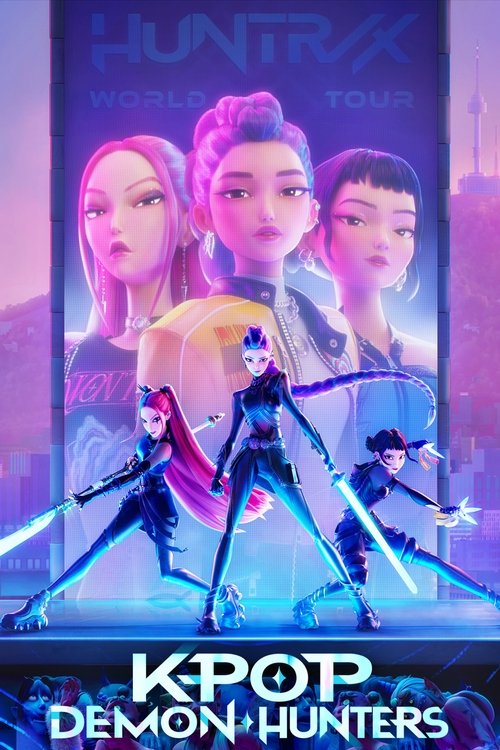
KPop Demon Hunters
2025 · Chris Appelhans
Netflix's most-watched film ever and 2025's genuine monoculture moment: "Golden" topping Billboard, sing-along theatrical releases hitting #1 while Netflix still refused wide theatrical — the film that made the streamer argue against its own evidence.
For a sing-along night, a pick-me-up, or watching with kids or friends who'll scream at the screen — pure comfort with a beating heart. If you've ever loved a band a little too much, this one gets you.
What it's about
Rumi, Mira, and Zoey are HUNTR/X, a stadium-filling K-pop girl group whose real job is secret: their songs sustain a mystical barrier that keeps demons out of the human world. When a suspiciously perfect demon boy band arrives to seduce their fandom and drain its devotion, the trio has to defend the barrier while one of them wrestles with a secret and a serious case of self-doubt.
The experience
A sugar-rush musical that's genuinely funny, visually explosive, and sneakily emotional — the songs are staged as full production numbers and they're actual earworms, not filler. It moves fast and lands its feelings harder than you expect from the premise.
The craft
Sony Pictures Animation's stylized, expressive character animation swings between idol-video gloss and rubbery cartoon comedy, and the original K-pop soundtrack is built like a real album — polished, hooky, and central to the plot rather than decoration. Good speakers are non-negotiable.
Why it matters
One of the defining pop-culture events of 2025, its soundtrack charted like a real group's and it became Netflix's proof that an original animated musical could dominate the conversation without a theatrical run.
Snapshot
KPop Demon Hunters is a computer-animated musical fantasy released on Netflix in June 2025, produced by Sony Pictures Animation. It follows HUNTR/X — Rumi, Mira, and Zoey — a chart-topping K-pop girl group who moonlight as demon hunters, sustaining a mystical barrier called the Honmoon that shields the human world from the demon realm. Their equilibrium fractures when a rival demon boy band, the Saja Boys, is dispatched to seduce the fandom and drain its devotional energy. The film pairs a conventional coming-into-power arc with a secret-identity melodrama and a full slate of original K-pop songs, staged as production numbers. Though the theatrical-scale ambition is unmistakable, its primary release was streaming. It became one of the defining pop-cultural events of 2025, driven as much by its soundtrack — the single "Golden" reached the top of the U.S. singles chart — as by the film itself, a rare instance of an animated feature functioning simultaneously as a movie and as a genuine music-industry release. Note that the film is credited to two directors, Maggie Kang and Chris Appelhans; the brief here names only Appelhans, but the historical record makes clear this was a co-directed project originated by Kang.
Industry & production
The film sits at the intersection of two industrial logics: the American theatrical-animation studio system and the streaming platform's global-content strategy. Sony Pictures Animation supplied the production apparatus and craft lineage — the same studio behind the Hotel Transylvania films and, more consequentially for this project, the Spider-Man: Into the Spider-Verse pictures, which had by the mid-2020s reset industry expectations for what mainstream CG animation could look like. Netflix supplied distribution, financing logic, and global reach, positioning the film as a platform tentpole rather than a theatrical wager.
The project's origin is well documented as a personal one for Maggie Kang, a Korean-Canadian filmmaker who developed the premise as a way to build a mainstream animated feature around Korean culture, mythology, and the aesthetics of K-pop rather than treating them as garnish. That authorial provenance matters industrially: the film arrived at a moment when K-pop and Korean screen content had already achieved sustained global penetration, and the production was able to draw on real songwriting and production talent from the K-pop ecosystem rather than approximating the genre from outside. The soundtrack was assembled with contributions from working K-pop and pop songwriters and producers, and the songs were engineered to compete as actual releases, not merely as diegetic set pieces — an unusual degree of integration between a film's music department and the commercial pop apparatus. The exact deal structure, budget, and internal financing splits are not matters of reliable public record, and I won't invent figures; what is clear is that the film functioned as a cross-media property from conception, with the music built to have a life independent of the picture.
Technology
Technically, KPop Demon Hunters belongs to the post–Spider-Verse generation of American CG animation, in which the underlying three-dimensional pipeline is deliberately pushed toward a flatter, more graphic, more overtly "drawn" surface. Rather than pursuing photorealism or the rounded plasticity of the classic Pixar-DreamWorks house style, the production uses its 3D toolset to emulate the line, color-blocking, and expressive shorthand of 2D illustration and, pointedly, of anime and Korean webtoon/manhwa visual language. This is a technological choice as much as an aesthetic one: it involves customizing shading, line-rendering, and frame-rate handling so that characters can shift into stylized modes — exaggerated "chibi" deformations, comic-book impact framing, motion smears — without breaking the world. The film also leans on the by-then-mature capacity of CG pipelines to choreograph large, camera-mobile crowd and stage sequences, which the concert numbers require. The specific proprietary tools are not something I can attribute with confidence, and I won't fabricate a toolchain; the salient point is that the technology is bent toward graphic expressivity and genre citation rather than toward realism.
Technique
Cinematography
The "camera" here is virtual, but the film thinks cinematographically. The concert and performance sequences adopt the visual grammar of the K-pop music video and the live stadium broadcast: sweeping crane-like moves, whip pans, rhythmic cutting synchronized to choreography, saturated stage lighting, and lens-flare and bloom effects that quote the look of televised performance. Away from the stage, the framing shifts register — flatter compositions, bold negative space, and graphic silhouettes that recall illustration and comics. The film is comfortable changing its own visual rules by scene: intimacy is staged with relatively still, character-centered framing, while the demon-world and action material becomes kinetic and maximalist. This modal switching — realism-adjacent for drama, hyper-stylized for spectacle and comedy — is the film's central cinematographic strategy.
Editing
Editing is organized around music. The set-piece songs are cut as performance numbers, with the rhythm of the images subordinated to the beat and structure of the track, so that the film periodically becomes a musical-video object embedded in a narrative. Elsewhere the picture uses brisk comic timing, with abrupt tonal cuts between sincerity and gag that are characteristic of contemporary animated comedy influenced by internet and meme culture. I don't have a reliable credit for the film's editor and will not invent one; what can be said from the finished work is that the cutting is confident about tempo and about moving between its dramatic and its music-video modes without friction.
Mise-en-scène / staging
The staging is dense with Korean cultural texture: contemporary Seoul, food, signage, fashion, and idol-industry iconography sit alongside mythological design drawn from Korean folklore. The demons and the reaper-styled antagonists derive from Korean supernatural tradition — the film's demon-boy-band conceit puns on the Korean word for the traditional grim-reaper figure — and the production design treats these sources with specificity rather than generic "Asian fantasy" pastiche. The idol world is rendered with equal attention: stage costuming, choreography formations, and fandom paraphernalia are staged as a coherent, recognizable culture. Costuming does narrative work, marking the heroines' double life and the antagonists' seductive artifice.
Sound
Sound is the film's motor. Music is not accompaniment but the primary dramatic and emotional vehicle: the songs carry exposition, characterization, and conflict, in the manner of an integrated musical, while also being built to succeed as standalone pop records. The two headline modes — the girl group's anthems and the rival boy band's seductive numbers — are opposed sonically as well as narratively. A separate orchestral/underscore layer supports the fantasy-action material. The vocal production is notable in that the singing voices are, in several cases, performed by artists distinct from the speaking-voice actors, a common and openly acknowledged practice for musicals of this kind; the singing performances were treated as genuine recording-artist work.
Performance
The voice performances balance comic timing, pop-star charisma, and the sincerity the drama needs. The three leads must register as both plausible superstars and as young women managing shame, secrecy, and friendship, and the film's tonal control depends on their ability to pivot from joke to vulnerability. The antagonists' appeal is deliberately double-edged — charming on the surface, hollow underneath — which the vocal performances have to sell for the story's central seduction to work.
Narrative & dramatic mode
The film runs several familiar structures in parallel. At its base is a heroine's coming-into-power arc built on a secret — a protagonist who must conceal part of herself, whose concealment becomes the story's central wound and whose eventual self-acceptance resolves it. Layered over this is a secret-identity double-life comedy (superstar by day, monster hunter by night) and a temptation/seduction plot in which the antagonist is also an object of sympathy. The dramatic mode is the integrated musical: songs advance the plot and externalize interior states rather than pausing it. Tonally the film moves fluidly between broad comedy, sincere melodrama, and fantasy action — a register-shifting mode characteristic of much 2020s animation, which trusts audiences to accept a gag and a genuine emotional beat in close succession.
Genre & cycle
KPop Demon Hunters is a hybrid: musical, fantasy-action, and comedy, wrapped around a pop-idol premise. It belongs to a contemporary cycle of American animated features that mine specific youth and internet subcultures — here, global K-pop fandom — and treat them as worlds worth building rather than as backdrops for a joke. It also participates in the broader "monster-hunting pop stars" and magical-girl lineage, in which performers are secretly warriors; that conceit has deep roots in Japanese magical-girl anime and idol narratives, which the film knowingly draws upon. Within American studio animation, it extends the post-Spider-Verse cycle of visually maximalist, culturally specific, music-forward features aimed at teen and young-adult as much as child audiences.
Authorship & method
The controlling authorial vision belongs to Maggie Kang, who originated the concept and co-directed; the film is legible as her attempt to place Korean culture and K-pop at the center of a mainstream animated feature rather than at its margins. Her co-director, Chris Appelhans, brought prior animated-feature directing experience (his Wish Dragon had already shown an interest in contemporary Asian settings and character-driven fantasy) and complementary craft in story and design. The pairing reads as a genuine collaboration between a culturally originating vision and an established animation-directing sensibility. The film's other decisive "authorship" is musical: its identity is inseparable from its songs, which were developed with songwriters and producers drawn from the pop and K-pop worlds and treated as a real recording project. I don't have reliable, verifiable individual credits for the film's cinematographer/head of layout, editor, and score composer to attribute here, and I won't manufacture names; the honest statement is that the film's authorship is best understood as a director-plus-music-team enterprise, with the songwriting and production talent functioning as co-authors of the film's cultural effect.
Movement / national cinema
The film occupies an unusual transnational position. It is an American studio production — Sony Pictures Animation, English-language, made for a U.S.-based global platform — but its content, sensibility, and much of its creative DNA are Korean. It is therefore not Korean national cinema in any strict sense, yet it is a direct product of the global ascendancy of Korean popular culture (the "Korean Wave") and of K-pop's worldwide industrial reach. It is most accurately placed as diasporic and transnational filmmaking: a Korean-Canadian director using the American animation system to render Korean culture for a global streaming audience, at a moment when that culture had already achieved mainstream global fluency.
Era / period
The film is emphatically of the mid-2020s. Aesthetically it belongs to the post–Spider-Verse moment in which graphic, illustration-forward CG had become the ambitious house style of American animation. Industrially it belongs to the streaming era, in which a platform can launch a "movie" as a global content event and in which the boundary between a film and a music release has grown porous. Culturally it belongs to the peak-globalization phase of K-pop and Korean screen content. And in sensibility — its meme-literate humor, its fandom self-awareness, its fluent register-shifting — it is thoroughly a product of internet-native 2020s youth culture.
Themes
The film's most insistent theme is the reconciliation of a divided self: a protagonist whose secret shame must be integrated rather than hidden for her to become whole, with the mystical barrier she guards standing as a literalized metaphor for the psychic and communal walls that concealment builds. Around this cluster the themes of authenticity versus performance (an idol industry premised on manufactured personas becomes the arena for a story about being truly seen), and the double edge of fandom — devotion as both a genuine, protective communal force and an energy that can be exploited and drained. Friendship and chosen sisterhood among the three leads function as the counterweight to shame and isolation. And underneath, running through the mythological apparatus, is a theme of cultural inheritance: tradition, folklore, and lineage reframed as living sources of power rather than museum pieces.
Reception, canon & influence
Critically and popularly, KPop Demon Hunters was received as a standout of 2025 — praised for the ambition and specificity of its visual style, the strength of its songs, and its confident fusion of Korean cultural material with mainstream animation. Its most striking legacy was musical: the film's songs crossed over into the real pop marketplace to a degree almost unprecedented for an animated feature, with the single "Golden" reaching number one on the U.S. Hot 100 and the soundtrack performing as a major commercial release in its own right. (Precise chart-week and viewership figures should be checked against the record; I'm describing the well-established fact of the film's outsized musical success without asserting exact numbers.) On the platform, it became one of Netflix's signature hits of the year and a bona fide cultural phenomenon.
Looking backward, the film's influences are legible: the graphic, stylized CG lineage of Sony's own Spider-Verse pictures; the magical-girl and idol-warrior traditions of Japanese and Korean animation and pop; the aesthetics and industrial forms of contemporary K-pop; and Korean folklore and its supernatural figures. Looking forward, its impact is twofold. Aesthetically and industrially it strengthened the case for culturally specific, music-forward animation aimed at teen-and-up audiences, and for treating a film's soundtrack as a genuine cross-media commercial asset. And as a proof of concept it demonstrated that a Korean-centered story, made within the American animation system for a global platform, could become a worldwide mainstream hit — a precedent likely to shape both animation greenlighting and the film-music relationship for some years. Because the film is recent, its fuller canonical standing and its concrete influence on subsequent productions remain to be written; what can be stated with confidence is that it registered immediately as a landmark of the streaming-era, post-Spider-Verse, Korean-Wave moment.
A Deleuzian reading
A stadium floor.
The full Deleuzian reading of KPop Demon Hunters →
Reception
Dropped quietly on Netflix in June 2025, then snowballed all summer on pure word of mouth into Netflix's most-watched film ever — less a reappraisal arc than a slow-motion coronation nobody at Netflix saw coming.
How KPop Demon Hunters was received, from release to now →
How to watch KPop Demon Hunters: what to notice on a first viewing
- Notice how still framing marks private scenes, wild motion marks songs. Appelhans and Kang switch cinematographic register scene to scene: realism-adjacent stillness for drama, hyper-stylized kinetic maximalism for spectacle and comedy. The shift signals the emotional register of a scene before any dialogue does.
- Listen for songs that explain plot, not just feeling. The film treats songs as an integrated musical device: they carry exposition and character conflict, and singing voices are often different from speaking voices. Music here does the work of dialogue, so missing a lyric means missing a plot beat.
- Watch crowds move as one shape during stadium scenes. Appelhans and Kang stage fans as synchronized formations, phone-lights and voices rising together, not as separate individuals. Deleuze calls this a dividual, a crowd rendered as one feeling-body whose energy can be raised or drained.
- Notice how costume changes mark stage self from private self. Stage costuming, choreography formations, and civilian dress mark the line between the heroines' idol persona and their hidden lives. The clothes carry the secret the story is built on, visible before it's spoken.
- Notice the palette shift between demon realm, stage, and comedy scenes. Color and shading register change by mode, so the rendering signals mood shift before any line is spoken. The image tells you the emotional weather of a scene before the story does.
The whole guide to watching KPop Demon Hunters, with the keys for a rewatch →
Influences: the films it descends from and the films it influenced
- Spider-Man: Into the Spider-Verse (2018) — Established the Sony non-photoreal CG grammar KDH runs on — halftone Ben-Day dots, chromatic-aberration offsets, hand-inked line work over 3D geometry, and characters animated on 2s to mimic drawn frames rather than smooth CG interpolation.
- Spider-Man: Across the Spider-Verse (2023) — Pushed the modal-stylization technique of assigning each world/character its own rendering style, which KDH echoes by shifting palette and shading register between its demon-realm, idol-stage, and comic-gag modes within one film.
- The Mitchells vs. the Machines (2021) — Sony's proof that 2D hand-drawn doodles, emoji, and graphic-text overlays can be composited directly onto CG for comic tonal cuts — the same emoji/sticker punctuation and chibi-mode gag inserts KDH deploys.
- Wish Dragon (2021) — Appelhans's own prior feature working out contemporary-Asian-set character fantasy — the appealing rounded character design, wish-fulfillment stakes, and comedic-sidekick staging he carries directly into KDH's design language.
- Perfect Blue (1997) — Originated the animated idol-industry iconography KDH borrows — the manufactured pop-idol persona, stage-vs-backstage duality, and Kon's abrupt tonal match-cuts between glamorous performance and private reality.
- Macross: Do You Remember Love? (1984) — Founded the idol-as-weapon premise KDH literalizes — a pop singer whose performance is diegetically a combat force against a supernatural enemy, fusing concert spectacle with battle staging.
- Interstella 5555: The 5tory of the 5ecret 5tar 5ystem (2003) — The purest model of music-driven cutting: a dialogue-free feature whose entire edit is timed to a pop album (Daft Punk's Discovery), treating songs as the narrative spine exactly as KDH structures scenes around its tracks.
- Yellow Submarine (1968) — The template for commercial-pop integration in animation — building an animated fantasy around a real chart act's songs while swapping modal art styles sequence-by-sequence to match each track's mood.
- Frozen (2013) — Set the modern precedent for the animated-musical soundtrack as a commercial engine, with 'Let It Go' crossing into the real pop marketplace and defining the chart-single-as-set-piece playbook KDH inherits.
- Puella Magi Madoka Magica the Movie: Rebellion (2013) — Carries the magical-girl-warrior lineage KDH descends from — a transforming female team fighting supernatural entities, with collage/mixed-media stylized combat spaces breaking from the show's baseline render.
- Belle (2021) — Shares the virtual-idol concert set piece rendered in CG with a sweeping, physically-impossible virtual camera, plus the split-voice convention of casting a distinct professional singer (Kaho Nakamura) apart from the speaking actor.
- Turning Red (2022) — The closest sibling in subject-craft: boy-band idol worship rendered with original commissioned pop (Finneas/Billie Eilish's 4*Town songs) engineered as real chart-style singles, tied to Asian-diaspora teen-girl specificity.
- Encanto (2021) — Extends the same craft of treating integrated musical numbers as cross-media commercial assets — Lin-Manuel Miranda's songs built as standalone chart singles, with 'We Don't Talk About Bruno' topping the Hot 100 the way KDH's 'Golden' did.
- Trolls World Tour (2020) — Sibling in commercial-pop integration — a feature engineered around a licensed/original pop catalog where genre and music production are the narrative content itself, and the soundtrack is a co-equal commercial release.
- Arcane (2021) — Streaming-era sibling from Fortiche: painterly 2D-texture emulation hand-painted over 3D geometry, and music-driven montage sequences scored to commissioned pop tracks (Imagine Dragons' 'Enemy') cut as embedded music videos.
- The Bad Guys (2022) — Parallel post-Spider-Verse experiment outside Sony: DreamWorks graphic-CG that flattens 3D characters with 2D ink lines and comic-book smear frames, sharing KDH's illustration-emulation and stylized action staging.
Similar films
- Interstella 5555: The 5tory of the 5ecret 5tar 5ystem (2003) — influence & lineage
- Spider-Man: Across the Spider-Verse (2023) — influence & lineage
- The Mitchells vs. the Machines (2021) — influence & lineage
- Nimona (2023) — same viewing thread
- Demon Slayer: Kimetsu no Yaiba Infinity Castle (2025) — same viewing thread
- Ne Zha 2 (2025) — same viewing thread
- The Legend of Hei 2 (2025) — same viewing thread
- Chainsaw Man - The Movie: Reze Arc (2025) — same viewing thread
All the films related to KPop Demon Hunters →
Watch it with: curated runs of related films
- Sympathy for the Demon — A run of the 2025 animation wave where the line between demon-hunter and demon keeps blurring — outcast heroes carrying monstrous power, and monsters worth rooting for.