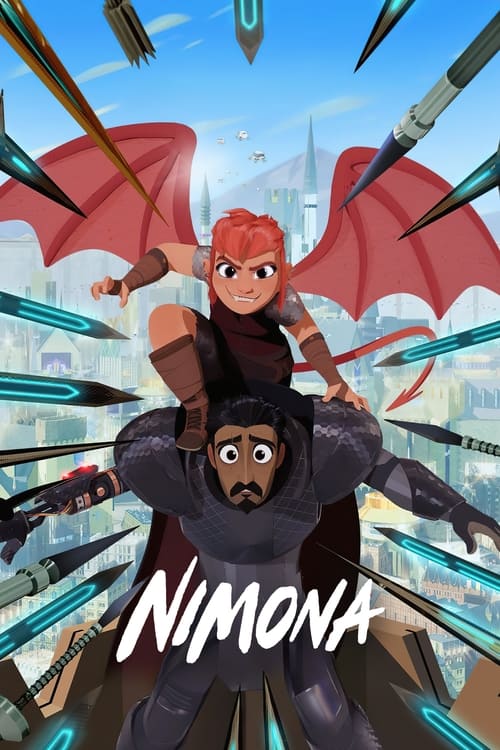
Nimona
2023 · Troy Quane
For a family movie night that doesn't talk down to anyone, or when you want animation with attitude and a message about being yourself that actually earns the tears. Comfort viewing with a rebel streak.
What it's about
In a techno-medieval kingdom of holograms and heraldry, a knight is framed for a shocking crime and goes on the run — only to pick up an unwanted sidekick: Nimona, a shapeshifting teenager who'd much rather be the villain, thank you. As the two chase the truth, the film asks what happens to people an institution can't categorize. Adapted from ND Stevenson's beloved graphic novel.
The experience
Fast, funny, and punk-hearted, with bursts of real ache under the jokes — Nimona's chaos is a delight, and the film sneaks up on you emotionally. It plays breezy but lands with surprising weight.
The craft
Directors Troy Quane and Nick Bruno keep the surfaces kinetic — pink smears of transformation against a kingdom rendered like a screen-saturated police state — and the shapeshifting animation is a constant visual joke and thesis at once. Bright, punchy, and great on a big TV.
Why it matters
Nearly finished when Disney shuttered Blue Sky Studios, it was rescued by Netflix and completed in exile — a survival story that rhymes with the film's own fable about institutions destroying what they can't categorize — and it's become a touchstone of queer allegory in mainstream animation.
A disgraced knight in a techno-medieval kingdom — all holograms and heraldry — gets an unwanted sidekick: a shapeshifting teenager who'd rather be the villain, thank you, and whose refusal to hold one form is the film's whole beating heart. Adapted from ND Stevenson's beloved webcomic-turned-graphic-novel, it carries one of modern animation's great survival stories: nearly finished at Blue Sky Studios when Disney shuttered the place in 2021, the film was rescued by Annapurna and Netflix and completed in exile. That backstory rhymes uncannily with the movie itself, a fable about institutions that destroy what they can't categorize. Directors Troy Quane and Nick Bruno keep the surfaces punk and kinetic — pink smears of transformation, a kingdom rendered like a screen-saturated police state — while letting the queer allegory stay legible to any kid who's been called a monster. It earned an Oscar nomination for Best Animated Feature, vindication for a film a studio system had left for dead.
A Deleuzian reading
The pink comes first.
The full Deleuzian reading of Nimona →
Reception
Famously left for dead when Disney shuttered Blue Sky Studios in 2021 with the film mostly finished, it was rescued by Annapurna and Netflix — and rode that survival story all the way to a Best Animated Feature Oscar nomination in 2024.
How Nimona was received, from release to now →
Influences: the films it descends from and the films it influenced
- Spies in Disguise (2019) — The same directing duo's prior Blue Sky feature built its comedy on involuntary body-transformation (a spy turned into a pigeon) and a mismatched reluctant duo — the exact shapeshifting-gag and buddy grammar Nimona reworks.
- Spider-Man: Into the Spider-Verse (2018) — Broke CG from photorealism with comic-book linework, halftone dithering and mixed on-ones/on-twos frame rates, licensing the illustrative, graphic-novel-faithful rendering that Nimona uses to honor Stevenson's flat-color panel art.
- Puss in Boots: The Last Wish (2022) — Pushes CG toward painterly illustration with stepped on-twos animation and visible brush-texture backgrounds — a parallel post-Spider-Verse stylized-rendering pipeline released the same window.
- ParaNorman (2012) — Templated the monster-as-misunderstood-outsider plot driven by mob/institutional persecution, and slipped in mainstream animation's first openly gay character — the queer-coded othering Nimona makes central.
- The Iron Giant (1999) — Character animation that makes a feared non-human 'weapon' read as gentle and sympathetic while a paranoid state institution mobilizes to exterminate it — the sympathy-for-the-monster staging Nimona inherits.
- Scott Pilgrim vs. the World (2010) — Translated comic panels to live action with on-screen onomatopoeia titles, video-game HUD graphics and percussive match-cut editing — the kinetic comic-to-screen punctuation Nimona's punk editing descends from.
- How to Train Your Dragon (2010) — Built a reluctant-duo bond between a misfit and a feared creature almost wordlessly, through incremental trust-building body-language animation — the emotional-choreography model for Nimona and Ballister.
- The Sword in the Stone (1963) — The Wizards' Duel codified the metamorphosis gag — rapid comic shapeshifting as escalating combat and one-upmanship — the classic-Disney transformation craft Nimona's morph-comedy riffs on.
- Lilo & Stitch (2002) — A destructive 'monster' adopted by a lonely outsider, animated with elastic squash-and-stretch chaos and softened by watercolor warmth — the disruptive-creature-as-found-family animation Nimona echoes.
- TRON (1982) — Established the neon-grid, screen-saturated luminous-future palette that Nimona's glowing techno-medieval cityscape and dystopian production design descend from.
- Batman: Mask of the Phantasm (1993) — Its 'Dark Deco' city design fused gothic-medieval architecture with sleek retro-futurist technology on painted black backgrounds — the anachronistic techno-medieval staging vocabulary Nimona builds its world from.
- Entergalactic (2022) — Graphic-novel-styled CG with bold flat color fields and comic-panel compositing in adult-leaning animation, continuing the streetwear/comic surface culture Entergalactic drew from.
- The Mitchells vs. the Machines (2021) — Lord/Miller-produced collage editing layers hand-drawn doodles, meme text and emoji over CG at meme-speed cutting rhythm — the same 'kinetic punk' overlay-and-jump-cut editing grammar.
- Steven Universe: The Movie (2019) — Uses fluid shapeshifting and fusion as an explicit metaphor for queer identity, animating morphs as identity-affirmation rather than horror — the closest thematic-craft cousin to Nimona's 'this is just what I am' transformations.
- The Bad Guys (2022) — Overlays 2D graphic-illustration linework onto 3D characters for a 'moving comic' look and stages heist action with kinetic speed-line flourishes — a parallel DreamWorks strand of stylized-CG craft.
- Klaus (2019) — Netflix's flagship feature-animation gamble, engineering volumetric hand-drawn-look lighting to prove streaming-era 2D viability — part of the same platform-rescue animation economy that saved Nimona.
- Wendell & Wild (2022) — Contemporaneous Netflix animation foregrounding an openly trans supporting character and an outsiders-vs-carceral-institution plot — the same queer-coded, anti-conformity animation wave.
- Teenage Mutant Ninja Turtles: Mutant Mayhem (2023) — Another 2023 stylized-CG feature built on graphic-shape design and outsider-teen energy, sharing the strategy of bending the pipeline toward an illustrated, comic-panel look.
Similar films
- Spider-Man: Into the Spider-Verse (2018) — influence & lineage
- Puss in Boots: The Last Wish (2022) — influence & lineage
- KPop Demon Hunters (2025) — same viewing thread
- Ne Zha 2 (2025) — same viewing thread
- Marona's Fantastic Tale (2020) — shared sensibility
- Arco (2025) — shared sensibility
- Jim Queen and the Quest for Chloroqueer (2026) — shared sensibility
- Teenage Mutant Ninja Turtles: Mutant Mayhem (2023) — shared sensibility
All the films related to Nimona →
Watch it with: curated runs of related films
- Sympathy for the Demon — A run of the 2025 animation wave where the line between demon-hunter and demon keeps blurring — outcast heroes carrying monstrous power, and monsters worth rooting for.