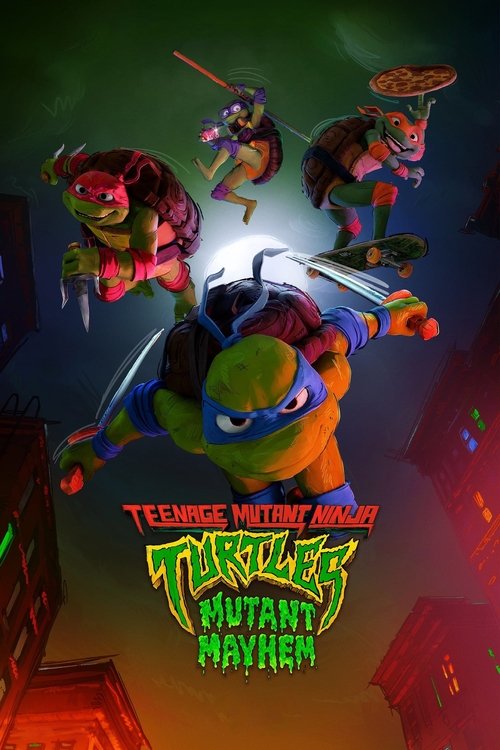
Teenage Mutant Ninja Turtles: Mutant Mayhem
2023 · Jeff Rowe
For a fun, no-homework night — when you want something playful and visually dazzling that works equally well for kids, teens, and grown-ups who remember the turtles fondly. Comfort viewing with style to spare.
What it's about
Four teenage mutant turtles have spent their whole lives hidden in the New York sewers by their overprotective rat father, watching human life from a distance and aching to be part of it. Their plan: do something heroic enough that the city has to accept them. With aspiring student journalist April O'Neil as their first real friend, they go after a mysterious crime syndicate — and stir up an army of fellow mutants far above their weight class.
The experience
Loose, loud, and disarmingly sweet — the brothers actually talk like teenagers, riffing over each other, and the film's scribbly, graffiti-bright look makes every frame feel alive. It's a hangout comedy wearing an action movie's clothes, and the energy is infectious.
The craft
Jeff Rowe pushes the sketchbook aesthetic further than any studio feature before it: deliberately wobbly linework, graphite smudges, and marker-bright color that make the CG image look hand-scrawled by a teenager. Casting actual teens as the turtles and letting them improvise gives the dialogue a rare, unpolished charm. It's a feast on a big screen.
Why it matters
It revitalized a four-decade-old franchise by finally taking the 'teenage' part seriously, and confirmed the stylized, hand-touched look as the new frontier of mainstream American animation.
Snapshot
Mutant Mayhem is the seventh theatrical feature built around the Teenage Mutant Ninja Turtles and the first to fully commit to the premise buried in the property's name: that the Turtles are teenagers, awkward and yearning, rather than quippy action figures. Directed by Jeff Rowe — fresh from co-directing The Mitchells vs. the Machines — and produced through Seth Rogen and Evan Goldberg's Point Grey Pictures for Nickelodeon Movies and Paramount, the film reboots the 1984 Mirage comic characters as a hand-scrawled coming-of-age story. Its most conspicuous gesture is aesthetic: a computer-animated image deliberately roughened to look drawn by a teenager, all graphite smudge, wobbling contour lines, and marker-bright color. Released in the late summer of 2023, it arrived in the immediate wake of Spider-Man: Across the Spider-Verse and was widely received as further proof that mainstream American animation had broken decisively with the smooth photoreal house style of the 2000s and 2010s.
Industry & production
The film sits at the intersection of two industrial stories. The first is Paramount/Nickelodeon's long, uneven stewardship of the Turtles, a brand that had cycled through the gritty 1990 New Line live-action film, a run of sequels, a 2007 CG feature (TMNT), and the Michael Bay–produced Platinum Dunes live-action films of 2014 and 2016, whose commercial returns diminished. By the early 2020s the property needed reinvention rather than continuation, and Point Grey's involvement signaled a tonal reset toward comedy and character.
The second story is the ascendance of Mikros Animation, the Montreal- and Paris-based studio (part of the Technicolor Creative group) that executed the film. Mikros had built feature capacity on the PAW Patrol movies and here was handed a project explicitly meant to look like nothing it had done before. Production leaned on the Rogen/Goldberg method familiar from their live-action comedies: extensive improvisation, loose recording sessions, and a writers' room sensibility. The screenplay carries credits for Rogen, Goldberg, Rowe, Dan Hernandez, Benji Samit, and Brendan O'Brien, reflecting that collaborative churn. The picture was a mid-budget studio animated feature rather than a top-tier tentpole, and while I won't cite specific grosses I can't verify, it was generally reported as a solid earner that, combined with strong reviews, was enough to secure a franchise future almost immediately.
Technology
Technically the film belongs to the post-Spider-Verse moment in which studios use conventional 3D CG pipelines as an armature and then aggressively "break" the render to mimic 2D handcraft. Mikros modeled and animated the characters in three dimensions but applied non-photorealistic rendering throughout: inked and sketched outlines that wobble and double back, cross-hatching and pencil texture mapped onto surfaces, visible construction lines, and flattened, poster-like color fields. Backgrounds carry the grain of paper and the imperfection of hand painting.
Crucially, the imperfection is engineered, not incidental. Contour lines were treated so they would not sit with mechanical evenness; textures were designed to read as graphite and marker rather than clean vector art. The effect places Mutant Mayhem within a small but rapidly growing family of features — Spider-Verse, The Mitchells vs. the Machines, Puss in Boots: The Last Wish — that use the computer to counterfeit the hand. What distinguishes it is the specific reference point: not comic-book halftone but a school notebook, the doodled margins of a bored, imaginative kid.
Technique
Cinematography
Animation has no photographic cinematographer in the live-action sense, but the film's "camera" is expressive rather than invisible. It favors handheld-feeling framings, whip movements, and compositions that privilege character over spectacle geography. Lighting is graphic — often a flat, saturated key that reads as colored paper rather than modeled illumination — and the New York setting is rendered as a moody, neon-and-grime nightscape that owes an evident debt to the way the 1990 live-action film treated the city as a warm, dirty refuge. The virtual camera stays low and close during the Turtles' scenes, emphasizing their smallness and adolescence.
Editing
Editorially the film runs on comic timing. Its rhythm is built around overlapping teenage cross-talk — the product of recording the four young leads together — which the cutting has to accommodate rather than flatten, letting lines pile up and interrupt. Action is assembled for legibility and gag payoff more than for sustained kinetic overwhelm, and montage is used efficiently to compress the Turtles' surveillance of and longing for human life. I cannot reliably attribute the edit to a specific credited editor from memory, and would rather flag that gap than invent a name.
Mise-en-scène / staging
Production design (led, as I recall, by Yashar Kassai) is the film's signature. The sewer lair is a maximalist collage of salvaged human junk — a physical analog of the teenage-bedroom aesthetic that governs the whole image. Surface density is high: graffiti, stickers, tape, scavenged screens. Character design deliberately abandons the interchangeable-hunk look of prior versions in favor of genuinely reptilian, gawky, individuated Turtles, and the film's roster of secondary mutants is staged as a carnivalesque menagerie. The visual world argues, at every level of staging, that these are outsiders assembling identity from cast-off materials.
Sound
The sound design foregrounds the tactile and the youthful — skateboard scrape, subway rumble, the clutter of the lair — over polished action-movie sheen. The needle-drop soundtrack leans on hip-hop and contemporary tracks to locate the Turtles firmly in a specific adolescent present. Most consequentially, the score is by Trent Reznor and Atticus Ross, marking their first feature animated score; their contribution supplies a pulsing, synth-and-texture underlayer that grounds the cartoon brightness in something grimier and more propulsive, tying the film's sound to its handmade-but-urban visual identity.
Performance
The vocal performances are the film's ethical center. The four Turtles are voiced by actual teenagers — Micah Abbey (Donatello), Shamon Brown Jr. (Michelangelo), Nicolas Cantu (Leonardo), and Brady Noon (Raphael) — recorded together so their banter carries real overlap, hesitation, and sibling friction. Ayo Edebiri reconceives April O'Neil as an anxious teenage aspiring journalist rather than a glamorous adult reporter. Around them the film deploys a deep comic bench: Ice Cube as the vengeful Superfly, Jackie Chan as Splinter, and an ensemble of mutants voiced by figures including Rose Byrne, John Cena, Seth Rogen, Paul Rudd, Natasia Demetriou, Hannibal Buress, Post Malone, and Maya Rudolph. The casting logic mirrors the aesthetic logic: authenticity of youth over polish.
Narrative & dramatic mode
The dramatic mode is coming-of-age comedy grafted onto origin-story action. The Turtles' driving want is not to defeat a villain but to be accepted — to attend high school, make friends, and move through the human world unhidden. Splinter, scarred by human cruelty, has raised them in fearful isolation; the plot's engine is their disobedient longing to belong. April functions as the bridge to humanity and a fellow outsider. The antagonist, Superfly, is constructed as a dark mirror: another mutant, abandoned by humans, who has concluded that the species deserves annihilation. The film thus stages its conflict as a debate within the outsider position — assimilate and love, or reject and dominate — rather than a simple hero-versus-evil clash. It is a classic teen-movie structure (wanting to be liked, the humiliating setback, the earned belonging) wearing a monster-movie costume.
Genre & cycle
Mutant Mayhem is a hybrid of superhero origin, creature feature, and John Hughes–descended high-school comedy. Within the Turtles cycle specifically, it represents a return to the property's underground-comic and 1987-cartoon roots after the muscular live-action interpretations, but filtered through a distinctly 2020s sensibility. Within the broader animation cycle, it belongs to the "handmade CG" wave — the movement to make studio animation look authored and imperfect — and to a parallel push toward comedy-forward, improvisation-driven family features associated with the Lord/Miller and Rogen/Goldberg orbits. Its mutants-as-marginalized framing also connects it to the long superhero tradition (X-Men most obviously) of reading difference and belonging through the figure of the mutant.
Authorship & method
The controlling authorial voice belongs to Jeff Rowe, whose prior work — writing on Gravity Falls and Disenchantment, and co-directing The Mitchells vs. the Machines — established his affinity for warm, chaotic, sincerely emotional comedy about families of misfits. Kyler Spears is credited as co-director. The producers, Rogen and Goldberg, are effectively co-authors here, importing their improvisational, joke-dense method and their recurring theme of arrested-yet-tender adolescence.
Among key collaborators: Trent Reznor and Atticus Ross (composers) supply the film's grounding sonic texture, an unexpected pairing whose industrial sensibility keeps the candy-colored image from floating away. The production design (Yashar Kassai, to the best of my recollection) is arguably as determining as the direction, since the film's identity is so thoroughly a design achievement. On the writing side, the multi-hand screenplay reflects a room rather than a single pen. For the editor and the lead cinematography/lighting credits, I would rather note the limits of what I can verify from memory than assign names I'm not certain of — the honest record is that this is a design- and voice-driven authorship more than an editor- or DP-driven one.
Movement / national cinema
The film is an American studio production (Paramount/Nickelodeon) executed by a substantially Canadian-French crew at Mikros in Montreal and Paris — a now-typical transnational arrangement in which American IP and creative leadership are realized by offshore animation labor. Aesthetically it belongs to no national school so much as to the contemporary international movement of non-photorealistic feature animation, a movement crystallized by Sony's Spider-Verse films and rapidly adopted across studios. Its cultural imagination, though, is emphatically local and specific: a mythologized, multiethnic New York, and a hip-hop-inflected vernacular that roots the outsider story in a particular American urban texture.
Era / period
Mutant Mayhem is a document of the early-2020s inflection point in mainstream animation. It follows the industry's exhaustion with uniform photoreal CG and the commercial vindication of stylization; it follows, too, a broader appetite for reboots that reinterpret rather than merely relaunch legacy IP. Its teen sensibility — social-media-adjacent anxieties about acceptance, a self-aware and referential comic voice — is thoroughly of its moment. It also lands in a period when family features increasingly foreground themes of difference and belonging, and when studios were actively seeking the next stylistic frontier after Spider-Verse proved audiences would embrace a "messier," more graphic image.
Themes
The film's governing theme is acceptance and the fear of the outsider. Every major element — the sheltered upbringing, the longing for high school, Splinter's trauma, Superfly's genocidal resentment — is an argument about what marginalized beings owe to, or should expect from, a world that fears them. The mutant is the film's central metaphor: to be visibly other is to be assumed monstrous, and the drama asks whether that assumption is answered with love or with vengeance. Secondary themes cluster around family — the chosen, patched-together kind, embodied by both the Turtle brotherhood and, eventually, the wider mutant community — and around adolescence itself as a condition of being not-yet-formed, assembling a self from borrowed and scavenged parts, which the handmade aesthetic literalizes. The film ultimately affirms integration over isolation: belonging is earned by heroic vulnerability, not seized by force.
Reception, canon & influence
Critically, Mutant Mayhem was one of the best-reviewed entries in the entire Turtles canon and one of the more warmly received studio animated films of 2023, praised especially for its visual daring, its genuinely teenage voice cast, and its comic warmth. It was widely discussed alongside Across the Spider-Verse as evidence that stylized, "drawn-looking" CG had become a durable mode rather than a novelty. On the awards circuit it was a recognized contender in the animated-feature conversation, though 2023 was an exceptionally strong year and I would not want to overstate specific trophies I can't confirm from memory.
Its backward influences are legible and often acknowledged in spirit: the underground grit of the original Mirage comics; the warm, city-as-sanctuary tone of the 1990 live-action film; the Spider-Verse proof-of-concept for non-photoreal feature CG; the graffiti, marker, and sketchbook traditions of street and youth art; and the Hughes-lineage high-school comedy. Rowe's own Mitchells vs. the Machines is a direct stylistic and tonal antecedent.
Its forward legacy is still consolidating but already tangible. Commercially and creatively it re-legitimized the Turtles as an animated property and secured a continuation: a sequel was set in motion, and a spin-off series (Tales of the Teenage Mutant Ninja Turtles) extended the film's world and aesthetic for Paramount+. More broadly, it reinforced the industry's turn toward stylization and toward casting age-appropriate voices for young characters, and it stands as a model for how a fatigued legacy franchise can be revived by reinterpretation rather than escalation. In the atlas of influence, Mutant Mayhem is best read as a node where the Spider-Verse aesthetic revolution met a forty-year-old comic property and produced something that felt, improbably, brand-new.
Reception
Landed in summer 2023 to instant warmth — hailed as the best Turtles movie ever made and proof the Spider-Verse revolution wasn't a one-off. Three years on it's settled in as a load-bearing pillar of the stylized-animation wave rather than a footnote to it.
How Teenage Mutant Ninja Turtles: Mutant Mayhem was received, from release to now →
How to watch Teenage Mutant Ninja Turtles: Mutant Mayhem: what to notice on a first viewing
- Notice how flat and saturated the color looks, like colored paper. Rowe and his team light scenes as graphic blocks of color rather than modeled illumination, and New York glows neon and grimy at night, echoing the 1990 film's warm dirty city. The color choice trades photorealism for a hand-touched, teenage-bedroom feel that matches who these characters are.
- Watch how low and close the camera stays on the Turtles. The virtual camera favors handheld whip movements and stays tight during Turtle scenes, emphasizing their small size and adolescent awkwardness. The camera height keeps reminding you these are kids, not action figures.
- Look at what the lair is built from: junk, tape, screens. The sewer hideout is a maximalist collage of scavenged human trash, stickers and graffiti layered thick, a physical version of a teenage bedroom. The lair shows you these brothers assembling a self from cast-off parts, same as any teenager.
- Listen for a pulsing synth hum under the color and jokes. Trent Reznor and Atticus Ross score the film, threading grimy synth texture beneath the hip-hop needle drops and cartoon brightness. The score keeps the candy colors from floating away into pure kid-cartoon territory.
- Notice the brothers talk over each other like real siblings. Real teenagers voiced the four Turtles together in the same room, and the cutting keeps their interruptions and cross-talk rather than smoothing them out. That messiness is deliberate: authenticity of youth was chosen over vocal polish.
Influences: the films it descends from and the films it influenced
- Spider-Man: Into the Spider-Verse (2018) — Established the non-photoreal CG grammar Mutant Mayhem runs on — animating on twos, printed halftone dots, hand-inked linework and chromatic-aberration 'ink misregistration' to make a 3D render read as a drawn comic panel.
- Spider-Man: Across the Spider-Verse (2023) — Released the same year, it proved the drawn-CG mode was durable rather than a one-off, sharing the tactic of assigning each character/world its own visible art-medium so the frame reads as collage rather than uniform render.
- The Mitchells vs. the Machines (2021) — Rowe's own prior film supplies the direct method: hand-doodled 2D scribbles, emoji and marker graphics composited over CG, plus the hyperactive, sincere-under-the-chaos family-of-misfits comedy engine.
- Teenage Mutant Ninja Turtles (1990) — Set the tonal template of a grimy, rain-slicked NYC as sanctuary and the sewer lair as warm home, favoring streetwise texture and creature-driven warmth over spectacle escalation.
- Cloudy with a Chance of Meatballs (2009) — The Sony Animation house style of maximalist visual-gag density and elastic, squash-and-stretch comic timing feeds the film's cluttered collage staging and joke-per-second rhythm.
- Puss in Boots: The Last Wish (2022) — Deployed stepped/reduced framerate on action beats and painterly brushstroke textures baked into the render — the same 'handmade CG' toolkit that separates this generation of features from smooth Pixar-era interpolation.
- Entergalactic (2022) — Built a stylized non-photoreal CG city around a hip-hop soundtrack, prefiguring Mutant Mayhem's method of driving the neon-nightscape aesthetic with needle-drop rap cues as tonal architecture.
- The Breakfast Club (1985) — The Hughes high-school template — an outsider ensemble, overlapping naturalistic teen dialogue and adolescence-as-subject — is the comedic-DNA the film inherits, reinforced by casting actual teenagers to voice the Turtles.
- Superbad (2007) — The Rogen-Goldberg producing method arrives here: improvisational, joke-dense ensemble riffing and the recurring subject of tender, arrested adolescence, both imported wholesale into the Turtles' banter.
- Sausage Party (2016) — Rogen and Goldberg's first move into feature animation, establishing their model of loose, improv-recorded comic performances layered onto an animated ensemble.
- The Social Network (2010) — Origin point of the Reznor–Ross scoring method — cold, industrial electronic textures used as emotional ballast — the exact sonic strategy that keeps Mutant Mayhem's candy-colored image grounded.
- Fritz the Cat (1972) — The foundational tradition of grimy, hand-drawn urban animation — a counterculture, street-level, marker-and-grit city rendered with deliberate crudeness rather than polish.
- The Wild Robot (2024) — Extends the handmade-CG movement Mutant Mayhem consolidated — painterly, visibly brushed 'impressionist' surfaces that abandon photoreal rendering as the studio default for a look-of-a-painting finish.
- Tales of the Teenage Mutant Ninja Turtles (2024) — The spin-off series directly continues the film's sketchbook-CG aesthetic, teen voice casting and comic staging, extending Mutant Mayhem's design language into episodic television for Paramount+.
- The Bad Guys (2022) — DreamWorks' post–Spider-Verse move to flat 2D-graphic cel shading and visible ink outlines over CG models, wedded to graphic-novel heist framing, parallels Mutant Mayhem's sketchbook-line surface treatment.
- Nimona (2023) — Another 2023 stylized-CG feature built on graphic-shape design and outsider-teen energy, sharing the strategy of bending the pipeline toward an illustrated, comic-panel look.
Similar films
- Spider-Man: Across the Spider-Verse (2023) — influence & lineage · same viewing thread
- Spider-Man: Into the Spider-Verse (2018) — influence & lineage · same viewing thread
- Nimona (2023) — influence & lineage
- The Mitchells vs. the Machines (2021) — influence & lineage
- The Wild Robot (2024) — influence & lineage
- Spider-Man: Brand New Day (2026) — same viewing thread
- Zootopia 2 (2025) — shared sensibility
- The Lego Batman Movie (2017) — shared sensibility
All the films related to Teenage Mutant Ninja Turtles: Mutant Mayhem →
Watch it with: curated runs of related films
- Anyone Can Wear the Mask — A run of every screen Spider-Man — from Raimi's earnest Queens kid to the multiverse's infinite web-slingers — where the rival reboots stop competing and start rhyming into one myth retold.