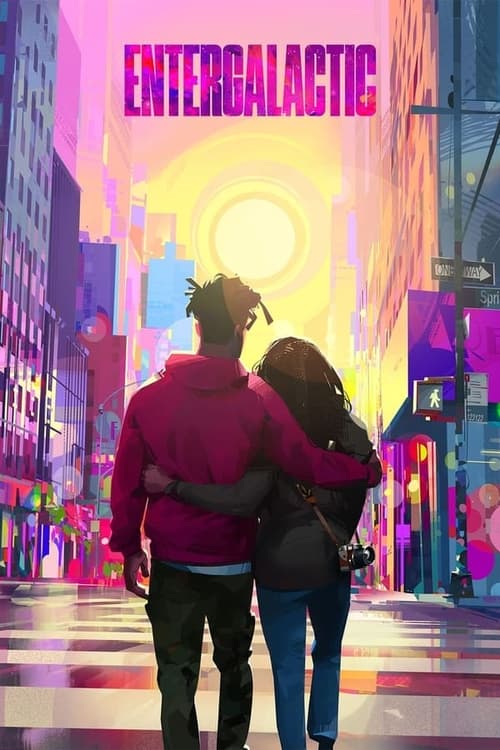
Entergalactic
2022 · Fletcher Moules
For a chill night in — date night, wind-down, or just wanting something beautiful and mellow in the background of your feelings. Pure comfort watch for anyone who loves love, city lights, and a great soundtrack.
What it's about
Jabari, a Brooklyn-bred comic artist on the verge of his big break, moves into a dream Manhattan apartment and falls hard for Meadow, the photographer next door. The film follows the sweet, nervous negotiation between two ambitious creative people — careers taking off, an ex still in the picture, friends offering terrible advice — set to a Kid Cudi album woven through the whole thing.
The experience
Smooth, glowing, and unhurried — more a vibe you sink into than a plot you follow, with painterly animation, hazy city nights, and music doing half the emotional talking. It's romantic in a grown-up, low-stakes way that feels like a warm evening.
The craft
The animation chases a moving-illustration look — painterly textures, stylized light, New York rendered as pure romance — and the film's structure is genuinely unusual: released day-and-date with Kid Cudi's album of the same name, it threads the songs through the story as its emotional score. Worth good speakers as much as a good screen.
Why it matters
A distinctive entry in the wave of stylized adult animation that followed the mid-2010s animation renaissance, and proof that an album and a film could be built as one object.
Snapshot
Entergalactic is a feature-length adult animated romance released by Netflix on September 30, 2022, conceived and driven by the musician Scott "Kid Cudi" Mescudi in partnership with writer-producer Kenya Barris. It follows Jabari, a young Black illustrator on the cusp of a career breakthrough — his streetwear-inflected comic character is being adapted for television — as he settles into a coveted Manhattan apartment and falls for Meadow, the accomplished photographer next door. The film is unusual as an object: it was released the same day as Kid Cudi's studio album of the same name, and functions as a visual companion to that record, with songs threaded through the narrative rather than deployed as a conventional score. Stylistically it belongs to the post–Spider-Verse moment in American animation, pursuing a "moving illustration" look that fuses 3D staging with 2D, comic-and-graffiti-derived surface treatment. Its ambitions are less about plot machinery — the story is a slender, familiar romance — than about mood, texture, and the translation of a musician's aesthetic sensibility into animated form. Note at the outset: several production specifics (the exact animation-vendor pipeline, Fletcher Moules's full biography, and any awards record) are thinly documented in reliable sources, and are flagged as such below rather than filled in speculatively.
Industry & production
Entergalactic was produced for Netflix and originated as a passion project of Kid Cudi, who developed it over several years and served as a creator, co-writer, star, and executive producer, with his Mad Solar banner involved. Kenya Barris — the creator of black-ish and a figure with his own Netflix output deal in this period — co-created and produced through his Khalabo Ink Society. The pairing situates the film at the intersection of two Netflix relationships: Barris's television-comedy franchise machine and Cudi's music-and-media ambitions.
The project's most telling industrial fact is its release strategy. Netflix positioned Entergalactic not as a standalone film in its marketing but occasionally as a "special," and its simultaneous launch with Cudi's album made it a cross-medium event — a rare case of a streamer coordinating an animated release with a major-label music drop. This dual identity (is it a movie, a TV special, a long-form music video?) shaped how it was covered and categorized, and it is part of why its metadata varies across databases.
Precise budget figures were not publicly disclosed, and because it premiered directly on Netflix there is no theatrical box-office record — any such number would be an invention. Likewise, the specific animation studios and production vendors that executed the film are not something the widely available record documents cleanly; I will not name a studio I cannot confirm. What is clear is that the film represents a substantial, multi-year animation undertaking backed by a global streamer, made outside the traditional feature-animation studio system (Disney/Pixar/DreamWorks/Illumination) as a bespoke, artist-led production.
Technology
The film's defining technical proposition is its hybrid rendering aesthetic. Rather than the smooth, volumetric CG surfaces of mainstream studio animation, Entergalactic pursues an illustrative, printed-page quality: characters and environments carry linework, flattened shading, halftone- and texture-like treatments, and a graphic sense of color that evokes comics, zines, and graffiti art. This places it downstream of the technical breakthrough popularized by Spider-Man: Into the Spider-Verse (2018), which legitimized the idea that a 3D animation pipeline could be art-directed to read as 2D illustration through non-photorealistic rendering, custom shaders, and hand-worked "imperfection."
I should be candid that the granular technical details — the specific software stack, the shader and compositing approach, whether elements were hand-drawn over 3D or achieved through stylized rendering — are not well documented in accessible, authoritative sources for this title. What can be said responsibly is that the film clearly employs a non-photorealistic, illustration-forward pipeline consistent with the broader industry shift of the early 2020s, and that its look is a deliberate technical achievement rather than an off-the-shelf style. The synchronization of that imagery to a full album's worth of contemporary hip-hop and R&B also makes it a work of audio-visual engineering as much as narrative animation.
Technique
Cinematography
As an animated film, Entergalactic has no photographed cinematography in the literal sense; its "camera" is a virtual one, and its images are authored frame by frame. The visual language leans on the vocabulary of stylish live-action romance and music video: neon-saturated night interiors, golden-hour New York exteriors, expressive lighting keyed to emotional temperature, and compositions that frequently flatten into poster-like graphic arrangements. The film indulges montage and reverie — walks through the city, first-date sequences, moments of creative flow — where the virtual camera moves lyrically rather than functionally. Color is arguably the film's primary cinematographic instrument, with palette shifts marking the arc of the romance.
Editing
Editorially the film is structured around its songs. Sequences are frequently cut to the rhythm and mood of Cudi's tracks, so that the pacing owes as much to the album's sequencing as to conventional scene-to-scene dramaturgy. This yields a rhythm closer to a suite of interlinked music videos than to a tightly plotted feature — passages of montage and mood alternate with dialogue scenes. The approach is a strength for atmosphere and a limitation for narrative propulsion; the cutting privileges feeling and flow over dramatic escalation.
Mise-en-scène / staging
The world-building is the film's richest register. Jabari's apartment, his artwork, the streetwear and sneaker culture, the record-and-comic ephemera, the New York streetscape — these are staged with loving specificity as an expression of a particular contemporary Black creative-class milieu. Production design doubles as characterization: we know Jabari through his walls, his desk, his objects. The staging embraces graphic flatness, sometimes arranging characters and signage into near-abstract compositions that foreground the illustrative conceit.
Sound
Sound is inseparable from music here. The Kid Cudi album Entergalactic effectively is the film's soundtrack, and the songs carry emotional exposition that dialogue does not. Beyond music, the film uses the ambient texture of New York — a naturalistic urban soundbed against the stylized imagery. Voice performance (below) is the other pillar of the sound design.
Performance
The film is voiced by a notably starry ensemble. Kid Cudi voices Jabari, and Jessica Williams voices Meadow; the supporting cast includes Timothée Chalamet, Macaulay Culkin, Vanessa Hudgens, Laura Harrier, Jaden Smith, Ty Dolla $ign, 070 Shake, and Christopher Abbott, among others. The performances lean conversational and naturalistic — the comedy is low-key and observational rather than broad — which suits the film's grounded romantic register even as the imagery is heightened. Williams in particular gives Meadow a wry, self-possessed presence that anchors the relationship.
Narrative & dramatic mode
Entergalactic operates in the mode of the contemporary urban romantic comedy-drama, transplanted into animation. Its narrative is intentionally slight: boy meets neighbor, they fall for each other, complications (an ex, professional ambition, fear of vulnerability) intervene, and the film works toward emotional reconciliation. The dramatic interest lies not in twist or incident but in the texture of a modern relationship among creative twenty- and thirtysomethings — the coyness, the timing, the negotiation of independence and intimacy. It is a character-and-mood piece, closer to a mixtape-with-plot than a conventionally structured feature, and it should be judged by the standards of tone poem and vibe as much as by dramaturgy.
Genre & cycle
The film sits at an unusual generic crossroads: adult animation, romance, music, and comedy at once. Its most important genre lineage is the visual album — the tradition of the long-form musical film companion, from Prince's Purple Rain era through Beyoncé's Lemonade (2016) and Black Is King (2020) — grafted onto animation. It also belongs to the modern wave of adult-oriented animation that streamers cultivated in the late 2010s and early 2020s, works that use animation for grounded, non-fantastical, character-driven stories aimed at adults rather than families. Within the romance genre it is a straightforward "neighbors fall in love" story; its novelty is entirely in the delivery system.
Authorship & method
Authorship here is genuinely plural, and the film is best understood as a producer/artist-auteur project rather than a director's film in the classical sense. Kid Cudi is the animating creative intelligence — the film is an extension of his musical persona, his visual taste, and his long-running interest in melancholy, alienation, and self-actualization; the story's illustrator protagonist is a lightly veiled avatar for a musician-artist working through fame and love. Kenya Barris brings a comedy-of-relationships sensibility and television-production muscle as co-creator.
Fletcher Moules directs. Moules is an Australian animation and commercial director with a background in high-end animated advertising and short-form work; his selection signals the film's alignment with the polished, art-directed aesthetic of contemporary commercial animation rather than the family-feature tradition. Beyond this, his biography and filmography are thinly documented in authoritative film-reference sources, and I will not embellish them.
On the writing side, the screenplay is credited to Kid Cudi and Kenya Barris with additional writers; I am not fully certain of the complete writers'-room credits and will not guess at names I cannot verify. The composer/music function is fulfilled by Kid Cudi and his collaborators via the album itself — most notably his longtime producer Dot da Genius has been central to Cudi's sound across his career, though the precise per-track production credits belong to the album's liner notes rather than to my confident recall. The editor and cinematography/visual-development leads are not names I can attribute reliably, and I flag that gap rather than fill it.
Movement / national cinema
Entergalactic is a product of American streaming-era media, and more specifically of a Black American creative movement in the 2010s–2020s that used major-platform resources to make personal, style-forward, culturally specific work — the same current that produced Barris's television and Cudi's cross-disciplinary output. It is not tied to a national-cinema "movement" in the art-house sense; its lineage is industrial and cultural. That said, its craft draws on a globalized animation-commercial talent pool (including its Australian director), reflecting how contemporary streamer animation assembles international creative labor around an American cultural vision.
Era / period
The film is emphatically of its moment — the early-2020s convergence of streaming, music, and animation. It reflects three period conditions at once: Netflix's aggressive investment in original animation and in artist-driven "event" content; the post-Spider-Verse aesthetic license for stylized, illustrative CG; and the maturation of the visual-album form as a prestige delivery vehicle for musicians. Set in a recognizable contemporary New York of creative gig-economy strivers, it is also a period document of a specific millennial/Gen-Z creative-class sensibility around 2022.
Themes
At its core the film is about the tension between ambition and intimacy — the difficulty of opening to love while chasing self-actualization and success. This is longstanding Kid Cudi territory: loneliness, self-doubt, the performance of confidence over vulnerability, and the search for emotional connection as a form of healing. Adjacent themes include the artist's identity (Jabari's work, his imposter anxieties, the commodification of his creativity), Black creative selfhood in a contemporary urban milieu, and the ordinary, unspectacular labor of building a relationship. The film treats these earnestly and gently; it is not ironic or cynical about romance. Its emotional register — bittersweet, yearning, ultimately hopeful — is continuous with Cudi's music.
Reception, canon & influence
Critically, Entergalactic was received as a visually distinctive and warm-hearted, if narratively modest, work. The consensus tenor of coverage praised its animation, its style, its soundtrack integration, and its emotional sincerity, while noting that the story itself is thin and familiar — a mood and a look in search of a stronger plot. I should be careful here: I do not have reliable specific numbers (aggregate scores, viewership figures, or a confirmed awards record) to cite, and inventing any would violate the standard of this dossier. If it received award recognition in the animation or television categories, that belongs in the record with a verifiable citation, which I cannot supply from memory.
Influences on the film (backward): the visual-album tradition (Beyoncé's Lemonade and Black Is King as the immediate prestige precedents); the illustrative-CG breakthrough of Spider-Man: Into the Spider-Verse; the adult-animation romance space that streamers had opened; and, thematically, the entire arc of Kid Cudi's own discography, which supplies the film's emotional grammar. The comic-book/graffiti visual culture of streetwear and skate art is a clear source for its surface style.
Legacy / what it shaped (forward): Entergalactic stands as a proof-of-concept for the animated visual album and for artist-led, streamer-backed animation aimed at adults — a template other musicians and platforms can follow for uniting a record and a film into a single release event. Its most durable contribution is likely aesthetic: it extended the post-Spider-Verse argument that CG animation can convincingly inhabit an illustrative, hand-made-feeling idiom, and it did so in service of a grounded contemporary romance rather than a superhero spectacle, widening the perceived range of the style. Because it is a recent (2022) work, its full influence is still resolving; its canonical status is best described as a notable, stylistically important entry in early-2020s streaming animation and in Kid Cudi's cross-media body of work, rather than an established classic. Where the longer-term record is not yet written, that uncertainty is itself the honest assessment.
A Deleuzian reading
The film's most loving camera moves are spent on a wall.
The full Deleuzian reading of Entergalactic →
Reception
Dropped quietly as a Netflix 'TV special' in 2022 and turned out to be a sleeper — critics called it one of the year's best animated surprises, and it's since settled in as a beloved adult-animation romance, with lingering grumbles that its TV-special classification kept it out of the Oscar animated-feature conversation.
How Entergalactic was received, from release to now →
How to watch Entergalactic: what to notice on a first viewing
- Notice the records, comics, and sneakers filling Jabari's apartment. Production design does the work dialogue usually does, showing who Jabari is through his walls and objects before he explains himself to anyone. You know this character through what he owns before you know him through what he says.
- Watch the light shift from neon night to golden-hour day. Color, not dialogue, is the film's primary instrument, with each palette shift tracking a new beat in the romance. You could follow this love story by color alone, with the sound turned off.
- Listen for a song arriving and the scene changing shape. Sequences are cut to the rhythm of the album rather than to conventional scene dramaturgy, so a track often carries what dialogue would normally explain. The soundtrack is not decoration here. It is doing the emotional work a script would otherwise carry.
- Notice how often figures and signage flatten into a poster-like image. The illustrative staging periodically arranges the frame into a near-abstract graphic, holding it for a beat before movement resumes. The film keeps stepping out of motion into a designed image, then stepping back in.
- Listen for how conversational and low-key the voice acting stays. Jessica Williams gives Meadow a wry, self-possessed presence, and the ensemble plays scenes closer to overheard conversation than to broad comic performance. The grounded voice work keeps the romance believable even while the imagery stays heightened and dreamlike.
The whole guide to watching Entergalactic, with the keys for a rewatch →
Influences: the films it descends from and the films it influenced
- Spider-Man: Into the Spider-Verse (2018) — Establishes the non-photorealistic CG pipeline Entergalactic runs on — Ben-Day halftone dots, deliberate chromatic-aberration offset on out-of-focus planes, hand-inked line overlays, and characters animated on twos to fake a hand-drawn cadence.
- Interstella 5555 (2003) — The purest ancestor of the album-as-film structure: a wordless feature cut one-to-one against a complete Daft Punk record, letting song sequencing rather than dialogue drive the edit — exactly Entergalactic's music-video-montage logic.
- Lemonade (2016) — Codifies the prestige 'visual album': discrete songs stitched by connective imagery and spoken-word interludes into a single authored film-event, the exact release-form template Entergalactic adopts for Cudi's record.
- Black Is King (2020) — Extends the visual album toward narrative and myth with lavish production-design-as-characterization, the immediate high-budget precedent for treating a Black artist's record as a designed, world-built film.
- American Pop (1981) — Adult urban animation whose emotional spine is its pop soundtrack — songs, not plot beats, carry the generational story — the same album-as-emotional-grammar move Entergalactic makes.
- Runaway (2010) — The musician-auteur long-form video built as a single visual for an album, pioneering the streetwear/art-world artist-avatar protagonist that Cudi's illustrator hero directly descends from.
- Waking Life (2001) — Proves adult animation can be a plotless, drifting mood-piece where visual style and voice performance, not story mechanics, carry the meaning — Entergalactic's 'mood in search of a plot' inheritance.
- A Scanner Darkly (2006) — Interpolated-rotoscope illustration laid over recorded actors yields a naturalistic voice-ensemble feel inside a stylized frame, the same grounded-performance-under-graphic-surface tension Entergalactic works in.
- Teenage Mutant Ninja Turtles: Mutant Mayhem (2023) — Extends the visible-linework, teen-sketchbook NPR look to a grounded youth story, carrying forward Entergalactic's proof that the illustrative idiom suits contemporary character drama, not just spectacle.
- Nimona (2023) — Graphic-novel-styled CG with bold flat color fields and comic-panel compositing in adult-leaning animation, continuing the streetwear/comic surface culture Entergalactic drew from.
- Your Name (2016) — Uses pop songs to structure time-skip montages and a hyper-saturated, light-drenched urban color palette to romanticize the city — the music-video-montage romance and expressive-color grammar Entergalactic shares.
- The Mitchells vs. the Machines (2021) — The other Lord/Miller-produced Sony film that layers 2D doodles, emoji and graphic-design elements over CG — the post-Spider-Verse compositing idiom of drawing on top of render that Entergalactic borrows.
- Spider-Man: Across the Spider-Verse (2023) — Pushes the NPR argument further by giving each world its own illustrative idiom, confirming the same post-Spider-Verse principle Entergalactic leans on: rendering as a stylistic choice, not a realism default.
- Puss in Boots: The Last Wish (2022) — Adopts stepped, reduced-framerate animation and painterly storybook textures to break from smooth CG — the same anti-photoreal, hand-made-feeling surface Entergalactic pursues in a grounded register.
- Arcane (2021) — Fortiche's hand-textured, painted-frame 2D-over-3D technique and its needle-drop montage sequences model the same 'CG that feels illustrated + song-driven set-pieces' fusion for an adult audience.
- The Bad Guys (2022) — DreamWorks' 2D-ink-line-over-CG, cel-shaded graphic idiom shows commercial feature animation absorbing the post-Spider-Verse illustrative style in parallel with Entergalactic's advertising-polished look.
Similar films
- The Mitchells vs. the Machines (2021) — influence & lineage
- Spider-Man: Across the Spider-Verse (2023) — influence & lineage
- Lost in Starlight (2025) — shared sensibility
- tick, tick... BOOM! (2021) — shared sensibility
- Jay Kelly (2025) — shared sensibility
- Little Amélie or the Character of Rain (2025) — shared sensibility
- Moonage Daydream (2022) — shared sensibility
- Asteroid City (2023) — shared sensibility