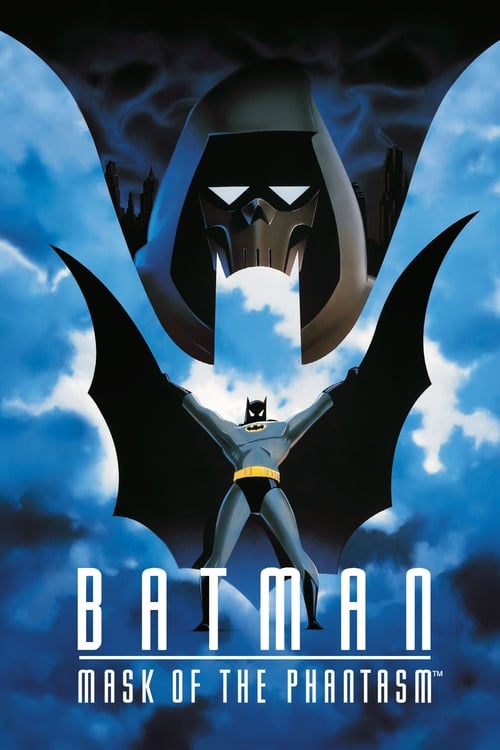
Batman: Mask of the Phantasm
1993 · Bruce Timm
When you want a superhero movie that's really a noir — stylish, a little sad, and over before it wears out its welcome. Works equally as a rainy-night comfort watch or a gateway for someone who thinks they're done with capes.
What it's about
A cloaked, scythe-wielding figure is executing Gotham's aging mob bosses, and the city blames Batman. As Bruce Wayne hunts the real killer while dodging the police, the return of Andrea Beaumont — the woman he once nearly built a different life with — pulls him back through the years when he was still deciding to put on the cowl at all.
The experience
A brisk, moody detective story with genuine melancholy under the action — more heartbreak than most live-action superhero films dare. At under eighty minutes it wastes nothing.
Performances
Kevin Conroy's voice work gives Bruce Wayne rare emotional weight, and Mark Hamill's Joker remains one of the great screen villain performances in any medium.
The craft
The art-deco Gotham of the animated series, painted in deep blacks and rendered on a theatrical scale, with a soaring orchestral score and hard-boiled flashback structure. It treats Batman's origin as a love story and a choice rather than a spectacle — and it still looks gorgeous on a big screen.
Why it matters
Overlooked in theaters, it was rediscovered as arguably the finest Batman film of its era and proof that American animation could carry adult noir storytelling.
Snapshot
Batman: Mask of the Phantasm is the theatrical feature spun off from Batman: The Animated Series, the Warner Bros. Animation program that had premiered in 1992. Though the credited billing here lists Bruce Timm, the film was co-directed by Timm and Eric Radomski, the two designers who had established the series' look and who together shaped the movie. Structured as a hard-boiled murder mystery, it braids two timelines: a present-day plot in which a caped, scythe-wielding figure — the Phantasm — begins killing Gotham's aging mob bosses while the police and public blame Batman, and an extended flashback to Bruce Wayne's early adulthood, his courtship of Andrea Beaumont, and the crystallization of his decision to become Batman. The film is unusual among screen Batmen for treating the origin not as spectacle but as a romance and a renunciation: the question is less "how did Batman come to be" than "what did Bruce give up to become him." It is now widely regarded as one of the finest Batman films in any medium, a reputation earned in reappraisal rather than at the box office.
Industry & production
The film was produced by Warner Bros. Animation as an outgrowth of the enormously successful animated series, itself greenlit in the wake of Tim Burton's live-action Batman (1989). Its production history is defined by a fateful mid-course change: the project began as a direct-to-video feature and was reassigned to a theatrical release relatively late, compressing an already tight schedule. The team has consistently described the production as rushed — completed in a matter of months rather than the longer runway a theatrical animated feature would normally command — which affected marketing lead time as much as animation. Released in North America on December 25, 1993, the film underperformed theatrically; the exact figures are a matter of record I won't reconstruct from memory, but the consensus of participants and historians is that it failed to recoup expectations at the box office, a disappointment attributed to the hurried release, minimal promotion, and a marketplace uncertain how to sell a "cartoon" Batman as a Christmas theatrical event. Its commercial life recovered on home video, where it found the audience the theatrical run had missed. The creative brain trust — Timm, Radomski, and writer-producers Alan Burnett and Paul Dini — carried over directly from the series, which is central to why the film reads as an extension of the show's world rather than a reinvention for the big screen.
Technology
The film was made with traditional cel animation, hand-drawn and hand-painted, with overseas animation houses executing the frames from the American team's designs and layouts — the standard division of labor for American television animation of the era, scaled up for theatrical quality. Its most distinctive technical signature is inherited from the series: backgrounds were painted on black cards or paper rather than white, so that shadow was the ground state of the image and light had to be positively added. This "paint on black" method produced the deep, enveloping blacks that define the look and made the animated Gotham feel genuinely nocturnal. The film also deploys computer-generated imagery selectively — most conspicuously in a sweeping opening flight through Gotham's skyline, and in vehicle and machinery movement — integrating early-'90s CGI with the cel work in the manner the series had pioneered for its title sequence and Batmobile. For theatrical exhibition the imagery was composed for the wider cinema frame and finished to a higher standard of line and paint than weekly television allowed, though it remained recognizably continuous with the show's technical vocabulary.
Technique
Cinematography
Because this is animation, "cinematography" is a matter of designed camera and staged light rather than photographed reality, and the film is notably cinematic in its choices. The virtual camera moves with weight — craning over rooftops, tracking Batman through canyon-like streets, pushing in for intimate two-shots between Bruce and Andrea. Framing leans on strong verticals and diagonals drawn from film noir and German Expressionism: shafts of light through blinds, silhouettes thrown large against walls, faces half-swallowed by shadow. The black-ground technique gives the "photography" its character — highlights read as carved out of darkness, and the Phantasm's fog-shrouded appearances exploit the medium's ability to let a figure dissolve into pure black. Compared with the television episodes, the compositions are more ambitious in depth and camera mobility, taking advantage of the theatrical frame.
Editing
The screenplay's defining structural device — intercutting the present-day murder investigation with the past-tense Bruce/Andrea romance — makes editing central to the film's meaning. The flashbacks are not decorative; they are timed to detonate against the present action, so that the audience assembles the mystery's solution and the emotional origin story simultaneously. The cross-cutting builds the central rhyme between Andrea and Bruce (two grieving people shaped by a murdered parent) and withholds the Phantasm's identity through careful sequencing. The film runs to a lean feature length, and its pacing alternates propulsive action set-pieces with quieter, longer-held dramatic scenes, a rhythm more measured than the series' 22-minute episodes could sustain.
Mise-en-scène / staging
The film's world is the fullest expression of the design philosophy Timm and Radomski dubbed "Dark Deco": a Gotham of the imagination that fuses 1930s–'40s Art Deco architecture, film-noir wardrobe and cars, retro-futurist technology (dirigibles, vintage police blimps), and timeless period-blur so the city belongs to no fixed year. Staging favors iconic clarity — bold, simplified character silhouettes (Timm's signature draftsmanship: heavy jaws, broad shoulders, economical linework) placed against elaborately painted environments. Key set-pieces are architecturally conceived: a climactic confrontation set within a decaying, futuristic world's-fair pavilion turned amusement park makes the environment itself an antagonist. Recurring motifs — cemeteries, monuments, the Wayne mansion's cavernous interiors — are staged to underline the film's preoccupation with grief and memory.
Sound
Shirley Walker's score is one of the film's most celebrated elements and among the most important superhero scores of its decade. Walker, who had shaped the musical identity of the animated series, wrote a full symphonic score performed by a live orchestra, distinguished by dark, romantic themes and, notably, a Latin choral setting used to give the material a liturgical, funereal gravity. Her work here is frequently cited as a landmark for a woman composing and conducting a major superhero film score. Beyond music, the sound design supports the noir atmosphere — rain, wind, the whisper of the Phantasm's fog — and the voice performances (see below) are foregrounded, with dialogue given room to breathe in the dramatic scenes.
Performance
The voice acting is anchored by Kevin Conroy as Bruce Wayne/Batman, whose bifurcated vocal characterization — a lighter, public Bruce and a lower, graveled Batman — had already become definitive on the series and is deepened here by the romantic register the story demands. Mark Hamill's Joker supplies the film's manic menace, a performance that, with Conroy's, became the reference standard for the characters for a generation. Dana Delany voices Andrea Beaumont with a warmth and melancholy essential to the film's romance, and Stacy Keach voices Carl Beaumont and the Phantasm. The supporting ensemble includes Efrem Zimbalist Jr. as Alfred, Bob Hastings as Commissioner Gordon, Hart Bochner as the opportunistic Councilman Arthur Reeves, Abe Vigoda as mob boss Salvatore Valestra, and Dick Miller among the gangsters. The casting of recognizable dramatic actors, directed for naturalistic underplaying rather than cartoon broadness, is a large part of why the film sustains a feature's emotional weight.
Narrative & dramatic mode
The dramatic mode is noir mystery fused with tragic romance. The surface engine is a whodunit — who is the Phantasm, and why is Batman being framed for the killings — but the film's real subject is the origin of Batman reframed as a story of thwarted love. The dual-timeline construction lets the mystery's solution and the emotional revelation land as one: the discovery of the Phantasm's identity recontextualizes the entire romance and Bruce's vocation. The tone is somber and adult, closer to a 1940s crime melodrama than to a children's adventure, with genuine moral ambiguity — the Phantasm is an avenger, not a supervillain in the conventional sense, and the film asks the audience to feel the pull of vengeance even as Batman rejects it.
Genre & cycle
The film sits at the intersection of the superhero picture, the animated feature, and — most defining — the gangster/noir crime film. Its villains are aging mobsters; its visual and narrative grammar is drawn from noir; its emotional structure is that of doomed romance. Within the Batman screen cycle, it arrived amid a busy period for the character: after Burton's Batman (1989) and Batman Returns (1992), alongside the ongoing animated series, and just before Joel Schumacher's Batman Forever (1995) shifted the live-action franchise toward brighter camp. Mask of the Phantasm represents the animated wing's darker, more classical alternative to that trajectory. It also stands within the tradition — then still novel in America — of animation made for a serious, older-skewing sensibility rather than exclusively for children.
Authorship & method
Authorship here is genuinely collective, centered on the creative team that built the animated series. Bruce Timm (credited director on this billing) was the principal character designer and creative force behind the show's house style; Eric Radomski co-directed and had, with Timm, originated the "Dark Deco" aesthetic and the paint-on-black technique. The screenplay is credited to Alan Burnett, Paul Dini, Martin Pasko, and Michael Reaves, working from a story by Burnett — a writers' room approach carried over from the series, with Dini in particular associated with the show's most character-driven scripts. Shirley Walker's authorship as composer is inseparable from the film's identity; her score gives the images their emotional and tragic dimension. The film thus has no single auteur in the traditional sense but is the product of a tightly integrated studio unit whose shared sensibility — noir, classicism, emotional seriousness, iconic design — is consistent enough to function as a collective signature. I won't attribute a specific director-of-photography or single editor credit from memory, as animation crediting differs from live-action and I don't want to misassign roles.
Movement / national cinema
This is American commercial studio animation, produced within the Hollywood system by Warner Bros. Aesthetically, however, it draws on transnational sources: German Expressionist lighting and design, American film noir, Art Deco architecture, and the disciplined production pipeline of American television animation executed with overseas (largely Asian) animation labor. It belongs to a broader early-'90s moment in which American TV animation matured in ambition — a movement led, in the action-adventure register, precisely by the Timm/Radomski Batman series — pushing back against the assumption that domestic animation was solely children's fare.
Era / period
The film is a product of the early-1990s superhero boom triggered by Burton's 1989 Batman, and specifically of the creative window opened by that film's success, which made a stylistically dark, adult-leaning Batman commercially viable. Its "Dark Deco" world is deliberately period-agnostic — evoking the 1930s–'40s while including anachronistic technology — so the film is set in an imagined temporal blur rather than a datable present. Historically, it marks a high point of hand-drawn theatrical animation just before the medium's late-'90s decline and the ascendancy of computer animation, and it sits at the front edge of what would become the long-running DC Animated Universe.
Themes
The film's governing theme is the road not taken: the parallel lives of Bruce and Andrea, two people orphaned by murder, one of whom channels grief into a self-abnegating war on crime and the other into personal vengeance. Bruce's vow is figured not as triumphant destiny but as a form of self-imprisonment — a famous, wrenching scene has him plead at his parents' grave to be released from the promise so he can pursue happiness with Andrea, only for that path to close. Love versus vocation, mourning and its transformations, justice versus revenge, the corrosive persistence of the past, and the loneliness of the chosen identity all run through the picture. The Phantasm literalizes the theme: it is what Bruce might have become had grief curdled into vengeance without the discipline of his code, making the antagonist a dark mirror rather than a mere threat.
Reception, canon & influence
Contemporary reception was muted, in keeping with the film's commercial disappointment; the rushed theatrical release and thin marketing meant it reached few viewers on first run. Critical opinion, where registered, was generally respectful, but the film did not become a phenomenon until its home-video afterlife, where it steadily accrued a reputation as a high point of the character's screen history and, for many, the best-realized Batman film. Looking backward, the film's influences are legible: film noir and the American gangster picture, German Expressionism, Art Deco design, the Burton films' permission for darkness, and the decades of Batman comics mythology reworked by the animated series' team. Looking forward, its legacy is substantial. It cemented Kevin Conroy and Mark Hamill as the definitive voices of Batman and the Joker, roles they would reprise for decades. It proved that animated superhero storytelling could carry adult emotional weight, helping to legitimize the direct-to-video and theatrical animated features that Warner Bros. and DC would produce in quantity thereafter, and it stands as a foundational text of the DC Animated Universe. Its critical stock has risen steadily over time; the pattern of a theatrical failure reclaimed as a canonical work is now a standard part of how the film is discussed, and its influence is felt whenever later Batman screen projects reach for noir, tragedy, and the interior life of the man behind the cowl.
Reception
Dumped into theaters at Christmas 1993 with almost no marketing, it flopped hard at the box office — then spent three decades climbing from home-video cult object to the near-universal fan pick for the best Batman movie ever made.
How Batman: Mask of the Phantasm was received, from release to now →
How to watch Batman: Mask of the Phantasm: what to notice on a first viewing
- Watch how backgrounds seem carved out of black. The film paints backgrounds on black rather than white, so shadow is the default state and every highlight has to be added back in. Gotham looks like darkness with light punched into it, not the other way around.
- Track how flashback scenes interrupt the present-day mystery. The film cross-cuts a present murder investigation with Bruce's past courtship of Andrea, timing each flashback to land against the current action. You piece together the mystery and the origin story as the same puzzle, not two separate ones.
- Notice the mix of Art Deco towers and old-fashioned blimps. Gotham fuses 1930s Art Deco architecture with noir wardrobe and retro-futurist dirigibles, a design built to belong to no fixed year. The city feels timeless because it's deliberately built from decades that never actually overlapped.
- Listen for a Latin choir under the orchestral score. Shirley Walker's full symphonic score includes a Latin choral passage that gives the film a liturgical, funereal weight most superhero scores don't reach for. The music treats this like a requiem as much as an action picture.
- Notice Batman's voice drop lower than Bruce Wayne's. Kevin Conroy plays a lighter, public Bruce against a lower, graveled Batman, a vocal split that becomes more pointed once the romance with Andrea enters the story. The two registers make the split between the man and the mask audible, not just visual.
The whole guide to watching Batman: Mask of the Phantasm, with the keys for a rewatch →
Influences: the films it descends from and the films it influenced
- Superman (Fleischer shorts) (1941) — The literal source of the paint-on-black method — cel superheroics matted against deep-shadow Deco cityscapes with rotoscoped mechanical motion, the exact background-on-black grammar Timm and Radomski revived for the series and film.
- The Cabinet of Dr. Caligari (1920) — Painted shadow and angular architecture as externalized psychology — the expressionist chiaroscuro logic underneath Gotham's flat black voids and raking key lights.
- Metropolis (1927) — The monumental Art Deco vertical cityscape — setback towers and colossal machinery — restyled into 'Dark Deco' Gotham.
- Citizen Kane (1941) — Assembling a man's life through crosscut investigative flashbacks, plus deep-focus low-key compositions, modeling the dual-timeline structure that intercuts young Bruce with the caped present.
- Out of the Past (1947) — Noir flashback architecture in which a returning lost love reactivates and destroys the present — the tragic-romance-as-mystery skeleton of the Andrea Beaumont plot.
- Vertigo (1958) — Obsessive mourning for an irretrievable woman scored with Bernard Herrmann's swooning tragic-romantic orchestration — the idiom Shirley Walker channels for the 'road not taken.'
- Chinatown (1974) — Neo-noir in which uncovering the past yields tragedy rather than resolution, and the detective's romance is poisoned by that history.
- The Godfather (1972) — Gordon Willis's underlit gangster classicism and the aging-crime-family milieu that Valestra, Chuckie Sol and the mob subplot directly inhabit.
- Once Upon a Time in America (1984) — Crosscutting a hopeful youth against a ruined present as the film's central elegiac device — gangster-tragedy told across two intercut time layers.
- Blade Runner (1982) — Retrofuturist noir fusing Deco surfaces, wet expressionist lighting and future tech into a mood template Gotham's timeless-anachronistic design echoes.
- Batman (1989) — Anton Furst's Deco-gothic Gotham and Danny Elfman's gothic-orchestral main title granted the license for darkness and the design/score template the animated unit extended.
- Batman Beyond (1999) — Direct authorial continuation that stretches Dark Deco into a neon future while keeping the paint-on-black backgrounds and tragic-legacy storytelling.
- Batman: Under the Red Hood (2010) — The mature direct-to-video DC animated feature whose whole market Phantasm legitimized, built on the same noir-tragedy tone and Conroy vocal anchor.
- The Dark Knight (2008) — Live-action Batman reaching for crime-noir tragedy and the interior life behind the cowl, spined by an escalating mob-picture plot in Phantasm's mold.
- Spider-Man: Into the Spider-Verse (2018) — Comics-native expressionist stylization proving, as Phantasm first argued theatrically, that superhero animation can be a formally ambitious, emotionally adult art object.
- Nimona (2023) — Its 'Dark Deco' city design fused gothic-medieval architecture with sleek retro-futurist technology on painted black backgrounds — the anachronistic techno-medieval staging vocabulary Nimona builds its world from.
- Batman: The Dark Knight Returns, Part 2 (2013) — The animated-feature template — noir silhouette staging and Shirley Walker's brooding orchestral scoring — that Christopher Drake's music directly extends.
- Batman: The Dark Knight Returns, Part 1 (2012) — Proved the feature-length noir Batman in 2D animation, with Shirley Walker's orchestral scoring template that Christopher Drake's line-continuity scores directly extend.
- Batman: The Animated Series (1992) — Same studio unit, house style and Shirley Walker music library — the film is a theatrical widening of the series' paint-on-black frame and writers'-room method.
- Superman: The Animated Series (1996) — The Timm/Radomski unit ports the identical Dark Deco house style, bifurcated-voice casting and Walker-derived scoring into the same DC animated universe.
- The Iron Giant (1999) — American cel animation integrating early CGI for a machine character while carrying genuine adult tragedy — the same craft bet that animation can hold serious emotional weight.
Similar films
- The Dark Knight (2008) — influence & lineage · same viewing thread
- Batman Begins (2005) — same viewing thread
- Batman: The Dark Knight Returns, Part 2 (2013) — same viewing thread
- Batman: The Dark Knight Returns, Part 1 (2012) — same viewing thread
- The Batman (2022) — same viewing thread
- The Dark Knight Rises (2012) — same viewing thread
- Man of Steel (2013) — same viewing thread
- Superman (2025) — same viewing thread
All the films related to Batman: Mask of the Phantasm →
Watch it with: curated runs of related films
- The Superhero Movie Grows Up — Watch these as one arc — Raimi's warmth into Nolan's gravity into Logan's elegy and The Batman's rain-soaked noir — the two decades the comic-book film reached for real weight.