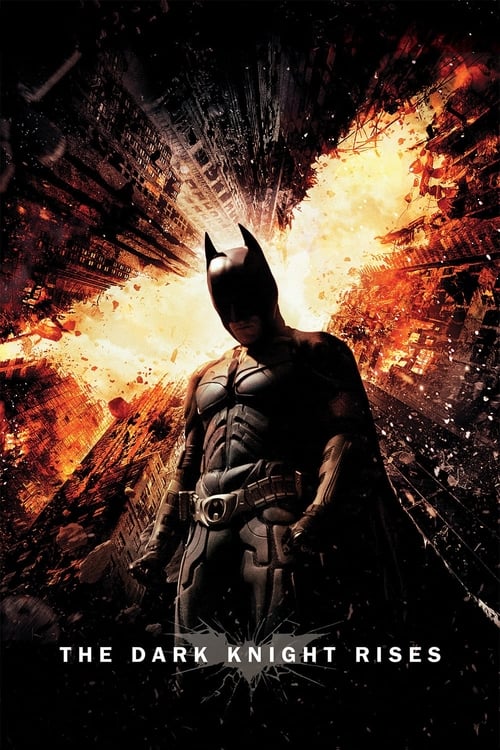
The Dark Knight Rises
2012 · Christopher Nolan
The director whose every release is treated as a referendum on theatrical cinema itself: Oppenheimer's IMAX-70mm pilgrimage culture, the Barbenheimer phenomenon, and now The Odyssey selling out screenings a full year in advance. Naming him signals you believe in the big screen; arguing about him (cold characters, muddy sound mixing) is its own cottage industry.
For a full-commitment movie night when you want spectacle with weight — settle in, turn it up, and let a whole city fall and rise. Comfort food for people whose comfort food is enormous.
What it's about
Eight years after taking the blame for Harvey Dent's crimes, Batman is gone and Bruce Wayne is a limping recluse in a peaceful Gotham built on a lie. Two arrivals shatter the quiet: Selina Kyle, a cat burglar with her own agenda, and Bane, a masked mercenary who brings an army and a plan to hold the entire city hostage in the name of revolution. Wayne has to decide whether he has anything left to give.
The experience
Operatic and heavy — a slow-building epic of collapse and comeback that trades the previous film's coiled menace for sheer scale. It's long and it swings big, and the final stretch is genuinely rousing.
Performances
Tom Hardy builds a memorable villain almost entirely from eyes, posture, and a strange courtly voice under the mask, while Anne Hathaway's Selina Kyle steals scenes with wit the trilogy hadn't allowed itself before.
The craft
Nolan shot over an hour of the film in IMAX — aerial hijackings, a city in winter, crowd scenes with thousands of real extras — and the practical scale is visible in every frame. Hans Zimmer's percussive, chant-driven score hits like artillery. Made for the largest screen and loudest room available.
Why it matters
One of the biggest films of 2012 and the rare superhero trilogy to land a deliberate, definitive ending — cementing the trilogy's status as a benchmark for finishing a blockbuster saga on your own terms.
Snapshot
The concluding chapter of Christopher Nolan's Batman trilogy, The Dark Knight Rises extends the series' project of refracting superhero mythology through the lens of post-9/11 political anxiety. Set eight years after the events of The Dark Knight, the film finds Bruce Wayne a broken recluse, his alter ego officially discredited, before the terrorist warlord Bane descends on Gotham with a program of violent egalitarianism that frames itself as revolution. Where its predecessor was a crime procedural about the philosophy of chaos, The Dark Knight Rises is an epic of civil collapse, drawing more from Charles Dickens than from comic-book tradition. Grand, operatic, occasionally overextended, it is the trilogy's most explicitly political and thematically ambitious entry — and, cinematographically, its most technically daring.
Industry & production
Warner Bros. and DC Entertainment produced the film under Nolan's Syncopy banner, with Charles Roven and Emma Thomas as co-producers alongside Nolan. The budget was substantial even by blockbuster standards of the era; estimates placed it among the most expensive films yet made, though the studio has not released precise figures. Filming took place from May 2011 to November 2011 across a global grid of locations: Pittsburgh's industrial architecture served as Gotham's street level (its bridges, stadiums, and downtown blocks visible throughout), while Manhattan provided skyline shots, London stood in for Wayne Manor interiors, and Jodhpur, India — specifically the Mehrangarh Fort region — supplied the ancient, sun-scorched landscape of "The Pit," Bane's subterranean prison. The production required the logistical coordination of a small military campaign, and the Heinz Field football sequence — a real Steelers game crowd augmented by extras — represents one of the largest practical crowd setups in studio history.
The film was released on July 20, 2012. That same day, a mass shooting during a midnight screening in Aurora, Colorado killed twelve people and injured dozens more. Nolan, the cast, and Warner Bros. canceled promotional appearances and issued public statements. The tragedy complicated the film's cultural reception in ways that remain difficult to fully disentangle from critical assessment. Commercially, the film crossed the billion-dollar threshold in global gross, completing a trilogy that had entirely transformed the economic and aesthetic coordinates of the superhero genre.
Technology
The Dark Knight Rises was the most expansive deployment of large-format IMAX photography in a feature film up to that point. Nolan and cinematographer Wally Pfister shot approximately seventy-two minutes of the finished film in 15/70mm IMAX, using the same Panavision-IMAX camera systems they had developed across The Dark Knight and Inception. The remainder was photographed in anamorphic 35mm. Both formats used photochemical film stock rather than digital capture — a principled refusal at a moment when digital acquisition was rapidly becoming the industry default. Pfister has spoken publicly about his commitment to the texture, latitude, and organic grain of film; the visual weight of the image in The Dark Knight Rises is inseparable from these choices.
The contrast between the cramped 35mm compositions and the horizon-filling IMAX ratio — which expands the frame's aspect ratio from approximately 2.39:1 to 1.43:1 — is used as a deliberate expressive tool. Gotham in extremis opens up; the film breathes wider as the stakes enlarge. The opening aerial sequence, in which Bane hijacks a CIA aircraft mid-flight using a smaller plane, was shot practically in IMAX and remains among the most technically ambitious practical aerial sequences of the digital era.
Technique
Cinematography
Pfister's visual approach in The Dark Knight Rises emphasizes scale, solidity, and the weight of civic space. Gotham is photographed as a real city — layered, inhabited, architecturally differentiated — rather than as a stylized crime-genre abstraction. The Pittsburgh locations give Pfister genuine industrial grandeur: rusted steel bridges, massive concrete stadiums, rivers. His lighting tends toward naturalism within extraordinary setups; even the large action sequences maintain a legibility that post-production digital photography of the period often sacrificed to kinetic blur. The Pit sequences, lit by a single shaft of natural light descending from a circular aperture, are among the film's most visually considered passages — Caravaggio-like in their chiaroscuro, functional as both spectacle and symbol.
Editing
Lee Smith, Nolan's editor since Batman Begins, cuts The Dark Knight Rises with a tempo calibrated to the film's operatic ambitions rather than to conventional thriller pacing. The film runs approximately 164 minutes and makes no apology for it. Smith's strategy is architectonic: sequences are built, not interrupted. The intercutting during the climactic siege — between street-level combat, the bomb's countdown, and aerial pursuit — achieves genuine tension through temporal compression without sacrificing spatial clarity, a rarity in contemporary large-scale action cinema. Critics noted that the film's middle section, with Wayne incapacitated in the Pit, suffers from a structural slowness that the editing cannot entirely compensate for.
Mise-en-scène / staging
Nolan's staging philosophy is determinedly physical. The battle for Gotham's streets — police officers in close-quarter combat with Bane's army — was choreographed as a mass practical event, filmed with hundreds of real participants. Nolan has spoken about preferring to photograph events rather than to manufacture them in post-production, and the sequence has a documentary density as a result. The film's most theatrically charged staging is the series of confrontations between Batman and Bane: the first fight is deliberately un-glamorized, shot in a tight sewer corridor with harsh industrial lighting, the choreography stripped of cinematic grace to convey the fact that Batman is badly outmatched. The rematch inverts this, restoring space and rhythm.
Sound
Hans Zimmer's score replaces the Batman theme's familiar two-note motif with a choral texture derived from a massed human voice: the chant of Bane's followers, built from a syllable Zimmer sourced from the Moroccan tradition and layered into a kind of liturgical drone. The effect is of a religious movement, a political mass — consonant with the film's themes of populist insurrection. Bane's voice, processed through his mask into a mid-register theatrical resonance, generated considerable debate after early exhibition footage was deemed unintelligible; revisions were made before wide release. Sound designer Richard King — who won Academy Awards for his work on The Dark Knight and subsequently on Nolan's later films — contributed to the texture of Gotham under occupation: the specific acoustics of a city in siege.
Performance
Tom Hardy's Bane requires a performance delivered almost entirely through eyes and body, the lower face permanently masked. He constructs the character through posture — an unusual stillness, hands clasped behind his back, chest forward — and through vocal theatricality, the deliberate diction of a man who has learned language as an instrument of dominance. It is a physically imposing, intellectually legible performance within the limits of a character whose backstory is revealed late and incompletely. Anne Hathaway's Selina Kyle operates in a register the trilogy had not previously accommodated: ironic, physically self-possessed, morally provisional. She provides the film's wryest moments without tipping into camp. Christian Bale navigates a role requiring Wayne's physical and psychological deterioration before recuperation; Michael Caine's Alfred, given a valedictory arc, offers the film's most emotionally direct performances. Marion Cotillard's Miranda Tate is serviceable until the film asks the character to pivot at the revelation of her true identity, at which point the execution has been widely noted as abrupt.
Narrative & dramatic mode
The screenplay, by Christopher and Jonathan Nolan from a story by Christopher Nolan and David S. Goyer, openly acknowledges A Tale of Two Cities as a structural and thematic reference: the Dickens epigraph opens the film, and the vision of Gotham under the Reign of Terror — its tribunal, its dispossessed summarily judged by the mob — translates Victorian social critique into post-financial-crisis American idiom. The film's class politics are its most provocative dimension: Bane's populist rhetoric is presented as simultaneously sincere in its indictment and nihilistic in its application, a demagogy that exploits real inequality toward ends of destruction rather than justice. Whether the film endorses this reading or merely dramatizes it has been a persistent critical debate.
The narrative mode is classical epic — long arcs, reversals, a literal katabasis (the descent into the Pit) and return. The twist regarding Talia al Ghul's identity is a late-film structural gambit that the screenplay had arguably not laid sufficient groundwork for; it reorients causation without substantially deepening the drama.
Genre & cycle
The Dark Knight Rises sits at the apex of what critics have identified as the "serious" or "prestige" superhero cycle of the 2000s, which sought legitimacy through tonal gravity, psychological realism, and political allegory. It arrives just as Marvel's interconnected cinematic universe — launched with Iron Man in 2008 — was establishing a competing model based on franchise continuity, tonal lightness, and genre cross-pollination. Nolan's trilogy explicitly rejected that model's logic; The Dark Knight Rises insists on closure and self-containment. In retrospect, it marks an end as much as a conclusion: the last major superhero film to operate on genuinely standalone terms before the post-Avengers era normalized the open-ended franchise serialization that has since become normative.
Authorship & method
Nolan's trilogy-concluding praxis is consistent with his established methods: location-heavy production, practical effects prioritized over digital, photochemical capture, genuine IMAX exhibition. What distinguishes The Dark Knight Rises is the degree to which the logistical ambitions were expanded — more IMAX, more locations, more practical crowd work. Wally Pfister brought a cinematographic discipline that grounded the film's spectacle in optical reality; his subsequent departure from camera operating to directing (with Transcendence, 2014) ended one of contemporary cinema's most productive director-DP partnerships. Hans Zimmer's score deepens and extends the aesthetic language he had developed with Nolan since Batman Begins. Lee Smith's editing reflects Nolan's preference for extended sequence architecture over rapid-cut action. The Nolan brothers' screenplay demonstrates both the trilogy's intellectual seriousness and its occasional susceptibility to over-elaboration.
Movement / national cinema
The film is a product of American studio infrastructure and British creative sensibility — Nolan being British-born, many key collaborators British, much of the production based in the United Kingdom. It belongs to the prestige blockbuster tradition that Hollywood has periodically cultivated when seeking cultural legitimacy: large in scale, literary in aspiration, formally conservative in execution. Its ambition to be taken seriously — as political allegory, as character study — distinguishes it from the genre's more purely entertainment-oriented output without quite placing it in the tradition of European auteur cinema.
Era / period
Released in 2012, the film arrives in the wake of the 2008 financial collapse and the Occupy movement (whose class-conflict imagery it obliquely mirrors), and in the early years of what would become the Marvel Cinematic Universe's decade-long market dominance. It is a film of late Obama-era ambivalence: skeptical of both establishment order and populist insurgency, finding heroism in sacrifice rather than systemic change. Its politics are ultimately conservative in the classical sense — order restored, institutions preserved — but the film is sufficiently serious about the contradictions it raises to resist easy categorization.
Themes
The film's dominant concerns are legacy, mortality, and the sustainability of symbols. Batman as a concept — the idea, not the man — is what Nolan's trilogy has interrogated throughout; The Dark Knight Rises asks whether that idea can survive when the man behind it is broken. The answer involves a form of succession (John Blake's emergence) alongside a literal death-and-resurrection arc for Wayne himself. Class warfare and the instrumentalization of revolution provide the film's political texture: Bane offers Gotham liberation while delivering annihilation, a parable about the difference between genuine justice and the performance of it. The film also dwells on sacrifice as a condition of genuine heroism — distinguishing between the performance of heroism (which Wayne has maintained for years) and its actual cost.
Reception, canon & influence
Critical reception at release was broadly positive, though more qualified than the near-universal acclaim that had greeted The Dark Knight in 2008. The film was recognized for its ambition and scale; its length, its structural complications, and the Talia revelation were recurring points of criticism. Over subsequent years, reassessment has been mixed: some critics have come to regard it as undervalued in its formal achievement, while others have identified its narrative seams and political ambiguities as genuine weaknesses rather than productive tensions.
The influences bearing on the film are layered. From comics: Frank Miller's The Dark Knight Returns (1986) — an older, retired Batman returning to a decayed Gotham — is the most legible precursor; Chuck Dixon and Graham Nolan's Knightfall arc (1993), in which Bane physically breaks Batman's back, is the direct source for the film's central incapacitation plot. The "No Man's Land" arc (1999), in which Gotham is cut off from the United States, informs the occupation narrative. From literary tradition, Dickens' A Tale of Two Cities is explicitly invoked, providing both structural template and moral framework. Fritz Lang's Metropolis (1927) haunts the film's imagery of underground workers and surface elites.
The film's forward influence is harder to trace cleanly, partly because the Marvel model so thoroughly displaced the Nolan model in the years immediately following. Its seriousness of purpose — the willingness to address political upheaval and mortality within the superhero frame — has been cited by filmmakers working in adjacent genres, and the practical-effects-first aesthetic continues to be invoked as a counterweight to digital maximalism. Tom Hardy's Bane, as a model for how to construct a physically imposing villain through restricted means, has had measurable influence on subsequent villain performance. The trilogy as a whole has become a reference point for discussions of what the superhero film can aspire to be — a standard against which later entries in the DC and Marvel cycles are regularly, sometimes unfairly, measured.
A Deleuzian reading
The image that stays is a hole in the earth with a circle of sky at the top.
The full Deleuzian reading of The Dark Knight Rises →
Reception
Landed in 2012 to strong-but-not-rapturous reviews and instant 'weakest of the trilogy' chatter after The Dark Knight's impossible act to follow; a decade on, that ranking has hardened, but it's been partly reclaimed as the last true blockbuster of its scale-obsessed, practical-effects kind.
How The Dark Knight Rises was received, from release to now →
Influences: the films it descends from and the films it influenced
- Metropolis (1927) — The underground/surface spatial dichotomy — workers below, elites above — and the staging of class uprising as mass-extras spectacle directly supply TDKR's visual grammar: the pit as underworld, quarantined Gotham as surface, the proletarian army as physical force rather than abstracted threat.
- Lawrence of Arabia (1962) — Lean built epic spectacle from thousands of real extras in practical desert locations through spatial choreography rather than editorial assembly — the template for Nolan's 11,000-extra Gotham stadium sequence shot at Pittsburgh's Heinz Field and the ground-level army battle on Nolan's closed bridge set.
- 2001: A Space Odyssey (1968) — Kubrick's insistence on Super Panavision 70 and Cinerama exhibition as formal argument — that large-format photochemical capture delivers optical grain and lens behavior no smaller format replicates — is the philosophical precedent for Nolan's IMAX 15/70mm commitment as artistic position rather than spectacle upsell.
- Blade Runner (1982) — Jordan Cronenweth's chiaroscuro system — individual practical light sources carving figures from near-total shadow, illumination functioning as moral information — directly informs Wally Pfister's photographic approach to TDKR's interrogation, pit, and nocturnal sequences, where darkness is constitutive rather than incidental.
- Ran (1985) — Kurosawa choreographed hundreds of real mounted soldiers into geometric battle formations legible as continuous wide shots, building action through spatial architecture rather than editorial fragmentation; this practical mass-staging discipline is a direct ancestor of how Nolan blocks the ground-level Gotham streets battle.
- Heat (1995) — Mann's downtown LA shootout constructs its geography through extended shots anchored in real city space, building suspense through blocking and camera placement rather than rapid cutting; this long-form location-based sequence architecture is the immediate ancestor of Lee Smith's editorial approach to TDKR's extended action passages — Nolan has cited Heat directly as a model.
- Batman Begins (2005) — Establishes the trilogy's complete photographic and sonic toolkit — Pfister's photochemical discipline, Zimmer/Howard's drone-based score vocabulary — and the katabasis narrative spine (Bruce's descent into isolation, training under a master, return to Gotham) that TDKR mirrors structurally with its literal pit imprisonment, rehabilitation, and comeback arc.
- The Dark Knight (2008) — Established IMAX integration across six sequences (~28 minutes) and Lee Smith's long-form sequence-editing rhythm; TDKR scales both — to ~72 minutes of IMAX and longer continuous action passages — while inheriting the prestige-superhero template of moral seriousness anchored in practical location work rather than studio simulation.
- Interstellar (2014) — Hoyte van Hoytema maintains IMAX 15/70mm photochemical capture after Pfister's departure, proving the methodology transferable; Hans Zimmer's choral-drone score language extends directly from TDKR's 'Deshi Basara' template; Lee Smith's long-form sequence architecture governs the docking sequence and the wave-planet passage at the same extended durations.
- Mad Max: Fury Road (2015) — Miller built the film's spectacle from practical in-camera stunt work — John Seale shooting real vehicles in real Namibian desert — positioning it explicitly against CGI-dominant blockbuster production; the commercial and critical viability of this argument as a prestige-blockbuster proposition was made by the TDKR model.
- Dunkirk (2017) — Van Hoytema extends Pfister's IMAX photochemical approach across a film shot predominantly in 65mm/IMAX; Lee Smith's ticking-clock multi-timeline editing evolves the long-form sequence architecture from TDKR into compressed structural counterpoint; practical aircraft and naval vessels in real-scale open water continue the location-over-studio methodology.
- Tenet (2020) — Van Hoytema's large-format location photography and escalated practical-effects maximalism — a Boeing 747 crashed in-camera for the airport sequence — extend TDKR's position that photochemical capture of actual events carries epistemic weight CGI cannot match; Smith's sequence architecture governs the Oslo freeport and highway inversion passages.
- The Batman (2022) — Greig Fraser's chiaroscuro extremism — individual practical light sources as near-sole illumination in near-total darkness — radicalizes Pfister's approach while inheriting its grammar; Reeves explicitly positioned the film's visual austerity against digital-maximalist superhero production, and Fraser's subsequent Oscar win ratified the aesthetic as the prestige end of the spectrum TDKR had opened.
- The Master (2012) — Anderson simultaneously championed large-format photochemical capture against industry digitization — Mihai Malaimare Jr. shot in 65mm — making the same artistic argument Nolan was making: that film grain and anamorphic lens behavior carry affective information digital sensors cannot reproduce, warranting theatrical exhibition in a format most cinemas had abandoned.
- Man of Steel (2013) — Produced by Nolan, Snyder adopted photochemical capture and practical-effects emphasis in direct dialogue with the TDKR model; Amir Mokri's desaturated anamorphic cinematography attempted the same optical-reality aesthetic, demonstrating how the prestige-superhero visual grammar had codified into a replicable template almost immediately after TDKR established it.
Similar films
- The Dark Knight (2008) — influence & lineage · same viewing thread
- The Batman (2022) — influence & lineage · same viewing thread
- Batman Begins (2005) — influence & lineage · same viewing thread
- Man of Steel (2013) — influence & lineage · same viewing thread
- Tenet (2020) — influence & lineage
- Dunkirk (2017) — influence & lineage
- Batman: The Dark Knight Returns, Part 1 (2012) — same viewing thread
- Batman: The Dark Knight Returns, Part 2 (2013) — same viewing thread
All the films related to The Dark Knight Rises →
Watch it with: curated runs of related films
- The Superhero Movie Grows Up — Watch these as one arc — Raimi's warmth into Nolan's gravity into Logan's elegy and The Batman's rain-soaked noir — the two decades the comic-book film reached for real weight.