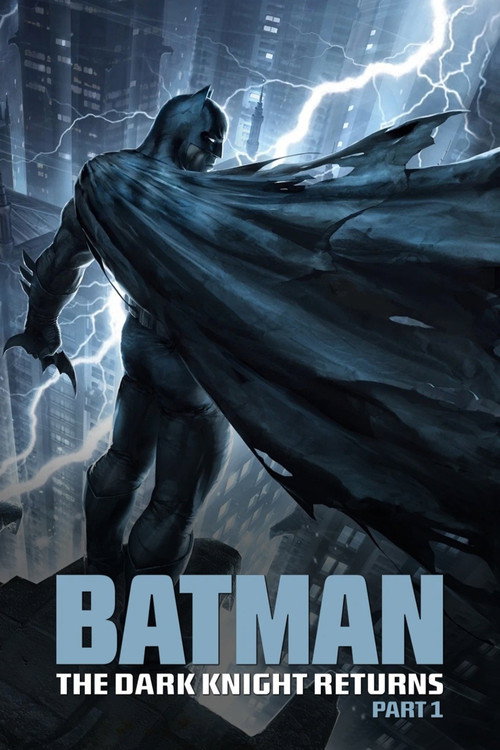
Batman: The Dark Knight Returns, Part 1
2012 · Jay Oliva
For when you want your superhero story dark, adult, and stripped of quips — a solid pick for a late-night watch when comfort-food capes won't cut it.
What it's about
Batman has been gone for ten years. Gotham has rotted in his absence, terrorized by a savage gang called the Mutants, and Bruce Wayne — now fifty-five, restless, and drinking through retirement — finally stops pretending he can stay out of it. The film follows his return to the cape in a city and media landscape that no longer knows what to make of him, and the arrival of a teenage girl, Carrie Kelley, determined to fight at his side as a new Robin.
The experience
Grim, punchy, and fast — a lean dystopian action film that takes its aging hero's aching body seriously and builds to genuinely bruising confrontations. The mood is heavy but the momentum never flags.
Performances
Peter Weller voices Bruce Wayne with a weathered, gravelly weariness that fits the character's age and bitterness — casting that does a lot of the film's work.
The craft
Jay Oliva's direction treats Frank Miller's 1986 miniseries with near panel-level fidelity, translating its blocky compositions and dystopian TV-chatter texture into clean, hard-hitting animation. The fight choreography — especially the brawls with the Mutant Leader — has real physical weight for a direct-to-video feature.
Why it matters
It's among the most respected entries in DC's animated original movies line, bringing one of the most influential comics ever published to the screen faithfully and whetting the appetite that live-action films would later chase.
Snapshot
Batman: The Dark Knight Returns, Part 1 is the first half of a two-part animated adaptation of Frank Miller's landmark 1986 comics miniseries, produced by Warner Bros. Animation and DC Entertainment as an entry in the DC Universe Animated Original Movies (DCUAOM) line of direct-to-video features. Directed by Jay Oliva from a screenplay by Bob Goodman, it dramatizes the first movement of Miller's book: a fifty-five-year-old Bruce Wayne, ten years retired, drawn back into the cowl by a Gotham overrun by the nihilistic "Mutant" gang, culminating in his brutal reckoning with the Mutant Leader and the emergence of a young girl, Carrie Kelley, as a new Robin. Where the source is one of the most influential comics ever published, the film's ambition is fidelity — a faithful, almost panel-conscious transcription rather than a reinvention. It is best understood not as an auteur statement but as a high-craft act of adaptation, and it is animation's most direct attempt to render Miller's dense, editorializing, media-saturated Gotham in motion. The TMDB genre tags (Science Fiction, Action, Animation, Mystery) are loose; the film is more precisely a dystopian superhero crime drama.
Industry & production
The film sits squarely within a successful, well-established business model. Beginning with Superman: Doomsday (2007), Warner Bros. Animation and DC built a steady pipeline of feature-length animated films released directly to DVD and Blu-ray, bypassing theaters. These were mid-budget productions designed to serve the adult and adolescent comics readership, frequently adapting canonical story arcs (Batman: Year One, All-Star Superman, The Flashpoint Paradox). The Dark Knight Returns was among the most anticipated of these because its source is so revered, and Warner's decision to split it across two roughly seventy-six-minute films — Part 1 in 2012, Part 2 in early 2013 — reflected both the density of Miller's four-issue narrative and a commercial logic of two sell-through releases rather than one.
Bruce Timm, the defining figure of modern DC animation, served in a supervising/producing capacity over the line during this period, and Andrea Romano — the field's most important casting and voice director — shaped the vocal performances. Production followed the standard DCUAOM template: development and design in the United States, with the labor-intensive animation executed by overseas studios in Asia, a practice common across the line. I would not overstate specifics I cannot verify: exact budget figures were not publicly disclosed, and because the film was direct-to-video it has no theatrical box-office record, so any claim to precise financial performance would be invention. What is documentable is its strong critical and fan reception and its place among the more admired entries in the series.
Technology
Technically, the film is a work of digital 2D animation in the tradition that WB Animation refined across the DCUAOM line: hand-drawn or digitally-drawn character animation composited over painted and digitally-rendered backgrounds, with digital ink-and-paint replacing the older cel process. Selective computer-generated elements — vehicles such as the Batmobile/tank, certain crowd or camera-move effects — are integrated with the 2D artwork, a hybrid approach typical of the era's television-derived feature animation. Christopher Drake's score and the sound mix were produced for home-video formats, released on DVD and Blu-ray with high-definition presentation. The technology is not experimental; its interest lies in how conventional tools were bent toward reproducing a very particular graphic-novel look — heavy blacks, weathered textures, and a color logic derived from Lynn Varley's original palette.
Technique
Cinematography
Because this is animation, "cinematography" means the design of virtual framing, staging, and camera movement — and here Oliva's storyboarding is the operative craft. The film is notable for its conscious echoing of Miller and Klaus Janson's page compositions: low, monumental angles on Batman; silhouette-heavy compositions that read almost as woodcuts; and the recurring device of the television screen as a framing element. Miller's comic is structured around fragmentary talking-head news broadcasts and "man on the street" commentary, and the film reproduces this by literally staging much of Gotham's social texture inside floating TV frames. The visual grammar is high-contrast and weather-beaten — rain, snow, and grain evoke Varley's muddy, bruised color scheme rather than the primary brightness of classic superhero imagery.
Editing
The editing must reconcile two rhythms: the propulsive action set-pieces (the Mutant fights, the Batmobile assault, the mud-pit brawl with the Mutant Leader) and the discursive, montage-like interludes of media chatter. The film cuts frequently to the news-broadcast fragments, using them as connective tissue and ironic counterpoint — a technique inherited directly from the comic's page layouts, where such panels interrupt and comment on the main action. This gives Part 1 a pace that alternates between visceral combat and satirical commentary, and the two-part structure lets the first film end on a genuine climax (the defeat of the Mutant Leader) rather than an arbitrary break.
Mise-en-scène / staging
The staging is the film's most faithful register. Costumes, character silhouettes, and Gotham's decaying architecture follow Miller's designs closely: the bulked, aging Batman; Carrie Kelley's homemade red-and-green Robin outfit; the fluorescent, feral Mutants. The film preserves key iconographic beats — Bruce Wayne's haunted domesticity, the bat crashing through the window, the tank-like Batmobile — as recognizable tableaux. The production design leans into dilapidation and grime, a Gotham of the near-future imagined from the vantage of the Reagan-era 1980s.
Sound
Christopher Drake's score, a regular presence across the DCUAOM line, supports the film with dark, orchestral, at times electronic textures suited to the dystopian tone. The sound design foregrounds the crunch and impact of Batman's aging, laborious physicality — a body that hurts — which is thematically essential to Miller's conception. The layered news-broadcast audio, with overlapping anchor voices, is a distinctive sonic feature carried over from the source's structure.
Performance
Voice performance is the film's headline achievement. Peter Weller — himself an emblem of 1980s screen dystopia through RoboCop — voices Bruce Wayne/Batman with a gravelly weariness that captures the character's age, bitterness, and reawakening appetite for violence. Ariel Winter brings youthful eagerness to Carrie Kelley; David Selby lends a world-weary gravity to Commissioner Gordon; and Wade Williams voices Harvey Dent/Two-Face, whose disfigured-inside subplot is central to Part 1. Andrea Romano's casting is characteristically shrewd, using Weller's cultural association with hard-edged science-fiction heroism to deepen the role. (The Joker, voiced by Michael Emerson, is essentially a Part 2 presence.)
Narrative & dramatic mode
The dramatic mode is tragic and interior. Miller's innovation was to render superheroism as psychological compulsion — Bruce Wayne narrates in feverish first-person, and the film retains this through voice-over that treats the Bat as an addiction and a second, truer self. Part 1's arc is a return-of-the-repressed structure: retirement, temptation, relapse, and escalating commitment, ending with Batman victorious over the Mutant Leader and, implicitly, over his own doubt. Around this spine, the film runs a chorus of external voices — psychiatrists, politicians, pundits — debating Batman's legitimacy, so that the private drama is continuously refracted through public discourse. This double register, intimate confession set against media cacophony, is the story's defining formal idea.
Genre & cycle
The film belongs to the "grim-and-gritty" or revisionist superhero cycle that Miller's comic helped inaugurate in 1986 alongside Alan Moore and Dave Gibbons's Watchmen. That cycle interrogated the superhero as a figure of authoritarian fantasy, aging flesh, and political anxiety. As a 2012 animated adaptation, the film is a late, canonizing entry in that tradition — a look back at the ur-text of dark superhero storytelling. Within the DCUAOM catalog it sits alongside other Miller-derived work (Batman: Year One, 2011) as part of a run adapting foundational Batman comics. Generically it fuses crime drama, dystopian science fiction, and superhero action, with a satirical edge aimed at mass media and political spectacle.
Authorship & method
Authorship here is layered and, unusually, weighted toward the source. Frank Miller — writer/artist of the original, with inker Klaus Janson and colorist Lynn Varley — is the dominant creative presence; the film is in large part a translation of his authored images. Among the film's own makers, director Jay Oliva is the key figure. Oliva built a reputation across DC animation as a storyboard artist and director with a particular gift for staging comics-faithful action; he storyboarded and directed several of the line's most ambitious titles, and The Dark Knight Returns is often cited as a showcase of his panel-to-screen sensibility. Screenwriter Bob Goodman performed the essential adaptive labor of compressing and sequencing Miller's dense prose and layouts into film scenes. Composer Christopher Drake provided musical continuity with the broader line, and voice/casting director Andrea Romano shaped the ensemble. Producer/creative overseer Bruce Timm stood behind the project as the guiding sensibility of DC's animation output. The method, in short, was reverent adaptation: honor the book's compositions and narration, and cast for resonance.
Movement / national cinema
As a product of American commercial animation, the film is not part of an art-cinema "movement" in the European sense. It belongs instead to a distinctly American institutional tradition — the Warner Bros./DC animation house style that descends from Batman: The Animated Series (1992) and its successors, with Bruce Timm and Andrea Romano as connective figures. Its aesthetic DNA is that of sophisticated American superhero animation aimed increasingly at adult audiences, distinct from both Disney-Pixar family features and Japanese anime, though its overseas production partners locate it within the globalized labor structure of contemporary TV-derived animation.
Era / period
The film exists in two temporal frames. Its 2012 moment of production places it in the boom of superhero media that followed Christopher Nolan's live-action Dark Knight trilogy — whose very title borrowed from Miller — and the broader mainstreaming of comics-derived cinema. But its imaginative period is the mid-1980s: Miller's story is saturated with Cold War dread, Reagan-era politics (the original famously features a version of Ronald Reagan), tabloid television, and urban-decay anxiety. The adaptation preserves that 1980s dystopian texture rather than updating it, making the film a period piece of a very specific American mood — even as it speaks to enduring debates about vigilantism and media spectacle.
Themes
The dominant themes are aging and mortality (a hero in a failing body confronting his own obsolescence); the psychology of vigilantism (heroism as compulsion, even pathology); law versus order and the legitimacy of extralegal violence; generational renewal (Carrie Kelley as inheritor); and the power of mass media to manufacture consensus and spectacle. Miller's ambivalence — Batman is both savior and authoritarian fantasy — is retained, and the film does not resolve the question it raises about whether Gotham needs a man like this or is deformed by him. The Two-Face subplot doubles the central question, asking whether a scarred psyche can ever truly be healed or only masked.
Reception, canon & influence
Critically, the film was among the better-received DCUAOM titles, widely praised for its fidelity to Miller and for Peter Weller's performance, and it is frequently ranked near the top of the animated line by fans and reviewers. I want to be careful not to fabricate specifics: because it was direct-to-video, there is no theatrical gross to cite, and I will not attribute particular scores or quotations I cannot verify.
The influences on the film run backward through a clear lineage. First and foremost is Miller, Janson, and Varley's 1986 comic — the primary text the movie reproduces. Behind that stand the noir and crime traditions Miller drew on, the dystopian science fiction of the 1980s (to which Weller's own RoboCop belongs), and the house style of Timm-era DC animation. The Nolan films, though live-action and released earlier, share the same ancestral source and formed the cultural context in which this adaptation landed.
Its legacy forward is more about consolidation than disruption. The two-part Dark Knight Returns is often held up as a benchmark for faithful comics adaptation in animation, cited when later DC projects are judged against it, and it reinforced Jay Oliva's standing as the line's premier action director. It contributed to the sense that the DCUAOM catalog could deliver "definitive" screen versions of canonical comics for an adult audience. In the longer arc, Miller's book continues to shape live-action DC filmmaking — visible in the aesthetics and casting logic of later theatrical Batman/Superman projects — and this animated version stands as the medium's most complete rendering of that foundational text. Its influence is thus less that of an originator than of a faithful monument: it fixed a beloved comic in animated form and, in doing so, became a reference point for how such translations should be done.
Reception
Dropped direct-to-video in 2012 to strong reviews, though some fans grumbled about the two-part split and a non-Conroy Batman; a decade on it's routinely ranked at the very top of DC's animated movie line.
How Batman: The Dark Knight Returns, Part 1 was received, from release to now →
Influences: the films it descends from and the films it influenced
- Batman: The Animated Series (1992) — Established the 'dark deco' model-sheet economy and Andrea Romano's resonance-based ensemble voice-casting method that the entire DCUAOM line — and this film — inherited wholesale.
- Batman: Mask of the Phantasm (1993) — Proved the feature-length noir Batman in 2D animation, with Shirley Walker's orchestral scoring template that Christopher Drake's line-continuity scores directly extend.
- Superman: Doomsday (2007) — The first DCUAOM feature; it fixed the adult-oriented direct-to-video pipeline, running time, and Christopher Drake scoring approach within which this adaptation operates.
- RoboCop (1987) — Its satirical 'media break' news interstitials as ironic counterpoint to violence are the model for DKR's TV-anchor montage — and Peter Weller reprises the same clipped, armored authority as Batman.
- Network (1976) — Pioneered television broadcast as a running Greek chorus narrating and moralizing the protagonist's acts, the exact function of the film's layered news-audio counterpoint.
- Taxi Driver (1976) — Supplies the diaristic first-person voiceover of an isolated urban vigilante whose interior monologue narrates escalating violence, echoed in Batman's internal narration.
- Dirty Harry (1971) — The rogue-lawman archetype dramatizing institutional failure and extralegal justice that Miller's book — and this film — transpose onto an aged Batman confronting a paralyzed state.
- Akira (1988) — Landmark of dystopian adult animation whose dense hand-drawn 2D detail fused with mechanical precision prefigures DKR's 2D/CG-hybrid rendering of a decaying city.
- Justice League: The Flashpoint Paradox (2013) — Oliva reapplies the panel-conscious action staging and storyboard-to-screen fight choreography honed here to another canonical event comic, consolidating his standing as the line's action director.
- Batman v Superman: Dawn of Justice (2016) — Directly restages DKR's armored Bat-versus-Superman climax and inherits its casting and armor logic, drawing on the very Miller book this film renders in full.
- Logan (2017) — Carries into live action the revisionist 'aging hero facing mortality and legacy' mode that Miller's DKR pioneered for superheroes and this film fixes on screen.
- Sin City (2005) — Direct panel-to-frame translation of Frank Miller's compositions — the same 'honor the drawn image' adaptation ethic Oliva applies to comics-faithful tableaux in animation.
- 300 (2006) — Frame-for-frame fidelity to a Miller/Varley book, matching splash-page tableaux and hard-boiled narrator voiceover, paralleling Oliva's panel-conscious staging and first-person narration.
- Watchmen (2009) — Reverent, near-shot-for-shot adaptation of a canonical 1986 graphic novel, sharing DKR's fidelity-as-method benchmark for translating a single author's layouts to screen.
- The Dark Knight (2008) — Arrives from the same Miller-derived source to interrogate vigilante legitimacy and treats the media/press as an institutional actor, the shared thematic-formal ancestry in live action.
- Batman: Year One (2011) — The DCUAOM line's other Frank Miller adaptation, built on dual first-person voiceover and comics-faithful David Mazzucchelli layouts as its structural spine, the immediate template for this film's method.
- All-Star Superman (2011) — Contemporary DCUAOM feature that likewise subordinates its animation to faithfully reproducing one author-artist's compositions (Quitely) as this film does with Miller/Varley.
- Batman: The Dark Knight Returns, Part 2 (2013) — The other half of the same production, it establishes the panel-literal staging of Miller's four-issue arc and Peter Weller's clipped, aged-Batman voice that Part 2 completes.
Similar films
- The Dark Knight (2008) — influence & lineage · same viewing thread
- Batman: Mask of the Phantasm (1993) — influence & lineage · same viewing thread
- Logan (2017) — influence & lineage · same viewing thread
- Sin City (2005) — influence & lineage · same viewing thread
- Batman: The Dark Knight Returns, Part 2 (2013) — same viewing thread
- The Batman (2022) — same viewing thread
- The Dark Knight Rises (2012) — same viewing thread
- Batman Begins (2005) — same viewing thread
All the films related to Batman: The Dark Knight Returns, Part 1 →
Watch it with: curated runs of related films
- The Superhero Movie Grows Up — Watch these as one arc — Raimi's warmth into Nolan's gravity into Logan's elegy and The Batman's rain-soaked noir — the two decades the comic-book film reached for real weight.