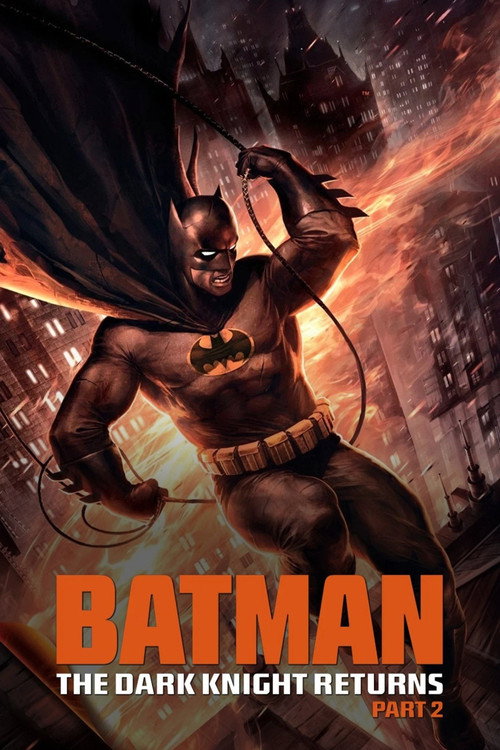
Batman: The Dark Knight Returns, Part 2
2013 · Jay Oliva
For when you want your superheroes serious — a night in with something pulpy but weighty, best watched back-to-back with Part 1. Not comfort viewing; it's the challenge-your-icons kind.
What it's about
Gotham, the near future: an aging Bruce Wayne has clawed his way back into the cape and broken the Mutant gang's grip on the city, but his return wakes up an old enemy — the Joker stirs from catatonia for one last dance. Meanwhile the federal government, embarrassed by a vigilante it can't control, sends its own man to shut Batman down: Superman. It's the back half of Frank Miller's landmark story, building to a collision between the two icons.
The experience
Grim, propulsive, and heavier than you expect from animation — this is a brutal, political, middle-of-the-night Batman story, not a kids' cartoon. The last act plays like a slow drumroll toward something mythic.
Performances
Peter Weller voices the older Wayne with a gravelly, exhausted authority that fits Miller's battered warhorse, and Michael Emerson makes the Joker quietly skin-crawling rather than cackling.
The craft
Jay Oliva's direction honors Miller's blocky, iconic panel compositions while keeping the action fluid and hard-hitting; the animation earns its violence. The Batman–Superman confrontation is staged with real scale and works loud, in the dark.
Why it matters
With Part 1 it stands among the most respected of DC's animated features, bringing the comic that redefined Batman as a dark, aging antihero to the screen largely intact — and its imagery echoes through the live-action films that followed.
Snapshot
Batman: The Dark Knight Returns, Part 2 is the concluding half of Warner Bros. Animation's two-part adaptation of Frank Miller's landmark 1986 comic-book miniseries The Dark Knight Returns. Released direct-to-video in the winter of 2013 as part of the DC Universe Animated Original Movies (DCUAOM) line, it completes the story begun in Part 1 (2012): a fifty-something Bruce Wayne, a decade out of retirement, faces the resurgence of the Joker and a state-sanctioned reckoning with Superman. Where Part 1 dramatizes Batman's return and his war on the Mutant gang, Part 2 adapts the back half of Miller's four-book structure — roughly the chapters "Hunt the Dark Knight" and "The Dark Knight Falls" — and culminates in the mythic Batman–Superman confrontation in Crime Alley. Directed by Jay Oliva from a screenplay by Bob Goodman, it is fundamentally a work of adaptation and fan-address: a faithful, image-for-image translation of a canonical text rather than an original authorial statement. Its ambitions lie in fidelity, in the caliber of its voice performances (notably Peter Weller as Batman and Michael Emerson as the Joker), and in the technical polish it brings to a limited-animation, home-video production model.
Industry & production
The film belongs to the DC Universe Animated Original Movies, the direct-to-video franchise Warner Bros. launched in 2007 and sustained across roughly two to four releases per year through the 2010s. These were mid-budget, PG-13-leaning animated features produced by Warner Bros. Animation for the home-video and (later) digital markets, distributed by Warner Home Video, and conceived to monetize DC's deep catalog of prestige story arcs — Superman: Doomsday, Justice League: The New Frontier, All-Star Superman, Batman: Year One, and others. Adapting The Dark Knight Returns was a high-value proposition within that model: Miller's book is among the most commercially durable graphic novels ever published, and its length and density justified splitting it into two features — a strategy Warner had not previously applied to a single source, and one that both honored the material's scale and, candidly, doubled the retail units.
Production followed the standardized DCUAOM pipeline: development and storyboarding supervised in-house at Warner Bros. Animation in Burbank, with the labor-intensive frame animation executed by overseas service studios, the common arrangement for cost-controlled American TV-and-video animation of the period. Bruce Timm, the defining figure of the modern DC animated house style, served as a supervising producer across the line during these years, lending institutional continuity even where he was not a hands-on creative lead. The recording of dialogue was overseen by Andrea Romano, the veteran casting-and-voice director whose work anchors nearly the entire Warner animated canon. The two parts were subsequently repackaged in a combined "Deluxe Edition," underscoring that they were always conceived as a single work released in installments.
Technology
This is a digitally produced 2-D animated feature. By 2013 the DCUAOM line worked in a fully digital ink-and-paint and compositing environment: hand-drawn or digitally drawn character animation composited over painted and digitally rendered backgrounds, with digital effects animation for fire, smoke, energy, and — significant here — the film's several explosive and superhuman set pieces. Selective 3-D and CG elements were integrated where 2-D would have been prohibitively laborious (vehicles, crowds, and mechanized objects in these films frequently carry a CG under-layer), though the house aesthetic keeps such elements subordinated to the drawn look. The film was authored for high-definition home video, released on Blu-ray and DVD with a 1080p master; the format, not theatrical exhibition, defined its technical target — image and sound mixed for domestic playback rather than large-auditorium projection. As a matter of record, the specific overseas animation vendor and precise budget for this title are not prominently documented in public sources, and I will not assign figures I cannot verify.
Technique
Cinematography
As an animated film there is no photographed cinematography; the equivalent craft is the design of virtual framing, staging, and camera movement, and here it is largely inherited. Oliva's controlling method is to treat Miller's comic pages as storyboards. Miller's original art is famously graphic — heavy blacks, brutalist silhouettes, a nine-panel grid interrupted by splash pages — and the film reconstructs many of his most iconic compositions directly: the lightning-struck Batman rearing over Gotham, the low-angle heroic framings, the recurring insert "panels" of television screens. The animated "camera" favors strong silhouette, high-contrast lighting, and stark down-shots and up-shots that quote Miller's angularity. Simulated camera moves — pushes, whip-pans, and crane-like descents — are used to open Miller's static grid into motion without abandoning his framing vocabulary.
Editing
The editing translates comic-panel sequencing into continuity cutting, and its most distinctive device is the media-collage montage carried over from the source: the constant intercutting of talking-head newscasters, pundits, and person-on-the-street reactions that punctuate and ironize the action. In Part 2 this becomes structurally central, as public opinion, government messaging, and televised spin frame both the Joker's return and the sanctioned move against Batman. The climactic Crime Alley duel is cut for escalating impact — a rhythm of blows, feints, and reversals building to Batman's staged collapse — and the film paces its two adapted "books" as a rising action (the Joker) and a final movement (Superman), preserving Miller's two-beat back half.
Mise-en-scène / staging
The production design reproduces Miller's near-future Gotham: a Reagan-era-inflected dystopia of decaying infrastructure, saturated television culture, and civic exhaustion. Costuming and character design follow Miller's conception — the older, bulkier, gray-templed Bruce Wayne; the compact, homemade look of Carrie Kelley's Robin; the Joker's gaunt, dandyish menace; a Superman rendered as a sun-powered instrument of the state. Staging emphasizes scale contrasts: Batman dwarfed by Superman, the aged Batman looming over ordinary criminals, the human figure set against vast Gotham vistas and skies. The palette leans on strong blacks and bruised, high-contrast color, echoing the print source.
Sound
Christopher Drake composed the score, as he did for numerous DCUAOM titles; his idiom here is orchestral and dark-hued, supporting the noir-dystopian register without a pop sensibility. Sound design carries considerable weight in the action climaxes — the concussive register of the Batman–Superman fight, the crackle of energy and gunfire, the ambient hum of a media-soaked city. Dialogue is foregrounded and theatrical, consistent with a text driven by internal monologue and public rhetoric.
Performance
Voice performance is the film's most-praised craft dimension. Peter Weller voices Bruce Wayne/Batman with a weathered gravity suited to Miller's aging, punitive protagonist — a grim, clenched interiority that carries the character's first-person narration. Ariel Winter returns as Carrie Kelley. The standout is Michael Emerson as the Joker: a soft, insinuating, psychologically precise reading that deliberately avoids the manic register the role often invites, matching the character's poisoned intimacy in Miller's telling. Mark Valley voices Superman as a conflicted agent of authority. Michael McKean appears as the sensationalist pop-psychologist Bartholomew Wolper. Andrea Romano's direction shapes an ensemble tuned for adult, dramatic delivery rather than cartoon broadness.
Narrative & dramatic mode
The dramatic mode is tragic and elegiac, filtered through hard-boiled crime melodrama and superhero myth. Part 2 advances two confrontations. In the first, the Joker — catatonic for years, roused only by Batman's return — engineers a final atrocity, forcing Batman toward a moral threshold he has always refused; their reckoning ends in a grim, ambiguous fashion that indicts Batman's self-imposed limits as much as the Joker's evil. In the second, a fearful government deploys Superman against an outlaw Batman, staging an ideological duel between accommodation and defiance, order and autonomy. Narration is heavily internal, preserving Miller's first-person captions as voice-over, and the story resolves on a note of feigned death and clandestine renewal: Batman engineers his own apparent end to disappear underground and rebuild, a downbeat-yet-defiant coda rather than a clean triumph.
Genre & cycle
The film sits at the intersection of the superhero film and the "dark," revisionist comic-book adaptation. The TMDB genre tags — Action, Animation, Mystery, and Science Fiction — are partly descriptive and partly loose: the "science fiction" label attaches to Superman's powers, the near-future dystopian setting, and a Cold-War-brinkmanship subplot, while "mystery" understates a work that is far more political thriller and character tragedy than whodunit. Its truer generic lineage is the mature superhero deconstruction that Miller's comic helped inaugurate in the mid-1980s alongside Alan Moore and Dave Gibbons's Watchmen. Within the animated home-video cycle, it belongs to the wave of faithful, adult-oriented DCUAOM adaptations of prestige source arcs.
Authorship & method
Authorship here is doubled and, frankly, weighted toward the source. The originating author is Frank Miller, whose 1986 comic supplies the story, the imagery, the political charge, and much of the dialogue; any account of this film's meaning begins with him. The adapting authors are director Jay Oliva and screenwriter Bob Goodman. Oliva — who had risen through the DC animated ranks as a storyboard artist and director, and was known within the studio for a fidelity-first approach to Miller's layouts — treats direction as curation and translation, choosing which panels to animate literally and how to bridge them. Goodman's screenplay compresses and sequences Miller's prose-dense narration into speakable, performable dialogue and voice-over. Key collaborators include composer Christopher Drake, voice/casting director Andrea Romano, and supervising producer Bruce Timm, whose long stewardship defined the visual grammar the DCUAOM line works within. The method is best understood as high-fidelity adaptation: the creative achievement is less invention than faithful, disciplined transposition of a canonical text into motion, sound, and performance.
Movement / national cinema
The film is a product of the American commercial animation industry — specifically the Los Angeles/Burbank studio system's direct-to-video branch — realized through the globalized production chain (domestic pre-production and design, overseas frame animation) typical of U.S. television-tier animation. It is not affiliated with any art-cinema movement. If it participates in a "movement" at all, it is the decades-long lineage of the Warner/Timm DC animated house style, and, at the level of content, the American comics tradition of 1980s revisionist superhero storytelling that the source text helped define.
Era / period
Two time-frames matter. The film was made in the early-2010s boom of superhero screen media, when the commercial and cultural stakes of the genre were high and studios were mining the most prestigious comic arcs for adaptation. Its source, however, is rooted in the mid-1980s: Miller's book is saturated with late-Cold-War anxiety, Reagan-era politics, nuclear brinkmanship, and a cynicism about mass media that the adaptation preserves rather than updates. The film thus carries a deliberate period double-exposure — a 2013 production faithfully transmitting a 1986 sensibility, its "future" Gotham still legibly an artifact of Reagan-era imagination.
Themes
The central themes are inherited and sharply drawn. Aging, mortality, and compulsion: Batman as an old man unable to stop, his heroism inseparable from obsession and violence. Order versus autonomy: the Superman confrontation stages a debate between the hero who serves the state and the hero who defies it, and refuses to flatter either side. Violence and its justification: the Joker plotline pushes Batman's no-kill code to its breaking point and interrogates the cost of that principle. Media, spectacle, and public opinion: the relentless television collage frames heroism and villainy alike as media events, satirizing a culture that consumes catastrophe as entertainment. Legacy and renewal: Carrie Kelley's Robin and the film's clandestine ending gesture toward continuity beyond the individual, even as the story ends in staged death. These are Miller's themes; the film's contribution is to voice and stage them.
Reception, canon & influence
Critically, the two-part adaptation was received as one of the stronger entries in the DCUAOM line, with particular praise for its fidelity to Miller's imagery and for the voice cast — Weller's Batman and, above all, Emerson's Joker drew consistent commendation. Reviews and fan discourse treated Part 2 as the payoff of Part 1's setup, with the Batman–Superman climax singled out as its centerpiece. (I'm characterizing the tenor of that reception; I won't attach specific scores or box-office/sales figures, which for a direct-to-video title are not reliably documented in a form I can cite.)
The lines of influence run overwhelmingly backward, into the source. Miller's The Dark Knight Returns is one of the two or three most influential superhero comics ever published; it reshaped Batman as grim, aging, and morally severe, and its DNA runs through decades of subsequent Batman screen work. That influence had already reached the screen indirectly — its imagery and ideas inform Tim Burton's Batman, Christopher Nolan's trilogy, and, most explicitly, the aesthetic and the very premise of the Batman–Superman conflict later dramatized in Batman v Superman: Dawn of Justice (2016), which quotes Miller directly. This animated film's own forward influence is more modest and more specific: as a faithful, well-regarded rendering, it became for many audiences the definitive moving-image version of Miller's book, cementing the DCUAOM strategy of splitting long prestige arcs across multiple features and standing as a benchmark for fidelity within that line. Its legacy is thus less that of a trailblazer than of a definitive adaptation — the animated canon's authoritative transmission of a foundational text.
Reception
Praised on release as the rare DC animated project that earned a 'better than most live-action Batman movies' reputation, its stock only rose after 2016, when Batman v Superman borrowed its imagery and fans started saying 'just watch the animated version instead.'
How Batman: The Dark Knight Returns, Part 2 was received, from release to now →
How to watch Batman: The Dark Knight Returns, Part 2: what to notice on a first viewing
- Watch for splash pages rebuilt in high contrast and heavy black. Oliva treats Miller's pages as literal storyboards, rebuilding iconic compositions like the lightning-struck Batman rearing over Gotham. The film is translating a specific comic page by page, not just adapting its story.
- Notice the cuts to newscasters and pundits reacting on screen. The editing constantly intercuts talking heads and person-on-the-street opinion with the action, framing events through media spin as much as through what's shown directly. Public opinion becomes part of the drama, not just commentary sitting outside it.
- Watch how small Batman looks next to Superman. The staging repeatedly uses scale contrast, an aged, bulkier Batman set against a towering, sun-powered Superman. The size difference shows you how unequal the two men are.
- Listen to how weathered and internal Batman's narration sounds. Peter Weller voices Bruce Wayne's first-person captions as a low, clenched, aging voice running under the action. The narration keeps you inside an old man's compulsion, not a hero's confidence.
- Listen to how quiet and gentle the Joker's voice is. Michael Emerson plays the character soft and insinuating rather than manic, a deliberate departure from the usual cackling register. The calm is more unsettling than volume would be, and it's the performance most people remember.
The whole guide to watching Batman: The Dark Knight Returns, Part 2, with the keys for a rewatch →
Influences: the films it descends from and the films it influenced
- Superman: Doomsday (2007) — Inaugurates the direct-to-video DCUAOM line and its house strategy of adapting a single landmark comic arc as a feature, the production model this film extends by splitting one across two.
- Batman: The Animated Series (1992) — Originates the 'dark deco' high-contrast silhouette design language and Andrea Romano's ensemble voice-direction method that the DCUAOM inherits wholesale.
- Batman: Mask of the Phantasm (1993) — The animated-feature template — noir silhouette staging and Shirley Walker's brooding orchestral scoring — that Christopher Drake's music directly extends.
- Sin City (2005) — The literalist Frank Miller panel-to-screen method — hard-shadow monochrome and hardboiled first-person internal-monologue voiceover — that Oliva animates rather than composites.
- Batman (1989) — First carried Miller's grim revisionist Batman and expressionist high-contrast Gotham to the screen, establishing the brooding silhouette palette the animation inherits.
- The Dark Knight (2008) — Dramatizes Miller's order-versus-autonomy argument through escalating TV-news broadcasts as a public chorus — the media-spectacle interstitial structure this film renders as collage montage.
- RoboCop (1987) — Peter Weller anchors both, and Verhoeven's satirical newscast interstitials are the direct model for the talking-head pundit montages that frame and ironize the action here.
- Justice League: War (2014) — Oliva carries the panel-driven, storyboard-fidelity adaptation grammar forward into the New 52 relaunch, translating Jim Lee's widescreen layouts the way he translated Miller's.
- Batman v Superman: Dawn of Justice (2016) — Stages the armored-Batman-versus-Superman brawl and Kryptonite-assisted climax as near-direct quotations of the very Miller sequence this film animates.
- Batman: The Dark Knight Returns, Part 1 (2012) — The other half of the same production, it establishes the panel-literal staging of Miller's four-issue arc and Peter Weller's clipped, aged-Batman voice that Part 2 completes.
- Batman: Year One (2011) — The DCUAOM's other fidelity-first Frank Miller adaptation, transposing Mazzucchelli's spare panel layouts and paired dual-voiceover narration into motion by the same curatorial method.
- Justice League: The Flashpoint Paradox (2013) — Oliva's same-year film applies his identical storyboard-artist-turned-director approach: adapting a specific comic's splash pages into kinetic, panel-bridged action choreography.
- 300 (2006) — Snyder's frame-accurate Frank Miller adaptation shares the identical device of reproducing the source's high-contrast silhouettes-against-sky compositions shot-for-panel.
- Watchmen (2009) — The era's other panel-for-panel fidelity adaptation of a 1986 revisionist comic, matching source splash pages one-to-one — the same reverence-as-direction that governs this film.
- Superman/Batman: Apocalypse (2010) — Oliva's storyboard work here choreographs the Batman–Superman power dynamic and Kryptonian action beats he would later direct in Miller's climax.
- Justice League: The New Frontier (2008) — An early DCUAOM entry built on faithful transposition of a single auteur comic (Darwyn Cooke's), sharing the line's core discipline of period-accurate panel translation over invention.
Similar films
- Batman: The Dark Knight Returns, Part 1 (2012) — influence & lineage · same viewing thread
- Batman: Mask of the Phantasm (1993) — influence & lineage · same viewing thread
- The Dark Knight (2008) — influence & lineage · same viewing thread
- Sin City (2005) — influence & lineage · same viewing thread
- The Batman (2022) — same viewing thread
- The Dark Knight Rises (2012) — same viewing thread
- Batman Begins (2005) — same viewing thread
- Man of Steel (2013) — same viewing thread
All the films related to Batman: The Dark Knight Returns, Part 2 →
Watch it with: curated runs of related films
- The Superhero Movie Grows Up — Watch these as one arc — Raimi's warmth into Nolan's gravity into Logan's elegy and The Batman's rain-soaked noir — the two decades the comic-book film reached for real weight.