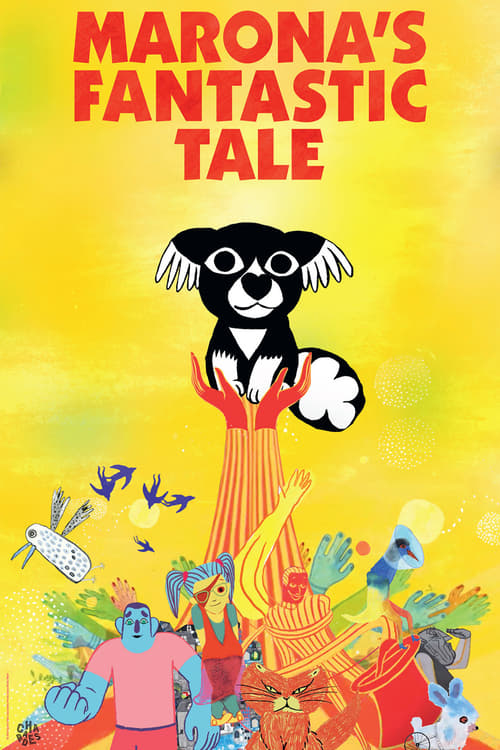
Marona's Fantastic Tale
2020 · Anca Damian
When you need a good cry that leaves you softer rather than wrecked — or when you want animation that feels like art and still hits you square in the chest. Keep tissues close, especially if you've ever loved a dog.
What it's about
At the end of her life, a small mongrel dog looks back on everything — from the ninth puppy of a litter to the succession of humans who took her in, loved her in their imperfect ways, and each gave her a new name: an acrobat, a construction worker, a little girl. It's a whole life story told from a foot off the ground, in the streets and apartments of a French city.
The experience
Tender and wrenching by turns, with bursts of visual joy — the film keeps reinventing its own look as the dog's world changes, so grief and wonder arrive braided together. It's openly emotional without being cheap about it.
The craft
Anca Damian gives each of Marona's owners a distinct visual universe — bodies stretch, colors flood, geometry bends to match how each human feels from a dog's-eye view — making this one of the most visually inventive animated features of its decade. The constantly morphing, hand-crafted style is the emotional engine, not decoration; it's gorgeous on a good screen.
Why it matters
The film that carried Damian beyond the festival circuit for animated documentary into international arthouse animation, and a frequent example of how far European feature animation can travel from the mainstream studio look.
Snapshot
A dog is struck by a car on a city street. In the seconds before she dies, she remembers everything. That is the whole architecture of Marona's Fantastic Tale (L'extraordinaire voyage de Marona / Extraordinara călătorie a Maronei), Anca Damian's third animated feature and the film that carried her name beyond the festival circuit that had championed her animated documentaries. Roughly ninety minutes long, French-Romanian-Belgian in financing, and unlike almost anything else in feature animation of its decade in the way it looks, the film narrates a mongrel's life backwards through the sequence of humans who owned her and renamed her: born the ninth of a litter and called Nine by her mother, she becomes Ana to Manole, an acrobat; Sara to Istvan, a construction worker; and finally Marona to Solange, a child whose family gives her a last home.
The renaming is the film's thesis in miniature. Each owner receives the same unconditional attention and gives back what their own circumstances permit — which is sometimes love, sometimes distraction, sometimes abandonment. Damian and her designers refuse to make this cute. The dog is not anthropomorphized into a comic sidekick; she is a consciousness with a narrow, generous, non-judgmental aperture, and the film's radical formal move is to build the entire visual world out of what that aperture would plausibly contain. Marona's Bucharest and Paris are not places rendered; they are places felt — elastic, transparent, overlapping, drawn in colored inks that bleed through one another.
It premiered in the feature competition at Annecy in 2019 and reached American audiences in 2020 through GKIDS, arriving in the first months of the pandemic and finding its audience largely through virtual-cinema bookings rather than theatrical runs.
Industry & production
The film is a product of the European co-production architecture that has sustained auteur animation since the mid-2000s: national funding bodies, Eurimages, Creative Europe MEDIA, and a lead producer with the patience to assemble a decade's worth of soft money. Sacrebleu Productions in France — a house with a long record in animated shorts and features — took the lead position; Damian's own Romanian company, Aparte Film, carried the Romanian side; Belgian co-production support (Minds Meet) completed the triangle and connected the project to the Flemish illustration culture from which its designer came.
This structure is not incidental to the film's character. A single-territory animated feature at this budget level would have faced commercial pressure toward a recognizable house style. The tripartite co-production, by contrast, distributes both the risk and the labor: animation work spread across three countries, with the design authority centralized in a small group of illustrators rather than a studio art department. The result is a film that could not have been made inside a vertically integrated animation studio, and that is legible as a European public-funding artifact in the best sense — the money bought idiosyncrasy.
Damian occupies an unusual industrial position. She is a Romanian director working principally in animation, in a national cinema that in the 2000s and 2010s became internationally famous for the exact opposite: unadorned, long-take live-action realism. She has functioned as her own producer for much of her career, which has allowed her to move between animated documentary (Crulic: The Path to Beyond, 2011; The Magic Mountain, 2015) and this more fabulist register without needing to establish a commercial track record in either.
Distribution followed the standard path for adult-facing European animation: festival premiere at Annecy, a circuit run through specialist animation and art-house festivals, then territory-by-territory sales. GKIDS — the American distributor that has done more than any other company to build a U.S. audience for animation that is neither Disney nor Japanese — took North America and released it in 2020. Its timing put it into the improvised distribution landscape of that spring, where independent distributors split virtual-cinema revenue with shuttered art houses. The film's modest commercial footprint should be read against that context; no reliable box-office comparison is available for a title released under those conditions.
Technology
Marona is a digital 2D film. Its images are drawn and composited in software rather than photographed on cels, which is what makes its particular visual strategy possible: the layering of translucent, saturated colors that read like overlapping washes of ink and gouache. On cel, transparency of that kind is a nightmare of registration and density; in a digital compositor it becomes a controllable variable, and Damian's team treats it as the film's primary expressive resource.
The pipeline combines drawn 2D character animation with constructed environments that behave more like architecture than backgrounds — spaces that unfold, rotate, flatten, and re-fold as the camera moves through them. Some of this is achieved with dimensional layout work underneath the drawn surface, allowing a "camera" to travel through a graphic space that would be impossible to sustain in pure hand-drawn perspective. The technology is not showcased; it is the invisible enabler of a design conceit that would otherwise be unaffordable at feature length.
Technique
Cinematography
Damian trained as a cinematographer before she directed, and Marona is a film with genuine camera thinking in it — which is rarer in animation than one might expect, since animated "camera" work often defaults to either flat theatrical framing or unmotivated CGI swooping. Here the virtual camera is tied to the dog's scale and attention. Sightlines run low. Human faces arrive as looming, distorted approaches. Rooms are apprehended in fragments and then assembled, so that a domestic interior can appear as a set of transparent overlapping planes rather than a single coherent box.
The film's most distinctive optical idea is transparency itself. Bodies and buildings show through one another; a wall does not occlude, it tints. This is a claim about perception — that a dog's world is layered by smell and sound as much as by line of sight, and that occlusion is a specifically human, specifically ocular convention. The camera also stretches and contracts space to match emotional pressure: the acrobat's Paris is elongated and vertiginous, the construction worker's world is heavy, blocky, and gravity-bound.
Editing
The cut is credited to Dana Bunescu, one of the central craftspeople of contemporary Romanian cinema and a figure with deep experience in both editing and sound across the Romanian New Wave. Her presence matters. The film's structure is an extended deathbed retrospection, which is an editing problem before it is anything else: how to move between four discrete life-chapters without the joins reading as chapter breaks in a picture book.
Bunescu's solution is elision and graphic rhyme rather than transition. Episodes end abruptly — an owner simply stops being present — and the film declines to dramatize most of the separations. What binds the segments is the returning voice of the narrating dog and a set of repeated visual figures. The pacing is unhurried within scenes and ruthless between them, which is precisely the temporal shape of memory under duress.
Mise-en-scène / staging
The design is led by the Belgian graphic novelist Brecht Evens, whose books (The Wrong Place, Panther) established a signature of translucent watercolor crowds where figures are distinguished by color and pattern rather than outline. Additional illustration work by Gina Thorstensen and Sarah Mazzetti extends and varies that vocabulary across the film's chapters.
Evens's contribution is the boldest authorial decision in the film. Characters are not naturalistic bodies but graphic propositions: Manole the acrobat is a chain of articulated geometric segments, all limb and no mass; Istvan the builder is a slab, his arms swinging like crane jibs. These are not stylizations of appearance — they are stylizations of function, of what each human is to a dog who knows them primarily as a kinetic presence. Each chapter shifts palette and pattern logic to match its owner, so that the film's look narrates the same information as its plot.
Sound
The score is by Pablo Pico, working in a chamber-scaled, texturally varied idiom rather than symphonic underscoring; the music tends to color a chapter rather than cue an emotion. The sound design does the harder work of establishing non-human perception, layering ambient detail so that off-screen space is continuously present. Voices are handled as one element among many — a dog hears human speech as tone and rhythm before meaning, and the mix respects that hierarchy without resorting to muffling gimmicks. The narration itself, delivered in the first person by the dog, is calm and slightly formal, which keeps the film's sentiment from tipping into pleading.
Performance
Animated performance here is divided between voice and drawing, and the drawing carries more. The voice work is restrained by design: Marona narrates without self-pity, and the human characters are voiced in a naturalistic register that contrasts against their extreme graphic abstraction. The essential performance choice is that Marona's body language is observed rather than cartooned — she has weight, patience, and a repertoire of small waiting gestures. The film earns its emotion from that observational fidelity, not from wide eyes.
Narrative & dramatic mode
The structure is a retrospective first-person life-narrative delivered from the threshold of death — a form with a long literary pedigree and a specific consequence: it removes suspense and replaces it with accumulation. We know the ending in the first minute. What remains is the question of what a life amounts to when it is measured entirely in the quality of attention received.
Each chapter is a small self-contained study of a human being seen from below and without judgment, and the film's dramatic mode is fundamentally elegiac rather than dramatic. Conflict, when it arrives, is circumstantial — an injury, a landlord, an eviction, a family's fatigue. There are no villains. The nearest thing to an antagonist is ordinary human distraction, which the film treats as tragic precisely because it is unremarkable. The device of renaming supplies the through-line: every new name is an act of love that is also an act of erasure, and by the end the dog has been so thoroughly renamed that her original self exists only in the narration.
Genre & cycle
Marona belongs to two overlapping traditions. The first is the animal-passion film, in which a non-human protagonist passes through a series of owners and thereby indicts the human world — the canonical instance being Bresson's Au hasard Balthazar (1966), whose donkey moves through a chain of masters in exactly this way, and whose refusal of anthropomorphic interiority Marona both honors and departs from by granting its dog a voice. Antecedents in fiction run through Tolstoy's Strider and Woolf's Flush; in cinema the lineage includes the dog-centered melodrama from Umberto D. (1952) onward.
The second is the wave of adult-facing European animated features that crested between roughly 2018 and 2021 — Buñuel in the Labyrinth of the Turtles, Funan, I Lost My Body, Away, Josep, and shortly after, Flee. These films share a financing model, a festival ecology (Annecy above all), and a conviction that hand-drawn or illustrator-led design is an argument rather than a limitation. Marona is among the most formally extreme of them.
It also sits, awkwardly and productively, in the family-film category. Its Family genre tag is not wrong — a child can watch it — but its opening death and its unsentimental account of adult failure place it closer to the European tradition of children's art that does not lie about mortality.
Authorship & method
Anca Damian's method across her animated work is consistent: take a real or emotionally documentary premise, and then find a graphic language for it that no existing house style provides. Crulic: The Path to Beyond (2011) reconstructed the death of a Romanian man on hunger strike in Polish custody using collage, cut-out, and photographic fragment. The Magic Mountain (2015) treated the life of a Polish adventurer with similarly heterogeneous means. In both, Damian assembled a bespoke visual system per project rather than developing a personal drawing style.
Marona extends this by outsourcing the drawing authority almost entirely — to Evens, Thorstensen, and Mazzetti — while retaining directorial control over camera, rhythm, and tone. Her cinematography training shows in how confidently she subordinates spectacular design to spatial legibility. The screenplay is credited to Anghel Damian, the director's son, and the collaboration produces a script notably free of the ironic self-awareness that often accompanies animal narration.
The key collaborators are therefore four: Evens on design, Bunescu on cutting, Pico on score, and Anghel Damian on script. Damian's subsequent feature, The Island (2021), a loose animated musical variation on Robinson Crusoe, confirms the pattern — again a new visual system, again built around an outside artistic sensibility.
Movement / national cinema
Romanian cinema's international identity in this period was forged by the New Wave — Puiu, Mungiu, Porumboiu, Muntean, Netzer — and rests on long takes, natural light, deadpan bureaucratic satire, and a documentary surface. Damian is the movement's most significant outlier: a Romanian director whose principal medium is animation and whose visual register is maximalist where the New Wave is austere.
Yet the connection is real and runs through personnel and ethics rather than style. Bunescu is a New Wave craftsperson of the first rank. And Marona's attention to precarious labor — the acrobat's injury, the builder's site, the cramped apartments, the economics that make a dog disposable — is recognizably the same social terrain the New Wave maps, viewed from a different altitude. The French and Belgian sides of the co-production supply the other half of the lineage: the CNC-supported tradition of graphic auteur animation, and the Flemish comics culture that produced Evens.
Era / period
The film is a document of the late 2010s in European animation: digital 2D pipelines mature enough to make painterly transparency affordable; a pan-European funding apparatus willing to back non-commercial design; a festival at Annecy functioning as the sector's Cannes; and a small group of distributors — GKIDS chief among them — building a specialist audience abroad. It also arrives at the moment when animation's association with children's entertainment had begun, in critical discourse if not in the market, to loosen.
Its 2020 release date belongs to a different era than its 2019 completion. The pandemic closed the theatrical route, and the film's American life took the shape of home viewing and streaming — a fate that suited its intimate scale but denied its images the size they were designed for.
Reception, canon & influence
Critical reception was warm and concentrated on the design: reviewers consistently singled out the visual invention, the chromatic logic of the chapter structure, and the refusal of standard animal-movie sentiment. The most common reservation concerned structure — that an episodic life-story with a foreknown ending risks emotional repetition, and that the film's insistence on the dog's unconditional goodness leaves it without internal friction. Both the praise and the reservation are fair readings of the same design choice.
Looking backward, the influences are traceable with confidence. Bresson's Au hasard Balthazar supplies the serial-owner structure and the moral method of observation without commentary. Evens's own graphic novels supply the transparency and the crowd-as-color technique wholesale. Damian's animated documentaries supply the practice of building a new visual system per film. The broader tradition of European hand-drawn auteur animation — Ocelot, Chomet, and more immediately the stripped-down painterliness of Sébastien Laudenbach's The Girl Without Hands (2016) — establishes the permission structure within which Marona operates.
Looking forward, honesty requires acknowledging that the record is genuinely thin. The film is recent enough, and its audience small enough, that direct descendants cannot be identified with any rigor. What can be said is narrower and more durable: Marona stands as one of the strongest available demonstrations that a feature can be designed by an illustrator with a fully formed personal style rather than by a studio art department, and that the resulting film can hold together across ninety minutes. It has become a standard reference point in arguments about animation's capacity for adult and non-human subjectivity, and it consolidated Damian's standing as the leading animation auteur working from Romania. Its clearest measurable legacy is internal — the freedom with which she proceeded to The Island. Whether it shaped anyone else's work is a question the historical record is not yet in a position to answer.
A Deleuzian reading
Istvan the builder is drawn as a slab, and his arms swing like crane jibs.
The full Deleuzian reading of Marona's Fantastic Tale →
Reception
A festival darling out of Annecy 2019, its 2020 US release from GKIDS landed square in pandemic-shuttered theaters and barely registered — since then it's grown a quiet word-of-mouth reputation as one of the most gorgeous animated features of its era.
How Marona's Fantastic Tale was received, from release to now →
How to watch Marona's Fantastic Tale: what to notice on a first viewing
- Watch how low to the ground the camera stays. The camera is tied to Marona's scale, so sightlines run low and human faces arrive as looming, distorted approaches rather than centered portraits. You're watching from a dog's height and a dog's attention, not from a storyteller looking down at her.
- Notice walls and bodies that you can see through. Damian draws buildings and figures so they tint instead of block, letting one shape show through another rather than hiding it. Occlusion turns out to be a human habit of seeing. A world known by smell has no need for it.
- Watch how differently each owner is drawn. Manole the acrobat is a chain of thin, jointed segments. Istvan the builder is a heavy slab with crane-jib arms. Each owner gets his own shape and palette. These aren't caricatures of how the men look. They're pictures of what each man is to a dog who only knows him as weight and motion.
- Listen to how human speech sounds like tone, not words. The mix treats dialogue as rhythm and pitch before meaning, roughly what a dog would actually hear when people talk over her. You're hearing the film the way Marona does, and that choice never once turns cute or gimmicky.
The whole guide to watching Marona's Fantastic Tale, with the keys for a rewatch →
Influences: the films it descends from and the films it influenced
- Sunset Boulevard (1950) — Establishes the already-dead first-person narrator who opens on the image of their own corpse and then rewinds the life that led to it — the exact framing contract Marona signs in its opening roadside death, which converts suspense into elegy and licenses the retrospective chapter structure.
- Au hasard Balthazar (1966) — Supplies the serial-owner armature — an animal passed hand to hand, each owner a moral episode — plus the method of registering human cruelty purely through the animal's unreacting body and framing, with no interpretive commentary attached to it.
- Yellow Submarine (1968) — The precedent for handing a feature's entire look to a single outside illustrator (Heinz Edelmann) rather than a studio art department, including the device of swapping the whole palette and graphic register at each new episode — Marona's palette-per-chapter logic in embryo.
- Kirikou and the Sorceress (1998) — Proves flat, unshaded color-field design with hard graphic silhouettes can carry a feature's depth cues through layered planes and staging rather than modeling — the European hand-drawn permission structure Damian and Evens work inside.
- The Triplets of Belleville (2003) — Character-as-function caricature — bodies distorted into single legible shapes that encode role before dialogue does — plus a near-wordless feature carried by a dog's perceptual world, with Bruno's sound-triggered dream sequences prefiguring Marona's non-human perception mix.
- Persepolis (2007) — The template for transposing a comics author's autographic line into feature animation without smoothing it into house style — chaptered memoir narration over high-contrast flat graphics, the same authority transfer Damian makes to Brecht Evens.
- Waltz with Bashir (2008) — Legitimizes digital 2D cutout-and-composite animation as documentary-grade tooling, with rigid layered assets moved through spatially planned camera pushes — the technical register Damian had already adopted for her animated documentaries and refines here.
- Chico & Rita (2010) — A designer-authored feature (Mariscal's line applied wholesale) in which flat 2D drawings are staged inside 3D-laid-out environments so the camera can travel through streets and interiors — precisely Marona's dimensional-layout-under-2D pipeline.
- Crulic: The Path to Beyond (2011) — Damian's own prior deathbed-retrospection film: a dead protagonist narrates his life in calm past tense while the image system is built bespoke for the project from collage, cut-out and photographic fragment, with Bunescu already cutting.
- Ernest & Celestine (2012) — Watercolor backgrounds that dissolve to bare paper at the frame edges and lines that don't close — the non-occlusion principle where figures and grounds bleed through each other, which Evens pushes further into full transparency of overlapping bodies.
- The Magic Mountain (2015) — Confirms Damian's rule of inventing a new heterogeneous visual system per film — cut-out figures over photographic and drawn strata — while she retains control of camera and rhythm and delegates the drawing hand to an outside artist.
- The Girl Without Hands (2016) — A feature carried by one illustrator's unfinished, gestural brush-and-ink marks where figures are indicated by partial contour and floating color rather than closed outlines — the immediate proof that a stripped painterly hand can hold ninety minutes.
- The Island (2021) — The measurable internal legacy: Damian again builds the whole film around an outside artistic sensibility and a freshly invented graphic system, now looser and more collage-musical, with the compositing and elastic-space camera vocabulary developed on Marona applied without hedging.
- Robot Dreams (2023) — Extends the wordless, comics-derived flat-line feature (Sara Varon's authorial style kept intact) into an episodic structure of serial separations, using observed body language and a foreknown loss instead of dialogue to carry a non-speaking companion's inner life.
- 4 Months, 3 Weeks and 2 Days (2007) — Dana Bunescu's cutting school: withholding the expected reaction shot and letting elision carry the violence, a duration-and-omission discipline she imports into Marona's transitions, where each owner's abandonment is cut around rather than dramatized.
- White God (2014) — Sustained knee-height camera locked to a dog's eyeline through crowds and traffic, and a refusal to anthropomorphize the performance — the same commitment to observed canine body language as the source of expression rather than cartoon facial mugging.
- Adama (2015) — Pablo Pico's chamber scoring method — small acoustic ensembles and prepared textures used as perceptual coloring rather than emotional underlining — applied to another film that renders a subjective, non-standard perception of space through hybrid 2D/3D surfaces.
- The Red Turtle (2016) — Dialogue-free storytelling in which a non-human presence organizes the narrative, with score and layered ambience carrying interiority — the same wager that a chamber-scale sound design can substitute for spoken psychology in flat-drawn animation.
- Flow (2024) — European art-animation told from an animal's subjective point of view, sharing Flow's commitment to rendering the world through a non-human gaze.
- I Lost My Body (2019) — A same-year French-produced adult auteur feature using shifting hand-drawn styles and a non-linear life-in-flashback structure, a direct contemporary in the crosscut-memory adult-animation cohort.
Similar films
- Robot Dreams (2023) — influence & lineage
- Waltz with Bashir (2008) — influence & lineage
- In Waves (2026) — shared sensibility
- Nimona (2023) — shared sensibility
- Little Amélie or the Character of Rain (2025) — shared sensibility
- Memoir of a Snail (2024) — shared sensibility
- Flow (2024) — shared sensibility
- When Marnie Was There (2014) — shared sensibility