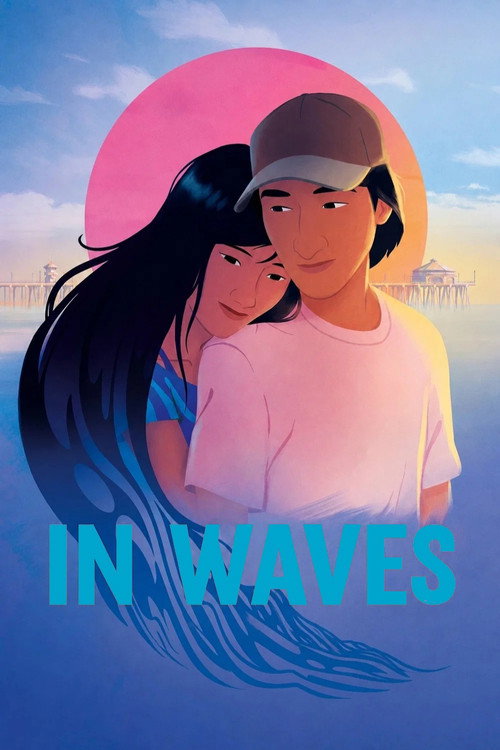
In Waves
2026 · Phuong Mai Nguyen
When you need a good cry that leaves you feeling more alive rather than wrecked — a short, beautiful film about love and loss for an open-hearted evening.
What it's about
In Los Angeles, AJ, a shy teenager who skates and draws, falls for Kristen, a girl who lives for surfing. Their first love opens into a shared future — beaches, friends, the ocean — until a sudden illness forces them both to grow up faster than any teenager should. Adapted from AJ Dungo's autobiographical graphic memoir, it's a love story told from inside real grief.
The experience
Tender and quietly devastating — the buoyancy of first love and the pull of the ocean run right alongside the ache of what's coming. It's gentle in tone but honest about loss, and it earns its tears without forcing them.
The craft
Hand-crafted French animation in the tradition of drawn, personal features, translating the graphic-novel source's clean lines and wave imagery into motion — the surfing passages are the sensory heart, and the images deserve a proper screen. It opened Critics' Week at Cannes and competed at Annecy, animation's flagship festival.
Why it matters
The debut fiction feature of Phuong Mai Nguyen arrived as one of the most acclaimed animated films of its year, part of the growing wave of adult, autobiographical animation reaching festival main stages and global streaming.
Snapshot
In Waves is a French animated feature, the debut fiction feature of director Phuong Mai Nguyen, adapting AJ Dungo's autobiographical graphic memoir In Waves (2019). It transposes Dungo's book — a dual-stranded work that braids the story of his girlfriend Kristen's terminal illness with a researched history of surfing — into a 91-minute hand-crafted animation. The film premiered as the opening title of the 65th Semaine de la Critique (Critics' Week) at the 79th Cannes Film Festival in May 2026 and subsequently competed at the Festival d'Annecy, animation's flagship event. It reached French theaters on 1 July 2026 through Diaphana Distribution; Netflix acquired worldwide streaming rights (outside France) following the Cannes premiere. Though set among American teenagers in California, it is a French production, made in French, and belongs squarely to the tradition of European auteur animation aimed at adult and adolescent audiences rather than the family market. Its subject — first love shadowed by grief, and the ocean as a vessel for mourning — places it in a small, serious lineage of animated films that treat death and memory with adult candor.
Industry & production
The film was produced by the Paris-based Silex Films, with producers Priscilla Bertin and Judith Nora, a company known for auteur-driven and animated projects. It is a French national production; Diaphana handled French theatrical release and Netflix took global streaming rights (with a reported worldwide streaming bow on 11 December 2026, France excluded from that deal). The screenplay was adapted by Fanny Burdino and Samuel Doux — screenwriters associated with live-action French auteur cinema — rather than by animators, a choice that signals the producers' intent to foreground narrative and emotional structure over spectacle.
The production reflects the characteristic economics of European feature animation: modest budgets relative to American studio output, reliance on public and co-production financing typical of the French system (the CNC and associated mechanisms), and a long gestation in which a bande dessinée property is developed with an established indie animation house. That the film emerged from Cannes's Critics' Week — a section devoted to first and second features, and rarely a home for animation — is itself notable, marking In Waves as a prestige launch positioned as discovery rather than genre product. The Netflix pickup after the premiere follows a now-familiar pattern by which streamers absorb festival-validated animated features for international distribution. Exact budget figures are not part of the public record and are not asserted here.
Technology
The central technical problem of the production, by the director's own account, was the animation of water. Nguyen wanted waves and ocean that read as painterly and heavily textured rather than photoreal or slickly simulated, and reportedly the team developed bespoke digital tools to achieve this — a way of giving computer-assisted fluid motion the grain and touch of hand-drawn or painted imagery. The pipeline is described as a hybrid of 2D and 3D: 3D used to enable dynamic, volumetric movement (crucial for surfing sequences, where the wave is effectively a moving landscape), and 2D/painterly surfacing to preserve an organic, illustrated aesthetic consistent with Dungo's source art. This "2D-over-3D" or textured-hybrid approach is broadly consonant with contemporary European feature animation practice, where studios use 3D as a substructure while resisting the plastic look of default CGI. The specific software suite is not detailed in the public record beyond the reference to custom tools built for the water.
Technique
Cinematography
Animation has no cinematography in the photographic sense, but In Waves exercises a strong sense of virtual camera and composition. The surfing and skating sequences invite mobile, kinetic framing — the drop down a wave face, the arc of a skateboard line — while the intimate domestic and hospital scenes favor stillness and held compositions. Critics at Cannes and Annecy described the film as "elegantly" and "luminously" animated, with a palette built around Californian light: pink-and-blue skies, the glare and shimmer of coastal atmosphere. This color-as-light strategy substitutes for lens work, using saturation and warmth to modulate emotional temperature across scenes.
Editing
The film's editing must negotiate the memoir's braided structure — the contemporary love story and the historical surf-history passages — and its movement, in the director's framing, "through grief and memory." Reviews characterize the film as moving fluidly between timelines and emotional registers, suggesting an associative, memory-led cutting logic rather than strict chronology. The specific editor is not named in the sources consulted, and no attribution is invented here.
Mise-en-scène / staging
Staging divides between two worlds: the terrestrial, quotidian spaces of teenage life (bedrooms, skateparks, the beach, later the hospital) and the ocean, which functions less as backdrop than as a character and a moral space. Nguyen has stressed that the film "is absolutely not about the technique of surfing" but about the waves and ocean as "a way to connect to something more sacred" — a framing that governs how water is staged: as sublime, enveloping, and finally consoling. The design draws on Dungo's distinctive illustration, with its flat planes, expressive economy, and restrained line, translated into moving image.
Sound
The score is by Rob (Robin Coudert), a French composer with a substantial film résumé, together with the musician Oklou (Marylou Mayniel) — for whom this marks a first film score. Their music is described as blending orchestral, electronic, and pop textures, a combination well suited to a contemporary teen romance that also reaches for the elegiac. Oklou's presence signals an attempt to bind the film to a current pop-adjacent, atmospheric sound world rather than a purely traditional orchestral idiom, aligning the film's sensibility with its young protagonists while reserving orchestral weight for its passages of loss and the ocean.
Performance
Performance here is vocal and, through the animators, gestural. Nguyen personally cast the French-language version, underscoring how much she treated voice as the film's acting core. The French cast is led by Rio Vega as AJ and Lyna Khoudri as Kristen, with Paul Kircher and Birane Ba among the voices, under dubbing/voice direction by Céline Ronté. Khoudri and Kircher are among the more prominent young French screen actors of their generation, lending the roles naturalistic, grounded readings. The English-language version pairs Will Sharpe (AJ) and Stephanie Hsu (Kristen), directed by René Veilleux. The animation of faces and bodies — restraint in the intimate scenes, release in the surfing — carries the register the voices set.
Narrative & dramatic mode
The narrative follows AJ, a shy Los Angeles teenager who draws and skateboards, and Kristen, who lives to surf; they fall in love, share their passions, and confront her sudden, ultimately terminal illness (in Dungo's memoir, osteosarcoma, a bone cancer). The dramatic mode is intimate melodrama in the honorable sense — a chamber story of two people and their circle — inflected by the memoir form. The source book's defining device is its interweaving of the personal love-and-loss story with a second, documentary strand: the history of surfing, from its Polynesian origins through the Hawaiian champion Duke Kahanamoku and the innovator Tom Blake. This counterpoint gives the private grief a mythic and historical frame, situating one death within a longer human relationship to the sea. How fully the film preserves this dual structure versus foregrounding the romance is a matter the finished film adjudicates; reviews confirm the film retains a movement between memory and present that echoes the book's braided design.
Genre & cycle
Generically the film sits at the intersection of animated romance, coming-of-age drama, and grief narrative. It participates in a small cycle of adult-oriented, illustrated auteur animations that treat mortality seriously — a lineage that includes works such as Tomm Moore's and Wolfwalkers-era Cartoon Saloon output, the graphic-memoir adaptations descending from Persepolis (2007) and Waltz with Bashir (2008), and grief-centered animation like The Red Turtle (2016) in its oceanic register. It also belongs to the broader wave of comics-to-animation adaptations that has become a hallmark of European feature animation. As a "sick-lit"/YA romance in animated form, it converses with the live-action teen-illness melodrama (The Fault in Our Stars and its kin) while displacing that genre into a medium better suited to interior states, memory, and the abstraction of the sea.
Authorship & method
Director — Phuong Mai Nguyen. French-Vietnamese, trained at two of the most important schools in French animation, Les Gobelins and La Poudrière, Nguyen built her reputation in the short form (including the acclaimed short Mécanique, 2016, on the Annecy circuit) before this feature debut. She is, by her own description, neither surfer nor skater, and approached the material as an illustrator drawn to its emotional and spiritual dimension rather than its sport. Her method for In Waves was research-led and ethically careful: she met AJ Dungo and Kristen's family early in development, visited locations, and conducted interviews to honor a story rooted in real loss. Her insistence on personally casting the French voices and on a painterly, non-photoreal water aesthetic marks a strong authorial signature over what could have been a straightforward adaptation.
Key collaborators. Screenwriters Fanny Burdino and Samuel Doux shaped the adaptation; composers Rob (Robin Coudert) and Oklou (Marylou Mayniel) provided the score; producers Priscilla Bertin and Judith Nora at Silex Films mounted the production. The source author, AJ Dungo, supplies both the story and the visual DNA. The film's editor and lead art/animation-direction credits are not established in the sources consulted and are not attributed here.
Movement / national cinema
In Waves is a product of the French animation ecosystem — arguably the strongest in Europe — which combines elite training institutions (Gobelins, La Poudrière, EMCA), robust public financing, and an auteurist tradition that treats animation as a director's medium for grown-up subject matter. Its selection by Cannes's Critics' Week situates it within French art cinema's institutions rather than a genre or children's-media pipeline. At the same time, its American setting, Netflix deal, and English-language version reflect the transnational reach of contemporary French animation, which routinely produces stories that travel while remaining rooted in French craft and financing. The film also carries a Franco-diasporic authorial dimension through Nguyen's French-Vietnamese background, though the story itself is Dungo's Filipino-American Californian experience.
Era / period
The film is contemporary in setting — a present-day or near-present Californian youth milieu of skateparks, smartphones-era friendship, and surf culture — while its embedded surf-history strand reaches back across the twentieth century and earlier. It arrives at a moment (mid-2020s) when feature animation for adults has gained festival legitimacy and streaming distribution has become central to how such films reach audiences internationally. Its Cannes-then-Netflix trajectory is emblematic of the 2020s configuration of prestige animation: festival validation as the launch, a streamer as the primary global exhibitor.
Themes
The film's governing themes are first love and mortality held in a single frame: the intensity of adolescent romance sharpened and deepened by illness. The ocean is the film's central metaphor — surfing as a discipline of surrender, of riding forces larger than oneself, and finally as a way of processing loss and touching, in Nguyen's words, "something more sacred." Grief and memory structure the telling; the film moves as remembrance moves. Through the source memoir's historical strand, the film also engages continuity and inheritance — the passing down of surf culture from Kahanamoku and Blake, the dignity of a practice threatened by commercialization, and the placing of an individual sorrow within a long human relationship to the sea. Creativity and expression form a quieter theme, embodied in AJ's drawing (a mise-en-abyme of the memoir's own origins as art) and Kristen's surfing.
Reception, canon & influence
Critical reception. The film opened Critics' Week to a warm reception and screened in competition at Annecy, the two most significant possible launches for a European animated auteur feature. Trade and critical notices (Variety, The Playlist, Collider, French outlets) were positive, praising the elegance and luminosity of the animation and the film's tender, unforced handling of grief; several framed it as a standout of the 2026 animation year and an emotionally devastating experience delivered with restraint. As of this writing the film is new and its critical record still forming; box-office and audience figures are not established here.
Influences on the film (backward). The most direct influence is AJ Dungo's In Waves itself — its braided memoir/history structure, its restrained illustration, and its signature two-color palette (turquoise for the contemporary story, burnt sienna/sepia for the historical surf passages), a scheme the film reinterprets in moving color. Beyond the source, the film sits downstream of the graphic-memoir-to-animation lineage (Persepolis, Waltz with Bashir) and of oceanic, painterly art animation (The Red Turtle), as well as the French school's tradition of illustrator-directors working in hybrid 2D/3D. Nguyen's own short-form practice and her Gobelins/Poudrière formation are formative.
Legacy / what it shaped (forward). As a very recent release, its influence is prospective. Its significance is likely to rest on three things: as a high-visibility argument for adult, grief-centered animation reaching mainstream audiences through a Cannes-to-streamer pipeline; as a further proof of concept for adapting graphic memoirs into feature animation; and as the emergence of Phuong Mai Nguyen as a feature director to watch. Whether it becomes a durable reference point in animation history will depend on how it ages against its peers; the honest assessment now is that its canonical standing is unwritten.
A Deleuzian reading
Start with the water, because the film starts there and keeps coming back to it.
The full Deleuzian reading of In Waves →
Reception
It arrived in May 2026 as a Cannes history-maker — the first animated film ever to open Critics' Week — rode that buzz into Annecy's main competition, and got scooped up by Netflix out of the festival. Too new for a reappraisal arc; right now it's still in its honeymoon.
How In Waves was received, from release to now →
How to watch In Waves: what to notice on a first viewing
- Notice the sky's color shift with the mood of a scene. Nguyen washes scenes in pink and blue Californian light, using saturation and warmth instead of a camera lens to set the emotional temperature. The color is doing the feeling directly, not just decorating a scene that already has one.
- Watch the ocean seem to move AJ rather than the reverse. When the water carries the scene, his body goes still while the world around him keeps moving. The ocean does the acting here, which is a very different feeling than watching someone surf.
- Notice the water look painted rather than simulated. The waves carry a grained, hand-touched texture built from custom tools, closer to something you could imagine drawing than to a slick, photoreal simulation. The water looks made by a hand, which matters in a film this attentive to touch and loss.
- Listen for electronic textures under the orchestral swell. Rob and Oklou blend orchestral, electronic, and pop sounds, keeping the register close to the teenagers' own world while saving fuller orchestral weight for the ocean. The score tracks two different worlds, a teenage one and an oceanic one, before the story ever merges them.
- Watch AJ's drawing hand move with the same care as Kristen's surfing. The animation gives AJ's sketching and Kristen's surfing the same attentive, unhurried motion, treating drawing and riding a wave as versions of the same act. Two different passions get animated as the same kind of concentration, which quietly links the two leads.
The whole guide to watching In Waves, with the keys for a rewatch →
Influences: the films it descends from and the films it influenced
- Hiroshima mon amour (1959) — Foundational template for associative memory-editing, intercutting present-tense intimacy with involuntary flashes of the past so that grief is constructed through montage rather than exposition.
- Persepolis (2007) — The graphic-memoir-to-feature-animation blueprint that preserves the source author's flat, high-contrast ink line as the film's controlling visual identity rather than 'opening it up' into naturalism.
- Waltz with Bashir (2008) — Animated first-person memoir built from recorded interviews, using non-linear, dreamlike editing to reconstruct suppressed traumatic memory — the ethical interview-led method Nguyen adopts with Dungo and Kristen's family.
- Ponyo (2008) — Hand-drawn, deliberately non-photoreal water animation that treats the sea as a living, willful character — the expressive water-as-force approach behind In Waves' custom, painterly water tooling.
- Song of the Sea (2014) — Illustrator-driven flat 2D design in which the ocean and its folklore carry the story's mourning, proving a graphic, decorative surface can hold deep emotional weight in a feature.
- The Girl Without Hands (2016) — Loose ink-and-watercolor animation where fluid, unfixed brushwork lets water and bodies bleed into one another — a French hand-painted, non-photoreal water aesthetic directly upstream of Nguyen's palette.
- The Red Turtle (2016) — Wordless, restrained painterly staging that positions the ocean as an active antagonist/partner, using tone and light on water surfaces instead of dialogue to convey loss.
- A Silent Voice (2016) — Delicate youth-mortality register built on negative-space staging, water/light motifs, and associative flashback cutting — the emotional grammar of animated first-love-and-death handled without melodrama.
- Your Name (2016) — Braided, time-crossed memory structure fused to luminous naturalistic light and a pop-song score used as load-bearing structural device rather than accompaniment — the orchestral/pop-scored braided-memoir model.
- I Lost My Body (2019) — French adult 2D-over-3D hybrid organized around associative memory editing, and the Cannes Critics' Week-to-streamer (Netflix) release pipeline In Waves follows almost exactly.
- Flee (2021) — Contemporary animated memoir drawn from the real subject's recorded testimony, extending the ethical documentary-reconstruction method into festival-circuit adult animation about loss.
- Charlotte (2021) — Adapts an artist's autobiographical gouache series into feature animation, translating a fixed graphic-memoir palette into moving color — the same source-DNA-into-motion problem In Waves solves with Dungo's two-color scheme.
- The Peasants (2023) — Painted-surface animation layered over live-action/3D underpinning, pushing the 2D-over-3D hybrid toward gallery-grade painterly texture in adult, festival-launched animation.
- Robot Dreams (2023) — Wordless graphic-novel adaptation carrying an entire grief-and-first-attachment arc through staging, gesture, and needle-drop music alone — the dialogue-light emotional-restraint craft shared with In Waves.
- Chicken for Linda! (2023) — French auteur animation using loose, hand-painted flat-color figures to process a parent's death, extending the illustrator-director tradition of confronting grief through deliberately unpolished 2D.
- The Boy and the Heron (2023) — Hand-drawn feature that routes bereavement through associative, dream-logic passages and water imagery, a contemporary case for adult, grief-centered 2D animation reaching mainstream audiences.
Similar films
- Flee (2021) — influence & lineage
- I Lost My Body (2019) — influence & lineage
- Robot Dreams (2023) — influence & lineage · same viewing thread
- Flow (2024) — same viewing thread
- Memoir of a Snail (2024) — same viewing thread
- Arco (2025) — same viewing thread
- Marona's Fantastic Tale (2020) — shared sensibility
- Little Amélie or the Character of Rain (2025) — shared sensibility
All the films related to In Waves →
Watch it with: curated runs of related films
- Animation That Aches — A run of animated films that take loneliness, grief, and memory as seriously as any live-action drama — watch them in a row and the cartoon surface stops mattering.