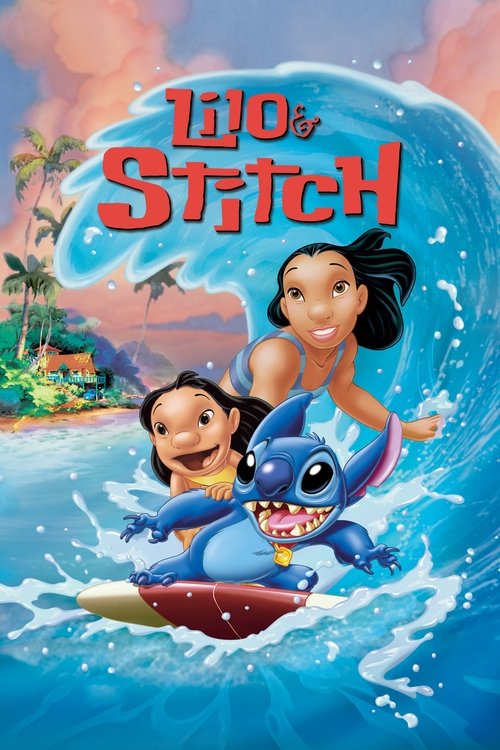
Lilo & Stitch
2002 · Dean DeBlois
When you want a family movie with an actual heart — comfort viewing that will still make you cry, whether you're eight or thirty-eight. Ideal for a cozy night when 'found family' is exactly the medicine you need.
What it's about
A destructive little alien — a runaway genetic experiment — crash-lands in Hawaii and gets adopted as a 'dog' by Lilo, a lonely, odd, grieving girl being raised by her overwhelmed older sister. While alien bounty hunters close in, the real stakes are down here on Earth: a tiny household barely holding together under the eye of a social worker, and a lab-grown chaos machine learning what ʻohana means.
The experience
Anarchic and laugh-out-loud in one scene, quietly devastating in the next — it earns its tears honestly, through two sisters trying not to lose each other. Funnier and sadder than you remember.
Performances
Chris Sanders voices Stitch in a growl of his own invention, somehow making a snarling gremlin one of Disney's most lovable creations.
The craft
Made with unusual freedom at Disney's Florida studio, it pairs Sanders's rounded, off-model character designs with watercolor backgrounds — the studio's first sustained use of the medium since the 1940s — giving Hawaii a soft, sun-washed glow no other Disney film of its era has. The elvis-inflected soundtrack and handmade look hold up beautifully.
Why it matters
The great outlier of post-Renaissance Disney animation: proof the studio could tell a small, scruffy, emotionally honest story, and the birth of one of its most enduring characters.
Made far from Burbank at Disney's Florida studio, on a modest budget and with unusual creative freedom, Chris Sanders and Dean DeBlois's alien-adoption comedy is the great outlier of post-Renaissance Disney animation. Its heroine is a lonely, odd, grieving Hawaiian girl being raised by her overwhelmed older sister under the eye of a social worker; its 'puppy' is a lab-grown engine of destruction learning, against his programming, what a family is. The emotional stakes — poverty, child services, a household barely holding together — are more Ozu than princess movie, and the film honors them. Sanders, who also voices Stitch in a growl of his own invention, drew the characters in his rounded, off-model style, and the backgrounds were painted in watercolor, the studio's first sustained use of the medium since Dumbo in 1941 — giving Kaua'i a soft, sun-washed tenderness. Elvis on the soundtrack, hula treated with rare care, and 'ohana' entering the global vocabulary followed. Sanders and DeBlois would leave for DreamWorks and make How to Train Your Dragon; the misfit-and-creature bond they perfected here became a genre of its own.
A Deleuzian reading
Watch how Stitch moves before anyone has taught him to act like a puppy.
The full Deleuzian reading of Lilo & Stitch →
Reception
A modest sleeper hit in 2002 while Disney's other hand-drawn films (Atlantis, Treasure Planet) were flopping, it's since been canonized as the bright spot of the studio's post-Renaissance slump — and the 2025 live-action remake only intensified affection for the original.
How Lilo & Stitch was received, from release to now →
Influences: the films it descends from and the films it influenced
- Dumbo (1941) — Lilo & Stitch revived the watercolor-painted background, a technique Disney had not used on a feature since Dumbo, and matched its small-scale, near-wordless pantomime of a rejected outcast.
- Bambi (1942) — Its atmospheric painted-nature backgrounds and weight-driven, naturalistic animal acting are the model for how Stitch is animated as a real quadruped creature rather than a cartoon.
- Tokyo Story (1953) — DeBlois cited Ozu directly: the film borrows his low, static, tatami-level domestic framings and unhurried 'pillow-shot' pauses to let the family scenes breathe.
- E.T. the Extra-Terrestrial (1982) — Supplies the template of a lonely child secretly harboring a misunderstood alien who learns domestic human life — the 'creature learns family' structure Lilo & Stitch inherits.
- Frankenstein (1931) — Stitch as Experiment 626 is the engineered 'monster' built to destroy, reframed sympathetically — the destructive created being who is taught tenderness.
- Pinocchio (1940) — The manufactured non-human who longs to become a real, belonging member of a family — Stitch's arc toward 'ohana' descends from Pinocchio's quest to earn a place at the hearth.
- Blue Hawaii (1961) — Its Elvis-Presley Hawaiian song catalog is the direct source of the Elvis needle-drops that form Lilo & Stitch's diegetic musical spine.
- The Iron Giant (1999) — A near-contemporary hand-drawn film built on the same beat: a weaponized machine-creature choosing gentleness over its destructive design, bonded to an isolated child.
- Mulan (1998) — Directed by Mulan's head of story Chris Sanders, carrying his character-driven storytelling forward and reviving watercolor backgrounds as a painterly counter to CGI slickness.
- Ponyo (2008) — Extends the hand-painted seaside naturalism and the off-model, rubbery squash-and-stretch energy of a small chaotic creature loose in a household.
- WALL-E (2008) — Builds an entire lead performance on non-verbal growls, expressive eyes, and pantomime — the same wordless creature-acting vocabulary Sanders gave Stitch.
- How to Train Your Dragon (2010) — The same directors' misfit-and-creature bond; Toothless is Stitch reborn, carrying the cat-like off-model design and the growl-based nonverbal performance Sanders voiced himself.
- Big Hero 6 (2014) — Repeats the grief-and-found-family engine, pairing a bereaved child with a huggable, near-nonverbal companion whose comic physicality heals loss.
- Moana (2016) — Continues Disney's location-rooted staging of Pacific-Islander culture, with choreography and dance treated with the same research-grounded specificity Lilo & Stitch gave hula.
- Klaus (2019) — Revives hand-drawn painterly warmth and rounded, off-model character design in a found-family story, reasserting the traditional-media craft Lilo & Stitch fought to keep alive.
- Nimona (2023) — A destructive 'monster' adopted by a lonely outsider, animated with elastic squash-and-stretch chaos and softened by watercolor warmth — the disruptive-creature-as-found-family animation Nimona echoes.
- The Wild Robot (2024) — Sanders' own earlier film establishes his watercolor-washed backgrounds and the feral-creature-tamed-by-tenderness template — Stitch's 'genetic weapon softened into family' is Roz's arc rehearsed in 2D.
- How to Train Your Dragon: The Hidden World (2019) — DeBlois and Sanders' template for staging a dangerous non-human companion as a behaving animal rather than a talking sidekick — Stitch's affection is played entirely in ear-set, spine curl and eyeline, the same pantomime grammar that carries Toothless and the Light Fury's wordless courtship.
- My Neighbor Totoro (1988) — Shares the watercolor natural backgrounds, the mostly wordless creature-companion to a grieving/lonely child, and the Ozu-like patience with everyday domestic rhythm.
- Treasure Planet (2002) — Same-year Disney 2D feature whose character-effects work (water, alien morphing) and watercolor backgrounds represent the parallel hand-craft track Treasure Planet abandoned for CG environments.
Similar films
- WALL·E (2008) — influence & lineage · same viewing thread
- How to Train Your Dragon (2010) — influence & lineage
- Ponyo (2008) — influence & lineage
- Moana (2016) — influence & lineage
- Big Hero 6 (2014) — influence & lineage
- The Wild Robot (2024) — same viewing thread
- Finding Nemo (2003) — same viewing thread
- Memoir of a Snail (2024) — same viewing thread
All the films related to Lilo & Stitch →
Watch it with: curated runs of related films
- Animation That Aches — A run of animated films that take loneliness, grief, and memory as seriously as any live-action drama — watch them in a row and the cartoon surface stops mattering.