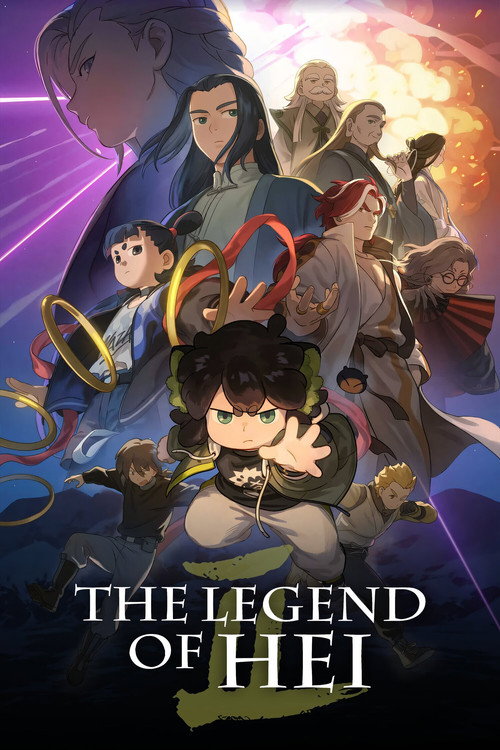
The Legend of Hei 2
2025 · Gu Jie
For when you want animation that's both adorable and genuinely thrilling — a big adventurous ride you can share across ages without it ever feeling like a kids-only affair. Comfort viewing with real craft behind it.
What it's about
The fragile peace between the spirit world and humanity is shattered by a sudden attack, and the cat-spirit Hei — small, black, and deceptively powerful — sets out to uncover who's behind it. Teaming up with Luye, the last disciple of his master Wuxian, he follows a conspiracy that threatens both realms and tests the bonds between master, student, and friend.
The experience
Fleet, lyrical, and bursting with kinetic action — it alternates gentle, almost pastoral charm with fight sequences of remarkable clarity and invention. It's the rare fantasy spectacle that stays light on its feet for two full hours.
The craft
Made by creator MTJJ's team at studio HMCH, it doubles down on hand-drawn 2D animation at a moment when Chinese features are dominated by CG — clean lines, expressive character work, and action choreography with real spatial logic. The fluidity and detail absolutely reward a big screen.
Why it matters
As the flagship sequel in one of China's most beloved homegrown animation franchises, it stands as a proof of concept that traditional 2D can still anchor blockbuster-scale filmmaking in the donghua boom.
Snapshot
The Legend of Hei 2 (罗小黑战记2, Luo Xiaohei Zhanji 2) is a Chinese animated fantasy-action feature released in mainland China on 18 July 2025, running roughly 120 minutes. It is the long-awaited follow-up to The Legend of Hei (2019) and the third principal work — after that film and the long-running web series — set in the world of the cat-spirit Xiaohei ("Hei") and his human master Wuxian. The picture is co-directed by the franchise's creator, the pseudonymous animator MTJJ (Mu Tou / 木头), together with Gu Jie (顾杰); the prompt's sole director credit for Gu Jie reflects his elevation to full co-director on the sequel. Produced by Beijing's Hanmu Chunhua (HMCH) studio, the film sustains the franchise's defining commitment to hand-drawn 2D animation at a moment when the Chinese feature market is dominated by CG spectacle. It earned a Douban score around 8.6–8.7 — reportedly the highest for a Chinese theatrical release in 2025 — and grossed roughly 533 million RMB (about US$75 million), a strong if not record-breaking result, before international rollouts through GKIDS in North America (September 2025) and in Japan (November 2025).
Industry & production
The film was made by Beijing Hanmu Chunhua Animation Technology Co. (HMCH / 寒木春华), the independent studio that has housed the Luo Xiaohei property since MTJJ began the web animation in 2011. Producers are credited as Cong Fangbing and Cao Zijian, with distribution through Qianwanjian Media and co-financing partners including Chinese Online (中文在线) and Maoyan Pictures (猫眼影业) — a mix of a boutique creative studio with larger capital and distribution muscle that is characteristic of the contemporary "guochan donghua" (domestic-animation) sector. Public accounts place the sequel's project filing around 2023 and describe a long gestation: screenwriting reportedly began not long after the 2019 film and stretched across roughly a year and a half, while the full production cycle is repeatedly cited at about six years. That timeline underscores the economics of hand-drawn feature animation — labor-intensive, slow, and difficult to scale — and helps explain the six-year gap between installments. The 2019 predecessor had already proven the property's theatrical viability and cultivated a devoted fanbase both in China and, via a 2020 Japanese release, abroad; the sequel was positioned as a marquee 2025 title in a year whose animation conversation was otherwise consumed by the record-shattering Ne Zha 2.
Technology
The Legend of Hei 2 is built on traditional 2D hand-drawn animation supported by 3D modeling — a hybrid pipeline in which digital tools assist layout, camera moves, and the placement of complex or repeating elements while the character animation and much of the linework remain drawn by hand. Studio and press materials cite figures that convey the scale of the undertaking: on the order of 200,000 drawings across roughly 2,400 shots. The most significant technical choice is the extensive use of animating "on ones" (一拍一 / "one-to-one") in the action set pieces — a new drawing for every frame rather than the more economical practice of holding each drawing for two frames. On ones yields conspicuously fluid, weighty motion, but at double the drawing labor, and its deployment across ten major action sequences is the film's headline technical ambition. As with all animation, the "photography" or compositing stage — the digital layering, lighting, and finishing that unify drawn and modeled elements — is where the film's polished, painterly surface is finally assembled. Beyond these well-documented points the granular pipeline specifics are not fully public, and I won't speculate about software or per-department workflows.
Technique
Cinematography
In an animated film "cinematography" denotes the compositing and virtual-camera work rather than a photographed image, and here it is credited to Liang Shuang (梁爽). The franchise's visual signature is a clean, high-key palette, generous negative space, and a picture-book clarity of staging inherited from MTJJ's web work and the 2019 feature. The sequel expands the pictorial ambition toward more dynamic camerawork — sweeping moves and depth staging enabled by the 3D-assisted layout — while preserving the readable, uncluttered frames that let the drawn characters carry the eye. Precise shot-by-shot analysis of the finished film is beyond what the public record supports in detail, so I describe tendencies rather than catalog specific compositions.
Editing
The film's editing rhythm is organized around the contrast between its quiet, pastoral passages and its extended action sequences. The "on ones" set pieces are engineered for sustained fluidity, which typically favors longer-held, choreographed shots over rapid cutting — letting the eye follow motion across space rather than assembling impact from fragments. Named editorial credits are not prominent in the available sources, and I won't attribute the cut to a specific hand without confirmation.
Mise-en-scène / staging
Staging is the franchise's strongest suit. The world of Luo Xiaohei mixes contemporary and traditional Chinese settings with a spirit realm of transforming yaoguai, and the sequel continues to render both with warmth and specificity — mountain retreats, guild halls, and the human city — while integrating recognizably Chinese architectural and decorative motifs. Character designs for Xiaohei, Wuxian, and the guest-appearing Nezha carry over from the 2019 film with updated costuming, and the new co-lead Luye is staged as Wuxian's disciple and Hei's "senior sister" (shijie), her design and bearing keyed to the master-disciple lineage at the story's heart.
Sound
The score is composed by Sun Yujing (孙玉镜). The Mandarin release carries the opening theme "嘘" performed by the artist billed as Aiso (艾索), and the Japanese version features "Little Bouquet" by Aimer — a notable cross-market touch given the franchise's strong following in Japan. Detailed sound-design credits are not surfaced in the sources I consulted; I note the music above as the confirmed element and leave the mix and effects work undescribed rather than invent particulars.
Performance
The Mandarin voice cast reprises and extends the franchise's ensemble: Shan Xin (山新) returns as Xiaohei, doubling as the guest Nezha; Liu Mingyue (刘明月) voices the master Wuxian; and Zhu Jing (朱婧) plays the new disciple Luye. Supporting players include Li Haojia, Luan Lisheng, Huang Zhenji, and Fu Chenyang. Shan Xin's continuity in the title role is central to the property's identity — her light, boyish reading of Xiaohei anchors the character across web series and features — and the sequel's dramatic weight rests substantially on the vocal interplay between the wary, grieving Hei and the composed, watchful Luye.
Narrative & dramatic mode
The sequel operates in a mode of mystery-driven adventure grafted onto the franchise's gentle, character-first sensibility. Its inciting event is an attack that ruptures the fragile truce between spirits and humans; physical evidence at the scene implicates Wuxian himself, and the film follows Hei and Luye as they pursue a tangled conspiracy toward the truth. This is a whodunit structure in fantasy dress — the audience, like the protagonists, is asked to doubt a figure the series has taught it to trust — and it lets the film dramatize loyalty, framing, and betrayal without abandoning the intimate register of its predecessor. Chronologically the story is positioned between the 2019 film and the ongoing web series, deepening the Hei–Wuxian bond that the first feature established as its emotional core. The dramatic mode balances propulsive action beats against reflective, slice-of-life interludes, a rhythm the franchise inherits partly from Japanese television animation.
Genre & cycle
The film sits at the intersection of fantasy, wuxia-inflected action, and coming-of-age adventure. Its supernatural "executors" who police the spirit-human border, its transforming spirits, and its martial choreography place it adjacent to the broader xianxia/wuxia imagination, but its scale is intimate rather than mythological. Within the Chinese animation revival cycle — from Monkey King: Hero Is Back (2015) and Big Fish & Begonia (2016) through White Snake (2019), Ne Zha (2019), and Ne Zha 2 (2025) — The Legend of Hei 2 is a deliberate outlier: where the dominant blockbuster mode is 3D CG spectacle drawn from classical mythology, the Hei films pursue hand-drawn 2D and original, contemporary-fantasy worldbuilding. That positioning makes the franchise a distinct cell within the cycle — the standard-bearer for 2D feature animation in a CG-dominated market.
Authorship & method
The authorial center of the property is MTJJ (Mu Tou / 木头), who created The Legend of Luo Xiaohei as a web animation in 2011, directed the 2019 feature, and co-directs and co-writes the sequel. His method is auteur-driven in the manner of independent animation: a personal, hand-drawn style, patient production timelines, and a worldview — coexistence and ecological displacement — carried consistently from short-form web episodes to features. The sequel formalizes Gu Jie (顾杰) as co-director, reflecting a shift from single-author origin toward a studio-team model as the productions grow in scale and ambition. The screenplay is credited to MTJJ, Gu Jie, Peng Kexin (彭可欣) — a returning writer associated with the property's scripting — and Fengxishenlei (风息神泪). Key collaborators include composer Sun Yujing, compositing/"cinematography" lead Liang Shuang, and the returning voice ensemble led by Shan Xin. Public biographical detail on Gu Jie specifically is thin, and I won't fill it with invented particulars; his significance here is best read through the collaborative, studio-forward method the sequel represents.
Movement / national cinema
The film belongs squarely to contemporary Chinese animation (国漫) and its post-2015 renaissance, a movement propelled by domestic box-office growth, national cultural policy favoring homegrown content, and a maturing talent pool. Yet the Hei films also wear their debts to Japanese animation openly: the slice-of-life pacing, the spirit-versus-humanity thematics, and the Ghibli-adjacent naturalism recall Miyazaki — Princess Mononoke above all, given the shared premise of spirits displaced by human expansion. The franchise's warm reception in Japan, including a Japanese-language release with an Aimer theme song, marks it as a genuinely cross-cultural work within the East Asian animation sphere rather than a purely national product.
Era / period
The Legend of Hei 2 arrives at a high-water mark for the Chinese animation industry. Its 2025 release year coincided with Ne Zha 2's historic box-office run, which reframed expectations for domestic animation's commercial ceiling. Against that backdrop the sequel's roughly 533-million-RMB gross reads as a solid mid-scale success — proof that a hand-drawn, fan-cultivated property can sustain a theatrical business without blockbuster mythology. The era is defined by industrial maturation: multi-year production cycles, hybrid 2D/3D pipelines, and coordinated theatrical-plus-international distribution (GKIDS in North America, a dedicated Japanese release), all of which the film exemplifies.
Themes
The franchise's governing theme is coexistence under strain — the fragile, negotiated peace between humans and the spirit world, and the ecological anxiety of yaoguai losing their homes to human expansion. The sequel channels this into a story of trust and its betrayal: an attack that pins guilt on the trusted master Wuxian forces Hei and Luye to weigh evidence against loyalty, and to distinguish conspiracy from truth. Around that spine cluster the series' recurring concerns — the master-disciple bond and found family, pacifism versus vengeance, and the moral cost borne by the "executors" who keep an uneasy order. Reviewers have singled out the film's more mature handling of war-and-peace motifs, a darkening and deepening of themes the 2019 film introduced more gently.
Reception, canon & influence
Critically the film was very well received at home, carrying a Douban score in the 8.6–8.7 range — cited as the highest for any Chinese theatrical release of 2025 by that measure — with particular praise for its action animation (described in some coverage as a domestic high-water mark) and its integration of Chinese aesthetics with genuine emotional maturity. Commercially its roughly US$75-million gross confirmed the property's theatrical durability, and international releases through GKIDS extended its reach to Western audiences who had discovered the 2019 film on the festival and specialty circuit.
Influences on the film (backward): it draws most directly on its own lineage — the 2011 web series and the 2019 feature that established the world, characters, and hand-drawn house style — and beyond that on Japanese animation, especially the Ghibli tradition's human-nature-spirit conflict (the Princess Mononoke comparison is apt), the pacing of slice-of-life TV anime, and the choreographic grammar of anime action. Wuxia cinema's martial staging informs its fight design.
Legacy (forward): it is too recent for its influence to be assessed with any confidence, and I won't overstate it. What can be said is that the film strengthens the case for hand-drawn 2D as a viable feature format within a CG-dominated Chinese market, consolidates Luo Xiaohei as one of the country's most respected animation franchises, and — through its "on ones" action work — sets a visible craft benchmark that peers may measure themselves against. Whether it seeds a broader 2D revival or remains a distinguished outlier will only become clear as the decade's animation slate unfolds.
Reception
Arrived six years after the 2019 original to instant acclaim rather than sophomore-slump skepticism — it opened in China in July 2025 to rave audience scores (an 8.7 on Douban, the best of any domestic Chinese release that year) and was quickly snapped up by GKIDS for North America.
How The Legend of Hei 2 was received, from release to now →
Influences: the films it descends from and the films it influenced
- The Legend of Hei (2019) — The direct source of the house style — the same soft-line hand-drawn character construction, flat-shaded high-key compositing, and cat-spirit design vocabulary that Hei 2 inherits and scales up.
- Princess Mononoke (1997) — Supplies the staging template for spirit-vs-human conflict as a morally ambiguous ecological standoff, where gods/beasts hold the frame with the same gravity as humans rather than serving as villains.
- Spirited Away (2001) — Model for spirit-realm worldbuilding as a densely populated otherworld governed by its own social rules and hierarchy, which Hei 2's realm of spirits directly echoes in its layered background design.
- Redline (2009) — The benchmark for fully hand-drawn action animated 'on ones' — every frame a discrete drawing — establishing the frame-by-frame density that Hei 2's fight sequences pursue as a domestic high-water mark.
- A Touch of Zen (1971) — Founds the wuxia martial grammar — weightless vertical leaps, elevation edits, and bamboo/negative-space framing — that informs Hei 2's fight choreography and high-key negative-space compositions.
- Crouching Tiger, Hidden Dragon (2000) — Translates wire-fu into lyrical, gravity-defying duels whose airborne, decelerated-then-explosive rhythm is the choreographic logic Hei 2 renders as drawn action.
- The Boy and the Beast (2015) — Provides the mentor-apprentice training arc across a human/spirit-realm divide, blending hand-drawn figures into 3D-assisted environments — the same hybrid pipeline and master-pupil spine Hei 2 uses for Wuxian and Xiaohei.
- The Tale of Princess Kaguya (2013) — Asserts expressive line economy and high-key minimalism with vast empty space as a deliberate formal device, precedent for Hei 2's negative-space, low-density compositing.
- Monkey King: Hero Is Back (2015) — The film that proved theatrical viability for guochan donghua and paired a jaded warrior with a child companion — the commercial and relational template Hei 2 extends in the same movement.
- Big Fish & Begonia (2016) — Builds a Chinese-mythology spirit realm through Ghibli-inflected hand-drawn aesthetics, running the same coexistence-of-worlds worldbuilding within the Chinese-animation-maturation cohort.
- White Snake (2019) — A xianxia feature reviving classic Chinese fantasy for theatrical animation — the CG-pipeline counterpart to Hei 2 within the guochan xianxia-wuxia revival.
- Ne Zha (2019) — The commercial breakout of mythic-action set-piece scale that set the box-office and spectacle bar Chinese animated peers, including Hei 2, are measured against.
- Wolfwalkers (2020) — Cartoon Saloon's flagship case that hand-drawn 2D remains a viable feature format against CG dominance, carrying the identical human/nature-spirit coexistence theme in drawn form.
- Promare (2019) — Runs the hybrid 2D-on-3D pipeline with virtual-camera compositing and high-contrast graphic negative space — the exact technical toolkit behind Hei 2's virtual-camera action staging.
Similar films
- The Boy and the Beast (2015) — influence & lineage
- Spirited Away (2001) — influence & lineage
- Wolfwalkers (2020) — influence & lineage
- Ne Zha 2 (2025) — same viewing thread
- KPop Demon Hunters (2025) — same viewing thread
- Demon Slayer: Kimetsu no Yaiba Infinity Castle (2025) — same viewing thread
- Puss in Boots: The Last Wish (2022) — shared sensibility
- The Cat Returns (2002) — shared sensibility
All the films related to The Legend of Hei 2 →
Watch it with: curated runs of related films
- Sympathy for the Demon — A run of the 2025 animation wave where the line between demon-hunter and demon keeps blurring — outcast heroes carrying monstrous power, and monsters worth rooting for.