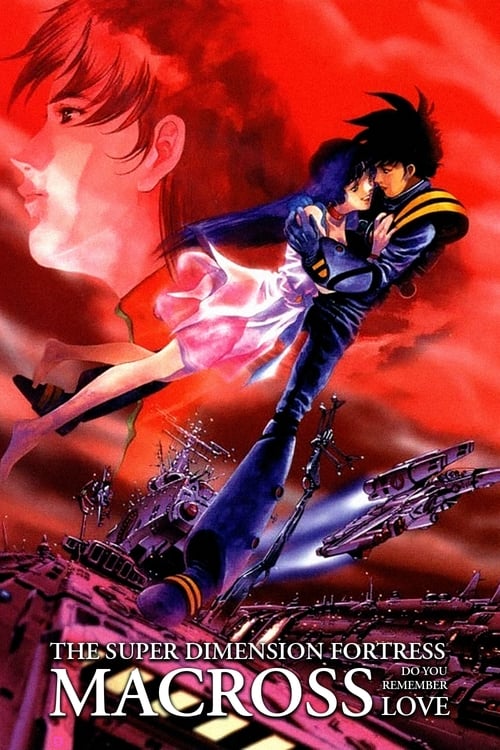
Macross: Do You Remember Love?
1984 · Noboru Ishiguro
For when you want to be swept up — big romantic sci-fi that takes both its dogfights and its love songs seriously. Reach for it when you're craving maximalist animation and don't mind your space opera unabashedly sincere.
What it's about
In 2009, the giant warship SDF-1 Macross limps back toward Earth with an entire refugee city sealed inside its hull, caught in a war between two sundered halves of a giant alien species — the male Zentran and female Meltran. Aboard, a rookie fighter pilot, a poised bridge officer, and a teenage pop idol are tangled in a love triangle while battles rage outside the hull. It's a space war epic where a pop song may matter as much as a fighter squadron.
The experience
Overwhelming in the best way — dense, gorgeous frames, transforming fighters tumbling through missile trails, then sudden hushes for a ballad or a stolen moment between two people in a dead city. It swings between spectacle and ache, and the melodrama is played completely straight.
The craft
A wholesale theatrical remake of a TV series, re-storyboarded and re-animated at a level of finish television could never afford — the mechanical animation, crowded battle choreography, and painted detail were a high-water mark for hand-drawn sci-fi. The music is structural, not decoration: songs drive the story. It absolutely rewards the biggest screen and best sound you can give it.
Why it matters
A touchstone of 1980s anime and the definitive statement of the Macross idea — that culture and song belong at the center of a war story — with an influence on mecha and idol-driven sci-fi that runs through decades of the medium.
Snapshot
Released in Japan by Toho in July 1984, Chōjikū Yōsai Macross: Ai Oboete Imasu ka is the theatrical retelling of the 1982–83 television series The Super Dimension Fortress Macross — not a compilation, but a wholesale remake, re-storyboarded and re-animated at a level of finish the TV production could never have afforded. In roughly 115 minutes it condenses a 36-episode war epic into a single arc: the colossal alien warship SDF-1 limping home across the solar system with a refugee city sealed inside its hull; a rookie pilot, a bridge officer and a teenage pop singer bound in a love triangle; and a war between two sundered halves of a giant humanoid species, male Zentran and female Meltran, that ends not by force of arms but by the recovery of an ancient love song.
It arrived in the same year as Nausicaä of the Valley of the Wind, and the pairing is not incidental: 1984 is the hinge at which Japanese theatrical animation established itself as a medium with its own visual ambitions rather than a merchandising afterthought. Where Miyazaki's film argued for animation as ecological parable, Do You Remember Love? argued for it as spectacle — hand-drawn aerial combat of a density and spatial coherence that had, quite simply, not been seen before. Four decades on it remains one of the most technically admired anime features ever made, and one of the least legally available outside Japan.
Industry & production
The Macross project originated at Studio Nue, a small design house staffed by science-fiction illustrators and fans — Shōji Kawamori, Kazutaka Miyatake, Haruka Takachiho — working with the sponsor Big West and, for broadcast, Tatsunoko Production. The television series was chronically underfunded and notoriously uneven; its production breakdowns are part of anime folklore, with certain episodes shipping in a state of visible collapse. That the series nonetheless became a phenomenon created an unusual opportunity: a theatrical budget and schedule with which to make the show its makers had actually designed.
The film was assembled the way ambitious 1980s anime features generally were — a core studio (Artland, which Noboru Ishiguro had co-founded, alongside Studio Nue's design leadership) supplemented by a large freelance corps of the era's strongest animators. Rather than spread the money thinly, the production concentrated it: exceptionally high cel counts, complex multi-layer photography, and full re-animation of every sequence. The result is a film whose per-second cost is legible on screen in a way that TV-derived features of the period rarely are.
Two structural facts shape its afterlife. First, the film was a genuine commercial success in Japan and its theme song a real pop hit, which established that anime features could operate as mainstream entertainment events. Second, the tangled ownership of Macross — the long-running dispute between Big West/Studio Nue and Harmony Gold, which had licensed the TV series as part of Robotech — kept Do You Remember Love? effectively locked out of legitimate Western release for decades. Its only significant early English-language circulation was a heavily cut and re-dubbed home-video version titled Clash of the Bionoids, widely regarded as a mutilation. A settlement between the rights holders reported in 2021 opened a path for legitimate international distribution, but for most of its life the film reached non-Japanese audiences through imports, laserdiscs and bootlegs — an unusual case of a canonical work whose canonicity was built almost entirely on fan circulation.
Technology
This is a pre-digital film in the strictest sense: cels, paint, painted backgrounds, an optical camera stand, 35mm. Its technical reputation rests on how far conventional cel technology was pushed rather than on any new tool.
The signature apparatus is the multi-pass photography stage. Beam weapons, engine exhaust, explosive cores and the glow of the Macross's reactor are rendered with tōkakō — transmitted light, exposed through masks so that light appears to emanate from within the image rather than being painted on top of it. Diffusion filters, double exposures and airbrushed gradient work give the space battles a luminous, atmospheric quality; smoke and vapor trails are treated as a persistent, accumulating element rather than an effect that clears between shots.
The mechanical animation is entirely hand-constructed. There is no computer assistance in the perspective work: every rolling, banking, transforming fighter is drawn frame by frame with the volumes held consistent through arbitrary rotations. Kawamori's design method is relevant here — he is widely reported to have worked out the VF-1 Valkyrie's three-mode transformation with physical models, so that the fighter-to-humanoid conversion obeys a real mechanical logic rather than a cheat. That constraint is what makes the transformations legible in motion; the audience can follow the geometry because the geometry is actually closed.
Technique
Cinematography
"Cinematography" in cel animation means layout plus the photography stage, and Do You Remember Love? is exemplary in both. Layouts favour long, deep compositions — the interior of the SDF-1's dome, the ruined surface of Earth, alien fleets receding into vanishing points — with multiplane separation giving parallax to foreground debris and background hulls. The framing is composed for a theatrical matte, and it uses the width: the film repeatedly stages tiny human figures against Zentran giants, or a single Valkyrie against a wall of capital ships, so that scale is delivered compositionally rather than through dialogue.
The virtual camera is the film's most influential invention. Ichirō Itano's action sequences place the viewpoint inside the engagement — riding a missile, tumbling with a fighter, whipping past hulls at speeds that force the eye to reconstruct space from motion. Focal-length behavior is simulated: distortion at the frame edge on close passes, compression in long lock-on shots. Where earlier space combat animation cut between fixed vantage points, this film moves the camera continuously through a three-dimensional battlefield, and that continuity is what makes the chaos readable.
Editing
The credited editing on 1980s anime features is thinly documented in English-language sources, and the substantive cutting decisions here were made upstream, in storyboard and timing sheets, as is standard for the form. What matters is the structural editing: the reduction of 36 episodes to a single feature arc. The film's solution is aggressive ellipsis. It opens in media res, mid-battle, with almost no exposition; relationships are established in glances and fragments; entire subplots of the series are simply absent. Newcomers frequently find the first act opaque, and the criticism is fair — the film assumes a viewer who already knows this world, or who is willing to infer it.
Against that compression, the film spends lavishly on two rhythms. One is the sustained action set piece, allowed to run long enough to build sensation rather than merely advance plot. The other is the musical montage: sequences carried by Minmay's songs over image, closer to music video than to conventional scene construction, and among the earliest fully realized instances of a device that would become standard in anime. The climax fuses both, cross-cutting a concert with a fleet engagement until the two become a single continuous action — the song is not accompaniment to the battle, it is the weapon being fired.
Mise-en-scène / staging
The central production-design conceit is the city inside the ship: a rebuilt town, complete with shops, streets and neon, sealed within the SDF-1's hull. It gives the film a domestic register — laundry, restaurants, a concert hall — running directly against the military-SF exterior, and it makes the stakes concrete. What the pilots defend is not an abstraction but a visible, inhabited interior.
Staging exploits the species scale gap relentlessly. Zentran and Meltran are giants; humans are handled, examined, dwarfed. The film returns to the confrontation of the very small and the very large as its basic visual idea, and extends it to the war itself — individual fighters against fleets that fill the frame to the horizon. The redesign of the Zentradi into two mutually hostile gendered branches is a script change from the series with direct staging consequences: it turns the war into a literalised sexual division, so that the resolution — a love song from a culture neither side remembers — lands as a structural answer rather than a sentimental one.
Sound
Kentarō Haneda, a jazz pianist and arranger who had scored the television series, returned with orchestral resources the broadcast production never had, and the film's dramatic scoring is correspondingly fuller and more symphonic. But the sound design's real distinction is its integration with the action animation: the layered wash of missile ignition, thruster roar and debris impact is mixed as a continuous texture rather than as discrete cues, and the mix takes advantage of theatrical multi-channel presentation in ways the series' broadcast audio could not.
The title song, "Ai, Oboete Imasu ka," was written outside the anime industry — music by Kazuhiko Katō, of the Folk Crusaders and Sadistic Mika Band, with lyrics by Kazumi Yasui — and performed by Mari Iijima. Commissioning mainstream pop professionals for an anime feature's centerpiece song was an early and consequential crossover; the record became a genuine hit, and the film's most famous sequence is built entirely on the assumption that the audience will hear it as a pop single, not a film cue.
Performance
Mari Iijima's Lynn Minmay is the film's load-bearing performance and one of the most consequential vocal performances in anime. Iijima was a working singer-songwriter cast as a teenager, and she both voices and sings the role; the slight amateurishness of her early line readings is inseparable from the character's credibility as a girl who becomes a star by accident. Arihiro Hase gives Hikaru Ichijyo an unpolished ordinariness that keeps the pilot from heroic inflation; Mika Doi's Misa Hayase carries the film's adult register, competent and guarded; Michio Hazama's Captain Global supplies weary authority, and Shō Hayami's Maximilian Jenius the film's touch of prodigious cool. Kazuyuki Sogabe's Roy Focker anchors the older-brother register the story removes early.
Narrative & dramatic mode
The film runs on two engines that most war stories keep separate. The outer engine is military SF: a stranded ship, a hopeless force disparity, a return to a ruined home. The inner engine is romantic melodrama — a triangle among a pilot, an officer and a singer, resolved without villains. Neither is subordinated. The dramatic mode is closer to opera than to war film: characters sing, the emotional stakes are total, and the resolution is achieved by an aesthetic act.
The Protoculture revelation supplies the joint. The discovery, in the ruins of the ravaged Earth, of an ancient archive containing a song and images of a vanished progenitor civilization reframes the entire conflict as a form of cultural amnesia. The Zentran and Meltran are not evil; they have been engineered into forgetting. Broadcasting the song is an act of restoration. It is a startlingly unmartial climax for a film so committed to the pleasures of combat, and the tension between those two commitments — spectacle of war, victory by culture — is the film's real subject.
Genre & cycle
Do You Remember Love? sits inside the "real robot" cycle inaugurated by Mobile Suit Gundam (1979) and extended by Space Runaway Ideon (1980): machines as mass-produced military hardware, wars with logistics, pilots who are soldiers rather than champions. Macross's specific contribution to the cycle was the transformable variable fighter — an aircraft first, a humanoid second — which pushed the genre toward aerial rather than infantry idioms.
It also belongs to a second, less obvious cycle: the idol film. Early 1980s Japan was saturated with the aidoru boom, and Macross imported its logic wholesale, making the manufactured pop star a protagonist and her performance a plot mechanism. The fusion of these two cycles is the franchise's permanent signature, and it happens most cleanly here.
Authorship & method
Noboru Ishiguro is credited as director, with Shōji Kawamori as co-director — Kawamori's first directing credit. Ishiguro was a veteran of the industry's founding generation, with roots reaching back to Mushi Production and Astro Boy and significant work on the Space Battleship Yamato franchise; he brought the classical space-opera grammar of long voyages, bridge crews and fleet actions, and he would go on to direct the monumental Legend of the Galactic Heroes. Kawamori supplied the mechanical conception and much of the film's visual imagination, and would later steer the whole Macross franchise (Macross Plus, Macross 7, Frontier) as well as The Vision of Escaflowne and Aquarion.
The other decisive collaborators: Haruhiko Mikimoto, whose soft, large-eyed character design gave the film its distinctive tension between delicate figures and brutal hardware, and whose style shaped a generation of character designers; Kazutaka Miyatake, responsible for much of the alien and capital-ship design; Sukehiro Tomita on screenplay; Ichirō Itano, whose action direction is the film's most imitated element; and Kentarō Haneda on score. The animation corps included figures who would become central to the following decade — Hideaki Anno among them — and the film functions in retrospect as a gathering point for the talent that would define late-1980s and 1990s anime.
Movement / national cinema
The film is a product of a specifically Japanese configuration: a fan-founded design studio (Studio Nue) with science-fiction literary roots, a toy-and-merchandise sponsor, a television system that produced the property, and a major studio distributor (Toho) that treated the feature as a mainstream release. Nothing in the contemporaneous American animation industry resembled this arrangement, which is a large part of why the film looked, to Western viewers who eventually saw it, as though it had arrived from a parallel industry.
It belongs to the moment when anime's authorship moved from studios to individuals — the same current that produced Miyazaki's and Ōtomo's features and, within a year, the OVA boom that let creators make direct-to-video work outside broadcast constraints. Ishiguro himself would participate in that shift with Megazone 23.
Era / period
1984 is the film's context in two directions. Its diegetic present, A.D. 2009, is a near-future extrapolation of Cold War anxiety — an alien war standing in for the annihilation the era assumed was coming, and the destruction of Earth's surface staged with an unmistakable memory of atomic devastation. Its production present is the height of Japan's bubble-era consumer culture: idol pop, city-pop gloss, a mass audience for entertainment technology, and a merchandising apparatus that could underwrite an expensive animated feature.
The film's central proposition — that culture, specifically pop culture, is powerful enough to end a war — reads as a statement of that moment's confidence. It also reads, less comfortably, as an argument that the audience's own consumption is meaningful, which is one reason the film has never quite been dismissible as escapism.
Themes
Culture as weapon and as inheritance. The Zentran and Meltran have been stripped of art, sexuality and memory; exposure to human ordinariness — cooking, kissing, singing — is a systemic shock. The film's proposition is that culture is not decoration but the substance of personhood, and that its loss is the actual atrocity.
Memory. The title is a question, and the film asks it of a species that cannot answer. The Protoculture archive is the plot's fulcrum, and the recovery of a song is presented as a form of historical restitution.
Scale and intimacy. The film's defining formal gesture — the small figure against the enormous machine — is also its thematic one. Everything that matters happens at human size inside structures indifferent to it.
The manufactured and the sincere. Minmay is a product, packaged and marketed, and the film neither pretends otherwise nor lets that fact void her sincerity. That refusal to resolve the contradiction is more sophisticated than the material's reputation suggests.
Reception, canon & influence
In Japan the film was a success and quickly became a benchmark; among animators and industry professionals it has held a near-permanent place in discussions of the best-animated anime features, cited alongside Nausicaä and later Akira as a marker of what theatrical animation could do. Critical reservations are consistent and legitimate: the compression makes the narrative elliptical to the point of obscurity for the uninitiated, characterization thins under the pace, and the resolution can strike unsympathetic viewers as a deus ex machina in a pop wrapper. Its outside-Japan critical reception was distorted for decades by unavailability and by Clash of the Bionoids, so the Western record is genuinely thin for the film's first twenty years and consists largely of fan criticism rather than mainstream review.
Backward. The film draws on Space Battleship Yamato for the long homeward voyage and the ship-as-community; on Gundam and Ideon for the real-robot idiom and, in Itano's case, directly for the missile-swarm technique he had been developing on those productions; on Star Wars for the grammar of fighter-scale combat against capital ships; on Studio Nue's science-fiction literacy for the Protoculture conceit; and on the contemporary idol industry for Minmay.
Forward. Itano's "Itano Circus" became a permanent part of the animated action vocabulary, visible across Gainax's output — Gunbuster, Neon Genesis Evangelion — and diffused far beyond anime into video-game combat design. Mikimoto's character style set a template for a decade of designers. The Macross formula of variable fighters, love triangle and song has governed every subsequent entry in the franchise, and the film's own status was later folded into the fiction: later Macross works treat Do You Remember Love? as an in-universe dramatization of the First Space War, a metafictional move that made the film simultaneously canonical and unreliable within its own continuity — an elegant solution to the contradictions between series and remake, and a rare instance of a franchise theorizing its own adaptation.
Its most durable legacy may be the simplest: it demonstrated that a television anime could be remade for cinema not as a cash-in but as a corrected, fully realized version of itself, and that audiences would treat the result as a major film. The anime feature as a serious commercial and artistic proposition begins, in significant part, here.
A Deleuzian reading
A missile leaves the rail and the camera goes with it.
The full Deleuzian reading of Macross: Do You Remember Love? →
Reception
A blockbuster event film in 1984 Japan, instantly hailed as a peak of cel animation — but in the West it spent decades as a bootleg legend, tangled in the Robotech-era licensing feud that kept it without an official US release, which only deepened its mystique before its eventual canonization as one of the most gorgeous animated films of the 80s.
How Macross: Do You Remember Love? was received, from release to now →
How to watch Macross: Do You Remember Love?: what to notice on a first viewing
- Watch the camera ride inside a fired missile. Itano's action sequences put the viewpoint inside the fight itself, tumbling with fighters and whipping past hulls as if a camera were physically there. You are placed somewhere no real camera or pilot could survive.
- Notice how tiny the human pilots look near giants. The film keeps returning to a single fighter against a wall of capital ships, or a human handled and examined by a towering Zentran, the same scale gap repeated throughout. The war's whole shape is delivered through size, not through anything a character says.
- Watch for shops, laundry, and streets inside the warship. A rebuilt town, complete with neon and a concert hall, sits sealed inside the SDF-1's hull, running directly against the military exterior surrounding it. What the pilots are defending is an ordinary, inhabited place, not an abstraction.
- Watch the beams and engines glow from within. Weapon fire and reactor cores are drawn so the light appears to come from inside the image itself, rather than being painted on top of the surface. The glow reads as a real presence in the frame, not just an effect layered over it.
- Listen for a song carrying a whole sequence. Several passages are built around Minmay's songs playing over the images, closer to a music video than an ordinary scene, well before that became common in anime. The music is not underscoring the picture. In these stretches, the music is the scene.
The whole guide to watching Macross: Do You Remember Love?, with the keys for a rewatch →
Influences: the films it descends from and the films it influenced
- Space Battleship Yamato (1974) — Ishiguro's own founding grammar for the ship-as-inhabited-community: battle scenes cut between command deck, engine spaces and civilian interiors so the vessel reads as a place rather than a vehicle — the direct precedent for DYRL's city-inside-the-Macross staging.
- Farewell to Space Battleship Yamato: Soldiers of Love (1978) — Established the theatrical remake as a 'corrected, finished' version of a TV property, and the device of dropping a commissioned vocal theme over the sacrificial climax so the song, not dialogue, delivers the resolution.
- The Super Dimension Fortress Macross (1982) — Source of the three-mode Valkyrie transformation animated as continuous mechanical geometry (no cutaway cheat) and of Minmay's diegetic idol numbers; DYRL re-boards its own material at feature density, converting serialized exposition into aggressive ellipsis.
- Mobile Suit Gundam III: Encounters in Space (1982) — Codified the real-robot idiom DYRL inherits — mass-produced machines with finite ammunition, thrust-vector maneuvering and no super-robot finishing move — plus the industrial model of recutting a TV series into theatrical features with new animation.
- Space Runaway Ideon: Be Invoked (1982) — Itano's mecha animation here developed the swarm-missile choreography — dozens of independently arcing smoke trails read as one volumetric mass moving through depth — that DYRL formalizes as the Itano Circus, alongside a climax built from accelerating crosscuts between fleet annihilation and intimate close-up.
- Star Wars (1977) — Supplied the fighter-versus-capital-ship shot grammar Kawamori restages by hand: long-lens flat-on strafing passes, foreground hull detail streaking through frame to sell velocity, and gunner's-eye reverses — a simulated physical camera rather than an animation camera.
- Crusher Joe: The Movie (1983) — The immediate rehearsal: Studio Nue's hardware-realist design lineage (Takachiho, Miyatake) meeting Itano's key animation on its space-combat sequences, at theatrical drawing counts, one year before DYRL.
- Galaxy Express 999 (1979) — Model for camera-stand transmitted-light (tokashi) work — starfields, engine bloom and beam flare exposed through the cel rather than painted on it — and for closing a feature on a commissioned pop single that carries the emotional resolution.
- Megazone 23 (1985) — Ishiguro immediately reruns his own kit: a city that turns out to be inside a ship, an idol singer (Eve) whose performance is the plot's hinge, and a transforming vehicle animated with Itano-school missile passes.
- Gunbuster (1988) — Anno, a DYRL animator, rebuilds the Itano Circus and the transmitted-light beam/flare palette wholesale, and pushes the giant-versus-human scale gap into widescreen compositions where the mecha exceeds the frame and the pilot is a single cel-level detail.
- Legend of the Galactic Heroes: My Conquest Is the Sea of Stars (1988) — Ishiguro extends DYRL's continuous-mix philosophy to an entire space opera — symphonic score running wall-to-wall under fleet action with dialogue and effects treated as texture inside the music rather than punctuating it.
- Macross Plus (1994) — Kawamori escalates the simulated focal length and lens artifacts of the dogfights with early CG camera moves, and turns the pop-single-as-plot-device into Sharon Apple — a song that literally seizes narrative control instead of merely resolving it.
- Neon Genesis Evangelion: The End of Evangelion (1997) — Inverts victory-by-song into catastrophe-by-song: a vocal pop track carries an extended crosscut montage with dialogue withdrawn, while the mass-production Eva pursuit is staged as a textbook Itano Circus.
- Voices of a Distant Star (2002) — A one-man production that keeps DYRL's structural rhyme intact — girl in a transforming mecha, intimate lyric line, combat cut to a song's phrasing — building whole action passages as musical montage rather than dramatized beats.
- Macross Frontier: The Wings of Goodbye (2011) — The formula's endpoint: climactic crosscutting between concert stage and dogfight locked to the song's beat, plus the metafictional move of treating DYRL itself as an in-universe film the characters have watched.
- KPop Demon Hunters (2025) — Founded the idol-as-weapon premise KDH literalizes — a pop singer whose performance is diegetically a combat force against a supernatural enemy, fusing concert spectacle with battle staging.
- Nausicaä of the Valley of the Wind (1984) — Same-year proof that TV-trained crews could sustain feature layout: multiplane parallax and scale contrast achieved by staging a moving camera past layered planes, so a tiny human figure registers against a colossal body without a scale-establishing cutaway.
- Royal Space Force: The Wings of Honnêamise (1987) — The Gainax cohort that animated on DYRL applied the same hardware-first discipline — every exhaust, rivet and control surface drawn to functional logic — to a launch sequence carried by one unbroken orchestral cue with dialogue mixed beneath it.
- Mobile Suit Gundam: Char's Counterattack (1988) — Tomino answers Itano's swarm grammar with funnel and beam lattices choreographed in three-dimensional depth, and scores the entire final act as a continuous orchestral-plus-vocal wall in DYRL's continuous-mix manner.
Similar films
- Neon Genesis Evangelion: The End of Evangelion (1997) — influence & lineage
- Evangelion: 2.0 You Can (Not) Advance (2009) — shared sensibility
- Interstella 5555: The 5tory of the 5ecret 5tar 5ystem (2003) — shared sensibility
- Evangelion: 3.0+1.0 Thrice Upon a Time (2021) — shared sensibility
- Redline (2009) — shared sensibility
- Cowboy Bebop: The Movie (2001) — shared sensibility
- Akira (1988) — shared sensibility
- Blue Giant (2023) — shared sensibility