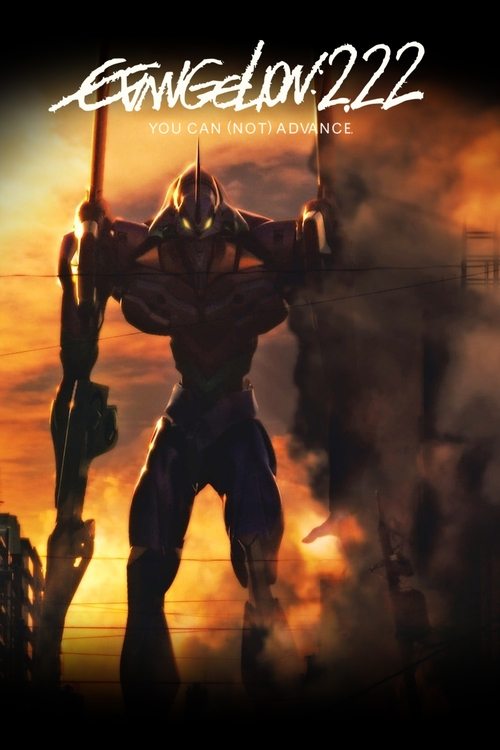
Evangelion: 2.0 You Can (Not) Advance
2009 · Masayuki
For when you want spectacle with a soul — a big, loud, gorgeous action movie that sneaks up on you emotionally. Comfort food at first, genuinely intense by the end; best when you're ready to feel wrung out.
What it's about
Monstrous beings called Angels keep descending on the fortified city of Tokyo-3, and a handful of teenagers are the only ones who can pilot the biomechanical giants built to stop them. Into that pressure cooker arrive two new pilots — the fierce, prideful Asuka and the enigmatic Mari — while the adults running the defense agency NERV pursue a secret agenda of their own. At the center is Shinji, a boy trying to connect with the people around him even as the stakes of each battle grow apocalyptic.
The experience
It runs hot and fast: dazzling, color-drenched battle sequences that hit like a rollercoaster, threaded with quieter scenes of teenagers cooking dinner and testing out something like friendship. The warmth is real, which is exactly why the mounting dread underneath it lands so hard — by the finale the film is operating at an almost overwhelming emotional and visual pitch.
The craft
Made at Studio Khara, the company Hideaki Anno founded to reclaim his own creation, it fuses hand-drawn intensity with digital production, and the action choreography is some of the most kinetic in modern animation — geometrically audacious, saturated in color, cut to the millisecond. This is a film built for the biggest screen and loudest speakers you can find.
Why it matters
The second chapter of the Rebuild of Evangelion project, where Anno's rewriting of his epochal 1990s series stopped being a remaster and became something new — familiar scenes bending into unfamiliar shapes, which electrified and destabilized a global fanbase in equal measure.
The second installment of the Rebuild of Evangelion tetralogy is where Hideaki Anno's project reveals its true ambition: not a remaster of his epochal 1990s television series but a rewriting of it, familiar scenes bending into unfamiliar shapes until longtime viewers lose their footing entirely. Teenage pilots in biomechanical giants still defend a fortified Tokyo-3 from inscrutable invaders called Angels, but the emotional temperature has changed — warmer, more social, almost hopeful, which in the Evangelion universe is its own kind of dread. Produced at Studio Khara, the company Anno founded to reclaim his creation, the film marries hand-drawn intensity with digital production, and its battle sequences — color-saturated, geometrically audacious — rank among the most kinetic in modern anime. A new pilot, Mari, and a subtly altered Asuka signal that the deck has been reshuffled. The final movement, scored to Hikaru Utada, escalates with an abandon that left theaters in stunned silence, and its closing minutes remain a landmark of animation as pure emotional overload. Few franchise films have dared to betray their source this thrillingly.
Reception
A crowd-pleasing event on release in Japan in 2009, it was embraced as the moment the Rebuild films stopped being a remake and became something new — and after the divisive 3.0, fans retroactively canonized 2.0 as the tetralogy's high point.
How Evangelion: 2.0 You Can (Not) Advance was received, from release to now →
Influences: the films it descends from and the films it influenced
- Neon Genesis Evangelion (1995) — The TV original supplies the exact shot compositions, character designs, and Angel roster that Rebuild's 'self-rerewrite' method recopies and then deliberately diverges from, making the recomposition legible as authorship.
- The End of Evangelion (1997) — Its climactic strategy — cranking cross-cut destruction against a single pop-vocal ballad until affect overloads — is the template Rebuild 2.0 reworks with Utada's 'Beautiful World' over the Zeruel finale.
- Gunbuster (1988) — Anno's Gainax debut established his signature escalation of mecha scale plus a sudden emotional/tonal switch at the finale, the same build-and-detonate curve driving 2.0's Unit-01 awakening.
- Ultraman (1966) — Anno's lifelong tokusatsu debt shows in the geometrically posed giant-vs-monster staging — figures planted mid-frame against receding cityscape grids — that structures the color-saturated battle set-pieces.
- Space Runaway Ideon (1980) — Tomino's apocalyptic 'everyone transcends flesh' finale and the idea of a robot as an incomprehensible divine engine feed Eva's dread-in-hope theology and the berserker Unit-01.
- Mobile Suit Gundam (1979) — The 'real robot' innovation — mecha as maintained military hardware with logistics, launch sequences, and umbilical cables — is the genre grammar Eva inherits and then re-mystifies.
- 2001: A Space Odyssey (1968) — Kubrick's frontal, symmetrical framing of monoliths and vast machinery as sublime geometric objects is a direct source for Anno's 'geometric audacity' staging of Angels and the Eva launch bays.
- Devilman (1972) — Nagai's fusion of protagonist and monstrous power, where the hero's body becomes the horror, prefigures the pilot-Eva symbiosis and the fleshy, screaming Unit-01.
- Puella Magi Madoka Magica (2011) — Inherits Eva's deconstruction method — a wish-fulfillment genre revealed as a trap for traumatized children — plus abstract, collage-based monster design descended from the Angels' non-figurative geometry.
- Evangelion: 3.0 You Can (Not) Redo (2012) — The next tetralogy installment weaponizes 2.0's 'reshuffled deck': the timeskip and consequence-of-the-finale structure only work because 2.0 rewrote the source enough to strand the audience.
- Evangelion: 3.0+1.0 Thrice Upon a Time (2021) — The tetralogy's resolution completes the hand-drawn/digital-hybrid technique 2.0 pioneered, fully integrating CG Eva bodies with 2D animation into a single plastic, warping space.
- Promare (2019) — Extends 2.0's color-saturated battle palette and geometric-audacity staging into flat CG polygonal shapes, treating combat as pure graphic design of hue and angle rather than realism.
- Nadia: The Secret of Blue Water (1990) — Anno developed here the reluctant-boy/wounded-girl dynamic and the warmer social-comedy register that 2.0 amplifies with Mari and the softened Asuka to make the eventual cruelty land harder.
- FLCL (2000) — Co-director Tsurumaki's hyper-kinetic, genre-collaging edit — coming-of-age emotion channeled through robots erupting from a body — is the sensibility he carries into Rebuild's overload climaxes.
- RahXephon (2002) — A direct post-Eva descendant that keeps the mystical-mecha-piloted-by-a-troubled-boy frame while trading dread for lyricism, defining the sibling field 2.0 competes in.
- Tengen Toppa Gurren Lagann (2007) — The Gainax lineage's counter-move: it takes Anno's escalation-of-scale staging and strips the despair, letting 2.0's warmer, more triumphant beats read as Eva answering that optimism on its own terms.
Similar films
- Evangelion: 3.0+1.0 Thrice Upon a Time (2021) — influence & lineage
- Neon Genesis Evangelion: The End of Evangelion (1997) — shared sensibility
- Jujutsu Kaisen 0 (2021) — shared sensibility
- Demon Slayer: Kimetsu no Yaiba Infinity Castle (2025) — shared sensibility
- Macross: Do You Remember Love? (1984) — shared sensibility
- The Matrix Revolutions (2003) — shared sensibility
- Shin Godzilla (2016) — shared sensibility
- Godzilla Minus One (2023) — shared sensibility
All the films related to Evangelion: 2.0 You Can (Not) Advance →