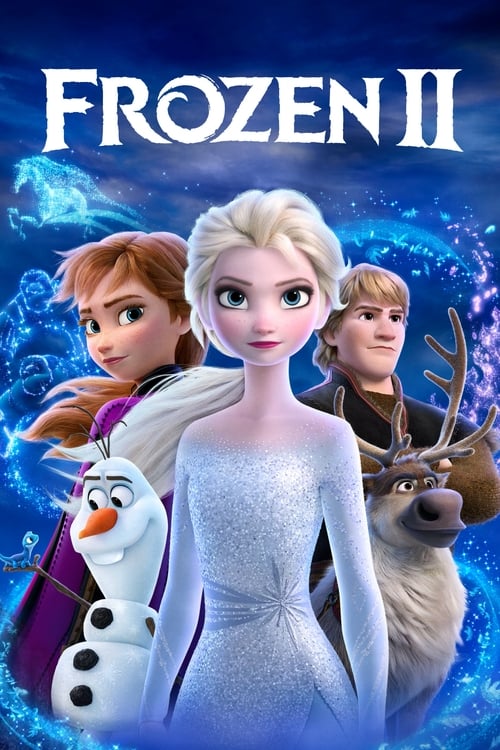
Frozen II
2019 · Jennifer Lee
For family movie night when the kids are ready for something a shade darker, or when you want a big-hearted musical that takes feelings seriously. Comfort viewing with an autumnal soul.
What it's about
A mysterious voice only Elsa can hear calls her away from Arendelle, and she, Anna, Kristoff, Olaf and Sven follow it into an enchanted, mist-locked forest. What they find there is the buried history of their own family and kingdom — an old wrong that must be faced before it can be put right. It's a quest about where Elsa's powers come from, and about two sisters learning who they are when everything changes.
The experience
Moodier and more mythic than the first film — grief, change and growing up run under the songs, and some stretches are genuinely melancholy. It's still funny (Olaf carries the comedy) and still builds to soaring musical numbers, but the emotional register is deeper than you expect from a family blockbuster.
Performances
Idina Menzel and Kristen Bell again anchor the film vocally — Menzel's showstopper 'Into the Unknown' became the sequel's signature belt.
The craft
The animation is some of Disney's most lavish — the autumn palette, the water and wind effects, and one spectacular sequence involving a dark sea reward the biggest screen you have. The songwriting team returned with a more theatrical, searching set of songs, and the whole design trades the first film's winter whites for russet and gold.
Why it matters
One of the highest-grossing animated films ever made, and proof a mega-franchise sequel could choose elegy and historical reckoning over simple repetition.
Snapshot
Frozen II is Walt Disney Animation Studios' sequel to its 2013 global phenomenon, a film that arrived carrying the weight of one of the most lucrative entertainment properties of the 2010s and responded not by repeating its predecessor but by darkening and complicating it. Where Frozen was a fairy-tale musical about sisterhood displacing the romance plot, Frozen II is a mythic origin quest: Elsa, Anna, Kristoff, Olaf and Sven leave the safety of Arendelle to follow a mysterious voice into an Enchanted Forest, uncovering the history of their grandfather, an act of colonial betrayal, and the source of Elsa's powers. It is a rare mega-budget sequel that trades whimsy for elegy, foregrounding grief, change and historical reckoning. Commercially it was an enormous success, becoming one of the highest-grossing animated films ever released; critically it was received as handsome, ambitious and tonally heavier than the original, if less tightly plotted. It is credited to Jennifer Lee as director and sole screenwriter, with Chris Buck co-directing, the same creative pairing that shaped the first film.
Industry & production
Frozen II was produced by Walt Disney Animation Studios and released theatrically by Walt Disney Studios Motion Pictures in November 2019, at the apex of Disney's late-2010s dominance. It landed in a year that also saw Disney's photorealistic The Lion King remake, Toy Story 4 (Pixar) and the culmination of the Marvel "Infinity Saga," underscoring how thoroughly the studio controlled the global box office that year.
The production is inseparable from Jennifer Lee's ascent. Having co-written and co-directed the original Frozen — and become, with that film, associated with Disney Animation's creative resurgence — Lee was named Chief Creative Officer of Walt Disney Animation Studios in 2018, succeeding John Lasseter. She therefore made Frozen II both as its author-director and as the executive steward of the studio releasing it, an unusual concentration of creative authority.
A defining feature of the production was Disney's engagement with the Sámi people, the Indigenous population of northern Scandinavia and the acknowledged inspiration for the film's Northuldra characters. After the first Frozen drew on Sámi and Nordic culture without formal consultation, Disney entered into an agreement with Sámi representatives (including Sámi parliamentary bodies across Norway, Sweden and Finland) to guide the depiction of Northuldra culture. This consultation shaped design, music and narrative and stands as one of the more prominent recent instances of a Hollywood studio formalizing Indigenous consultation for an animated feature.
The film reunited most of the original above- and below-the-line talent: Kristen Bell (Anna), Idina Menzel (Elsa), Josh Gad (Olaf) and Jonathan Groff (Kristoff), the songwriting team of Kristen Anderson-Lopez and Robert Lopez, and composer Christophe Beck. This continuity was central to the sequel's identity as a genuine second chapter rather than a reboot.
Technology
Frozen II is a landmark of computer-animated effects rendering, and much of its production story is a technical one. Disney Animation rendered the film with its proprietary path-tracing renderer, Hyperion, developed in-house and first deployed on Big Hero 6 (2014); by 2019 the renderer had matured considerably, enabling the film's richly lit autumnal forest, atmospheric haze and complex reflective surfaces.
The film's central technical ambition was the elemental effects work. The story literalizes the classical four elements — wind, fire, water, earth — and the animators had to make each one a legible character. The water horse, the Nokk, required simulating a creature made of moving water that also had to read as a solid, rideable form; the sequence of Elsa crossing the Dark Sea is among the most demanding fluid-simulation set pieces the studio had attempted. Fire (the salamander spirit Bruni), wind (the Gale) and the crashing final flood likewise pushed volumetric and particle systems.
Disney's effects pipeline leaned on tools developed and refined across the decade, including the Matterhorn snow-simulation system originally built for the first Frozen and successors for water, cloth and hair. The consistent goal was physical plausibility in service of stylization: hair that moves with weight, water that carries momentum, snow that compacts and shears. Frozen II is best understood technologically as a consolidation and escalation of a decade of Disney Animation R&D rather than the debut of a single new tool.
Technique
Cinematography
Animated "cinematography" at Disney is a virtual discipline, typically divided between layout (camera and staging) and lighting. Frozen II uses its virtual camera to signal its move away from fairy tale toward myth and adventure: sweeping tracking shots through the forest, vertiginous verticals as Elsa climbs the glacier Ahtohallan, and wide, painterly compositions of the Northuldra lands. The palette shifts decisively from the icy blue-white of the original to autumnal ambers, reds and deep forest greens, with the recurring "into the unknown" imagery of mist and threshold. The lighting design exploits Hyperion's global illumination for atmospheric depth — shafts of light through fog, the bioluminescent glow of magic, the diffuse overcast of the enchanted forest. I would not attribute the specific director-of-cinematography credits here without confirmation, as animation credits for layout and lighting leads are less consistently recorded than live-action equivalents.
Editing
The film's editor was Jeff Draheim, who also cut the original Frozen. Editing in a musical of this kind governs the interlock of song and story: numbers such as "Into the Unknown," "Show Yourself" and "The Next Right Thing" must build and release as self-contained dramatic units while advancing the plot. Frozen II's cutting handles a more fragmented, quest-structured narrative than the original, cross-cutting between separated characters (Anna and Olaf below, Elsa above) in the third act. The consensus critical note that the sequel feels busier and more diffuse than the first is partly a structural and editorial observation: the film juggles more mythology, more characters' arcs and more set pieces.
Mise-en-scène / staging
Production design was led by Michael Giaimo, art director on the original film, whose visual identity — clean Scandinavian line, strong silhouette, a controlled palette — carries into the sequel and then expands. The Enchanted Forest, ringed by a magical mist and populated by the Northuldra and trapped Arendellian soldiers, is the film's signature environment: a bounded, autumn-locked world that externalizes the story's themes of arrested history and suspended truth. Costume and character design distinguish Northuldra dress (informed by Sámi consultation) from Arendellian court style, and Elsa's successive costume changes chart her transformation from queen to elemental spirit. Staging repeatedly uses thresholds, dams, bridges and water as literal and symbolic barriers.
Sound
Frozen II is a through-composed musical, and sound is central to its architecture. Christophe Beck's orchestral score binds the songs into a continuous emotional fabric, developing leitmotifs — including the wordless four-note "call" that recurs as Elsa's summons. The film's sound design carries substantial narrative weight: the elemental spirits are characterized as much by sound (wind, crackling fire, surging water) as by image, and the "voice" Elsa hears is a crafted sonic object that had to be alluring, ambiguous and non-threatening. The mix balances intimate dialogue scenes against large-scale effects sequences (the flood, the Dark Sea) that exploit the full dynamic range of theatrical sound.
Performance
Vocal performance drives the film. Idina Menzel's Elsa is given the sequel's most demanding material — "Into the Unknown" and the self-actualizing "Show Yourself" — and her belted, Broadway-scaled delivery again defines the character. Kristen Bell's Anna carries the film's emotional climax with "The Next Right Thing," a notably somber song about acting through grief and despair, one of the darkest numbers Disney Animation has centered a heroine on. Jonathan Groff, largely sidelined musically in the first film, receives "Lost in the Woods," a comic power-ballad pastiche of 1980s soft rock, expanding Kristoff's role. Josh Gad's Olaf again supplies comic relief but is also used to voice the film's anxieties about change and mortality.
Narrative & dramatic mode
Frozen II shifts from the fairy-tale mode of the original to a mythological quest-and-mystery structure. The dramatic engine is not a villain but a buried truth: the discovery that Arendelle's prosperity rests on an act of aggression committed by Elsa and Anna's grandfather against the Northuldra, symbolized by a dam built as a false gift. The plot is organized around revelation and reparation rather than defeat of an antagonist, an unusually consequential moral structure for a family blockbuster, since it requires the protagonists to dismantle their own kingdom's founding lie.
The film also pursues a coming-of-age and separation arc: Elsa's journey toward her identity as the "fifth spirit" bridging nature and humanity, and Anna's parallel journey toward independent, adult agency. The dual-protagonist structure divides them physically for the climax, letting each complete her arc alone. Tonally the film is elegiac, preoccupied with impermanence — "some things never change" is stated precisely because everything is about to.
Genre & cycle
The film sits within several cycles at once. It is a Disney Animation musical, extending the studio's signature form. It is a sequel in the late-2010s wave of Disney legacy continuations and franchise-building. And it belongs to the broader post-Frozen cycle of animated films foregrounding female protagonists, sisterhood and emotional interiority over conventional romance. Within Disney's own history it can be read alongside the "Revival" era (roughly The Princess and the Frog through Moana) as that era's commercial capstone and a bridge toward the studio's subsequent, more experimental features. Its incorporation of Indigenous consultation and colonial-reckoning themes also links it to a wider contemporary movement in mainstream animation toward culturally specific, ethically self-aware storytelling.
Authorship & method
Frozen II is most coherently read as the work of Jennifer Lee, its director (with co-director Chris Buck) and sole credited screenwriter, made at the moment she also assumed creative leadership of the studio. Lee's authorial signature across both Frozen films is the reframing of Disney romance around familial and internal conflict, sharp comic dialogue, and heroines defined by psychological struggle rather than external villainy; the sequel intensifies these tendencies toward grief and self-knowledge.
Her key collaborators form a consistent unit. Chris Buck co-directed, providing continuity with the first film's tone and Disney's directorial tradition. The songwriting team of Kristen Anderson-Lopez and Robert Lopez, EGOT-winners for the first film's "Let It Go," again wrote the songs and are effectively co-dramatists, since the numbers carry the emotional structure. Composer Christophe Beck returned to score, integrating the songs into a symphonic whole. Jeff Draheim edited. Michael Giaimo shaped the production design and overall visual identity. This is a studio-authored film in the fullest sense — a large, iterative collaboration governed by Disney's development process — but one with a clear central authorial vision in Lee.
Movement / national cinema
As an American studio production from Walt Disney Animation, Frozen II belongs to the Hollywood mainstream, but its cultural setting is Nordic and specifically engages Sámi heritage. The film's world-building draws on Scandinavian landscape, folklore and Indigenous culture, and its formal agreement with Sámi representatives makes it a notable case study in transnational cultural representation by a major studio. It is not part of a national cinema in the auteurist sense; rather it is a globally distributed product that appropriates and, in this instance, attempts to responsibly consult the culture it depicts.
Era / period
Frozen II is a document of peak Disney, released when the company's theatrical output and IP consolidation were near their historical zenith and just months before the COVID-19 pandemic upended theatrical exhibition — making it one of the last billion-dollar animated films of the pre-pandemic era. It reflects late-2010s industry logic: franchise stewardship, four-quadrant global appeal, and the integration of streaming (it arrived on Disney+ notably early, during the pandemic). Thematically it registers the period's growing mainstream attention to colonial legacy, historical accountability and Indigenous representation, translating those concerns into a family-film register.
Themes
The film's governing theme is change and impermanence — accepting that growth requires loss, stated directly in "Some Things Never Change" and dramatized throughout. Closely bound to it is grief and perseverance: "The Next Right Thing" is explicitly about continuing to act in the face of despair, an unusually frank treatment of depression-adjacent emotion for the genre. Identity and origin drive Elsa's arc as she seeks the source of her power and her place between the human and natural worlds. Most strikingly for a blockbuster, the film centers colonial guilt and reparation: Arendelle's wealth is founded on betrayal, and justice requires destroying the dam even at cost to the kingdom, an ending that literalizes reparative sacrifice. Sisterhood, self-actualization and the reconciliation of nature and civilization round out the thematic field.
Reception, canon & influence
Critically, Frozen II was received as a visually spectacular, emotionally ambitious and musically strong sequel that nonetheless struggled to match the narrative cohesion and cultural lightning of the original; reviewers frequently praised its animation, songs and thematic daring while noting a busier, more diffuse plot. Commercially it was a triumph, ranking among the highest-grossing animated films of all time and reaffirming the Frozen franchise as one of Disney's most valuable properties. (I've avoided citing a precise gross figure here to stay within verifiable bounds, but the film grossed well over a billion dollars worldwide.)
The influences on the film run backward into Disney's own Revival era and its fairy-tale musical tradition, into Nordic and Sámi folklore and landscape, and into the classical elemental mythology that structures its plot; the songwriting continues the Broadway-inflected idiom that "Let It Go" made the franchise's calling card. Its legacy forward is still consolidating. It cemented Elsa and Anna as durable cultural figures and kept the franchise commercially central, and its formalized Sámi consultation has been cited as a reference point in discussions of Indigenous representation in animation. Within Disney it marked the high-water commercial mark of the Revival period and Jennifer Lee's tenure as Chief Creative Officer. The full measure of its influence — including a widely reported third and fourth Frozen film in development — remains to be seen, and claims about that future output should be treated as provisional.
Reception
A colossal hit in 2019 — it overtook the original to become the highest-grossing animated film ever at the time — but reviews were noticeably cooler than the first's, settling into 'gorgeous, ambitious, narratively muddled.' Time has softened it a little, with defenders praising it as the weirder, more melancholic Frozen.
How Frozen II was received, from release to now →
How to watch Frozen II: what to notice on a first viewing
- Notice the ambers and reds where the first film used blue. Michael Giaimo takes the palette out of icy blue-white into autumn. Deep forest greens, red leaves, mist everywhere, and shafts of light pushed through fog by Disney's path-tracing renderer. A sequel announces a change of genre with color before it changes a single plot point. This one is set in fall on purpose.
- Listen for the same four notes calling Elsa. A wordless figure keeps arriving, sung rather than played, and Christophe Beck threads it through the score until it functions as a character. The voice had to sound alluring and ambiguous without sounding like a threat. The whole quest is set in motion by a sound. Everything that follows is an attempt to find out what is making it.
- Watch how wind, fire, water and earth each behave. The four elements are given bodies and personalities. The animators had to make each legible as a creature, including a horse made of moving water that still has to read as solid enough to ride. The technical problem is the story's problem. Nature has to be something you can meet and bargain with.
- Notice the camera sweeping and climbing instead of sitting still. The virtual camera tracks long distances through the forest and goes vertiginously vertical as Elsa ascends the glacier. The compositions of the Northuldra lands are wide and painterly. The first film was staged as a fairy tale. This one is staged as a myth, and the camera moves like an adventure picture.
- Count the thresholds the characters have to cross. A wall of mist around the forest, a dam, bridges, the edge of a dark sea. Jennifer Lee keeps putting a barrier in front of people and making the crossing of it the scene. A bounded, autumn-locked world holds a history that has been stopped. Every barrier is something somebody built and left.
The whole guide to watching Frozen II, with the keys for a rewatch →
Influences: the films it descends from and the films it influenced
- Frozen (2013) — Established the direct template Frozen II extends — the Buck/Lee direction paired with Kristen Anderson-Lopez and Robert Lopez's Broadway songwriting, and the reframing of the Disney fairy tale around a sisterly bond rather than a romantic villain.
- Tangled (2010) — Inaugurated the Revival-era hybrid pipeline of painterly, hand-drawn warmth rendered in CG that Frozen II's autumnal, stylized environments build directly upon.
- Big Hero 6 (2014) — Was the first Disney feature built on the in-house Hyperion path-tracing renderer whose physically-based light transport makes Frozen II's translucent ice, mist and forest lighting possible.
- The Little Mermaid (1989) — Imported Howard Ashman's Broadway book-musical craft — the 'I Want' song and numbers that advance plot — the idiom the Lopezes work in when 'Into the Unknown' functions as Elsa's dramatic engine.
- Beauty and the Beast (1991) — Model for the through-composed integration of song and symphonic score into a single dramatic fabric, the structure Christophe Beck reprises by scoring around the Lopez numbers.
- Fantasia (1940) — Pioneered choreographing abstract elemental effects animation — water, fire, wind — to symphonic music, the tradition behind Frozen II's personified elemental spirits and fluid simulation set-pieces.
- Bambi (1942) — Set the benchmark for naturalistic effects animation of a forest across seasons, whose observed light and autumnal palette Michael Giaimo's Enchanted Forest design echoes.
- Sleeping Beauty (1959) — Eyvind Earle's flattened, graphically stylized production design is the lineage feeding Giaimo's insistence on a strong, illustrative art-directed look over pure photorealism.
- Avatar (2009) — Established the virtual-camera / virtual-cinematography workflow — a director operating a handheld camera inside a digital environment — that Frozen II uses to stage its swooping quest sequences.
- Encanto (2021) — Extends Jennifer Lee's villain-less, family-psychology musical structure, letting songs carry the entire emotional architecture of a story about generational grief rather than external conflict.
- Raya and the Last Dragon (2021) — Carries forward the elemental mythic-quest — a journey to heal a broken, spirit-inhabited world — rendered with the same Hyperion path-tracing and folklore-consultation model Frozen II formalized.
- Wish (2023) — Consciously returns to the through-composed Disney fairy-tale musical form, applying Frozen II's stylized-illustration-in-CG approach to a folk-inflected origin story.
- Into the Woods (2014) — Shares the Sondheim-descended song-story interlock the Lopezes draw on, using musical numbers as fairy-tale deconstruction where the song carries the psychological turn rather than decorating it.
- Moana (2016) — Companion Revival musical that drove Disney's water fluid-simulation R&D on the same Hyperion renderer, its ocean-as-character prefiguring Frozen II's water-horse Nokk.
- Zootopia (2016) — Part of the same Hyperion-era wave, advancing the fur, foliage and large-environment rendering pipeline that Frozen II's misty forest and detailed costuming inherit.
- How to Train Your Dragon (2010) — Established the emotive creature-flight sequence built with a Deakins-consulted virtual camera and naturalistic light, the craft Frozen II reprises in Elsa's ride across the Dark Sea on the Nokk.
- Zootopia 2 (2025) — The template for Disney Animation extending a billion-dollar original property into a sequel via markedly escalated effects and environment simulation — the strategic and technical playbook Zootopia 2 follows.
Similar films
- Tangled (2010) — influence & lineage
- Moana (2016) — influence & lineage
- How to Train Your Dragon (2010) — influence & lineage
- Avatar (2009) — influence & lineage
- How to Train Your Dragon 2 (2014) — shared sensibility
- How to Train Your Dragon: The Hidden World (2019) — shared sensibility
- Shrek 2 (2004) — shared sensibility
- Inside Out 2 (2024) — shared sensibility