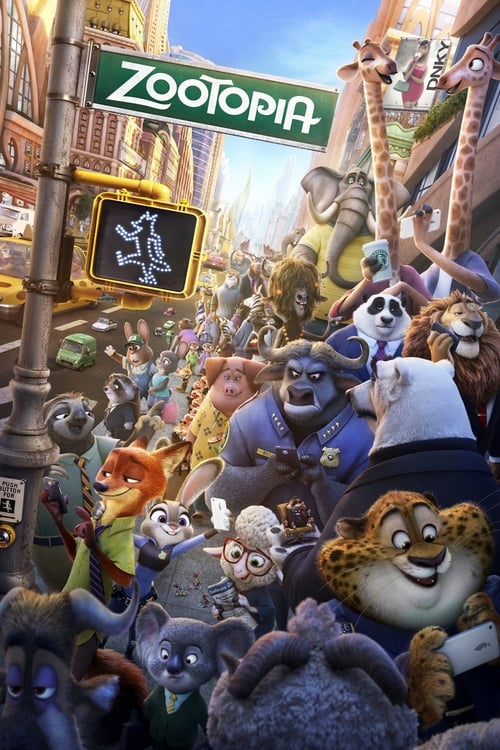
Zootopia
2016 · Byron Howard
For a family night or a comfort watch when you want laughs with a brain — easy to put on, but it gives you something genuine to talk about after.
What it's about
Judy Hopps, the first rabbit ever to make the police force in a sprawling city of animals, gets one shot at a real case: a missing-persons file nobody else wants. To crack it she has to lean on Nick Wilde, a fox who runs cons for a living, and their trail leads out of petty street hustles and into something rotten at the heart of a city that prides itself on everyone getting along.
The experience
A fast, funny buddy-cop caper that keeps landing sharp little jokes while quietly turning into a real mystery — and then surprises you by having actual teeth about prejudice and who gets trusted. It moves quickly, warms you up, and leaves a thought or two lodged in your head.
The craft
The city itself is the star: distinct climate districts, crowd scenes teeming with dozens of species at wildly different scales, and fur rendering that was state of the art for Disney at the time. The script is unusually tight for a studio animation — a genuine noir-shaped mystery plot that pays off its setups. Big and bright enough to reward the best screen in the house.
Why it matters
A billion-dollar hit and Oscar winner for animated feature, it proved a mainstream cartoon could build its whole plot around bias and profiling — and it reset expectations for how much a Disney comedy could say.
Snapshot
Zootopia is Walt Disney Animation Studios' 55th feature, a computer-animated buddy-cop mystery set in a metropolis built entirely by and for anthropomorphic mammals. Directed by Byron Howard and Rich Moore, with Jared Bush as co-director, it follows Judy Hopps, an idealistic rabbit who becomes the city's first bunny police officer, and Nick Wilde, a con-artist fox she coerces into helping her crack a missing-persons case that widens into a conspiracy about predators "going savage." The film is significant on three axes: as a technical showcase for Disney's then-young Hyperion rendering pipeline and its fur and crowd systems; as a mainstream animated feature that built its entire plot engine around prejudice, profiling, and implicit bias; and as a commercial phenomenon that crossed the billion-dollar mark and won the Academy Award for Best Animated Feature. It sits in the middle of the "second Disney renaissance" that ran from Tangled through Frozen and Moana.
Industry & production
Zootopia was produced by Walt Disney Animation Studios in Burbank, distributed by Walt Disney Studios Motion Pictures, and produced by Clark Spencer, with John Lasseter serving as executive producer in his role as the studio's chief creative officer. Development stretched over roughly five years; Byron Howard pitched the concept in the early 2010s, initially as a spy-tinged comedy conceived around Nick Wilde as the protagonist. The project underwent a well-documented late-stage overhaul. In its earlier form the world leaned darker — predators were kept in check by shock "tame collars," and the story was told largely from the fox's cynical point of view. Disney's "Story Trust," the studio's rotating peer-review body of directors and story artists, pushed back, and roughly midway through production the film was restructured to follow Judy Hopps as the optimistic newcomer and audience surrogate. This pivot is one of the more openly discussed examples of the modern Disney/Pixar collaborative revision process, in which a film can be substantially re-boarded and re-conceived after years of work.
The film opened in March 2016. It was a major commercial success, surpassing one billion dollars in worldwide box office — placing it among the highest-grossing films of the year and among the top-earning animated features to that point. It won the Academy Award and Golden Globe for Best Animated Feature and took multiple Annie Awards. Precise grosses and award tallies are a matter of public record, but the headline facts — a billion-plus worldwide and the Best Animated Feature Oscar — are the load-bearing ones.
Technology
Zootopia was rendered with Disney's proprietary Hyperion renderer, the physically based path-tracing system the studio had introduced on Big Hero 6 (2014). Hyperion's global-illumination model let the filmmakers light the city's wildly varied biome-districts — humid rainforest, arctic Tundratown, blazing Sahara Square — with naturalistic bounced light and translucency, which matters enormously for a film whose emotional register depends on reading fur, eyes, and skin.
The signature technical problem was fur. Because nearly every character is a furred mammal, the studio invested heavily in tools to author, groom, and light hair at scale; Disney's technical talks around the film describe purpose-built grooming and controls that let artists shape fur direction, clumping, and under-layers on dozens of species with distinct coat types. The second scaling problem was population: a believable city required crowds of many different animals, so the production developed character-variation and crowd systems capable of generating large numbers of background mammals across species, sizes, and clothing rather than cloning a handful of models. Disney's published research and SIGGRAPH-adjacent material remain the authoritative source here; specifics beyond the broad strokes (species counts, crowd-system internals) should be checked against those technical papers rather than paraphrased loosely.
Technique
Cinematography
As a fully CG feature, Zootopia's "cinematography" is the combined work of layout (virtual camera) and lighting departments rather than a single photographed image. The film uses its virtual camera for genuine spectacle set-pieces — most famously Judy's train arrival, where the camera cranes and pushes to unveil the city and its adjoining districts in a single sweeping reveal, a sequence engineered to sell scale and diversity of environment at once. Elsewhere the staging is deliberately grounded and procedural-drama-like: eye-level two-shots, over-the-shoulder framings in interrogations, and the flat fluorescent geography of civic interiors. The film also mines scale contrast as a visual joke and worldbuilding device, cutting between the enormous (Chief Bogo, the arctic mob boss Mr. Big's henchmen) and the tiny (Little Rodentia's mouse-scaled streets), using camera height and lens choice to make size a running motif. Specific director-of-photography credits for layout and lighting are a matter of studio record; I won't attribute individual names I can't confirm.
Editing
Editing is credited to Fabienne Rawley and Jeremy Milton. The cut has to hold two modes together — a brisk comedy of set-piece gags and a genuine detective procedural that must dole out clues, red herrings, and escalating stakes fairly. The film's most celebrated editorial achievement is comic rather than structural: the DMV sloth sequence, "Flash," whose humor is built almost entirely in the cutting and sound timing, stretching a mundane errand into an agonizing, precisely paced bit that lets the audience run ahead of the joke. The mystery's information architecture — the Nighthowler thread, the missing predators, the third-act reversal — is managed so that the reveal reframes earlier scenes without cheating, a demanding editorial task in a family film.
Mise-en-scène / staging
Production design (credited to David Goetz) is the film's most ambitious element. The conceit — a city subdivided into climate districts engineered for different animals — turns worldbuilding into a design thesis: Sahara Square's heat-pumped luxury, Tundratown's refrigerated affluence, the misted Rainforest District, the miniaturized Little Rodentia. Sight gags are embedded in the environment (animal-scaled infrastructure, species-specific signage, a naturalist club, brand and transit parodies), rewarding re-watching. Character design (art direction of characters led by Cory Loftis) solves a hard problem: making predators and prey, from an elephant to a shrew, share a stylistic language and a consistent standard of appeal while reading instantly as distinct species with class and personality coding.
Sound
Michael Giacchino's score underpins the procedural with propulsive, noir-inflected cues while leaving room for comedy. Sound design does heavy lifting in the comic set-pieces — again the sloth scene, where pacing of dialogue and effects is the gag — and in selling scale, with the low-end weight of large animals against the smallness of rodent spaces. The film's diegetic pop anchor is "Try Everything," performed by Shakira (who also voices the megastar Gazelle); the song functions as Judy's optimistic thesis statement and recurs as a motif tying the emotional arc to the soundtrack.
Performance
The voice cast is central to the film's tonal balance. Ginnifer Goodwin gives Judy an earnest, brisk determination that keeps the character from tipping into naïveté; Jason Bateman's dry, transactional delivery as Nick supplies the film's cynicism and much of its comedy, and the two-hander rapport is the picture's engine. The supporting ensemble is deep: Idris Elba as the gruff Chief Bogo, Jenny Slate as the meek assistant mayor Bellwether, J.K. Simmons as Mayor Lionheart, Nate Torrence as the doughnut-loving cheetah Clawhauser, Alan Tudyk as the weasel Duke Weaselton, plus Octavia Spencer, Tommy Chong, and others. Disney's animation performances are, of course, a collaboration between vocal actors and character animators; the acting "read" of Judy's expressive ears and Nick's half-lidded skepticism is as much draftsmanship as voice work.
Narrative & dramatic mode
Structurally, Zootopia is a detective procedural wearing a buddy comedy — a mismatched-partners investigation with a mystery plot that turns on a social conspiracy. It hits classic beats: the underestimated rookie, the reluctant informant, the ticking-clock case, the wrongful accusation, the reversal that unmasks a hidden antagonist. What distinguishes it is that the mystery's solution is thematic: the "why" behind the savage predators is engineered fear-mongering, so the genre machinery pays off as social argument. The film also runs a sincere emotional through-line — Judy's own unexamined bias, which surfaces in a public misstep that fractures her partnership with Nick and forces a genuine reckoning before the case can be solved. That willingness to let the protagonist be complicit in the prejudice she's fighting gives the dramatic mode more moral weight than the buddy-cop frame implies.
Genre & cycle
The film sits at the intersection of the talking-animal fable — a lineage running through Robin Hood and countless funny-animal cartoons — and the police procedural / conspiracy thriller. Within Disney's own output it belongs to the post-Tangled cycle of CG features that paired technical polish with more self-aware, thematically pointed storytelling (Wreck-It Ralph, Frozen, Big Hero 6, Moana). Its particular innovation within that cycle is the near-total commitment to an all-animal social world used as sustained allegory, rather than animals as incidental character design. It is also a clear entry in the tradition of children's films that smuggle in adult-facing satire, with its parody of civic bureaucracy, media panic, and organized crime (the Godfather-riffing Mr. Big being the most overt homage).
Authorship & method
Authorship here is corporate-collaborative in the modern Disney mode, but with identifiable hands. Byron Howard (co-director of Bolt and Tangled) and Rich Moore (a veteran of The Simpsons and Futurama who directed Wreck-It Ralph) co-directed, with Jared Bush as co-director; the pairing of Moore's satirical, genre-literate sensibility with Howard's character-driven Disney craft is legible in the finished film. The screenplay is credited to Jared Bush and Phil Johnston, from a story developed by a larger group including the directors, Bush, Johnston, Jim Reardon, Josie Trinidad, and others — the standard Disney story-team model. Michael Giacchino composed the score. Editing was by Fabienne Rawley and Jeremy Milton; production design by David Goetz. The method is defined by the Story Trust revision culture described above: the film's identity emerged less from a single auteur's initial vision than from an institutional process that reoriented the project around Judy and sharpened its theme. Beyond the confirmable credits, attributing the film's meaning to any one author would misrepresent how it was made.
Movement / national cinema
Zootopia is a product of the American studio-animation establishment — specifically the Lasseter-era Walt Disney Animation Studios, revitalized after Pixar's leadership took creative oversight in the late 2000s. It exemplifies the technological and organizational model of that movement: proprietary in-house rendering technology, the Story Trust, appeal-driven character design, and features aimed simultaneously at children, families, and the international four-quadrant market. It is not an art-cinema or auteur-driven national movement so much as an expression of Hollywood's dominant animation industry at a moment of both technical maturity and unusual thematic ambition.
Era / period
The film is firmly of the mid-2010s: the second Disney renaissance at its commercial peak, physically based rendering becoming standard, and mainstream American entertainment increasingly engaging — and being scrutinized for how it engaged — questions of prejudice and systemic bias. Released in an especially charged social and political climate, Zootopia was received as unusually timely, and much of the discourse around it concerned whether a talking-animal fable was an apt or a distorting vehicle for a lesson about human prejudice. Its billion-dollar success also marks the period in which Disney Animation, not just Pixar, could reliably headline the global box office.
Themes
The film's central theme is prejudice in its several registers: overt bigotry, the "well-meaning" liberal's unexamined bias (Judy's own), stereotype threat and self-limiting expectation, and — most pointedly — the political manufacture of fear, in which a demagogue engineers a predator-versus-prey panic to seize power. Around this core cluster related ideas: the gap between civic idealism ("anyone can be anything") and lived reality; the way institutions both enable and obstruct justice; and the possibility of change through discomfort and self-correction rather than innocence. The film has been widely praised for taking these on directly, and just as widely debated: because predator/prey is a biological category and race is not, critics have questioned how cleanly the allegory maps, and whether the "10% of the population" framing carries unintended implications. That the film generates such readings at all is a measure of its ambition; the debate is part of its legacy.
Reception, canon & influence
Zootopia was a strong critical and commercial success, praised for its worldbuilding, its Bateman/Goodwin partnership, its comedy (the sloth scene became an instant reference point), and its willingness to build a family blockbuster around bias and profiling. It won the Academy Award and Golden Globe for Best Animated Feature and multiple Annie Awards, cementing its place in the studio's modern canon alongside Frozen and Moana.
Looking backward, its influences are legible: the mismatched-partners cop movie and the conspiracy thriller; the Godfather and gangster-picture homages of the Mr. Big material; the long lineage of anthropomorphic-animal storytelling in animation; and the noir/procedural tradition of a city that is itself a character. Its immediate stylistic and technological lineage runs through Wreck-It Ralph and Big Hero 6.
Looking forward, the film's success validated Disney Animation's model of pairing heavy in-house technology with socially pointed, four-quadrant storytelling, and it became a fixture in discussions — both celebratory and critical — of how popular animation handles allegory about prejudice. Within the franchise it generated the Disney+ shorts anthology Zootopia+ (2022) and a theatrical sequel, Zootopia 2, extending the world; a Shanghai Disneyland themed land also drew on its districts. Its most durable influence, beyond the sequels, may be as a case study taught and cited on two fronts at once: as a technical milestone in fur, lighting, and crowd rendering, and as a lightning rod for the question of what a children's fable can and cannot say about real-world injustice.
Reception
A billion-dollar hit and Best Animated Feature Oscar winner on release, it's since become the go-to case study people argue over — is its prejudice allegory ahead of its time or does the metaphor fall apart the harder you look at it?
How Zootopia was received, from release to now →
Influences: the films it descends from and the films it influenced
- Chinatown (1974) — Supplies the detective-procedural engine Zootopia copies wholesale: a trivial missing-person case that telescopes, via drip-fed clues, into a systemic civic conspiracy where the corruption turns out to be the social order itself.
- The Godfather (1972) — The Mr. Big sequence is a direct staging-and-vocal homage — dim study, a supplicant crossing to a seated diminutive don, the ring-kiss ritual and the hoarse Brando cadence transplanted onto an arctic shrew.
- 48 Hrs. (1982) — Codified the antagonistic buddy-cop two-hander — by-the-book officer forcibly teamed with a streetwise hustler — whose banter-driven, friction-then-trust scene rhythm structures every Judy/Nick exchange.
- Who Framed Roger Rabbit (1988) — Established the precedent of playing a hardboiled noir plot completely straight inside a fully realized cartoon-animal metropolis, letting genre gravity coexist with anthropomorphic absurdity.
- Robin Hood (1973) — Disney's own fox-as-charming-trickster design and sly-con-man acting vocabulary is the studio lineage Nick Wilde's hustle performance directly extends.
- Monsters, Inc. (2001) — Its Sulley breakthrough — the first blockbuster per-hair fur simulation — is the technical forebear of Zootopia's fur-grooming system that individually grooms and light-scatters millions of follicles across dozens of species.
- Big Hero 6 (2014) — Debuted Disney's Hyperion path-traced renderer and global-illumination pipeline, the exact lighting technology Zootopia inherited and then scaled up to volumetric fur and citywide crowds.
- Wreck-It Ralph (2012) — Rich Moore's rules-based, genre-literate worldbuilding — an internally consistent fantasy society governed by satirical logic — is the authorial blueprint he carried directly into Zootopia's districts.
- Tangled (2010) — Byron Howard's hybrid CG-with-hand-drawn-appeal facial acting and expressive-eye performance craft is the character-animation foundation Judy Hopps is built on.
- The Incredibles (2004) — Michael Giacchino's genre-pastiche scoring method — deploying period jazz/noir idiom as narrative signposting rather than wallpaper — is the composer technique he reprises in Zootopia's noir score.
- L.A. Confidential (1997) — Neo-noir in which the mystery's true villain is institutional rot inside the force itself, the reveal architecture Zootopia mirrors in the Bellwether conspiracy.
- Encanto (2021) — Reunites Howard and co-writer Jared Bush and the Story-Trust method to extend Zootopia's fusion of dense allegorical worldbuilding with a socially pointed central metaphor.
- The Bad Guys (2022) — Builds an anthropomorphic-animal heist caper that explicitly weaponizes predator-species stereotyping for genre and character reversal, extending Zootopia's play of prejudice-as-plot inside an animal city.
- Zootopia+ (2022) — Anthology shorts that reuse the film's district-worldbuilding, crowd-rendering, and fur pipeline to expand the same craft ecosystem rather than a new one.
- Zootopia 2 (2025) — Supplies the entire inherited pipeline — biome-district city design, layered fur-shading and crowd-simulation systems, and the undercover buddy-cop mystery armature — which the sequel reprises and extends to reptile rigging.
- Hoppers (2026) — Combined a proprietary large-scale fur groom pipeline with an undercover-procedural plot in which animal society is read as a political system, making it the immediate commercial precedent for a talking-animal film structured as infiltration.
- Frozen (2013) — A parallel second-Disney-Renaissance product of the same Story Trust revision culture that reoriented a project mid-development around a reframed protagonist and theme.
- Moana (2016) — Same-year, same-studio film pairing heavy proprietary in-house simulation (its water pipeline) with mythic worldbuilding — the twin proof of Disney's tech-plus-four-quadrant model.
- The Sheep Detectives (2026) — Stages a genuine fair-play procedural — clue-by-clue deduction, planted red herrings, a retraceable solution — entirely with talking animals, the modern proof-of-concept for the animal whodunit.
- Frozen II (2019) — Part of the same Hyperion-era wave, advancing the fur, foliage and large-environment rendering pipeline that Frozen II's misty forest and detailed costuming inherit.
- Transformers One (2024) — Encodes social hierarchy and prejudice directly into character design and civic geography, the caste-legible world-building One uses to make Cybertron's cog/non-cog class order readable at a glance.
Similar films
- Who Framed Roger Rabbit (1988) — influence & lineage
- Big Hero 6 (2014) — influence & lineage
- Zootopia 2 (2025) — same viewing thread
- Blindspotting (2018) — same viewing thread
- The Sheep Detectives (2026) — shared sensibility
- Hoppers (2026) — shared sensibility
- Coyote vs. Acme (2026) — shared sensibility
- Nimona (2023) — shared sensibility
All the films related to Zootopia →
Watch it with: curated runs of related films
- Genre as Trojan Horse — Watch these together when you want the pleasures of a genre picture — a buddy-cop case, a heist crew, a monster in the sky — that turns out to be secretly arguing about who America polices, prices, and erases.