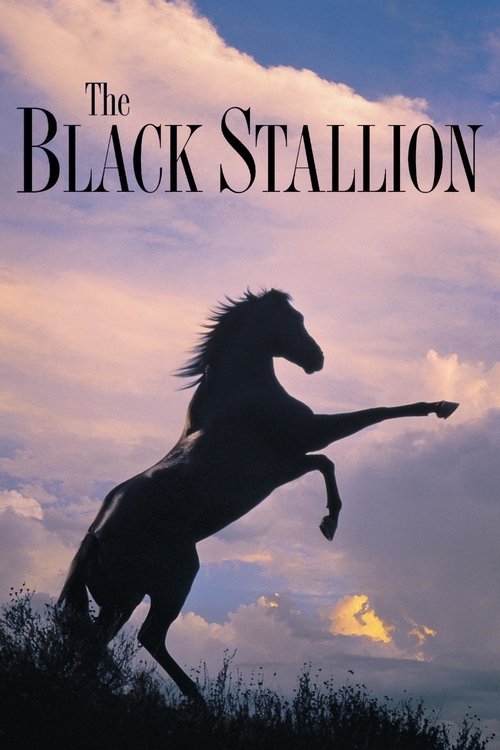
The Black Stallion
1979 · Carroll Ballard
When you want wonder without words — to be a kid again, or to show a kid what movies can do. Gentle, awestruck comfort viewing that also happens to be gorgeous.
What it's about
A boy named Alec is sailing with his father when he becomes fascinated by a wild Arabian stallion stabled aboard the ship. After a storm sinks the vessel, boy and horse wash up on a deserted island together, and a wary, wordless friendship forms. Back home, a retired trainer named Henry Dailey sees what the pair might be capable of on a racetrack.
The experience
The island stretch is close to silent — nearly half an hour told through sun, water, sand, and looking — and it casts a spell that's more art film than kids' movie. The second half shifts into warm, rousing sports-picture territory, but the hush of the first half stays with you.
Performances
Young Kelly Reno is remarkably natural opposite an actual horse, and Mickey Rooney brings lived-in, unshowy tenderness to the old trainer — one of the loveliest late turns of his career.
The craft
Carroll Ballard's debut is built on extraordinary nature cinematography and a faith in image and sound over dialogue that almost no family film attempts. The storm, the island light, the thunder of the race — this one genuinely deserves a big screen and good speakers.
Why it matters
Produced under Francis Ford Coppola, it became the benchmark for the children's film treated as serious cinema, proof that a family movie could trust silence and imagery completely.
Snapshot
The Black Stallion is the rare children's film that arrives fully formed as art cinema. Adapted from Walter Farley's 1941 novel, it opens aboard a tramp steamer somewhere off North Africa in 1946, drowns its own premise in a storm, and then strands its two survivors — a boy and an Arabian stallion — on an island where nothing is spoken for the better part of half an hour. That central passage, wordless, sun-bleached, built almost entirely from looking and listening, is the film's claim on posterity. What follows is a second movie: a return to small-town America, a partnership with a broken-down trainer, and a match race staged in the grammar of the sports picture. The join between the two halves is the film's most-discussed feature, and its most revealing. Carroll Ballard's feature debut, produced under Francis Ford Coppola's American Zoetrope banner and photographed by Caleb Deschanel, it stands as the founding document of a small, stubborn American tradition: the animal film taken seriously as a form of perceptual cinema rather than as sentiment with fur on it.
Industry & production
The film exists because of Coppola's patronage. Ballard had been a contemporary of Coppola's in the UCLA film program and had spent the 1960s and 1970s making documentaries, industrials, and commercials — including the short Harvest (1967), which earned an Academy Award nomination in the documentary short category — without converting any of it into a feature career. Coppola, then at the height of his leverage and actively using American Zoetrope to underwrite filmmakers the studios would not touch, executive-produced; Fred Roos and Tom Sternberg produced. United Artists distributed.
The production was, by every account that has surfaced, difficult in the way that location work with animals and children is always difficult: long schedules, weather dependency, and a director who insisted on waiting for light. The island material was shot in Sardinia; the American sequences were staged in and around Toronto, with Canadian racetracks standing in for the story's unspecified U.S. locations. Coppola's simultaneous ordeal on Apocalypse Now (1979) meant Zoetrope was overextended, and The Black Stallion sat for a period before release — it opened in limited engagements in 1979 and expanded in 1980. Reliable, verifiable financial figures for the picture are not something I can state with confidence; it is generally described as a commercial success, but I would not attach numbers to that claim.
Two contexts sharpen the picture. First, United Artists in 1979–80 was months away from the Heaven's Gate catastrophe that ended its independence — The Black Stallion belongs to the last moment when a major distributor would carry an uncommercial-looking art film for children on the strength of a producer's reputation. Second, the Zoetrope model itself — auteur-as-patron, financing directors rather than properties — was about to collapse under One from the Heart (1982). Ballard got through the window just before it shut.
Technology
The technical achievement is mostly an achievement of patience and exposure control rather than of hardware. The central problem Deschanel faced is stated simply: photograph a black animal, in direct Mediterranean sun, against white sand and reflective water, and retain detail in both. The solutions visible on screen are classical — shooting at the edges of the day, using the low sun as a rim light so the horse reads as silhouette and contour rather than as a hole in the frame, and letting backgrounds blow out when the alternative is losing the subject. Much of the island footage is long-lens work, which compresses boy and horse into the same plane and lets the camera hold at a distance an animal that cannot be directed.
The horse itself was a piece of production technology. The principal animal was Cass Ole, a Texas-bred Arabian, whose natural markings had to be made up to produce the uniform black of Farley's "Black"; doubles and stunt horses were used for the more demanding action, under the supervision of a professional horse master — Corky Randall is the name attached to the film's animal work in most accounts, though the detailed division of labor among wranglers is not well documented in the published record.
The underwater material — the horse swimming, seen from below and beside — required rigs and a tolerance for risk that the film does not advertise. Beyond these broad strokes, I would be cautious: the specifics of camera packages, lens sets, stock, and shooting ratio circulate mostly as interview anecdote, and I am not able to verify them precisely enough to assert them.
Technique
Cinematography
Deschanel's work here is the film's authorship as much as Ballard's. Two registers alternate. On the island, the camera is patient, low, and frequently at the height of a child or a horse's knee; the palette narrows to ochre, bleached white, and the blue-black of the animal. There is a fondness for figures moving laterally across the frame in long shot — the beach as a stage seen from the wings — and for the moment when the sun drops low enough that both the sand and the horse can be exposed in one image. The famous first ride is built from a handful of positions repeated: the gallop crossing the frame, the water thrown up by hooves, the boy's face pressed against the neck.
The second half shifts to a warmer, more conventional naturalism: interiors with practical sources, a small town rendered in autumnal browns, and a racetrack sequence that abandons contemplation for kinetics — track-level cameras, mounted rigs, and long lenses used the way sports coverage uses them, to flatten the field into a single churning mass.
The immediate visual precedent is Néstor Almendros and Haskell Wexler's work on Malick's Days of Heaven (1978): the same faith that magic-hour naturalism can carry narrative weight, the same willingness to organize a schedule around twenty usable minutes a day. The Black Stallion extends that discovery into a genre that had never asked for it.
Editing
Robert Dalva's cutting — Oscar-nominated — does two distinct jobs. The island section is edited associatively rather than causally: it accumulates rather than advances, joining images by rhyme (a shape in the sand, a shape in the water) and by the boy's attention, so that the sequence has the rhythm of memory. Cuts are held long; the film trusts an audience of children to sit inside a shot.
The race, by contrast, is cut hard and fast, and — crucially — it interpolates flashes of the island into the present tense of the contest. This is the film's structural argument: the race is won not by training but by the bond formed in silence, and the editing says so directly by cutting the island back into the track. Dalva went on to direct the sequel, The Black Stallion Returns (1983).
Mise-en-scène / staging
The island is staged as a proscenium — a curve of beach, a rock outcrop, a shallow lagoon — and Ballard uses its geography with real rigor, so that the audience learns the space and can read distance as emotion. The approach-and-retreat choreography between boy and horse is the film's central piece of staging: Alec advances, the horse withdraws, and the ground between them is measured in the mise-en-scène rather than narrated. The seaweed-feeding scene works because the frame has already taught us how far apart they have been.
The mainland is staged in the opposite mode: cluttered domestic interiors, a barn, a diner, a bedroom with a boy's accumulated objects. The visual density is deliberate — after the island's emptiness, the world of adults is a world of stuff.
Sound
Alan Splet received a Special Achievement Academy Award for the film's sound editing, and the citation was earned. Splet — best known for his work with David Lynch, from Eraserhead through Blue Velvet, often in collaboration with Ann Kroeber — treats the island as an acoustic environment rather than an ambience bed. The horse is constructed almost entirely out of sound: breath, snorts, the specific difference between hoof on wet sand and hoof on dry, the strain of rope. Because there is no dialogue, these sounds carry the dramatic information, and Splet mixes them close and dry against the wash of surf so that the animal is always more present than the landscape. The shipwreck sequence, by contrast, is a controlled overload — engine, storm, panicked animals, human shouting — that makes the subsequent silence feel like a physiological change.
Performance
Kelly Reno, cast in part for genuine riding ability rather than acting experience, gives the kind of performance that is really a quality of presence: unaffected, watchful, physically credible on a horse. Ballard films him the way one films a documentary subject.
Mickey Rooney's Henry Dailey was nominated for Best Supporting Actor and is a small marvel of casting-as-commentary: Rooney had played the jockey Mi Taylor in National Velvet (1944), and the film knows it. He plays Dailey as a man who has been demoted by time and is being handed one more chance — the comedy is real, and so is the fatigue underneath it. Teri Garr and Hoyt Axton, as Alec's mother and father, do a great deal in little screen time; Axton's card-game scene establishes the Bucephalus myth that the whole film then literalizes. Clarence Muse, appearing as Snoe, made this his final film; he died in 1979, closing a screen career that reached back to the early sound era.
Narrative & dramatic mode
The screenplay — credited to Melissa Mathison, Jeanne Rosenberg, and William D. Wittliff, with Mathison going on directly from this to E.T. the Extra-Terrestrial (1982) — makes one decisive structural choice: it front-loads a near-silent act. This is not a prologue. It is roughly a third of the film, and it operates in a mode closer to lyric than to drama, with no antagonist, no goal, and no dialogue.
The film then executes a hard modal shift into a conventional three-act sports narrative: mentor acquired, training montage, obstacle, race. Critics have argued about this ever since, and the argument is legitimate — the second half is recognizably a genre picture where the first is not. The defense is that the shift is the point. The island is prelapsarian; the mainland is the world of rules, entry fees, newspapers, and jockeys' weights, and the drama of the second half is whether anything of the island can survive translation into that world. The father's Bucephalus story, told and then orphaned by his death, supplies the mythic scaffolding: a boy who can ride an untameable horse because he alone knows what the horse is afraid of.
Genre & cycle
The Black Stallion sits at the end of a long, mostly studio-era cycle of boy/girl-and-animal pictures — Lassie Come Home (1943), National Velvet (1944), The Yearling (1946), Old Yeller (1957), and the Disney live-action nature films of the 1950s and 1960s. Its innovation is to remove the two things that cycle depended on: anthropomorphism and explanation. The horse is never given a human interiority; it is filmed as an animal whose motives are opaque and whose scale is dangerous.
It also belongs, less obviously, to the late-1970s American art-film moment — Days of Heaven, Apocalypse Now, the New Hollywood's final flush of formal ambition — and reads as that movement's one successful raid on family entertainment.
Authorship & method
Ballard's method is essentially documentary applied to fiction: shoot enormous amounts of material, wait for conditions, and find the film in the assembly. His earlier work — including a short built around a cat's point of view — already showed an interest in non-human perspective, and the island sequence is the mature version of that experiment. His subsequent career is short and consistent: Never Cry Wolf (1983), Wind (1992), Fly Away Home (1996), Duma (2005) — five decades, a handful of features, each one about a person calibrated against an animal or an element, each reportedly produced under friction with financiers.
The collaborators are inseparable from the result. Deschanel, whose breakthrough this was alongside Being There (1979) and who would go on to The Right Stuff (1983) and multiple Academy nominations, supplies the film's optical philosophy. Splet supplies its acoustic one. Dalva supplies the structural rhyme between island and racetrack. Carmine Coppola's score — sparing on the island, more conventionally romantic on the mainland — is the element most often criticized, and it marks the seam between the film's two halves as clearly as the editing does. Mathison's contribution, legible in retrospect, is the template she would perfect in E.T.: a child's relationship with a non-human other, filmed at child height, with adults kept structurally peripheral.
Movement / national cinema
Institutionally this is a Zoetrope film — that is, a product of Coppola's attempt to build an American auteur studio on the European model, with a director-patron distributing risk. Aesthetically it draws on a tradition largely outside Hollywood: the lyrical-ethnographic documentary of Flaherty, the animal-centered austerity of Bresson's Au hasard Balthazar (1966), and the child's-eye European art film of which The Red Balloon (1956) is the popular ancestor. Its production was itself transnational — Sardinian coast, Canadian racetracks, American story — in a way that reflects the runaway-production economics of the late 1970s as much as any artistic program.
Era / period
1979 is the hinge year of the New Hollywood: Apocalypse Now, Manhattan, Alien, The Deer Hunter just behind, Heaven's Gate just ahead. The blockbuster logic established by Jaws and Star Wars had not yet fully foreclosed the middle, and The Black Stallion is a film that could only be greenlit in that narrow interval — an expensive, slow, uninsurable animal picture with no stars and thirty minutes without dialogue, funded because a director with two Palmes d'Or vouched for a friend. Within five years the model was gone. The film's setting in 1946 gives it a second period register: a postwar world of ocean liners, newsreel journalism, and match races, filmed with a nostalgia that is visual rather than nostalgic in content.
Themes
The film's governing subject is trust across incommensurable difference — the boy and the horse have no shared language, and every step of their bond is built from physical evidence rather than communication. Grief runs beneath it: Alec's father dies in the wreck, and the horse arrives to occupy the vacancy, so the island idyll is also a mourning process conducted without a single line about mourning. The pocketknife the father gives Alec is the object that frees the horse, which is as neat a statement of inheritance as the film needs.
Against these, the second half poses the theme of institutionalization: the wild thing must be registered, weighed, silked, and entered, and the question is what is lost in the conversion of a private bond into a public spectacle. Finally there is the mythic layer — Bucephalus, Alexander, the boy who sees what the horse fears — which the film introduces casually and then never mentions again, letting it do its work as structure rather than as theme.
Reception, canon & influence
Critical reception was strong and, importantly, was strong in the terms usually reserved for art cinema rather than family films. Roger Ebert was among its most durable champions, praising it on release and later including it in his Great Movies series. The Academy responded with a Best Supporting Actor nomination for Rooney, a Best Film Editing nomination for Dalva, and the Special Achievement Award to Splet for sound editing. The critical reservation that recurs across reviews — including from writers otherwise enthusiastic — concerns the second half's turn toward formula, and any honest account has to record that the film's reputation rests disproportionately on its first act.
Backward, the film's lineage runs through Flaherty's poetic documentary, through Bresson's refusal to sentimentalize an animal protagonist, through the studio-era horse picture that Rooney's presence explicitly invokes, and through the immediately preceding Days of Heaven, whose natural-light method it adopts and popularizes.
Forward, its influence is concentrated rather than diffuse. It licensed the idea that a children's film could be formally serious, a permission visible in Mathison's E.T. and in the wordless-childhood passages of later filmmakers working in the same register. It made Deschanel's career and helped normalize available-light naturalism in mainstream American features. Ballard's own subsequent films — particularly Fly Away Home and Duma — are essentially continuations of its project, and Dalva's The Black Stallion Returns (1983) extended the franchise without the original's formal ambition. Its canonical position has been consolidated by home-video curation, including a Criterion release, and by its regular appearance on lists of the best-photographed American films. Its deepest legacy may be negative evidence: nearly fifty years on, almost nothing in the family-film market has attempted the same thing, which is the surest measure of how anomalous it was.
A Deleuzian reading
A boy kneels on a beach and holds out a fistful of seaweed.
The full Deleuzian reading of The Black Stallion →
Reception
United Artists executives reportedly sat on the finished film, fearing it was too slow and arty for a kids' picture, until Francis Ford Coppola (its executive producer) pushed it out — whereupon it became a hit, with Pauline Kael hailing it as possibly the greatest children's movie ever made. Today it's Criterion-canonized and routinely named among the most beautiful films of its era.
How The Black Stallion was received, from release to now →
How to watch The Black Stallion: what to notice on a first viewing
- Listen for breath, snorts, and hooves instead of dialogue. For roughly half an hour on the island nobody speaks, and the horse is built almost entirely out of sound, mixed close against the wash of surf. With no dialogue available, sound stops being background and becomes the only information you get.
- Notice the camera sitting low, near a child's or horse's height. Deschanel keeps the camera patient and close to the ground throughout the island section, rather than shooting down at the boy from an adult's eye level. The low camera cannot cut to a reaction shot, so it has to build meaning out of distance instead.
- Watch how much ground separates the boy and the horse. Alec advances and the horse withdraws, over and over, and the distance between them narrows scene by scene rather than being explained in a line of dialogue. You can read the whole trust-building process off the space between two bodies on an empty beach.
- Notice the sand and the horse exposed in the same shot. Deschanel times the island photography to the low sun so both bleached white sand and the black stallion stay visible together in a single frame. Getting a black horse and white sand in one exposure took real technical discipline, and you can see it working.
The whole guide to watching The Black Stallion, with the keys for a rewatch →
Influences: the films it descends from and the films it influenced
- Louisiana Story (1948) — The template for Ballard's island act: a boy alone with a non-human other, shot as staged documentary with long observational takes of physical process and near-total dialogue absence, the score and ambient track carrying the narrative load Flaherty refused to give speech.
- The Perils of Priscilla (1969) — Ballard's own dialogue-free short conducted entirely from a house cat's eye level, the rehearsal for the island sequence's low, animal-height camera and its refusal of reaction-shot psychology.
- Au Hasard Balthazar (1966) — Establishes the animal protagonist held in neutral, unsentimentalized close-up — no anthropomorphic cutting, no music cueing the animal's 'feelings' — with hoofbeats and breath doing the affective work; Ballard borrows the ethic even while reversing Bresson's fatalism.
- National Velvet (1944) — The studio-era horse picture whose training-to-race architecture the second half reproduces, and whose ex-jockey trainer Mickey Rooney literally played — so Rooney's casting here is a citation, the genre's own body imported as commentary.
- Days of Heaven (1978) — The immediate methodological source: magic-hour-only shooting schedules, fast stock and available light in place of arc-lit fill, and associative image-driven montage over dialogue scenes — a method Ballard knew from the inside, having shot second-unit material on it.
- Eraserhead (1977) — Alan Splet's prior laboratory, where sound is built as a continuous designed bed of processed drones and animal-organic textures rather than discrete synced effects; the island's wind-and-surf acoustic environment is that technique moved into daylight.
- Walkabout (1971) — Roeg's long-lens compression of children against hostile landscape plus associative cross-cutting between wilderness and civilization gives Ballard both the optical grammar of the island and the structural logic of intercutting it against the mainland.
- Kes (1969) — Chris Menges shoots a non-professional boy training an animal from a discreet long-lens distance, letting the training itself unfold in real duration — the observational-distance solution to filming a child who cannot be directed to 'perform' a bond.
- The Red Balloon (1956) — Proof that a children's film can run on wordless staging alone — the entire relationship built from approach-and-retreat blocking between a boy and a non-speaking companion, exactly the choreography of the beach taming sequence.
- Never Cry Wolf (1983) — Ballard and Splet repeat the formula exactly — a human isolated with animals in an extreme landscape, long stretches with no dialogue, sound design of wind and animal presence carrying dramatic information that dialogue would otherwise deliver.
- E.T. the Extra-Terrestrial (1982) — Melissa Mathison perfects the structure she drafted here: a child bonded to a non-verbal other, camera parked at child height with adults cropped or held out of frame, so the emotional logic is legible without an adult explaining it.
- The Black Stallion Returns (1983) — The original's Oscar-nominated editor directs the sequel, retaining the desert-approach staging and geographic legibility of the chase while abandoning the wordless, montage-driven construction that made his own cutting famous.
- The Bear (1988) — Extends the island experiment to feature length — near-dialogue-free animal point-of-view built from long-lens telephoto coverage of trained animals cut into the illusion of continuous behavior, with sound design substituting for narration.
- Fly Away Home (1996) — Ballard reunites with Deschanel to remake the project's core device: a child calibrated against a non-human creature, with the film's climax staged as sustained aerial long takes in golden light rather than cut-up action coverage.
- Duma (2005) — The boy-and-animal picture returned to its purest form — a journey structured for geographic legibility across landscape, non-professional-feeling child performance, and long wordless stretches where the animal's behavior is the only plot information given.
- Beasts of the Southern Wild (2012) — Inherits the specific package of a non-professional child lead shot at her own eye level, available-light handheld naturalism, and mythic scaffolding imposed on documentary-textured material — the formally serious children's picture the market otherwise abandoned.
- October Sky (1999) — Editor Robert Dalva's lyrical cutting of a boy's wordless physical aspiration — long passages of expressive silence built to a suspense climax — is the rhythm he reprises for the rocket launches.
- How to Train Your Dragon (2010) — The wordless cove taming — trust built through gesture, glance, and firelight with no dialogue — descends directly from Ballard and Deschanel's dialogue-free beach sequence where a boy and an animal learn each other in pure image.
- Never Look Away (2018) — Deschanel's own formative showcase, defining the golden natural-light, luminous-silhouette method he brings intact to Never Look Away's magic-hour interiors and back-lit close-ups.
- Spirit: Stallion of the Cimarron (2002) — Pioneers the long wordless horse-and-landscape passage that carries emotional narrative purely through cinematography, animal movement, and score.
- How to Train Your Dragon: The Hidden World (2019) — The live-action precedent for sustaining a wordless human-animal courtship across a full reel — the beach sequence's patient observational cutting, natural light and refusal to score over the silence is the structural model for the Hidden World's mating-display passages.
- Being There (1979) — Deschanel's other 1979 breakthrough, where the same soft available-light exposure and restrained long-lens framing establish the naturalist optical signature he was defining across both films simultaneously.
- The Right Stuff (1983) — Deschanel scales the rim-lit silhouette against a burning horizon from horse to aircraft, using backlit figures and heat-haze long lenses to convert documentary-looking material into mythic scaffolding — the Black Stallion optical philosophy applied to men.
Similar films
- Au Hasard Balthazar (1966) — influence & lineage
- Beasts of the Southern Wild (2012) — influence & lineage
- Spirit: Stallion of the Cimarron (2002) — shared sensibility
- Finding Nemo (2003) — shared sensibility
- How to Train Your Dragon (2010) — shared sensibility
- The Turin Horse (2011) — shared sensibility
- Ben-Hur (1959) — shared sensibility
- Au Revoir les Enfants (1987) — shared sensibility