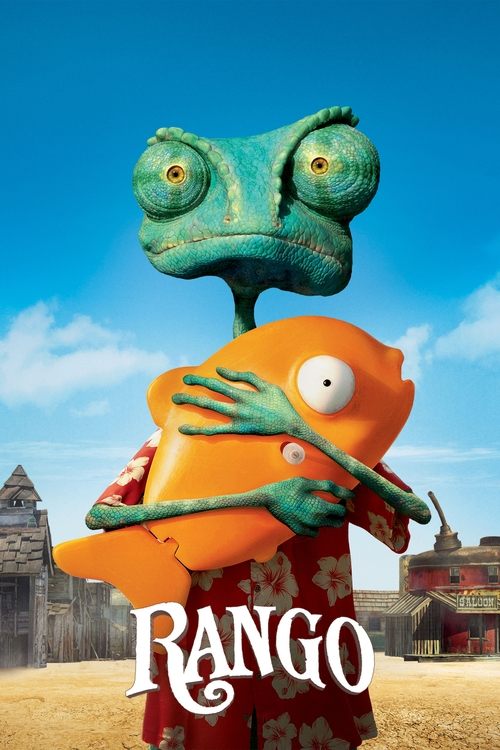
Rango
2011 · Gore Verbinski
When you want an animated film with actual flavor — for a night you'd like the comfort of a family movie but the sensibility of a Western. Great with older kids; even better with grown-ups who love genre movies.
What it's about
A pampered pet chameleon with theatrical ambitions tumbles out of his family's car and into the Mojave, where he wanders into Dirt — a parched frontier town of desert critters straight out of a Western. Improvising the role of a lifetime, he spins himself into a legendary gunslinger and gets appointed sheriff, then has to actually solve the town's crisis: the water is disappearing, and somebody powerful knows why. His act can only hold up so long.
The experience
Strange, funny, and far more textured than a talking-animal comedy has any right to be — a sun-blasted Western mystery with real grit under its jokes. It swings from slapstick to genuinely mythic desert imagery, and adults tend to enjoy it more than kids do.
Performances
Johnny Depp's voice work is a full-body comic performance — the cast recorded scenes together on a stage, in costume, and you can hear the live spark in every exchange.
The craft
The first animated feature from Industrial Light & Magic, with Roger Deakins consulting on the images — and it shows: heat-shimmer, dust, and desert light rendered with a photographic beauty almost no animated film attempts. Gore Verbinski stages it like a real Western, wide lenses and all, with a mariachi-owl chorus narrating; it rewards the biggest, sharpest screen you have.
Why it matters
Won the Oscar for Best Animated Feature and remains a landmark for how cinematic — how genuinely film-literate — a studio cartoon can be, a beloved outlier that studios have rarely dared to repeat.
Snapshot
Rango is an anomaly in the history of American studio animation: a $135-million computer-animated feature, released by Paramount Pictures and financed as a family tentpole, that behaves throughout like a late revisionist Western made by cinephiles who had absorbed Sergio Leone, John Ford, Chinatown, and Hunter S. Thompson in roughly equal measure. It was the first feature produced by Industrial Light & Magic as an animation house rather than a visual-effects vendor — the company that had spent three decades putting photoreal creatures into live-action frames now had to build an entire world and carry a performance-driven comedy through ninety-odd minutes. Gore Verbinski, coming off three Pirates of the Caribbean films, brought Roger Deakins in as visual consultant, shot the voice cast together on a stage in costume rather than isolating them in booths, and delivered a picture whose surfaces are pockmarked, greasy, sun-scorched and unlovely in a medium that had trained audiences to expect smooth plastic charm.
The film won the Academy Award for Best Animated Feature — beating, notably, a field in which Pixar's Cars 2 was not nominated — and it remains the rare animated Oscar winner produced entirely outside the Disney/Pixar/DreamWorks axis. It is also a film built almost entirely out of quotation: a lizard with an identity crisis learns to be a hero by performing one, in a town whose water supply has been diverted by its own mayor, in a landscape borrowed from Monument Valley and a plot borrowed from Robert Towne. Its lasting significance lies less in what followed it — its commercial performance was solid rather than transformative, and it spawned no cycle — than in what it proved possible: that animation could be photographed rather than merely rendered, and that a studio animated feature could be genuinely, unrepentantly strange.
Industry & production
Rango originated at Nickelodeon Movies and Paramount, and its production history is inseparable from a specific industrial moment. In the late 2000s Paramount's distribution arrangement with DreamWorks Animation was winding toward its end, and the studio needed animated product it controlled. At the same time, Industrial Light & Magic — Lucasfilm's visual-effects arm, and by then over thirty years into a business built on compositing digital elements into live-action photography — had ambitions to produce animated features in its own right. Lucasfilm had already established a separate animation operation for the Clone Wars television work, but a theatrical CG feature at ILM's fidelity was a different proposition entirely.
Verbinski had worked with ILM extensively on the Pirates films, where the company's Davy Jones and the cursed crew of the Black Pearl represented the state of the art in performance-driven digital character work. That relationship is the hinge: Rango was, in a real sense, an extension of the Davy Jones problem — how to build a fully digital character who reads as a performance rather than an effect — scaled up to an entire cast and an entire film. Verbinski co-founded the production entity Blind Wink for the project and served as producer alongside John B. Carls and Graham King.
The economics were unusual. ILM had the rendering infrastructure and the character-pipeline expertise but not the standing animation crew of a Pixar or a DreamWorks; the company had to staff up and, more consequentially, had to learn feature-animation workflow — sequence-based storyboarding, editorial-driven pacing over years, the long iterative development of performance — which is a fundamentally different discipline from shot-based effects work delivered against a live-action edit. Verbinski has spoken in interviews about wanting the production to feel like a film shoot rather than an animation pipeline, and the working method he imposed reflects that.
Commercially, Rango performed respectably: it opened at number one domestically and grossed somewhere in the neighborhood of $245 million worldwide against its reported $135 million budget — a profitable result, but not the runaway hit that would have established ILM as an ongoing feature-animation studio. ILM did not follow it with another animated feature, and the unit's ambitions in that direction did not materialize into a sustained slate. In that sense Rango is a one-off in industrial terms: a demonstration that was never repeated.
Technology
The technical achievement of Rango is best understood as ILM applying visual-effects standards of surface and light to a medium that had, for cost reasons, mostly avoided them. Feature animation pipelines at the time were engineered around throughput: simplify geometry, control the lighting, keep render times survivable across tens of thousands of shots. ILM's instincts ran the other way. The character models in Rango carry an extraordinary density of detail — scale, wrinkle, pore, chipped beak, matted feather, crusted dirt — and the film pushes subsurface scattering, translucency in ears and membranes, and complex specular behavior on wet or oily surfaces far beyond the norm for animated features of the period.
Two areas stand out. The first is fur and feather: the animal cast of Dirt includes birds, rodents, a hawk, and assorted mammals, and the grooming work — the simulation of individual hairs and barbs, their clumping, their response to wind and motion — is closer to Pirates-era creature work than to contemporaneous cartoon character design. The second is atmosphere. The film's desert is rendered with a persistent haze of dust, heat shimmer, and volumetric light, and its interiors are full of drifting particulate caught in shafts from windows. Air is treated as a material, which is a rendering expense most animated features of the era declined to pay.
Crucially, Rango was produced and released in 2D at a moment — the immediate post-Avatar years — when stereoscopic 3D was close to mandatory for a studio animated tentpole. Verbinski has been consistent in interviews that the choice was deliberate and aesthetic: the film's lighting scheme depends on deep, crushed shadow and hard sunlight, and 3D projection of that era cost significant screen brightness. Declining 3D also meant declining the premium ticket surcharge, a genuinely uncommercial decision that says a good deal about how the production understood itself.
Technique
Cinematography
Roger Deakins served as visual consultant on Rango, a role he had also filled on WALL·E and would fill again on How to Train Your Dragon. His involvement is the single most legible influence on the film's look. The picture is lit like a live-action Western shot on location: hard, high, directional sun that blows out the top of the frame and drops faces into shadow; long lens compressions across the flats; anamorphic-style flares and the falloff and slight softness at frame edges that real glass produces. Lens artifacts — flare, aberration, subtle distortion, shallow and imperfect focus — are simulated rather than avoided, which inverts the default logic of CG rendering, where such artifacts are things you have to work to introduce.
The camera itself behaves like a physical object operated by a person. It has weight; it settles; it reframes fractionally late; handheld sequences carry the specific inconsistency of a human operator rather than the smooth procedural noise usually applied to virtual cameras. Verbinski's staging favors wide compositions that place tiny figures against enormous landscape — the classic Fordian scale relationship — and the film repeatedly cuts between the extreme wide and the very tight, Leone-fashion, with much less of the medium-shot connective tissue that animated features typically rely on for legibility.
The color design runs to sun-bleached ochre, dust brown, and bruised amber, with the saturated palette that had become the default register of studio animation almost entirely withheld. Night sequences are genuinely dark. It is a film willing to let you struggle slightly to see, which is an unusual liberty in a family release.
Editing
Craig Wood, Verbinski's editor across the Pirates films, cut Rango, and the film's rhythm is a live-action rhythm rather than an animation rhythm. Animated features are typically boarded to something close to final cut length before animation begins, because animating unused footage is prohibitively expensive; the consequence is a tendency toward metronomic, pre-solved pacing. Rango instead sustains long-held wides and lets scenes breathe past their comic beats into discomfort — a strategy visible in the film's protracted standoffs and in the extended silence around Rango's confrontation with the Spirit of the West.
The set pieces cut with genuine live-action action grammar. The mine-cart-and-bat chase, staged as an aerial cavalry engagement, is edited for spatial coherence and escalating pressure in a manner directly continuous with Verbinski's Pirates sequences. Elsewhere, the film's mariachi-owl chorus functions as a structural editing device, punctuating and commenting between sequences in a way that borrows both from Greek chorus convention and from the ballad-narration tradition of the sung Western.
Mise-en-scène / staging
Dirt is a production-designed town in the fullest sense. Its architecture is a scavenge: bottle caps, cans, wire, bone, and cast-off human refuse assembled into saloon, bank, and main street. Every surface carries wear, and the design consistently favors decay over cuteness. The character designs are frankly grotesque — a mayor who is a tortoise in a wheelchair, an outlaw rattlesnake with a Gatling gun for a rattle, a bird with an eye permanently transfixed by an arrow — and the film makes no concession to the rounded, high-eye-ratio conventions of appealing animated character design.
Verbinski stages in depth and in long takes, using foreground occlusion, layered action, and off-center framing in ways that assume a viewer who will scan the frame. Water — its absence, its ritual dispensation from the town's bank, its final return — organizes the mise-en-scène throughout: the film is built around an empty pipe, a dry riverbed, and a golf course glimpsed as obscene abundance.
Sound
Hans Zimmer's score is a deliberate pastiche of Ennio Morricone's work for Leone — whistles, twanging electric guitar, chanted vocals, trumpet — deployed with enough self-awareness to function as commentary while still doing sincere dramatic work in the final act. The mariachi owls, performed with narration and song, sit between diegetic and non-diegetic and repeatedly foretell the hero's death, a joke that also carries the film's fatalism.
The sound design is dry, particulate, and specific: wind, grit, the creak of dry wood, the mechanical clatter of the town's water ritual. Dialogue was recorded with the cast performing together, which produces overlaps, interruptions, and off-mic reactions rare in animated features assembled from isolated booth sessions.
Performance
The film's most consequential production decision was Verbinski's "emotion capture" approach: rather than recording voices separately, the cast — Johnny Depp, Isla Fisher, Abigail Breslin, Ned Beatty, Bill Nighy, Alfred Molina, Harry Dean Stanton, Ray Winstone, Timothy Olyphant and others — performed scenes together on a stage, in rough costume and with props and set pieces, over roughly a month, videotaped from multiple angles. The footage was not motion-capture data; it was reference, given to animators as a record of how the ensemble actually played the scene.
The result is an unusual density of behavioral detail — actors reacting to each other in real time, physical business that emerged on the floor, timing that arrives from performance rather than from board. Depp's Rango is a study in a bad actor performing courage, and the animation preserves the specific mechanics of that: the over-projected gestures, the collapse when the audience turns away. Harry Dean Stanton and Ned Beatty bring the specific weathered authority of their own Western and New Hollywood careers; Beatty's Mayor is explicitly modeled on John Huston's Noah Cross, and Timothy Olyphant's Spirit of the West is a Clint Eastwood impersonation that the film treats as a genuine apparition rather than a gag.
Narrative & dramatic mode
Rango is a metafictional Western built on the logic of performance. Its protagonist is a chameleon — an animal defined by adaptive imitation — who begins the film as an actor without an audience, staging plays in a terrarium with inanimate props. Thrown into the desert, he invents a persona, is believed, and must then sustain the fiction. The dramatic engine is not "can the hero win" but "what happens when the performance is discovered," and the film's central crisis is the collapse of the fiction and the hero's exile.
Structurally, the plot is Chinatown transposed: a water conspiracy, a town dying of thirst, a corrupt patriarch who has diverted the supply to make worthless land valuable, and an investigator who is out of his depth. The film is explicit about this — Beatty's Mayor delivers the argument for controlling water almost as a direct restatement of Cross's position, and the visual reveal of a green, irrigated development mirrors the same logic. Onto that noir armature the film welds the classical Western arc of a stranger who arrives, is mistaken for a savior, and must become one.
The mode is comic but the register is unstable by design — it moves from broad slapstick to genuine dread to a mystical passage in which Rango walks a highway and meets the Spirit of the West, who is Eastwood in a golf cart, holding an Oscar statuette. That sequence is the film's thesis stated aloud: heroism is a role, and "no man can walk out on his own story."
Genre & cycle
The film belongs to the revisionist Western, and more specifically to the late, self-aware phase of it. Its debts are systematic: the Monument Valley landscape and the community-founding arc of Ford; the extreme telephoto compositions, ritualized standoffs, and Morricone-inflected score of Leone; the water conspiracy of Chinatown; the aging-gunslinger fatalism of the post-Unforgiven Western; and the desert-hallucination register of Fear and Loathing in Las Vegas, which the film quotes directly in its opening highway sequence when Rango's terrarium is knocked from a station wagon carrying two familiar figures.
It also participates, more loosely, in the animal-fable Western and in the tradition of animation as genre pastiche — but it differs from most such films in refusing to soften. The comparison most often made at release was to Chinatown and to the spaghetti Western, not to other animated films, and that is the correct frame. As a cycle, Rango began and ended one: no wave of adult-register animated Westerns followed.
Authorship & method
Verbinski's authorship here is unusually legible. Across Mouse Hunt, The Ring, the Pirates trilogy, and later A Cure for Wellness, his consistent interests are grotesque physical comedy, elaborate mechanical set pieces, decaying environments, and characters who are performing identities they do not own. Rango concentrates all of these. His method on the film — ensemble performance capture on a stage, live-action camera logic, a visual consultant drawn from live-action cinematography, a Western structure — amounts to a deliberate refusal of animation-pipeline convention.
The screenplay is credited to John Logan, from a story by Logan, Verbinski, and James Ward Byrkit. Logan's presence matters: a writer of Gladiator, The Aviator, Hugo, and Sweeney Todd, he brings a facility with genre architecture and with characters defined by self-invention. Byrkit — who would go on to direct Coherence — had worked closely with Verbinski on the Pirates films and served in a creative-consultant capacity across the production.
The key collaborators are largely Verbinski's Pirates company: editor Craig Wood, composer Hans Zimmer, and ILM's animation and effects leadership, with Mark "Crash" McCreery — the creature designer whose work runs from Jurassic Park through Davy Jones — driving the character design toward the anatomically grotesque. Deakins's consultancy on the lighting and camera is the outside voice, and the one whose fingerprints are most visible in the finished frames. Hal Hickel, ILM's animation supervisor on the Pirates films, brought the same character-animation discipline to the ensemble.
Movement / national cinema
Rango is an American studio film, and its national identity is central to its subject: it is a film about American myth-making, about the West as a story the country tells itself, and about the ecological cost of that story in the actual arid Southwest. The water plot is not incidental — it engages directly with the history of Western water politics, the Owens Valley legacy that Chinatown fictionalized, and the fundamental unsustainability of desert settlement.
Its aesthetic lineage is transnational, though: the Italian Western that reflected American myth back at America, filtered again through a Hollywood picture. The film sits within no organized movement, but it belongs to a loose tendency in late-2000s and early-2010s American animation — alongside Fantastic Mr. Fox, Coraline, and The Secret of Kells — in which directors from outside the animation establishment, or studios outside the majors, pushed the medium toward adult tonal registers and hand-inflected surfaces.
Era / period
The film arrives at a specific inflection point. Post-Avatar stereoscopic 3D was at peak industrial pressure; Pixar had just completed Toy Story 3 and was entering the sequel-driven phase that Cars 2 announced; DreamWorks had industrialized its own house style; and the animated feature had become one of the most reliably profitable and most creatively constrained categories in studio filmmaking. Rango runs against nearly all of it — 2D, adult-referential, visually dirty, structurally borrowed from 1974 noir.
It also arrives amid a genuine, if modest, Western revival: the Coens' True Grit had been released a few months earlier, Django Unchained and The Lone Ranger were ahead, and the television landscape had Deadwood recently behind it and Justified — starring Rango's Timothy Olyphant — running concurrently. The Western was available again as a form to think with, and Rango thinks with it seriously.
Reception, canon & influence
Critical reception was strong and notably enthusiastic about exactly the qualities that made the film commercially risky: reviewers praised its visual richness, its density of cinephile reference, and its willingness to be strange, while some noted that its humor and its noir plotting pitched over the heads of the youngest audience the marketing implied. The film won the Academy Award for Best Animated Feature and the BAFTA in the same category, and it took the Annie for Best Animated Feature as well — a clean sweep of the major prizes for a film produced outside the established animation studios.
Its backward influences are unusually explicit and worth naming precisely: John Ford's Monument Valley Westerns for landscape and community; Sergio Leone's Dollars films and Once Upon a Time in the West for framing, ritual, and score; Roman Polanski and Robert Towne's Chinatown for the water conspiracy and the corrupt patriarch; Terry Gilliam's Fear and Loathing in Las Vegas (and Hunter S. Thompson beneath it) for the desert-hallucination opening; Clint Eastwood's screen persona, invoked directly; and Verbinski's own Pirates films for the mechanics of grotesque digital performance.
Forward, the picture's legacy is real but diffuse. It did not launch an ILM animation studio, and it produced no imitators of consequence — the economics of animation continued to reward smoothness and 3D surcharges. What it did establish is a proof of concept that later work drew on: that live-action cinematographic logic could be imported wholesale into CG animation, and that a virtual camera modeled on physical glass and physical operators produces a different and richer image. That argument has since become close to standard in the medium, visible in the growing willingness of animated features to adopt lens artifacts, deep shadow, and non-standard framing. The film also stands as a durable counterexample within its category — cited whenever the question arises of whether a studio animated feature can be genuinely authored — and its reputation has, if anything, grown in the years since, as its refusals look less like eccentricity and more like conviction.
A Deleuzian reading
A lizard in a glass box, mid-performance, sliding around the back of a car on a desert highway.
The full Deleuzian reading of Rango →
Reception
Well reviewed on release and an Oscar winner for Best Animated Feature, but 2011 audiences mostly filed it as 'that weird lizard movie' too strange for kids; the internet has since canonized it as one of the great animated films of the 2010s and Exhibit A for a risk-taking studio era that no longer exists.
How Rango was received, from release to now →
How to watch Rango: what to notice on a first viewing
- Watch the sun blow out the top of the frame. Deakins consulted on the lighting; hard directional sun drops faces into shadow and night scenes stay genuinely dark throughout. The Western is lit like it was shot on location, not rendered in a studio.
- Notice how shots jump from wide landscape to tight close-up. Verbinski and editor Craig Wood cut Leone-style, skipping the medium shots animation usually leans on for clarity. The missing middle distance makes the town feel enormous and the standoffs feel ritualized.
- Look at what Dirt's saloon and bank are built from. Bottle caps, cans, wire, bone, and human refuse are assembled into a town where every surface shows wear. The design refuses the smooth, cute conventions studio animation trained audiences to expect.
- Listen for the mariachi owls singing between scenes. The owl chorus narrates, comments, and repeatedly predicts Rango's death, sitting between song and score. They work like a Greek chorus, framing the action as a story already being told about itself.
The whole guide to watching Rango, with the keys for a rewatch →
Influences: the films it descends from and the films it influenced
- The Searchers (1956) — Rango's Dirt is staged on Ford's Monument Valley grammar — mesa horizon held low in a wide frame, the township street as a single deep-focus proscenium, and doorway/porch framing used to bracket the outsider against the community he can't enter.
- The Man Who Shot Liberty Valance (1962) — The film's central device — a hero whose reputation is a performance built on a killing he didn't earn, sustained because the town needs the legend — is Ford's 'print the legend' structure transposed onto a lizard who literally auditions his own persona.
- Once Upon a Time in the West (1968) — Leone's water-rights land grab, his ritual cutting between extreme close-up and extreme long shot with no mid-range relief, and Morricone's assign-a-leitmotif-per-character scoring are all reproduced in Verbinski's showdown staging and Zimmer's mariachi-owl chorus.
- The Good, the Bad and the Ugly (1966) — The Eastwood squint-and-serape persona is quoted directly (down to the Spirit of the West cameo), and Zimmer's score is a deliberate Morricone pastiche — twanging guitar, whistle, wordless male voice, coyote-yelp brass — used as period signature rather than parody.
- Chinatown (1974) — Towne's architecture is imported whole: an aqueduct/water-diversion conspiracy hiding a land scheme, a courtly patriarch who owns the town's future, and a detective whose eventual understanding arrives too late to prevent anything.
- Fear and Loathing in Las Vegas (1998) — The desert-highway hallucination that opens Rango — wide-angle distortion, a terrarium as the vehicle, and a literal Raoul Duke in the passing convertible — is Gilliam's Thompson grammar of subjective lens abuse and paranoid road space, with Depp reprising his own performance.
- Mouse Hunt (1997) — Verbinski's own template for small creatures navigating a hostile, decaying, over-engineered architecture in long Rube Goldberg chains of cause and effect — the mechanical set-piece logic that Rango's mine-cart and pipeline sequences inherit intact.
- Pirates of the Caribbean: Dead Man's Chest (2006) — The direct pipeline ancestor: ILM's Davy Jones proved on-set performance capture could carry a grotesque non-human face with full ensemble eyeline and interaction, and Rango reuses that crew — animation supervisor Hal Hickel, designer Crash McCreery, editor Craig Wood — to do it for an entire cast.
- Jurassic Park (1993) — McCreery's creature-design line starts here, and so does ILM's governing discipline of animating to a photographic camera — matching CG creatures to real lens behavior, motion blur and light rather than to animation-pipeline cleanliness.
- No Country for Old Men (2007) — Deakins's Southwest lighting scheme — single hard directional sun, no fill, crushed shadow sides, sourced practicals at night — is the exact reference he carried into Rango as visual consultant, along with the refusal to lift shadows for legibility.
- Pirates of the Caribbean: At World's End (2007) — Verbinski reunites with ILM to render grotesque, hyper-textured character design in full CG animation, extending the eccentric maximalist world-building instinct of the Pirates films.
- Pirates of the Caribbean: The Curse of the Black Pearl (2003) — Reunites Verbinski and Depp to port Sparrow's eccentric character-actor voice and genre-pastiche sensibility into animation, with Wolski consulting on 'live-action' virtual cinematography.
- Coherence (2013) — Byrkit, Rango's story co-writer and creative consultant, built his directorial debut on the method he helped run on Verbinski's stage: an ensemble performing together in one continuous physical space with overlapping unscripted interaction, camera catching it rather than composing it.
- The Lego Movie (2014) — Extends Rango's central argument by simulating a physical camera outright — macro-lens depth of field, focus breathing, lens dust and imperfect rack focuses — so the CG image reads as photographed miniature rather than rendered space.
- Spider-Man: Into the Spider-Verse (2018) — Takes the simulated-lens-artifact idea to its conclusion: hand-placed chromatic aberration, dual-plane focus, and deliberately 'wrong' defocus treated as authored graphic marks, on a studio feature that likewise refused pipeline smoothness as a house style.
- Puss in Boots: The Last Wish (2022) — A mainstream CG feature built on Rango's Leone grammar — hard low sun and long shadows, ritualized showdown framing, stepped non-smooth animation, and a whistling Wolf antagonist scored as a Morricone leitmotif.
- Flow (2024) — Carries Rango's virtual-camera principle furthest: the camera is treated as a physical object with mass and an operator, drifting, over-shooting pans and losing its subject, so that framing becomes a record of someone holding a rig rather than a placed viewpoint.
- Transformers One (2024) — ILM's first fully-animated feature; the direct institutional and pipeline lineage that made Transformers One viable as an ILM full-animation production rather than a VFX-house-does-cartoon novelty.
- Good Luck, Have Fun, Don't Die (2026) — Verbinski's clearest prior statement of this sensibility — a pastiche ensemble of grotesques performing together in one room (the 'emotion capture' stage), a genre reconstructed from the inside out, and Deakins-consulted high-contrast key light that lets comic staging tip into dread without a tonal transition.
- Fantastic Mr. Fox (2009) — The immediately preceding proof that an animated feature can be authored like a live-action one: cast recorded together on location as a physical ensemble rather than isolated in booths, groomed fur left visibly imperfect, and camera moves restricted to real dolly/pan/snap-zoom vocabulary.
- The Lone Ranger (2013) — Verbinski and Depp re-run Rango's premises in live action — Monument Valley staging, a hero whose identity is assembled from costume and rumor, and long mechanically-choreographed train set pieces cut to the same Craig Wood rhythm.
- A Cure for Wellness (2016) — The same authorial signature in another register — a decaying institutional environment rendered with volumetric atmosphere and hard shafted light, anatomically grotesque body horror, and a protagonist performing a competence he does not possess.
- Kung Fu Panda (2008) — Another Deakins-consulted animated feature that pushes the live-action-DP-as-lighting-guide method further, treating CG shots with the anamorphic framing and hard desert lighting of a photographed Western.
Similar films
- Fantastic Mr. Fox (2009) — influence & lineage
- Spider-Man: Into the Spider-Verse (2018) — influence & lineage
- Puss in Boots: The Last Wish (2022) — influence & lineage
- Flow (2024) — influence & lineage
- Hell or High Water (2016) — often watched together
- Shrek (2001) — shared sensibility
- Ratatouille (2007) — shared sensibility
- Spirited Away (2001) — shared sensibility