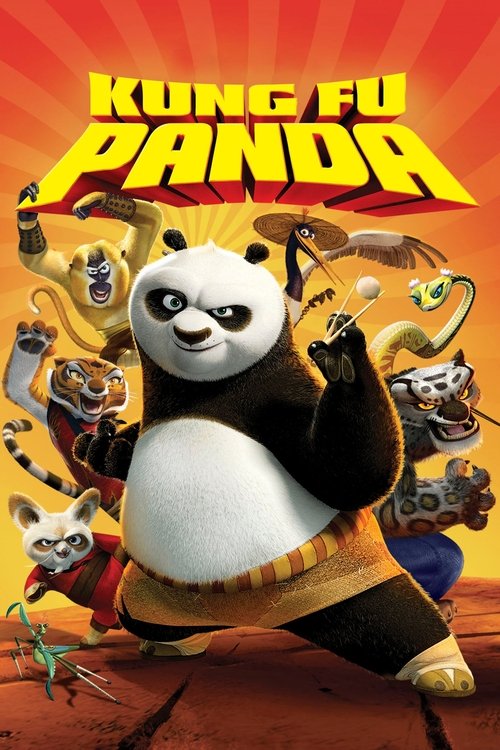
Kung Fu Panda
2008 · Mark Osborne
For a family movie night, a pick-me-up, or any time you want to laugh and leave feeling like maybe you're enough as you are — comfort viewing that never talks down to you.
What it's about
Po is a noodle-shop panda in the Valley of Peace who worships kung fu heroes from behind a serving counter — until a prophecy improbably names him the Dragon Warrior. Nobody believes it, least of all his reluctant teacher Master Shifu and the elite Furious Five, and a fearsome enemy is coming to test whether the clumsy fan can become the real thing.
The experience
Fast, funny, and surprisingly sincere — the slapstick lands, the training montages genuinely thrill, and the underdog arc sneaks up on you with real feeling. It's pure pleasure from the first frame.
Performances
Jack Black's voice work is the engine — his Po is all enthusiasm and self-doubt, and the film builds its comedy and its heart on that exact energy rather than on celebrity winking.
The craft
The animation treats martial-arts cinema with real love: fights are choreographed and cut like the Hong Kong classics, the Chinese landscapes glow, and a stunning hand-drawn dream sequence opens the film with pure style. It looks and sounds terrific on the biggest screen you have.
Why it matters
An Oscar nominee that proved DreamWorks could do mythic sincerity as well as jokes, it launched one of animation's most durable franchises and raised the bar for how Western animation handles martial-arts action.
Snapshot
Kung Fu Panda is DreamWorks Animation's most fully realized fusion of Western computer-animated comedy and the visual grammar of Hong Kong and mainland-Chinese martial-arts cinema. Directed by Mark Osborne and co-director John Stevenson, it tells of Po, a noodle-shop panda voiced by Jack Black, who is improbably anointed the Dragon Warrior and must earn the mantle he was handed by accident. The film matters historically for three reasons: it demonstrated that DreamWorks could pair its signature star-driven comic voice with sincere emotional and mythic stakes rather than pop-culture snark; it treated wuxia and kung-fu film language as a subject to honor rather than parody; and it launched one of animation's most durable franchises. Nominated for the Academy Award for Best Animated Feature (it lost to Pixar's WALL-E), it is widely regarded as a turning point in DreamWorks' artistic maturation.
Industry & production
The project sat in development at DreamWorks Animation for several years and reportedly began life closer to a broad spoof before being reconceived as a straight-faced action-comedy that took its martial-arts sources seriously. That tonal reset is the key production fact: the filmmakers chose reverence over irony. Producer Melissa Cobb oversaw the picture, and the screenplay is credited to Jonathan Aibel and Glenn Berger, writers who would remain attached across the franchise.
The film was made at the height of the DreamWorks era defined by celebrity casting, and its ensemble is a marquee in itself: Jack Black as Po, Dustin Hoffman as Master Shifu, Angelina Jolie as Tigress, Jackie Chan as Monkey, Seth Rogen as Mantis, Lucy Liu as Viper, and David Cross as Crane, with Ian McShane as the villain Tai Lung, James Hong as Po's goose father Mr. Ping, and Randall Duk Kim as the tortoise sage Oogway. Casting Jackie Chan — an icon of the very tradition the film draws on — was a pointed gesture of lineage, even if his role is comparatively small.
Commercially the film was a substantial global success and profitable enough to establish a tentpole franchise; it is frequently cited as one of DreamWorks' strongest performers of the period. Because exact grosses vary by source, this dossier declines to assert a precise figure, but the scale of its success is not in dispute: it generated sequels, television series, and holiday specials within a few years.
Technology
Kung Fu Panda was produced on DreamWorks Animation's proprietary CG pipeline of the late 2000s, and its technical ambitions are legible on screen. The panda's plush, layered fur, the cloth of robes and banners, and the volumetric handling of mist, snow, and cherry blossom were all showcases for the studio's simulation and lighting tools of the era. The film's most conspicuous technological choice, however, is aesthetic restraint deployed at scale: sweeping mountain vistas, temple interiors, and the vertiginous prison of Chorh-Gom are rendered with a painterly sense of atmosphere rather than raw detail density.
The best-documented technical collaboration is with cinematographer Roger Deakins, who served as a visual/lighting consultant — a role he also filled on other animated features of the period, including WALL-E and later How to Train Your Dragon. His involvement is consistent with the film's live-action sensibility: naturalistic key lighting, motivated sources, and a willingness to let faces fall into shadow.
The opening and closing sequences depart from CG entirely, rendered in traditional 2D animation with a stylized, graphic look evoking Chinese ink painting and shadow-puppet theater; hand-drawn animation veteran James Baxter is associated with this striking framing device. The juxtaposition of flat, mythic 2D against the rounded, tactile CG body of the film is one of its most sophisticated technological statements.
Technique
Cinematography
The film adopts an anamorphic-scope aesthetic and stages its action for a widescreen frame, borrowing the epic proportions of the wuxia films it admires. The virtual camera behaves like a physical one: it racks focus, uses long lenses to compress mountain ranges, and executes crane-like moves through temple architecture. Deakins' consultancy shows in the lighting design — dawn and dusk palettes, warm interiors set against cool exteriors, and dramatic silhouetting during Tai Lung's prison escape and the climactic duel. Landscape functions almost as a character, with compositions that isolate small figures against vast painterly backdrops in the manner of classical Chinese scroll painting.
Editing
The action editing is the film's clearest debt to Hong Kong cinema. Rather than the choppy, obscuring cutting common to CG action of the era, the fights are cut to preserve legibility of movement and spatial geography — the training-hall sparring, the "dumpling duel" between Po and Shifu over a single steamed bun, and the bridge fight against Tai Lung all sustain wide framings and clean beats so that choreography reads. The comic timing is likewise built in the cut, holding on reactions in the Jackie-Chan tradition where a pause sells the gag. The specific editing credit is not one I can attribute with full confidence from memory, so the record here is left deliberately unstated rather than risk a wrong name.
Mise-en-scène / staging
Production designer Raymond Zibach and the art department built a world of layered Chinese visual references: temple and pagoda architecture, the terraced Valley of Peace, ceremonial reds and golds, calligraphic banners, and props drawn from a martial-arts imaginary. The Furious Five are conceived around real animal-styles of kung fu — Tigress, Crane, Mantis, Viper (snake), and Monkey — so that character design and fighting style are unified. The staging repeatedly organizes space vertically (endless prison stairs, mountaintop temple, the Sacred Peach Tree of Heavenly Wisdom) to dramatize aspiration and descent.
Sound
The score, by Hans Zimmer and John Powell, weds a Western orchestral action idiom to traditional Chinese instrumentation and melodic color, with Zimmer having undertaken research in China to ground the sound. The result oscillates between soaring adventure cues and quieter, meditative passages built around Chinese timbres such as bowed strings and flutes. Sound design foregrounds the physicality of combat — impacts, cloth, and the whip of movement — while the mix reserves silence and stillness for the film's contemplative Taoist beats, notably Oogway's scenes beneath the peach tree.
Performance
Vocal performance is central to the film's success. Jack Black gives Po a manic, fan-boy enthusiasm underlaid by genuine self-doubt, and the animators pin the comedy to his specific vocal rhythms. Dustin Hoffman's Shifu supplies the film's dramatic spine, moving from exasperation to grief to a hard-won serenity. Ian McShane's Tai Lung is played with wounded aristocratic menace, and Randall Duk Kim's Oogway delivers the film's philosophy with unhurried gravity. The animation reads these performances closely — Po's weight and clumsiness, Shifu's coiled precision, Tigress's controlled stillness — so that body language does as much characterization as dialogue.
Narrative & dramatic mode
Structurally the film is a classic hero's-journey and mentor-story, executed with unusual discipline for a comedy. Po is the reluctant chosen one; Shifu is the mentor who must first overcome his own contempt for the student before he can teach; Tai Lung is the shadow — the "perfect" student whose thwarted entitlement makes him the dark mirror of Po. The dramatic engine is the gap between prophecy and merit: Po is chosen but unworthy, and the plot is the closing of that gap. The film's decisive narrative move is the reveal that the Dragon Scroll is blank — a reflective surface — and that "there is no secret ingredient." Mastery is not a hidden technique but self-belief; this is the film's structural and thematic payoff at once. The tone braids slapstick with sincere melodrama, and the film is confident enough to let its emotional scenes (Shifu and Oogway's parting; the flashback to Tai Lung's fall) play straight.
Genre & cycle
Kung Fu Panda belongs simultaneously to the CG family-animation cycle of the 2000s and to the martial-arts genre it lovingly reconstructs. Within animation it stands against the reflexive, reference-heavy comedy that defined much of DreamWorks' Shrek-era output; here the film commits to genre rather than mocking it. Within martial-arts cinema it functions as an anthology of forms: the training montage, the tournament, the prison break, the master-versus-rogue-student duel, the underdog-makes-good arc. It also participates in the broader late-2000s vogue for animals-doing-human-things franchises, but distinguishes itself by tying its animal cast organically to its subject matter through the animal-styles conceit.
Authorship & method
Mark Osborne came to the film from a background in stop-motion and short film — his acclaimed short More (1998) earned an Academy Award nomination — and he had previously co-directed The SpongeBob SquarePants Movie; his sensibility blends craft-conscious animation with broad comedy. Co-director John Stevenson came out of a storyboard and story background, and the film's strong sense of staged action reflects that story-driven approach. The screenplay by Jonathan Aibel and Glenn Berger supplies both the joke architecture and the surprisingly clean thematic throughline. Key collaborators define the house style: production designer Raymond Zibach for the world's Chinese visual identity; composers Hans Zimmer and John Powell for the hybrid score; and Roger Deakins as lighting/visual consultant, whose live-action eye pushed the cinematography toward realism. The 2D bookends associated with James Baxter represent a distinct authorial voice within the film. The method, in sum, was collaborative studio authorship in which a live-action cinematographer, a design team steeped in Chinese art, and directors from opposite ends of animation practice converged on a single, unusually coherent vision.
Movement / national cinema
The film is an American studio product, but its aesthetic project is an act of translation from Chinese and Hong Kong cinema. It draws on the wuxia revival internationally popularized by Crouching Tiger, Hidden Dragon and Zhang Yimou's Hero and House of Flying Daggers — their color-coded landscapes, wire-assisted grace, and elegiac tone — and on the older Shaw Brothers kung-fu tradition of training arcs and revenge duels. It equally honors Jackie Chan's comic-acrobatic style, in which fights are staged as slapstick problem-solving, and its knockabout physical comedy is close in spirit to Stephen Chow's Kung Fu Hustle. The film's cross-cultural reception in China itself became a notable talking point, as a Hollywood production about a national cultural icon; the depth of that discourse is beyond what can be responsibly summarized here without specific sources.
Era / period
Kung Fu Panda is a product of the late-2000s maturation of CG animation, when the technology had advanced far enough that studios could pursue restraint and atmosphere rather than showcasing novelty, and when DreamWorks in particular was consciously moving beyond wall-to-wall pop-culture gags toward emotionally grounded storytelling. It arrived the same year as WALL-E, and the two films together mark a high-water moment for ambition in mainstream animation. It also reflects a period of intensifying Hollywood attention to the Chinese market and to Chinese subject matter, though the film's engagement with that material reads as genuine enthusiasm as much as commercial calculation.
Themes
The film's governing theme is self-acceptance: the idea that identity is not something conferred by prophecy or earned by conforming to another's template, but discovered in what one already is. Po does not become the Dragon Warrior by ceasing to be a food-loving panda; his love of food and his heavy body become the sources of his kung fu. Around this sit several interlocking ideas drawn loosely from Taoist and Zen thought, voiced chiefly by Oogway: the futility of clinging to control ("one often meets his destiny on the road he takes to avoid it"), acceptance of the present ("yesterday is history, tomorrow is a mystery, today is a gift"), and the emptiness of seeking a secret that does not exist. The blank scroll dramatizes the Zen notion that the answer is the self. Counter-themed against Po is Tai Lung, embodiment of entitlement, ambition, and the corrosive belief that one is owed greatness — a foil that gives the self-belief theme its moral edge. Shifu's arc adds a parallel meditation on teaching, letting go, and atoning for the failures of a mentor.
Reception, canon & influence
Critically the film was received far more warmly than skeptics of a "panda kung-fu comedy" premise expected, praised particularly for the quality and legibility of its action animation, its sincerity, and its striking art direction; it is generally regarded as one of DreamWorks Animation's best and most respected films. Its Best Animated Feature nomination confirmed its critical standing even in a year dominated by WALL-E.
Its influences run backward into the whole apparatus of martial-arts cinema — Shaw Brothers kung-fu films, Jackie Chan's comic action, the wuxia of Crouching Tiger, Hidden Dragon and Zhang Yimou, and the anarchic energy of Kung Fu Hustle — filtered through the Western hero's-journey template and the training-montage sports-underdog formula.
Its forward influence is considerable. Most immediately it founded a franchise: Kung Fu Panda 2 (2011), directed by Jennifer Yuh Nelson — a landmark as one of the era's major studio animated features directed by a woman — followed by Kung Fu Panda 3 (2016) and Kung Fu Panda 4 (2024), plus television series and specials. Within DreamWorks it helped consolidate the more sincere, visually ambitious mode that How to Train Your Dragon would carry further, signaling a studio-wide move away from reflexive parody toward emotionally committed storytelling. More broadly, it stands as an influential model for how Hollywood animation can adapt and honor a non-Western cinematic tradition — treating genre and culture as material to be studied and elevated rather than merely referenced — and its action sequences remain a touchstone for legible, choreography-first animated combat.
Reception
In 2008 it landed as a genuine surprise — critics braced for another snark-and-pop-song DreamWorks cartoon and instead got lovingly choreographed wuxia — and it's since been reappraised as the moment DreamWorks got sincere, the bridge to the studio's How to Train Your Dragon era.
How Kung Fu Panda was received, from release to now →
How to watch Kung Fu Panda: what to notice on a first viewing
- Watch the fights stay wide enough to follow the moves. The action is cut for legibility instead of chopped into fragments. The training-hall sparring and the dumpling duel over a single steamed bun hold their framings and clean beats so the choreography reads. You can always tell who did what, which is what separates this from most computer-animated action of its era.
- Watch for dawn and dusk light and hard silhouettes. Roger Deakins consulted on the lighting, and the film keeps motivated sources, warm interiors set against cool exteriors, and figures thrown into pure outline at dawn and dusk. The lighting behaves like a live-action cinematographer's, which is why the film carries weight a cartoon usually does not.
- Count how often the film makes somebody climb. Endless prison stairs, a mountaintop temple, the Sacred Peach Tree, a valley built in terraces. Space is organized up and down, so getting anywhere in this world means climbing to it. Rising and falling become physical directions on screen, which is how a family film carries its argument.
- Watch how each of the Furious Five fights differently. Tigress, Crane, Mantis, Viper, and Monkey are built around real animal styles of kung fu, so the character design and the fighting style are the same decision. Bodies tell you who everyone is. Design is doing the characterization, so you learn a character from how they move before they speak.
- Listen for Chinese flutes and strings inside the orchestra. Hans Zimmer and John Powell fold traditional Chinese instrumentation into a Western action score. The music swings between soaring adventure cues and quiet meditative passages under Oogway's scenes. The score treats the tradition it borrows from as a subject rather than as a costume.
The whole guide to watching Kung Fu Panda, with the keys for a rewatch →
Influences: the films it descends from and the films it influenced
- The 36th Chamber of Shaolin (1978) — The Shaw Brothers training-through-graduated-trials structure — a clumsy novice mastering discrete 'chambers' of skill — is the direct template for Po's staircase-and-tournament apprenticeship montage under Shifu.
- Drunken Master (1978) — Jackie Chan's food-and-prop-motivated comic sparring and the 'unteachable oaf learns via appetite' gag structure is literalized in Shifu training Po with dumplings, a debt the facets tag as jackie-chan-comic-action.
- Crouching Tiger, Hidden Dragon (2000) — Yuen Woo-ping's weightless wire-fu — treetop drifting and rooftop pursuit choreographed for grace over impact — is the model for KFP's aerial, gravity-teasing combat staging.
- Kung Fu Hustle (2004) — Chow's roster of disguised neighborhood masters each fighting in a signature exaggerated style is the template for the Furious Five as distinct animal-style specialists, plus the cartoon-physics escalation the film borrows wholesale.
- Hero (2002) — Zhang and Christopher Doyle's color-coded, painterly widescreen wuxia — saturated single-hue duels composed for anamorphic scope — informs KFP's use of scope framing and its stylized, palette-driven set-piece design.
- Once Upon a Time in China (1991) — Tsui and Yuen's Wong Fei-hung wire-fu — vertical ladder and pole choreography exploiting height and scaffolding — is the ancestor of KFP's staging/vertical-space combat across bridges, staircases and the Wuxi Finger Hold tower.
- Come Drink with Me (1966) — King Hu's foundational Shaw Brothers wuxia grammar — the inn brawl edited for legible spatial geography rather than blur — is the deep root of KFP's choreography-first, readable action cutting.
- Star Wars (1977) — The Campbell monomyth scaffolding — reluctant nobody, aged mentor (Oogway as Obi-Wan, Shifu as Yoda), prophesied 'chosen one' — supplies the hero's-journey template onto which the martial-arts material is grafted.
- The Karate Kid (1984) — Avildsen's mentor-teaches-through-mundane-chores training arc and sports-underdog montage rhythm is the Western structural spine that organizes Po's transformation from noodle-cook to warrior.
- Kung Fu Panda 2 (2011) — Directly extends the film's 2D-in-CG juxtaposition, expanding the James Baxter-style hand-drawn bookend into full traditionally-animated flashback and shadow-puppet sequences telling Po's origin.
- How to Train Your Dragon (2010) — Carries forward KFP's sincere, choreography-first DreamWorks mode and its Deakins-consulted naturalistic lighting, applying the same photographic flight cinematography to the dragon-riding set pieces.
- Spider-Man: Into the Spider-Verse (2018) — Extends the 2D/CG juxtaposition and legible-choreography ethos into the next generation, mixing hand-drawn linework and stepped 'on-twos' animation with CG to make stylized action read cleanly frame by frame.
- Puss in Boots: The Last Wish (2022) — The clearest heir to KFP's legible animated combat — anime-inspired impact-frame duels with reduced frame rate and painterly staging that prize choreographic clarity, evolving the choreography-first house style KFP established at DreamWorks.
- Ne Zha 2 (2025) — DreamWorks' template of exaggerated, cartoon-timed martial-arts choreography paired with broad comic-relief vocal performance is the blockbuster-animation grammar mapped here onto Chinese motifs.
- WALL-E (2008) — A contemporaneous animated feature built on the same experiment — importing a live-action cinematographer's lens language (Roger Deakins consulted on both) to give CG lighting and depth-of-field photographic realism.
- Rango (2011) — Another Deakins-consulted animated feature that pushes the live-action-DP-as-lighting-guide method further, treating CG shots with the anamorphic framing and hard desert lighting of a photographed Western.
- Avatar: The Last Airbender (2005) — Shares KFP's method of grounding fantasy combat in real, distinct martial disciplines — each element's bending choreographed after a specific kung-fu style — treating animal/style-based movement as researched material rather than referenced flavor.
- The Boy and the Beast (2015) — Builds the same master-pupil training on mirrored-movement mimicry and reluctant, improvised mentorship between a comic beast-teacher and an unlikely pupil, staged as choreographed imitation.
Similar films
- Kung Fu Panda 2 (2011) — influence & lineage · same viewing thread
- Puss in Boots: The Last Wish (2022) — influence & lineage · same viewing thread
- How to Train Your Dragon (2010) — influence & lineage · same viewing thread
- Kung Fu Hustle (2004) — influence & lineage
- Crouching Tiger, Hidden Dragon (2000) — influence & lineage
- Come Drink with Me (1966) — influence & lineage
- Shrek (2001) — same viewing thread
- Ip Man (2008) — shared sensibility
All the films related to Kung Fu Panda →
Watch it with: curated runs of related films
- The DreamWorks Fable — A run of DreamWorks' own canon — the studio that answered Disney with ogres, pandas, Vikings and swashbuckling cats — half fairy-tale satire, half genuine heart.