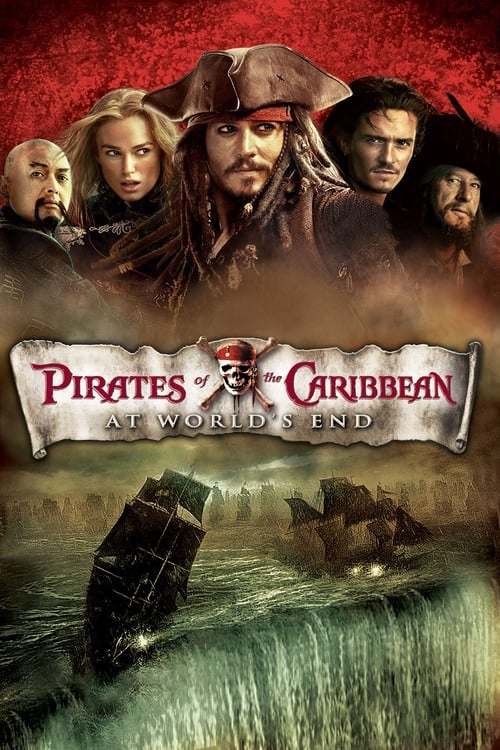
Pirates of the Caribbean: At World's End
2007 · Gore Verbinski
For a long, immersive adventure night when you want maximum spectacle and don't mind a plot that demands you keep score — best with the first two films fresh in mind. Comfort viewing at epic length.
What it's about
With Jack Sparrow trapped in Davy Jones's Locker and the East India Trading Company strangling piracy across every ocean, Will Turner, Elizabeth Swann, and the resurrected Captain Barbossa sail literally off the map to bring him back. The rescue is only the start: the world's nine pirate lords must be gathered for a last stand, and nearly everyone at the table is running a private double-cross.
The experience
Big, busy, and operatic — nearly three hours of shifting alliances, surreal detours, and escalating spectacle that ends in a sea battle inside a whirlpool. It asks more attention than most blockbusters and rewards it with genuine strangeness and swagger.
Performances
Johnny Depp's Jack Sparrow remains the franchise's engine of chaos, Geoffrey Rush is having visibly the most fun on screen as Barbossa, and Bill Nighy gives real melancholy to a man buried under tentacles.
The craft
Gore Verbinski pushes blockbuster imagery somewhere genuinely baroque — dreamlike visions in the Locker, candlelit pirate councils, and a maelstrom battle that stands among the most elaborate effects sequences of its era. Hans Zimmer's score goes full opera. This one was built for the biggest screen and loudest speakers you can find.
Why it matters
The capstone of the trilogy that turned a theme-park ride into one of the defining franchises of the 2000s, and a landmark of just how sprawling and expensive blockbuster filmmaking had become.
Snapshot
The third installment in Walt Disney Pictures' Pirates of the Caribbean franchise, At World's End is the culmination of the trilogy that Gore Verbinski and producer Jerry Bruckheimer built out of a theme-park ride. Shot back-to-back with its predecessor, Dead Man's Chest (2006), it inherits that film's sprawling, multi-party plot and pushes it toward operatic excess: a globe-spanning quest to rescue Jack Sparrow from Davy Jones's Locker, a convocation of the world's pirate lords, and a climactic sea battle fought inside a maelstrom. It is the longest and most narratively convoluted of the three, and the most nakedly ambitious in scale. Where the 2003 original was a nimble genre revival, At World's End is a blockbuster straining at the outer limits of its own machinery — visually baroque, tonally serious in places, and structured less as a single story than as a payoff for two films' worth of accumulated intrigue. It closed what remains, in retrospect, the trilogy proper, before the franchise continued with different directors.
Industry & production
The film is inseparable from the industrial gamble that produced it. After The Curse of the Black Pearl became an unexpected worldwide hit in 2003, Disney committed to two sequels shot simultaneously — an enormous logistical and financial bet that reflected the mid-2000s studio strategy of building franchises capable of anchoring theatrical calendars, home-video slates, and theme-park synergy. Dead Man's Chest and At World's End shared much of their principal photography, cast, crew, and effects pipeline, spreading fixed costs across two releases while raising the stakes on both.
Production reached across multiple continents, with location work and large-scale set construction, and the budget placed it among the most expensive films made to that point; precise figures reported in the press vary, so specific dollar amounts should be treated with caution rather than cited as settled. The film was a substantial commercial success, leading the global box office for its year, though it is generally understood to have earned somewhat less than Dead Man's Chest had the summer before. Ted Elliott and Terry Rossio, who scripted the entire trilogy, wrote a story of unusual density for a summer tentpole — a choice that would divide audiences and critics.
The production also carried real-world weight: the shoot involved marine work, complex stunt sequences, and the coordination of a very large ensemble, all under the pressure of a fixed, heavily marketed release date. This is filmmaking at the scale where the industrial apparatus becomes part of the text — the movie's grandiosity is, in a sense, the visible surface of the capital behind it.
Technology
At World's End sits at a significant moment in the maturation of digital effects, and specifically of performance-driven CGI characters. The trilogy's central technical achievement — carried over and extended from Dead Man's Chest — was Davy Jones, a fully computer-generated character built on the performance of actor Bill Nighy, whose facial acting was captured and translated into the tentacled visage. Industrial Light & Magic's work on Jones and his barnacle-crusted crew represented a landmark in integrating a photoreal, emotionally legible CG character into live-action ensembles, and it is frequently cited as a benchmark of that era's visual-effects craft. Coverage and industry recognition around the sequels' effects work reflect this; readers should consult the specific awards record rather than rely on generalized memory.
The film's other great technical set-piece is the climactic maelstrom battle, in which two ships circle and fire across a churning vortex. Realizing this required extensive water simulation, digital environment work, and the seamless blending of practical ship sets — often mounted on gimbals and motion rigs — with computer-generated ocean. The sequence is a showcase for the period's advances in fluid dynamics and large-scale digital compositing. Elsewhere, the film leans on the full contemporary toolkit: matte-painting-style digital environments for its extreme locations, and effects-heavy transformations tied to the supernatural rules of Jones and the Flying Dutchman.
Technique
Cinematography
Dariusz Wolski, the Polish-born cinematographer who shot all three original Pirates films (and much of Verbinski's other work), gives At World's End a darker, more saturated and stylized palette than the sunlit original. The film opens in a bleached, cold register for its Singapore and gallows sequences and moves through the eerie white void of Davy Jones's Locker before arriving at the storm-black climax. Wolski favors expressive, sometimes near-monochromatic color grading, strong silhouette, and a mobile camera that keeps pace with the film's crowded staging. The Locker sequence — a salt-flat expanse under a hard, colorless sky — is among the film's most distinctive images, a deliberate visual rupture from the tropical genre iconography.
Editing
Cut by Craig Wood and Stephen Rivkin, the film manages an enormous quantity of parallel action, shifting allegiances, and simultaneous plot threads. The editing challenge here is less about individual set-piece rhythm than about legibility across a story with many players and double-crosses; the film's frequently noted difficulty in following is partly a script problem and partly a function of how much narrative information the cutting must carry. In its major action sequences, particularly the maelstrom, the editing coordinates practical and digital elements, crosscut character beats, and spectacle into a sustained crescendo.
Mise-en-scène / staging
Production designer Rick Heinrichs — a longtime collaborator of Tim Burton before joining Verbinski's world — orchestrates an escalating series of richly detailed environments: the shadowy, waterlogged Singapore of Sao Feng, the ghostly Locker, and the grand convocation of the Brethren Court at Shipwreck Cove, a fortress improbably built from the wreckage of countless ships. The staging tends toward the maximal: dense frames, layered detail, and large ensembles arranged in tableau. This density is characteristic of the trilogy's design philosophy, in which every surface is weathered, ornamented, and storied.
Sound
The film's sound design foregrounds the physical world of ships, storm, and cannon — creaking timber, roaring water, the mechanical menace of the Flying Dutchman. Combined with Hans Zimmer's score, the soundscape of the maelstrom battle is built for immersive theatrical impact, layering musical swell against the concussive sound of combat.
Performance
Johnny Depp's Jack Sparrow — the performance that made the franchise — is refracted here through a comic sequence in the Locker where Jack, driven half-mad by isolation, hallucinates multiple copies of himself. Depp plays the role with the same rococo, Keith Richards–inflected mannerism, though some observers felt the character's novelty had begun to strain under repetition by the third film. Geoffrey Rush's resurrected Barbossa returns as a scheming co-lead, relishing the role's theatricality; Orlando Bloom and Keira Knightley carry the romantic and moral spine as Will and Elizabeth, with Elizabeth's arc elevating her to a position of pirate leadership. Bill Nighy's Davy Jones remains the ensemble's most affecting figure, his tragic-monstrous performance rendered through the CG mask. Chow Yun-fat appears as the pirate lord Sao Feng, and Keith Richards makes a cameo as Jack's father, Captain Teague — a knowing acknowledgment of the performance's origins.
Narrative & dramatic mode
At World's End operates in a mode of mythic, high-fantasy adventure grafted onto swashbuckling convention. Its narrative is notoriously elaborate: a web of competing agendas among pirates, the East India Trading Company, Davy Jones, and the sea goddess Calypso, whose imprisonment in human form supplies the film's mythological engine. The dramatic register oscillates — sometimes uneasily — between broad comedy (the Locker's multiplied Jacks, the perpetual double-crossing) and genuine tragedy and grandeur (the doomed love of Will and Elizabeth, the fatalism surrounding Jones and Calypso, the death and loss that punctuate the finale). The film reaches for the operatic: a wedding conducted mid-battle, a bargain with a god, a hero bound to eternal service. Whether the plot's density is a flaw or a feature is the central critical question the film provokes; it is unmistakably reaching beyond the tidy structure of a conventional adventure picture.
Genre & cycle
The trilogy revived the swashbuckler — a genre largely dormant since the classical Hollywood era of Errol Flynn and its later Technicolor echoes — and fused it with modern effects-driven fantasy and supernatural horror. At World's End pushes furthest into the fantastical, all but abandoning the historical-adventure grounding of the first film in favor of gods, curses, and afterlife geography. Within the mid-2000s cycle of studio franchise-building — alongside the Lord of the Rings films, the ongoing Harry Potter series, and the emerging superhero wave — Pirates proved that a non-literary, non-comic-book property (indeed, a theme-park attraction) could sustain a multi-film mythology. The film is thus both a genre revival and a specimen of the franchise logic that would come to dominate the following decade.
Authorship & method
Gore Verbinski, who directed all three original films, brought to the franchise a sensibility formed on offbeat, visually inventive work — his earlier features and his subsequent Rango (2011) reveal a filmmaker drawn to eccentric texture and elaborate world-building rather than clean minimalism. That maximalist instinct defines At World's End: the film is dense, strange, and unafraid of tonal risk. Verbinski's key collaborators formed a stable unit across the trilogy: cinematographer Dariusz Wolski, composer Hans Zimmer (whose thundering, motif-driven score for the sequels — including the widely recognized Davy Jones theme — is central to their identity), editors Craig Wood and Stephen Rivkin, production designer Rick Heinrichs, and writers Ted Elliott and Terry Rossio. The producer Jerry Bruckheimer was, in his own way, an authorial force, his high-gloss blockbuster house style shaping the films' scale and marketing. The trilogy is best understood as the product of this repeated collaboration under Verbinski's direction rather than any single voice.
Movement / national cinema
The film belongs to no art-cinema movement; it is a product of mainstream Hollywood at its most globally oriented. It is worth noting, however, its transnational dimensions — its cast draws on British, Australian, and Hong Kong performers (Chow Yun-fat's casting nods to the international reach of the production), its story is explicitly world-spanning, and its commercial success was disproportionately driven by overseas markets. In this sense it exemplifies the globalized American blockbuster of the 2000s, engineered for and dependent upon international audiences.
Era / period
At World's End is a quintessential mid-2000s tentpole, arriving at the height of the back-to-back-sequel, effects-saturated blockbuster model and just as digital character animation reached new plausibility. It reflects the period's confidence that audiences would follow long, complex serialized mythologies across multiple films — an assumption that would harden into industry orthodoxy in the following decade. Its setting is a vaguely eighteenth-century age of piracy, but its historical texture is thoroughly fantastical rather than researched; period here is atmosphere and iconography, not fidelity.
Themes
Beneath the spectacle, the film returns insistently to freedom versus institutional control. Its clearest thematic thread is the opposition between the anarchic, self-governing world of the pirates and the rationalized, commercial power of the East India Trading Company under Lord Beckett — a conflict the film frames as the twilight of an untamed age, with piracy standing (romantically) for liberty against a bureaucratic, mercantile order. Loyalty, betrayal, and shifting allegiance run through every relationship; nearly every character double-crosses another, and the drama turns on where each finally chooses to stand. Death, the afterlife, and bargains with fate supply the mythic layer — Jones's servitude, Calypso's imprisonment and release, and Will's ultimate binding to the Flying Dutchman. Love bound by duty and sacrifice gives the ensemble adventure its tragic undertow.
Reception, canon & influence
Critical reception was mixed to negative, and notably more divided than for the beloved first film. Reviewers widely praised the film's visual and technical achievement — the maelstrom battle and the effects work on Davy Jones drew particular admiration — while faulting its length and the near-impenetrable complexity of its plot. The common critical verdict cast it as a spectacular but overstuffed and exhausting conclusion, brilliant in its parts and bewildering in its whole. Audiences were more forgiving, and the film performed strongly at the global box office. (Specific review percentages, awards, and grosses should be checked against the record rather than asserted from memory.)
Influences on the film (backward): It draws on the classical Hollywood swashbuckler tradition, on maritime adventure fiction and lore, and — most directly — on Disney's own theme-park attraction, whose imagery and Gothic-comic tone seeded the franchise. Its supernatural machinery echoes the fantasy-horror sensibility that runs through the trilogy's creative lineage.
Legacy (forward): The film's most durable influence is technical and industrial. Its effects work — especially the performance-captured CG character of Davy Jones — advanced the craft of integrating photoreal digital characters into live action, feeding directly into the industry's growing capacity for such work. Commercially, the trilogy demonstrated that a theme-park property could become a self-sustaining cinematic mythology, validating the franchise-building strategy that dominated the following decade and ensuring the series' continuation with new directors and new installments. As the close of the original trilogy, At World's End also stands as a cautionary example within blockbuster discourse — the point at which narrative ambition outran clarity — frequently invoked in later conversations about the risks of over-serialized, over-plotted tentpole filmmaking. Its precise standing continues to be debated, with some later reassessments finding more to admire in its audacity than contemporary reviews allowed.
A Deleuzian reading
White ground, white sky, and Jack Sparrow standing in between, talking to himself.
The full Deleuzian reading of Pirates of the Caribbean: At World's End →
Reception
Critics shrugged in 2007 — too long, too convoluted — even as it became the year's biggest film worldwide. Now it's the poster child for blockbuster reappraisal: once the later sequels arrived, fans decided this was the last time a tentpole was allowed to be this strange and maximalist.
How Pirates of the Caribbean: At World's End was received, from release to now →
How to watch Pirates of the Caribbean: At World's End: what to notice on a first viewing
- Watch how little color Wolski lets into the opening scenes. The film opens bleached and cold on Singapore and the gallows, then keeps sliding toward storm-black. Dariusz Wolski shoots the sunniest genre in movies with the color pulled out of it, holding to hard silhouette. Verbinski keeps the swashbuckler's shapes and inverts its light, so the adventure arrives looking like a ghost story.
- Watch Davy Jones's face while nobody is speaking. Bill Nighy's captured performance runs through a tentacled computer-generated mask built by ILM. The smallest movements survive the translation: a twitch at the mouth, a look held too long. Feeling registers on a face that was never photographed, and you read it anyway.
- Count how many people Verbinski packs into a single frame. Rick Heinrichs builds every set as layered clutter: the waterlogged Singapore of Sao Feng, Shipwreck Cove assembled out of broken hulls. Large ensembles get arranged in tableau, and every surface is weathered and ornamented. The density is the design. The world reads as old and used rather than built for the shot.
- Track who has just betrayed whom in each scene. Nearly every character double-crosses another. The arrangements between Sao Feng, Barbossa, Beckett, Jones, Will and Elizabeth reset constantly. Follow the current pretense instead of the plan. The story is hard to follow because no one holds a position long enough to be checked.
- Listen for Zimmer's motifs returning under the ship noise. Hans Zimmer writes by motif, and the Davy Jones music comes back whenever his world does. Under the score the sound design keeps working: creaking timber, roaring water, the mechanical grind of the Flying Dutchman. The motifs organize a plot too crowded to organize itself, and the ship noise keeps the fantasy heavy and physical.
The whole guide to watching Pirates of the Caribbean: At World's End, with the keys for a rewatch →
Influences: the films it descends from and the films it influenced
- Captain Blood (1935) — Establishes the sound-era swashbuckler grammar of shipboard saber duels and the roguish outlaw-captain hero that the franchise consciously revives in Jack Sparrow and the Black Pearl.
- The Sea Hawk (1940) — Pioneers full-scale tall-ship broadside combat staged on studio water tanks with grappling, boarding, and rigging choreography — the naval-battle blocking template the maelstrom climax inherits and digitizes.
- Jason and the Argonauts (1963) — Harryhausen's skeleton warriors model the integration of an articulated fantastical crew into live-action swordplay, the direct conceptual ancestor of Davy Jones's barnacled, individually-designed monster crew.
- The Abyss (1989) — ILM's water-tentacle 'pseudopod' is the origin point of the CG fluid-simulation pipeline that produces the trilogy's photoreal ocean and the churning maelstrom vortex.
- Dark City (1998) — Dariusz Wolski's rain-slick, low-key, near-monochrome gothic lighting scheme is the desaturated visual signature he carries directly into the Pirates cinematography.
- Titanic (1997) — Establishes CG-ocean simulation fused with practical water and a cold desaturated maritime-disaster palette at tentpole scale, the technical and tonal precedent for the trilogy's sea spectacle.
- The Lord of the Rings: The Two Towers (2002) — Gollum proves that an actor's on-set performance can drive a photoreal CG character; that performance-capture-to-render method is exactly how Bill Nighy becomes Davy Jones.
- Gladiator (2000) — Hans Zimmer's brass-heavy, motif-driven epic scoring architecture is the template he extends into the pounding recurring themes (Davy Jones, the Kraken) that anchor the sequels' identity.
- Master and Commander: The Far Side of the World (2003) — Its meticulously researched tall-ship broadside gunnery and rigging realism set the contemporary bar for period naval combat that Verbinski's fantasy sea battles build spectacle atop.
- The Adventures of Baron Munchausen (1988) — Models the maximalist, tonally-reckless fantasy density — grotesque design piled on digression — that defines At World's End's overstuffed operatic excess.
- Pirates of the Caribbean: Dead Man's Chest (2006) — Shot back-to-back with this film, it completes the two-part story architected in a single conception by Ted Elliott and Terry Rossio.
- Pirates of the Caribbean: The Curse of the Black Pearl (2003) — Scales the shipboard-verticality staging into the maelstrom duel, fighting a boarding action across two ships circling a spinning vortex.
- Avatar (2009) — Extends the Davy Jones performance-capture-to-photoreal breakthrough into full-body, full-runtime digital protagonists with facial capture cameras derived from the same industrial trajectory.
- Rise of the Planet of the Apes (2011) — Weta's Caesar carries the photoreal, actor-driven facial-capture creature forward from Davy Jones's proof-of-concept into a fully emotive CG lead.
- Rango (2011) — Verbinski reunites with ILM to render grotesque, hyper-textured character design in full CG animation, extending the eccentric maximalist world-building instinct of the Pirates films.
- The Lone Ranger (2013) — Reassembles the exact authorial unit — Verbinski, Bruckheimer, Wolski, Zimmer, Depp — applying the desaturated-palette, operatic-set-piece blockbuster method to the Western.
- Avengers: Infinity War (2018) — Thanos as a performance-captured photoreal antagonist carrying an entire tentpole is the mature endpoint of the digital-character-lead integration Davy Jones inaugurated.
- Transformers (2007) — A same-year Bruckheimer-adjacent tentpole pushing ILM's photoreal integration of complex CG bodies into live plates, sharing the mid-2000s arms race in digital-character compositing.
Similar films
- The Lord of the Rings: The Two Towers (2002) — influence & lineage · same viewing thread
- Avatar (2009) — influence & lineage · same viewing thread
- Master and Commander: The Far Side of the World (2003) — influence & lineage
- Pirates of the Caribbean: The Curse of the Black Pearl (2003) — same viewing thread
- Jason and the Argonauts (1963) — influence & lineage · same viewing thread
- The Lord of the Rings: The Return of the King (2003) — same viewing thread
- Harry Potter and the Deathly Hallows: Part 2 (2011) — same viewing thread
- Indiana Jones and the Last Crusade (1989) — same viewing thread
All the films related to Pirates of the Caribbean: At World's End →
Watch it with: curated runs of related films
- Studio-Sized Mythmaking — A run of blockbuster quest epics — fellowships forged, dark lords faced, and long roads home — that rhyme on scale, world-building, and the pull of a saga you can lose a weekend inside.