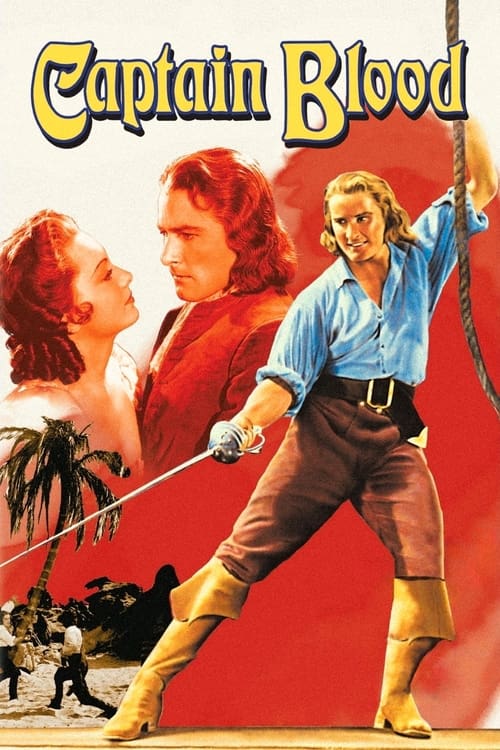
Captain Blood
1935 · Michael Curtiz
For when you want old-fashioned adventure done right — a rainy-Sunday swashbuckler to watch for pure escape and romance. Total comfort viewing with real craft under it.
What it's about
Peter Blood, an Irish doctor, is convicted of treason merely for treating a wounded rebel and shipped to Barbados as a slave. Sold at auction to a plantation owner's niece, he plots escape with his fellow convicts and reinvents himself as the most gallant pirate in the Caribbean — with a grudge against the empire that wronged him and a complicated pull toward the woman who bought him.
The experience
Swift, rousing, and endlessly charming — injustice, escape, sea battles, and a duel on a beach, all delivered with a grin. It's the kind of adventure that makes two hours feel like twenty minutes.
Performances
This is the film that invented Errol Flynn: 26, nearly unknown, and instantly the definitive swashbuckling star — effortless, witty, athletic. Nineteen-year-old Olivia de Havilland matches him spark for spark in the first of their many pairings.
The craft
Michael Curtiz directs with expressionist shadows and relentless pace, and Erich Wolfgang Korngold's surging orchestral score essentially founded the sound of Hollywood adventure music. The ship battles and the clifftop duel still play beautifully on a big screen.
Why it matters
It relaunched the swashbuckler for the sound era, earned a Best Picture nomination, made stars of Flynn and de Havilland, and set the Flynn–Curtiz–Korngold template that Hollywood adventure films followed for decades.
Snapshot
Captain Blood is the film that restarted the swashbuckler for the sound era and, in the same stroke, manufactured a movie star. Adapted from Rafael Sabatini's 1922 novel Captain Blood: His Odyssey, it follows an Irish physician transported to Barbados as a rebel slave after the Monmouth Rebellion of 1685, who escapes, turns buccaneer, and is finally restored by the Glorious Revolution. Warner Bros. gambled the picture on two near-unknowns — the 26-year-old Australian-born Errol Flynn and the 19-year-old Olivia de Havilland — and hedged the bet with a fast, expressionist-trained director in Michael Curtiz, a Polish-born art director in Anton Grot, and a Viennese opera composer in Erich Wolfgang Korngold. The result was nominated for Best Picture, drew enough write-in votes to place Curtiz second for Best Director, and set the template that Warners would refine through The Adventures of Robin Hood (1938) and perfect in The Sea Hawk (1940). Its importance is less a matter of individual brilliance than of synthesis: it fused the silent Fairbanks adventure film, the German-inflected Warners visual style, the studio's gangster-picture tempo, and a newly legitimized symphonic score into a single durable machine.
Industry & production
The film arrived inside a specific mid-1930s Hollywood convergence. The Production Code had been enforced with real teeth since July 1934, pushing studios toward literary and historical properties that carried built-in respectability; 1935 alone produced David Copperfield, Mutiny on the Bounty, A Tale of Two Cities, and The Lives of a Bengal Lancer. Sabatini was already proven screen material — his Scaramouche (1923) and The Sea Hawk (1924) had been substantial silent successes, and a Vitagraph Captain Blood had been filmed in 1924 with J. Warren Kerrigan. Warner Bros., which had absorbed Vitagraph, held the property and could plausibly present a pirate picture as prestige adaptation rather than pulp.
Casting is the production's decisive story. Robert Donat, fresh from The Count of Monte Cristo (1934) and The 39 Steps (1935), was the intended Blood and withdrew — chronic asthma and contractual complications are both cited in the record, which is not perfectly consistent on the sequence of events. Jack Warner's fallback was a contract player with almost nothing behind him: Flynn had a small role in The Case of the Curious Bride (1935) and a documentary-adjacent Australian credit in In the Wake of the Bounty (1933). De Havilland had just appeared in Warners' A Midsummer Night's Dream (1935). Neither could open a picture, so the studio surrounded them with reliable professionals — Basil Rathbone as the French buccaneer Levasseur, Lionel Atwill as the sadistic Colonel Bishop, Henry Stephenson as Lord Willoughby, Guy Kibbee among Blood's crew.
Warners' method was industrial in the strict sense: standing contracts, house departments, and schedules measured in weeks. The studio economized visibly here, incorporating sea-battle footage from its own 1924 The Sea Hawk into the climax alongside newly shot miniatures. Exteriors used Southern California coastline — the Levasseur duel is staged on a beach at Laguna — while ships were realized as partial full-scale decks on the lot cut against tank-shot models. Published budget and grosses for the period circulate widely but rest on inconsistent studio ledgers; the safe statement is that the picture was a clear commercial success and that Warners immediately reorganized its plans around Flynn.
Technology
Captain Blood is a mature product of the first-generation sound apparatus, made at the moment its constraints had loosened. Warners shot on 35mm nitrate black-and-white negative in the Academy ratio (1.37:1), standardized in 1932 to accommodate the optical soundtrack. Faster panchromatic emulsions reaching studios in the mid-1930s permitted lower light levels, longer takes, and more aggressive contrast without the exposure penalties that had flattened early talkies.
Sound was recorded optically under Warners' sound department, still trading under the Vitaphone brand years after the studio had abandoned the sound-on-disc system that gave the name its meaning. Effective camera blimping and the maturing crab dolly had restored the mobility that 1928–30 microphone practice had stripped away — a precondition without which the film's crane descents and tracking assaults would have been impossible.
The maritime spectacle is a compendium of period optical technique: rear projection for shipboard dialogue against moving sea, matte paintings and glass shots to extend Port Royal and the Barbados plantation, miniature vessels in the studio tank shot at high frame rates for scaled water, and optical-printer compositing to marry live action with the recycled 1924 material. The seams are visible today — grain and contrast shift where the older footage enters — but the assembly is confident, and it established the resource-pooling logic that Warners would reuse for a decade of sea pictures.
Technique
Cinematography
Hal Mohr receives sole credit, arriving directly from A Midsummer Night's Dream (1935), for which he became the only write-in winner in Academy history. His work here is less baroque than that film but shares its taste for hard-edged modeling: sharply raked keys, deep pools of shadow, and figures read as silhouette against sky, sail, or torchlight. The Barbados sequences use a bleached, overexposed brightness for the slave market and the plantation, then swing to low-key chiaroscuro for interiors and night work — a tonal contrast that carries the film's moral argument without dialogue. The camera moves with purpose rather than display: a descending crane over the slave auction that turns spectacle into indictment, lateral tracks along ranks of prisoners, and a mobile survey of the pirate deck during the reading of the articles.
Editing
George Amy, Curtiz's regular cutter, works in the Warners idiom of compression. The picture covers years in under two hours, and Amy handles the elisions with montage passages — Blood's rise from escaped slave to feared buccaneer rendered as superimposed sails, cannon fire, and dissolving seascapes. In action he cuts on movement and matches on the diagonal, keeping screen direction legible through the sea battle even where three photographic sources are being spliced together. The duel with Levasseur is cut long: the blades stay in frame, sustaining the reality of the fencing rather than manufacturing it from fragments — a decision that later swashbucklers would honor and modern ones largely abandon.
Mise-en-scène / staging
Anton Grot's art direction is the film's least-discussed strength. Trained in Europe and steeped in the same design vocabulary that produced Sodom und Gomorrha (1922) in Curtiz's Austrian period, Grot builds sets with exaggerated verticals, heavy beams, and grilled windows that throw usable shadow patterns — the Bridgewater jail and the Barbados stockade are lit as much by their own architecture as by lamps. Curtiz stages in depth, planting large foreground elements (rigging, cannon, cell bars, the backs of extras) to build the frame in receding planes. Crowds are choreographed rather than milled: the auction block, the courtroom, the pirate assembly are all blocked so that a single figure can be found instantly within a mass.
Sound
The sound design is conventional for 1935 — post-synchronized exteriors, discreet effects, dialogue mixed forward — but the music is not. Captain Blood is one of the pictures that reestablished continuous non-diegetic scoring after the early-talkie superstition that unexplained orchestras confused audiences. Roughly a third of the running time carries music, and Korngold's cues are mixed high enough to function as a second narrative voice. The transitions between scored and unscored passages are handled with more sophistication than most contemporaries manage: silence is deployed, not merely defaulted to.
Performance
Flynn's performance is not technically accomplished and does not need to be. What he brings is an unforced insolence — a lightness in the reading of a threat, a physical ease that makes the athleticism look incidental — and a face the camera finds regardless of composition. His weakest passages are the solemn ones; his best are those where wit and violence are simultaneous. De Havilland supplies more than the role demands, giving Arabella a cool self-possession that makes the romance's antagonistic first half credible. Rathbone, a genuinely expert fencer, plays Levasseur with brittle theatrical relish and gives Flynn a physical standard to be measured against. Fencing was staged by the Belgian master Fred Cavens, who had worked with Douglas Fairbanks and would return for Robin Hood — the direct human link between the silent cycle and its sound successor.
Narrative & dramatic mode
The structure is cleanly tripartite: injustice (Blood's arrest for treating a wounded rebel, the Bloody Assizes, transportation), servitude (Barbados, Bishop, the failed conspiracy, the escape), and reinvention (piracy, Levasseur, the Spanish assault on Port Royal, the pardon). Each act ends with an escalation of Blood's agency, moving him from object to agent to sovereign.
The mode is romantic melodrama governed by an ironic premise — a healer becomes a killer because the law has forfeited its claim on him. The film's most quietly radical scene is Arabella buying Blood at auction for ten pounds, an inversion that makes the heroine the purchaser of the hero and poisons their romance with a debt neither can discharge. That transaction, not any duel, is the engine of the love plot.
The pirate articles sequence — the escaped slaves drafting a compact, apportioning shares, binding themselves by consent — reads unmistakably as a Depression-era fantasy of the dispossessed constituting a fairer order among themselves. The Code's constraints are visible elsewhere: Levasseur's designs on Arabella are conveyed almost entirely by implication, and Blood's piracy is carefully bounded so that his violence never lands on the undeserving.
Genre & cycle
The costume adventure had been a silent-era Fairbanks monopoly — The Mark of Zorro (1920), Robin Hood (1922), The Black Pirate (1926) — and had effectively lapsed with the coming of sound, undone by camera immobility, the expense of period production during the early Depression, and Fairbanks's own decline. Treasure Island (1934) and The Count of Monte Cristo (1934) tested the water; Captain Blood proved the market.
It also fixed the sound swashbuckler's grammar: a wronged gentleman-outlaw of demonstrable moral seriousness; a heroine whose contempt converts to love; a duel with a stylish rival that is fought in long takes and full figure; a legitimizing political resolution; and a wall-to-wall symphonic score. Warners ran the formula immediately — The Charge of the Light Brigade (1936), The Prince and the Pauper (1937), The Adventures of Robin Hood (1938), The Sea Hawk (1940) — and rival studios followed with their own Sabatini and Dumas properties.
Authorship & method
Curtiz is the test case for auteurism's limits and its uses. He directed well over a hundred films across genres with no discernible thematic signature, yet his visual hand is unmistakable: diagonal composition, deep foreground occlusion, patterned shadow, and a restless camera that moves toward or through action rather than observing it. That vocabulary came from a Hungarian and Austrian apprenticeship before Warners imported him in 1926, and it is what allowed a studio adventure picture to look like something more severe than its material.
Casey Robinson's screenplay is the more invisible achievement, compressing Sabatini's episodic novel into three legible movements and finding the Arabella-buys-Blood hinge that the book treats more diffusely. Robinson would become one of Warners' most valuable adaptors, later shaping Now, Voyager (1942) and Dark Victory (1939).
Korngold's contribution is the one with the longest afterlife. A prodigy endorsed by Mahler and the composer of Die tote Stadt (1920), he had come to Warners to arrange Mendelssohn for A Midsummer Night's Dream. Captain Blood was his first original film score, taken on at very short notice — by his own account roughly three weeks — and he adapted passages from Liszt's symphonic poems to meet the deadline. He consequently regarded the score as not wholly his; under Academy rules of the period, the nomination went to Warners music director Leo F. Forbstein rather than to the composer. What Korngold introduced was operatic method: composing at the piano to projected film, assigning leitmotifs to character and idea, and treating the cue as a through-composed dramatic unit rather than accompaniment. Grot, Mohr, Amy, and Cavens complete a collaborative unit that Warners would keep largely intact across the Flynn cycle.
Movement / national cinema
The film is a product of American studio classicism inflected by European emigration. Curtiz and Grot brought Central European expressionist training; Korngold brought Viennese post-Romanticism; the Australian Flynn and the Anglo-American Rathbone and Stephenson supplied a transatlantic Britishness that Hollywood's historical pictures then required. This is the same emigration current that would give the late 1930s and 1940s their noir and their symphonic scoring, arriving here in an adventure picture rather than a tragedy.
It is also specifically a Warner Bros. film. The studio's gangster-cycle tempo, its taste for institutional injustice as a subject, and its economy of means are all present. Blood's arc — an honest man criminalized by a corrupt state, who builds an outlaw organization — is structurally the Warners gangster narrative relocated to 1685 and permitted a happy ending.
Era / period
1935 sits at the hinge between the Depression's grimmest years and the pre-war rearmament economy, and between pre-Code frankness and Code-era displacement. Audiences were returning to theaters; studios were investing in prestige again. The Code's prohibition on certain contemporary subject matter pushed moral seriousness into historical costume, where a story about lawless authority, arbitrary imprisonment, and forced labor could be told without confronting censorship or the domestic political present.
The film's anti-tyranny argument was legible in a year when European authoritarianism was consolidating, and Warners was the most politically alert of the majors — it would produce Confessions of a Nazi Spy in 1939. Attributing deliberate topical intent to Captain Blood would overstate the record; the resonance is real, the evidence of design is thin, and it is more honest to describe the film as available to that reading than authored for it.
Themes
The governing theme is the illegitimacy of law severed from justice. Blood is condemned for practicing medicine on a wounded man; every subsequent transgression proceeds logically from that first injustice, and the film asks the audience to accept outlawry as the reasonable response to a state that has abandoned its own principles. Its resolution is nonetheless conservative: Blood is not vindicated by revolution from below but by the arrival of a better king, which restores the legitimacy the story spent two hours dismantling.
Adjacent to this runs a sustained interest in bondage and ownership. Blood is enslaved, purchased, and branded; he is bought by the woman he comes to love; he then presides over a crew that has contractually purchased its own freedom. Ownership is the film's recurring metaphor for every relation it depicts — political, economic, and romantic.
Finally, there is the theme of professional identity. Blood is a physician before he is anything else, and the film repeatedly returns to his hands healing rather than killing — including the plot turn in which his medical skill purchases his standing on Barbados. His piracy is figured throughout as a suspension of vocation rather than a replacement for it.
Reception, canon & influence
Contemporary notices were strong, praising the picture's pace and spectacle and singling out Flynn's arrival; the trade and metropolitan press treated it as a confident return of a form presumed dead. The Academy nominated it for Best Picture in a twelve-nominee field won by Mutiny on the Bounty, and Curtiz's second-place finish for Best Director came entirely through write-in votes, a mechanism the Academy permitted only in 1935 and 1936 and then abolished. Nominations also came in screenplay, score, and sound categories.
Its debts are explicit. The Fairbanks silents supply the physical vocabulary and the moral outline of the gentleman-outlaw; Cavens carries the fencing style across in person. Sabatini's novel drew in turn on the published narrative of Henry Pitman, a physician transported after Monmouth's rebellion, and on the buccaneer literature surrounding Henry Morgan. The 1924 Sea Hawk is present not as influence but as literal footage. German and Austrian expressionist lighting and set design enter through Curtiz and Grot, and the Warners gangster picture supplies the tempo.
Forward, the influence is large and traceable. It made Flynn a star and initiated the twelve-film Curtiz–Flynn partnership and the eight-film Flynn–de Havilland pairing, both of which shaped what a Hollywood romantic lead could be for a generation. It established the Warners adventure cycle whose summit, The Sea Hawk (1940), reuses this film's personnel, its Sabatini source author, and much of its design logic. Sequels and successors followed the property itself — Fortunes of Captain Blood (1950) and Captain Pirate (1952) with Louis Hayward, and, with a certain poignancy, Son of Captain Blood (1962) starring Flynn's son Sean.
The deepest legacy is musical. Korngold's Warners scores — Captain Blood, then The Adventures of Robin Hood and The Sea Hawk — codified the leitmotivic symphonic idiom that defined Hollywood scoring for two decades, went out of fashion in the 1950s and 1960s, and returned wholesale with John Williams's Star Wars (1977), a revival Williams and George Lucas have consistently described in exactly these terms. Every subsequent pirate and adventure film that opens with brass fanfare over a sail — The Princess Bride (1987), The Mask of Zorro (1998), the Pirates of the Caribbean cycle from 2003 — is working downstream of what Warners assembled here in a few compressed weeks of 1935.
A Deleuzian reading
The camera comes down over the auction block.
The full Deleuzian reading of Captain Blood →
Reception
A gamble in 1935 — Warner Bros. handed a costly swashbuckler to two near-unknowns — that became a smash and a Best Picture nominee overnight. Today it's remembered less on its own terms than as the big bang of the Errol Flynn legend, often treated as the warm-up for The Adventures of Robin Hood.
How Captain Blood was received, from release to now →
How to watch Captain Blood: what to notice on a first viewing
- Watch the crane descend slowly over the auction block. The camera's downward movement turns a market scene into an accusation without a line of dialogue, then tracks sideways along the ranks of prisoners. The shot states the film's politics before anyone argues them out loud.
- Watch the light swing from bleached white to deep shadow. Mohr shoots the Barbados exteriors overexposed and glaring, then drops into low-key chiaroscuro for interiors and night scenes. Bright means exposed and dark means where you might hide, before the plot spells it out.
- Notice the rigging, bars, and cannon crowding the foreground. Curtiz plants large objects close to the lens so every shot builds in receding planes, from jail cells to ship decks. The depth makes the world feel solid and layered, not painted flat behind the actors.
- Watch how long the sword blades stay inside a single shot. Amy cuts the duels long, keeping full figures and both blades in frame instead of assembling the fight from close fragments. The length is proof the actors are really fencing, not proof assembled by editing.
- Listen for the orchestra returning under nearly every scene. Korngold's continuous score runs under roughly a third of the picture, functioning almost as a second narrative voice, and the film deliberately silences it in places too. The music tells you how to feel about a scene the images alone would leave uncertain.
The whole guide to watching Captain Blood, with the keys for a rewatch →
Influences: the films it descends from and the films it influenced
- The Mark of Zorro (1920) — Fairbanks fixed the gentleman-outlaw performance register — insolent comic byplay carried through the fencing itself, the taunt delivered mid-parry — and Flynn is directed into that exact blocking, fighting and quipping in the same sustained frame.
- The Sea Hawk (1924) — Not an influence but a physical component: Warners cut this First National production's full-scale galleon and ship-to-ship battle footage into Captain Blood as second-unit plates, matting new foreground coverage against inherited long shots.
- Don Q, Son of Zorro (1925) — Fred Cavens' Hollywood arms-master debut with Fairbanks; the same hand stages Flynn's duel a decade later, preserving Cavens' rule of wide stance and full figure held in frame so the exchange reads in long shot instead of being assembled from cuts.
- The Black Pirate (1926) — Supplies the boarding-action vocabulary — rigging descents, the dagger-slit sail, deck-to-yardarm vertical staging — and the convention of shooting stunts in unbroken wide takes so the star's body remains verifiable to the audience.
- Noah's Ark (1928) — The Curtiz–Anton Grot Warners partnership rehearsed at scale: deep foreground occlusion by beams and masts, crane descents into massed extras, and part-Vitaphone optical sound — the same compositional and technical logic Captain Blood applies to Port Royal and the deck sequences.
- I Am a Fugitive from a Chain Gang (1932) — Warners' house montage-compression grammar — hammer-rhythm dissolves over forced labor to elide months — is precisely the device Casey Robinson's script borrows to reduce Sabatini's episodic enslavement chapters to a few minutes of screen time.
- A Midsummer Night's Dream (1935) — The picture that brought Korngold onto the Warners lot (arranging Mendelssohn) and gave Hal Mohr his shaft-lit, backlit, atmosphere-heavy technique — both men carry that apparatus straight into Captain Blood's chiaroscuro interiors months later.
- The Charge of the Light Brigade (1936) — Immediately reassembles the Curtiz–Flynn–de Havilland–Cavens unit and transposes the moving-camera-inside-the-action principle from deck to cavalry line, tracking laterally alongside the charge rather than observing it from a fixed vantage.
- The Adventures of Robin Hood (1938) — Korngold's second Warners original expands the leitmotivic scheme trialled here into a fully thematic, near-continuous score; the Flynn–Rathbone climax adds Curtiz's patterned shadow by throwing the duellists' silhouettes up the castle wall as they fight.
- The Sea Hawk (1940) — The summit of the cycle rebuilt from identical parts — Curtiz, Korngold, Grot's storyboard-style production sketches, Cavens, Flynn, Sabatini as source — with Grot's deep-plane galley interiors barred in shadow and the sea action moved onto purpose-built sound-stage tanks.
- The Black Swan (1942) — Another Sabatini adaptation running the same three-act escalation, but proving the form's transfer to three-strip Technicolor — Leon Shamroy lighting sea and deck for saturated color where Mohr had worked in tonal contrast.
- Scaramouche (1952) — Sabatini again, and the long-take-duel principle pushed to its limit: a six-and-a-half-minute theater fight, choreographed in the Cavens tradition, sustained through architectural space with the combatants kept whole in frame.
- The Crimson Pirate (1952) — Lancaster's circus-acrobat body returns the Fairbanks physical register that Flynn had stylized, restaging the identical rigging-and-deck blocking with the timing recalibrated for burlesque rather than romance.
- Star Wars (1977) — John Williams's explicit, self-described revival of Korngold's Warners practice — brass-led character leitmotifs woven through near-continuous non-diegetic symphonic scoring — restoring the idiom Captain Blood inaugurated after two decades of disuse.
- The Princess Bride (1987) — The cliff duel is the Flynn–Rathbone set piece reconstructed by Bob Anderson and Peter Diamond: a long-take, full-body exchange in which characterization is delivered through dialogue spoken across the blades rather than through cutting.
- Pirates of the Caribbean: The Curse of the Black Pearl (2003) — Carries both inheritances at once — the brass fanfare over a filling sail as scene-establishing cue, and Bob Anderson's blacksmith-shop duel staged in sustained wide shots that keep the fencers' full figures legible, the Cavens rule passed down through his successors.
- Pirates of the Caribbean: At World's End (2007) — Establishes the sound-era swashbuckler grammar of shipboard saber duels and the roguish outlaw-captain hero that the franchise consciously revives in Jack Sparrow and the Black Pearl.
- Pirates of the Caribbean: Dead Man's Chest (2006) — Established the studio-era pirate-swashbuckler template of the roguish gentleman-outlaw and choreographed shipboard duel that Dead Man's Chest revives wholesale.
- Mutiny on the Bounty (1935) — The rival shipboard-tyranny picture of the same season, solving the same staging problem by opposite means: MGM sailed full-scale replicas at sea while Warners built equivalent scale from miniatures, tank work, optical composites and recycled 1924 plates.
- The Mark of Zorro (1940) — Fox's parallel deployment of the same craft personnel logic: Cavens again choreographs, keeping the legible full-figure duel for Power and Rathbone, while Alfred Newman's score adopts the Korngold fanfare-plus-character-leitmotif template wholesale.
Similar films
- The Adventures of Robin Hood (1938) — influence & lineage
- Pirates of the Caribbean: The Curse of the Black Pearl (2003) — influence & lineage
- Braveheart (1995) — shared sensibility
- Casablanca (1943) — shared sensibility
- From Here to Eternity (1953) — shared sensibility
- Gone with the Wind (1939) — shared sensibility
- Pearl Harbor (2001) — shared sensibility
- Bram Stoker's Dracula (1992) — shared sensibility