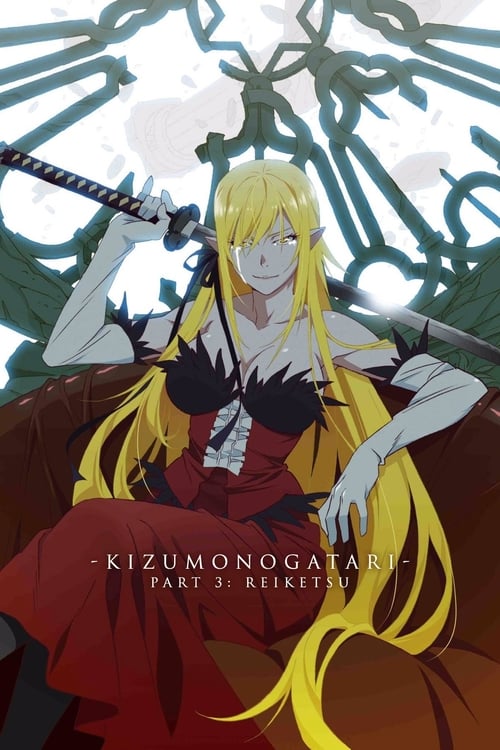
Kizumonogatari Part 3: Reiketsu
2017 · Tatsuya Oishi
For when you want animation as pure sensory event — maximalist, strange, and emotionally heavier than it has any right to be. Watch parts one and two first; this is the payoff night.
What it's about
The finale of the Kizumonogatari trilogy: a schoolboy who gave up his humanity to save a dying vampire must now battle three grotesque hunters to win back her scattered limbs — and then face the question of what, exactly, he owes her. It's a monster story that keeps narrowing to two damned souls and a debt neither can pay cleanly.
The experience
Overwhelming in the best way — action that swings from balletic to gleefully splattery slapstick, cut so fast it approaches typography, then long eerie stretches of silence in empty cityscapes. It's funny, gory, and then suddenly, genuinely sad.
The craft
Tatsuya Oishi spent the better part of a decade on these films under Akiyuki Shinbo at studio Shaft, and the obsessiveness shows: vast depopulated brutalist cityscapes rendered with architectural precision, every empty stadium and rain-slicked overpass composed like a stage set. It demands the biggest screen and loudest speakers you have.
Why it matters
It capped one of the most ambitious theatrical anime projects of its era and stands as the visual high-water mark of the sprawling Monogatari cycle, proof of what a TV-anime studio can do when given years instead of weeks.
The finale of the Kizumonogatari trilogy closes the prequel arc of the sprawling Monogatari cycle, adapting Nisio Isin's novel about a schoolboy who gave up his humanity to save a dying vampire — and must now win back her scattered limbs from three grotesque hunters before deciding what, exactly, he owes her. Tatsuya Oishi, working under Akiyuki Shinbo at the studio Shaft, spent the better part of a decade on these films, and the obsessiveness shows: vast, depopulated brutalist cityscapes rendered with architectural precision, action that veers from balletic to gleefully splattery slapstick, cutting so fast it approaches typography. Where television anime economizes, Reiketsu luxuriates — every empty stadium and rain-slicked overpass composed like a stage set for two damned souls. Beneath the pyrotechnics is a genuinely melancholy meditation on the price of rescue, and on monstrousness as a form of devotion. The trilogy stands as one of the most extravagant acts of style in twenty-first-century Japanese animation; in 2024 Oishi recut all three parts into a single film, Koyomi Vamp, as if unwilling to let the wound close.
Reception
By the time Reiketsu landed in January 2017, fans had waited nearly seven years since the adaptation was first announced — so relief mixed with rapture. Since then the trilogy has only climbed, with Part 3 now routinely called the payoff and the best of the three, and the 2024 'Koyomi Vamp' recut brought a whole new wave of viewers to it.
How Kizumonogatari Part 3: Reiketsu was received, from release to now →
Influences: the films it descends from and the films it influenced
- Belladonna of Sadness (1973) — Pioneers limited-animation maximalism by holding and slowly panning across elaborately illustrated still tableaux, letting graphic composition and paint texture carry emotion in place of movement — the same still-frame-as-spectacle economy Oishi exploits.
- Revolutionary Girl Utena (1997) — Codifies theatrical stage-set staging — abstract flat backdrops, silhouette shadow-play, and ritualized repeated transformation sequences — that SHAFT's proscenium-style flat-plane composition directly inherits.
- Neon Genesis Evangelion (1995) — Establishes single-color flash frames and full-screen kanji intertitles held as graphic beats, plus still-image-plus-text montage, the direct precedent for Shinbo's rapid typographic cutting.
- Angel's Egg (1985) — Composes desaturated gothic-brutalist architecture and near-static cathedral-scale cityscapes as painterly held frames, prefiguring Kizumonogatari's depopulated concrete voids.
- Ninja Scroll (1993) — Choreographs weighty, grotesquely fluid violence that snaps abruptly into stillness — the full-animation-versus-freeze dynamic Oishi deploys in Kizu's fight set-pieces.
- Vampire Hunter D: Bloodlust (2000) — Renders vampire-horror through baroque architecture and mutating grotesque anatomy, the gothic monster-design lineage Kizumonogatari's Kiss-Shot and enemy vampires extend.
- Mekakucity Actors (2014) — Extends SHAFT's typographic cutting and flat stage-set minimalism into a music-driven register, carrying forward the same graphic-title-card grammar as Kizumonogatari.
- Fireworks, Should We See It from the Side or the Bottom? (2017) — Pushes SHAFT's stage-set composition and stylized architectural framing into live-action-adjacent realism, descending from the same studio's brutalist-frame and head-tilt visual language.
- March Comes in Like a Lion (2016) — Applies SHAFT stage-set minimalism, typographic emotional beats, and expressive limited-animation stillness to intimate drama, carrying the studio's Kizu-era grammar forward.
- Sayonara Zetsubou Sensei (2007) — Builds SHAFT's typographic editing grammar out of blackboard-text gags and screen-filling word montages, the same author's-hand device recut into Kizumonogatari's koyomi-vamp title cards.
- Bakemonogatari (2009) — Same Monogatari franchise and staff: red/black flash intertitles, single-frame kanji cutaways, and bare stage-set rooms that Kizumonogatari inherits wholesale as house style.
- Puella Magi Madoka Magica (2011) — Deploys Gekidan Inu Curry's cutout-collage witch labyrinths as mixed-media brutalist stage-sets, the abstract dread-space vocabulary paralleling Kizu's empty white and tiled voids.
- Katanagatari (2010) — Adapts Nisio Isin's dense, digressive wordplay-driven prose by foregrounding stylized monologue and flat graphic-design staging over conventional coverage.
- Hellsing Ultimate (2006) — Fuses gothic vampire horror with cartoonishly excessive gore and slapstick bravado, the tonal action-slapstick register Kizu shares in its combat comedy.
- Mind Game (2004) — Whiplashes between full animation, photographic collage, and abstract graphic registers within single scenes, the animation-eclecticism logic Oishi uses to switch between lavish motion and SHAFT stillness.
- The Tatami Galaxy (2010) — Drives narrative through rapid-fire verbal-typographic montage, text and image cut to speech rhythm — a kindred approach to editing driven by language rather than action.
Similar films
- Demon Slayer: Kimetsu no Yaiba Infinity Castle (2025) — shared sensibility
- Your Name. (2016) — shared sensibility
- Jujutsu Kaisen 0 (2021) — shared sensibility
- Kaguya-sama: Love Is War -The First Kiss That Never Ends- (2022) — shared sensibility
- Chainsaw Man - The Movie: Reze Arc (2025) — shared sensibility
- Puella Magi Madoka Magica the Movie Part III: Rebellion (2013) — shared sensibility
- Suzume (2022) — shared sensibility
- The Tale of The Princess Kaguya (2013) — shared sensibility