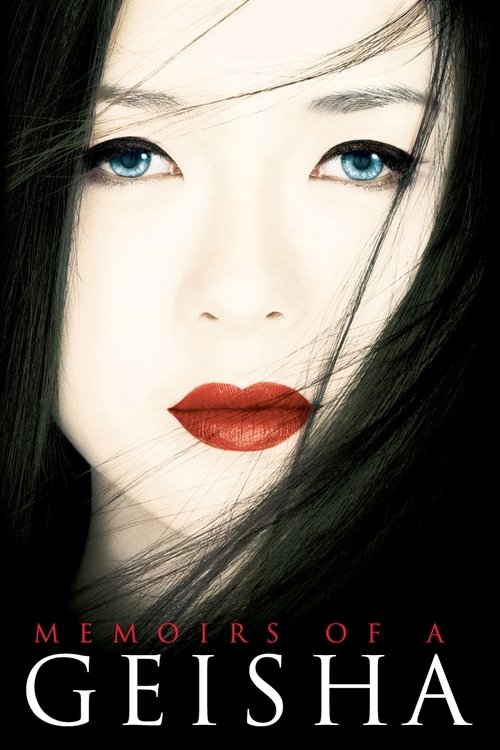
Memoirs of a Geisha
2005 · Rob Marshall
For when you want to be swept up in something beautiful and dramatic — a rags-to-riches story of survival and secret love to lose yourself in on a quiet night. Comfort viewing with a melancholy streak.
What it's about
In the years before World War II, a penniless girl from a Japanese fishing village is sold away from her family and put to work as a maid in a geisha house in Kyoto. The film follows her transformation into Sayuri, a celebrated geisha, through a world of rigorous training, ritual, and cutthroat rivalry — including a jealous senior geisha determined to destroy her — while she quietly carries a longing for one man across the years, and the coming war threatens everything the district is built on.
The experience
A swooning, old-fashioned melodrama drenched in color and silk — it moves like a fairy tale with sharp edges, alternating hushed elegance with flashes of cruelty. You watch it the way you'd watch a lavish costume epic: for atmosphere, longing, and spectacle.
Performances
Ziyi Zhang carries the film's yearning center, Gong Li is a magnetic, dangerous presence as the rival Hatsumomo, and Michelle Yeoh brings poise and warmth as the mentor who reshapes Sayuri's life.
The craft
This is a triumph of design: the sets, kimonos, and cinematography won Academy Awards, and nearly every frame is composed like a painting — lantern-lit alleys, snow, silk, and one showstopping dance sequence. It rewards a big, bright screen.
Why it matters
A major prestige production of the mid-2000s that swept the visual craft Oscars, and one that stirred lasting controversy over an American studio's imagining of Japan, including its casting of Chinese stars as Japanese characters.
Snapshot
Memoirs of a Geisha is a lavish, studio-backed adaptation of Arthur Golden's best-selling 1997 novel, charting the rise of a poor fishing-village girl named Chiyo into Sayuri, a celebrated geisha in the Gion district of Kyoto in the years bracketing the Second World War. Directed by Rob Marshall in the immediate wake of his Oscar-winning Chicago (2002), it is an English-language American production that stages an ornately imagined pre-war Japan as a realm of ritual, rivalry, and deferred romance. The film is best understood as a prestige melodrama built on the architecture of the classical Hollywood "woman's picture" — a Cinderella arc of survival, transformation, and longing — rendered through the resources of early-2000s craft cinema. It won three Academy Awards, all in the visual and design crafts, and it became a flashpoint in debates about cross-cultural casting and Western representations of Asia. Its reputation today rests less on its narrative achievement than on its production craft and on the controversy it generated.
Industry & production
The project had a long and conspicuous gestation inside the American studio system. Golden's novel was a publishing phenomenon, and its film rights were acquired with Steven Spielberg attached to direct through his Amblin/DreamWorks orbit, in partnership with Columbia Pictures (Sony). Spielberg developed the property for years before stepping back to a producing role; the producing team centered on Douglas Wick and Lucy Fisher (Red Wagon), with Spielberg among the executive principals. When Marshall inherited the director's chair, he arrived as a freshly minted A-list filmmaker whose first feature had won Best Picture — a pedigree that made a costly, design-heavy period piece a logical follow-up.
The most consequential industrial decision was casting. The three leading roles went to a triumvirate of the most internationally prominent Chinese-language stars of the moment: Zhang Ziyi as Sayuri, Gong Li as the rival Hatsumomo, and the Malaysian-Chinese Michelle Yeoh as the mentor Mameha. Ken Watanabe, fresh from The Last Samurai, played the Chairman, with Kōji Yakusho and Youki Kudoh among the Japanese cast. The choice to headline a film about Japanese geisha with Chinese actresses — speaking accented English — was a marketing calculation built on the global box-office capital those stars carried after films like Crouching Tiger, Hidden Dragon. It produced friction in both directions: criticism in Japan over authenticity and in China over the spectacle of Chinese women playing geisha in a wartime context freighted with historical grievance, and the film's release in China was curtailed.
Production was mounted not in Kyoto but largely in Southern California, where an entire hanamachi (geisha district) was constructed on a ranch in Ventura County, supplemented by location work in Japan for specific temple and exterior material. The decision to build rather than shoot on location gave the production total control over a vanished pre-war world but also reinforced the sense of a Japan reconstructed from the outside. The film opened in late December 2005, positioned squarely in the awards-season corridor, and performed respectably worldwide while drawing a mixed-to-negative critical response in the United States.
Technology
Memoirs of a Geisha is a photochemical, late-celluloid production: it was shot and finished on 35mm film at a moment just before digital intermediate workflows and digital capture became the studio default. Its technological signature is not novelty but the deployment of mature, conventional tools at maximum craft — large-scale practical set construction, extensive use of water (the climactic dance sequence on a constructed stage, rain, snow, and the river of Chiyo's childhood), and atmospheric effects achieved through in-camera and physical means as much as optical or digital ones. Where digital effects appear, they are largely invisible set extensions and environmental enhancements in service of period illusion rather than spectacle. The film belongs to the tradition in which technology serves the recreation of a lost world, with the apparatus deliberately effaced.
Technique
Cinematography
The film's most celebrated element is the cinematography of Dion Beebe, who won the Academy Award for his work — his second collaboration with Marshall after Chicago. Beebe's images are defined by a painterly, low-key palette and a sustained interest in light passing through and around obstruction: paper screens, lanterns, falling snow, the lattices of the okiya, the glow of a single match. He favors warm, lamplit interiors against cooler exteriors and uses the geisha's white-painted face as a luminous focal point within often shadowed frames. The cinematography codes Sayuri's signature trait — her famous gray-blue eyes, repeatedly described as "water" — through reflective surfaces, rain, and a recurring motif of fluidity. The look is unabashedly beautiful and at times pictorialist, a quality critics divided over: an immersive evocation of a sensuous world to admirers, an aestheticizing gloss to detractors.
Editing
Pietro Scalia, an editor of considerable prestige (a two-time Oscar winner for other films), cut the picture. The editing manages a long, episodic narrative spanning roughly two decades, compressing childhood, apprenticeship, wartime rupture, and reunion into a continuous melodramatic flow. Its most bravura passage is the cross-cut, percussive assembly of Sayuri's debut dance, where rhythm, movement, and music are bound tightly together — a sequence that draws directly on Marshall's background as a stage choreographer and director and recalls the kinetic editing logic of Chicago. Elsewhere the cutting is classical and unobtrusive, prioritizing legibility and emotional continuity across a sprawling timeline.
Mise-en-scène / staging
This is the film's center of gravity and the arena of its greatest achievement. Production designer John Myhre (with set decoration by Gretchen Rau) and costume designer Colleen Atwood both won Academy Awards, and the film's authority resides overwhelmingly in its physical world: the tiered streets of the constructed hanamachi, the interiors of the okiya, the teahouses, and above all the kimono — hundreds of garments deployed as instruments of character, status, and seasonal symbolism. Marshall stages much of the drama as a choreography of ritualized movement: the precise gestures of pouring tea, the dressing and painting of the geisha, the procession through the district. The mise-en-scène treats the geisha herself as a designed object, an artwork in motion — a reading the film embraces both as theme and as spectacle.
Sound
The film's sound design works to build an enveloping period atmosphere — wooden geta on stone, rain on tile, the rustle of silk, the plucked strings of the shamisen — and was recognized within the film's slate of Academy nominations in the sound categories. Sound functions to authenticate the constructed world and to underscore the tactile sensuousness that the cinematography and design also pursue.
Performance
Zhang Ziyi carries the film as the adult Sayuri, with Suzuka Ohgo memorable as the young Chiyo; Gong Li delivers the most forceful performance as the venomous, self-destructing rival Hatsumomo, and Michelle Yeoh brings poise to the mentor Mameha. The performances were complicated by the production's decision to have the predominantly Chinese and Japanese cast act in English — a choice that constrained nuance and drew criticism, and that sits at the heart of the film's authenticity debates. Within those constraints the leads work largely through gesture, bearing, and the controlled expressivity that the geisha's mask both demands and permits.
Narrative & dramatic mode
The film operates in the register of romantic melodrama and the rags-to-riches transformation tale. Its dramatic engine is deferred desire: Chiyo's childhood encounter with the kindly Chairman sets in motion a years-long, largely unspoken longing that structures every subsequent choice. The narrative is organized around classic melodramatic oppositions — cruelty and kindness, rivalry and mentorship, captivity and self-determination — and around the spectacle of suffering nobly endured. A voiceover frames the story as memoir, lending it the retrospective, confessional intimacy of the source novel. The mode is fundamentally that of the woman's picture: the heroine's interiority, her endurance, and her eventual emotional reward are the film's true subject, with the historical setting functioning as an exoticized backdrop rather than an analytical frame.
Genre & cycle
Memoirs of a Geisha sits at the intersection of the prestige literary adaptation, the period costume drama, and the cross-cultural Hollywood epic. It arrived during a cycle of early-2000s Western films engaging an East Asian setting for a global audience — among them Crouching Tiger, Hidden Dragon (2000), The Last Samurai (2003), and the martial-arts wuxia spectacles that made its leads international stars. It also belongs to the recurrent studio cycle of best-seller adaptations mounted as awards-season showcases, where craft excellence in design, costume, and cinematography is the expected currency. Marshall's own brief run of theatrical, design-forward films (Chicago, then Nine) forms a smaller authorial cycle around it.
Authorship & method
Rob Marshall came to cinema from the Broadway stage as a director-choreographer, and his method is rooted in staging, rhythm, and the orchestration of movement and music. Memoirs of a Geisha reflects that sensibility in its set-piece dances and its conception of the geisha's life as performance, though it largely sets aside the overt musical-number structure of Chicago in favor of straight dramatic narrative. The screenplay is credited to Robin Swicord, adapting Golden's novel (with additional writing associated with the development process, as is common on long-gestating studio projects). The decisive creative collaborators are arguably the below-the-line artists: cinematographer Dion Beebe, production designer John Myhre, set decorator Gretchen Rau, costume designer Colleen Atwood, and editor Pietro Scalia — the team whose work won or contended for the film's Oscars. Composer John Williams supplied a lyrical, melancholy score built around solo instrumental voices, performed by cellist Yo-Yo Ma and violinist Itzhak Perlman; the score was nominated for an Academy Award. The authorship of the film is thus genuinely distributed — a director orchestrating an ensemble of elite craftspeople around a property whose originating creative vision (and long shadow) belonged substantially to Spielberg as producer.
Movement / national cinema
The film resists tidy placement in any national-cinema movement. It is an American studio production about Japan, made largely by American and international craftspeople and headlined by Chinese-language stars — a thoroughly transnational commercial object rather than a work of any indigenous tradition. It is precisely this dislocation that makes it a useful case study: it sits outside Japanese cinema while representing Japan, and it draws on the global star system that the new wave of Chinese-language cinema had recently produced. The film belongs less to a movement than to the economics of early-21st-century global Hollywood, in which international stars and exotic settings are assembled for worldwide markets.
Era / period
The film is doubly periodized. Its diegetic period is roughly the 1920s–30s through the Second World War and its immediate aftermath, and the film stages the war as a rupture that scatters Gion's pleasure economy and forces Sayuri into manual labor before the postwar reconstruction enables her reunion with the Chairman. The war is treated largely as melodramatic catastrophe rather than historical reckoning — the occupation appears chiefly as a backdrop of GIs and disruption. As a production, the film is a document of mid-2000s prestige Hollywood: photochemically shot, design-maximalist, awards-calibrated, and made just before digital workflows and shifting representational politics reshaped what such a film could be and how it would be received.
Themes
The dominant themes are transformation and self-fashioning — the making of a geisha as both a craft and a form of constrained agency — and the tension between performance and authentic feeling. The film repeatedly frames the geisha as a work of art who must subordinate private desire to public artifice, and it dwells on water as a governing metaphor for Sayuri's adaptability and emotional depth. Rivalry, mentorship, captivity, and survival structure the social world, while the central romance proposes that genuine feeling can persist beneath, and ultimately reward, a life of disguise. Running beneath these is the more troubled theme the film does not fully interrogate: the commodification of women, including the auctioning of a young geisha's virginity (the mizuage), which the film romanticizes more than it examines — a point that fueled critical objection.
Reception, canon & influence
Critical reception in the United States was mixed to unfavorable. Reviewers widely praised the cinematography, costumes, and design while faulting the film as emotionally remote, overlong, and aestheticizing — a beautiful surface around a hollow center. The casting controversy dominated much of the discourse: the decision to cast prominent Chinese actresses as Japanese geisha drew objection on grounds of authenticity and cultural sensitivity, and the film's reception in East Asia was correspondingly fraught, with its distribution in China curtailed. There were also pointed critiques from within Japan and from cultural critics who saw the film as an Orientalist fantasy that exoticized the geisha for Western consumption — a charge sharpened by the earlier real-world dispute between Golden and a geisha he had interviewed for the novel.
Backward, the film's influences are clear: Golden's novel above all, the classical Hollywood woman's picture and Cinderella melodrama, the lush studio costume epics of an earlier era, and the contemporary wave of Chinese-language films that had elevated its stars and conditioned Western appetite for visually sumptuous Asian-set spectacle.
Forward, its legacy is concentrated in the crafts. It stands as a high-water mark of early-2000s costume and production design — a touchstone for kimono-centric design and for lamplit, painterly period cinematography. Its awards (three Oscars in the design and image categories) cemented the reputations of Atwood, Myhre, and Beebe. Equally, it became a recurring reference point in scholarly and popular debates about representation, cross-cultural casting, and the ethics of Hollywood's depictions of Asia — an object lesson invoked whenever those questions resurface. Its narrative influence on subsequent cinema is modest; its influence on the conversation about who gets to portray whom, and how, has proved more durable.
A Deleuzian reading
Start with the face.
The full Deleuzian reading of Memoirs of a Geisha →
Reception
Arrived in 2005 as a lavish Oscar-season prestige picture and left with three craft Oscars but bruised reviews — and it has never been reappraised upward; today it's cited less as a film than as a case study in mid-2000s Hollywood's handling of Asian stories.
How Memoirs of a Geisha was received, from release to now →
Influences: the films it descends from and the films it influenced
- Barry Lyndon (1975) — Established the lamplit, painterly period image — tableau compositions lit to resemble old-master canvases, episodic compression, and an ironic omniscient voiceover holding the costumed figures at aesthetic distance — the exact register Beebe and Marshall adopt.
- The Last Emperor (1987) — Storaro's filtered light raking through screens and curtains over a constructed/located Asian period grandeur, plus an all-Asian cast performing in English, is the direct template for Memoirs' light-through-obstruction interiors and English-language-constraint casting.
- Raise the Red Lantern (1991) — Lantern-lit, symmetrical low-key interiors and the ritualized daily movement of cloistered women — lighting and costume operating as character — supplied the Gong Li / Zhang Ziyi-era visual grammar Memoirs imports wholesale.
- Letter from an Unknown Woman (1948) — The deferred-desire epistolary voiceover structuring a woman's lifelong unrequited devotion to one man is the melodramatic narrative engine Memoirs reuses for Sayuri's narration of her fixation on the Chairman.
- Sayonara (1957) — Hollywood's English-language Orientalist romance staged on a constructed, picturesque Japan — geisha and theater performance packaged for Western consumption — is the studio-Orientalism tradition Memoirs both continues and is critiqued against.
- Days of Heaven (1978) — Almendros's magic-hour natural light filtered through grasses and obstructions, paired with a vernacular child's voiceover, is the painterly-naturalist cinematography lineage behind Memoirs' lyrical outdoor sequences.
- Chicago (2002) — Marshall's own director-choreographer method — cross-cut musical setpieces and life conceived as staged performance — carries directly into Memoirs' dance numbers and its framing of geisha life as choreographed spectacle, with Beebe/Myhre/Atwood/Scalia partly retained.
- The Last Samurai (2003) — Rides the same Hollywood-prestige-Japan wave, casting Watanabe and Japanese leads in a richly designed material world aimed at Western audiences.
- Dreamgirls (2006) — Rode the post-Chicago musical revival Marshall ignited, deploying John Myhre's production design and cross-cut musical numbers with costume-as-character — the design-ensemble lineage Memoirs cemented.
- Nine (2009) — Reassembles Memoirs' distributed elite craft ensemble (Beebe cinematography, Myhre design, Atwood costumes) around Marshall's cross-cut musical-setpiece structure — the most direct method descendant.
- Snow Flower and the Secret Fan (2011) — A transnational woman's-picture melodrama of bonded women in historical China, blending English and Chinese performance — extends Memoirs' global-Hollywood female-friendship-and-suffering template.
- The Handmaiden (2016) — Refines the lush constructed-period Asian melodrama — painterly low-key interiors, kimono/costume as character, and transgressive deferred desire — that Memoirs popularized as a prestige image-craft showcase.
- In the Mood for Love (2000) — Mark Lee Ping-bin's tactile period atmosphere, the cheongsam as costume-as-character, ritualized corridor movement and rain motif articulate the same deferred-desire Asian melodrama in the same years, as an art-house counter-model to Memoirs' studio gloss.
- Crouching Tiger, Hidden Dragon (2000) — Elevated Zhang Ziyi to global stardom and conditioned Western appetite for sumptuous, English-subtitled Asian-set prestige spectacle — the transnational global-Hollywood market Memoirs was engineered to inherit.
- Hero (2002) — Color-blocked, painterly martial spectacle that defined the early-2000s wave of lush Chinese-language films Memoirs draws its stars and visual ambition from.
- House of Flying Daggers (2004) — The Echo Game drum-dance builds an entire setpiece from Zhang Ziyi's ritualized movement as dancer-performer — the same conception of choreographed female performance Memoirs stages in Sayuri's debut dance.
- Lust, Caution (2007) — Rodrigo Prieto's low-key painterly period interiors and meticulous costume-as-character serve a narrative of dangerous deferred desire — the same prestige transnational Asian-period craft register, released two years later.
- The Painted Veil (2006) — English-language prestige literary adaptation of a Western novel set in early-20th-century China, with painterly location cinematography — the same transnational global-Hollywood, woman's-picture-adjacent formula.
Similar films
- Raise the Red Lantern (1991) — influence & lineage
- The Handmaiden (2016) — influence & lineage
- Crouching Tiger, Hidden Dragon (2000) — influence & lineage
- House of Flying Daggers (2004) — influence & lineage
- Hero (2002) — influence & lineage
- The Boy and the Heron (2023) — often watched together
- Spirited Away (2001) — often watched together
- The Life of Oharu (1952) — shared sensibility