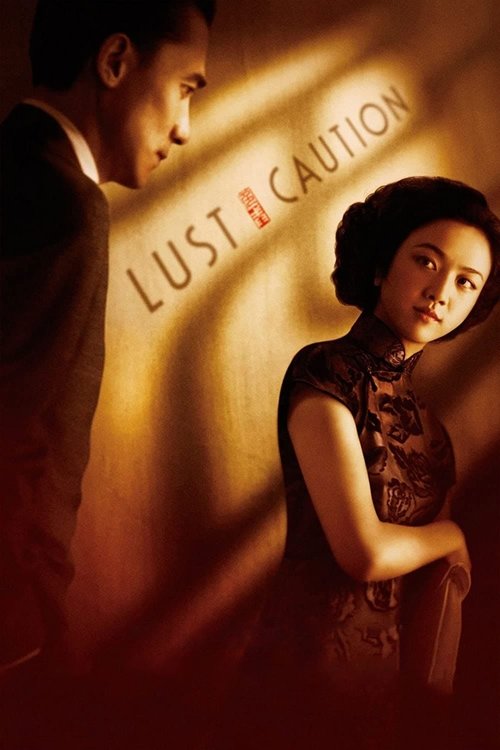
Lust, Caution
2007 · Ang Lee
When you want a serious, immersive evening — a long, grown-up thriller that demands your full attention and rewards it with real devastation. Challenge, not comfort.
What it's about
In Japanese-occupied Shanghai during the Second World War, a troupe of patriotic students turns itself into an amateur assassination cell. Their weapon is Wong Chia Chi, a young actress dispatched to seduce Mr. Yee, a feared security official of the collaborationist government, and lure him into a trap. Over years and two cities, the performance of desire becomes indistinguishable from desire itself, and the mission tightens around everyone in it.
The experience
Slow-burning, opulent, and almost unbearably tense — an espionage story told through glances, mahjong games, and dangerous intimacy rather than action. It's explicit, adult, and emotionally brutal in a way that stays with you.
Performances
Tang Wei, in her debut, gives one of the great first performances — a woman acting a role inside a role, every layer visible. Tony Leung Chiu-wai plays against his warmth as Mr. Yee, coiled and unreadable, and their scenes together are the film.
The craft
Ang Lee directs with exacting period craft — 1940s Shanghai rebuilt in fabric, smoke, and shadow — and stages the central relationship with a frankness few prestige films risk. The pacing is deliberate by design: 157 minutes of pressure applied one turn at a time, gorgeous on a big screen.
Why it matters
Winner of the Golden Lion at Venice — Lee's second — it became a cultural flashpoint across the Chinese-speaking world and made Tang Wei a star, standing as one of the boldest studio-scale erotic thrillers of its era.
Snapshot
Lust, Caution (色,戒, Sè, Jiè) is Ang Lee's adaptation of a slender, famously guarded novella by the Chinese writer Eileen Chang (Zhang Ailing), transposed into a 157-minute espionage melodrama set largely in Japanese-occupied Shanghai during the Second World War. A troupe of patriotic Hong Kong university students, radicalized into amateur assassins, dispatches one of their own — the young woman Wong Chia Chi (Tang Wei, in her debut) — to seduce and lure a senior official of the Japanese-backed collaborationist government, Mr. Yee (Tony Leung Chiu-wai), into an ambush. Over years and two cities the seduction curdles into something neither espionage nor love can fully name, and the mission collapses at the moment of its success. Made immediately after Brokeback Mountain (2005), the film won Lee his second Golden Lion at Venice in two years and became notorious in the West for the explicitness of its sex scenes, which earned it an NC-17 in the United States, and in China for the censorship it provoked — including a de facto broadcast ban on its unknown leading actress. It is at once one of Lee's most controlled genre exercises and one of his coldest, most ambivalent studies of performance, patriotism, and the body as an instrument of both.
Industry & production
The film was a pan-Asian, American-financed prestige production, embodying the transnational model Lee and his producing partner James Schamus had refined over more than a decade. Schamus was at the time chief executive of Focus Features, the specialty arm of Universal, which produced and distributed the film; the enterprise gathered talent from Hong Kong, Taiwan, mainland China, and Lee's regular international crew. Shooting took place across period-dressed locations in Shanghai and Hong Kong, with additional work carried out elsewhere in Asia to stand in for wartime cityscapes that no longer exist; the exact division of location and stage work I would not want to specify beyond what is firmly on the record.
Casting was the production's central gamble. Leung was an established international star, but Lee cast the pivotal role of Wong Chia Chi with a near-unknown, Tang Wei, then a drama-school graduate with almost no screen experience — a decision that mirrors the story's own theme of an amateur asked to sustain an impossibly demanding performance. The supporting cast included Joan Chen as Yee's wife and the singer-actor Wang Leehom as the idealistic student leader Kuang Yu Min.
The film's afterlife was shaped as much by regulators as by audiences. Focus released it uncut in the United States with an NC-17 rating, a commercially punishing classification the company chose to accept rather than trim. In mainland China the film was released only in a substantially shortened form, with the explicit material and other content removed. In its aftermath, Chinese authorities effectively barred Tang Wei from domestic media and advertising for a period — a striking instance of a state penalizing a performer for a role — which became part of the film's story in the culture. Precise box-office figures I will not cite from memory.
Technology
Lust, Caution is a late-photochemical film, shot on 35mm at a moment when the digital intermediate had become standard for high-end finishing but before digital capture had displaced film in prestige cinema. Its technological project is not novelty but recreation: the convincing reconstruction of 1938–1942 Shanghai and Hong Kong, achieved through the traditional apparatus of period filmmaking — sets, costumes, vintage vehicles, and controlled art direction — extended and cleaned up with the digital tools of the era for set extension and the erasure of anachronism. The image was almost certainly graded through a digital intermediate, which allowed the film's characteristic desaturated, lamp-lit interiors and its shifts between the students' bright, theatrical Hong Kong and the shadowed paranoia of occupied Shanghai. I would flag as uncertain any precise claim about the capture format's anamorphic-versus-spherical origin; the safe statement is that it was originated on 35mm and finished digitally in keeping with 2007 practice.
Technique
Cinematography
Rodrigo Prieto, who had shot Brokeback Mountain for Lee, photographs the film in a register of held, watchful restraint. The palette is muted and autumnal, built from browns, ochres, and lamplight, with the occupied city rendered in a perpetual low-key gloom that contrasts with the flatter, brighter light of the earlier student sequences in Hong Kong. Prieto favors compositions that trap Wong within frames-inside-frames — doorways, mirrors, the grid of the mahjong table — visually stating her confinement inside a role. The camera tends to observe rather than pursue; even the violence is often composed with a terrible patience. The much-discussed sex scenes are shot with the same compositional rigor, contorted and often uncomfortable rather than voluptuous, so that the cinematography reads them as extensions of the interrogation and power-play running through the rest of the film rather than as relief from it.
Editing
Tim Squyres, Lee's editor on nearly all his films, cuts Lust, Caution at a deliberate, accumulating pace that many Western viewers found demanding. The film's rhythm is one of slow tightening: long expository stretches of student idealism and domestic ritual are wound toward sudden, brutal punctuation — most famously an early amateur killing that is agonizingly protracted and clumsy, editorially refusing the clean elisions of the genre. The structure hinges on a large flashback: the film opens in the taut present of the mahjong table and the plot's endgame, then doubles back years to Hong Kong, so that the audience arrives at the climactic scenes already knowing their weight. Squyres's cutting withholds relief, keeping the viewer inside Wong's sustained, exhausting performance.
Mise-en-scène / staging
The film's design is one of its glories. Period detail — cheongsams, tailoring, interiors, the textures of scarcity and privilege in a divided city — is dense and specific without tipping into showcase. Recurring staging motifs carry the meaning: the mahjong table, where women's chatter masks surveillance and rivalry; the cocoon of the movie theater and the amateur stage, which established Wong's fatal susceptibility to being moved by fiction; the jeweler's shop and the pink-diamond ring that becomes the story's pivot. Lee stages intimacy and menace in the same enclosed, richly appointed rooms, so that seduction, dinner, and the threat of exposure share a single suffocating space.
Sound
Alexandre Desplat's score is central to the film's texture: a restrained, melancholy orchestral theme, often piano- and string-led, that supplies the yearning the characters cannot voice and that Lee's cool surfaces deliberately suppress. The sound design leans on the ambient particulars of the period city — the clack of mahjong tiles, rain, traffic, the murmur of Shanghainese and Mandarin (with Japanese and English threading through) — and on long passages of near-silence in which the strain of maintaining a false self becomes audible in its absence of music. The linguistic layering itself functions as sound design, mapping the city's occupation and the characters' shifting masks.
Performance
Performance is the film's true subject, and it is carried by two remarkable turns. Tony Leung plays Yee against his own charismatic screen persona: guarded, wary, capable of cruelty, a man whose power has hollowed him into fear, and whose eventual vulnerability is all the more devastating for how little he permits himself. Tang Wei, extraordinarily, must play a woman playing a woman — an amateur actress sustaining a fabricated identity — and calibrate the slippage between the two until neither she nor the audience can locate the seam. The role demanded not only the exposure of the sex scenes but an interior transparency about self-annihilation, and her debut performance anchors the film. Joan Chen, as the confined, oblivious wife, provides a quiet counter-portrait of a woman inside a different kind of role.
Narrative & dramatic mode
The dramatic mode is tragic irony sustained at length. The plot is an espionage narrative, but Lee empties the spy story of its usual pleasures — competence, momentum, catharsis — and refills it with dread and moral vertigo. The engine is dramatic irony layered upon performance: we watch a performer whose life depends on her performance, inside a plot the flashback structure has already told us will fail. The novella's celebrated ellipses and reticence are honored; the film resists explaining its heroine's final, self-destructive choice, presenting it instead as the logical terminus of a self she has performed into existence. The mode is closer to the interior, fatalistic melodrama of Chang's fiction than to the thriller its logline promises.
Genre & cycle
Lust, Caution sits at the intersection of the wartime-occupation espionage film, the erotic drama, and the literary period melodrama. It belongs recognizably to a lineage of "seduction as sabotage" spy stories, but it deliberately frustrates that genre's mechanics. It also participates in a broader 2000s cycle of ambitious Chinese-language historical films aimed at both domestic and international audiences, and in a strand of art cinema — one thinks of contemporaneous European and Asian films — willing to deploy explicit sexuality as dramatic argument rather than titillation. Its NC-17 places it within the small, embattled category of American-distributed prestige films that accepted commercial marginalization in exchange for keeping adult content intact.
Authorship & method
The film is a summit of Ang Lee's long practice of adaptation and of his method of building films with a stable company of collaborators. Lee's authorship here lies in his characteristic cool control and his abiding interest in repression — the gap between social role and inner life — which runs from The Wedding Banquet through Sense and Sensibility and Brokeback Mountain into this film's study of a self dissolved by performance. Working again with James Schamus, his longtime writer-producer, and co-screenwriter Wang Hui-Ling (a collaborator from Crouching Tiger, Hidden Dragon), Lee expanded Chang's compressed novella into a full dramatic architecture while preserving its reticence. Rodrigo Prieto (cinematography), Tim Squyres (editing), and Alexandre Desplat (score) supply the film's controlled surfaces. Lee's directorial method — famously exacting and immersive with actors — is inseparable from the film's central achievement: coaxing from a first-time lead a performance about performance itself, and asking his stars to enact intimacy at a level of exposure rare in mainstream cinema.
Movement / national cinema
The film resists a single national label, which is part of its significance. It is a work of Chinese-language cinema made by a Taiwan-born, US-based director with American studio money and a cast drawn from across the Chinese-speaking world, engaging a subject — collaboration with the Japanese occupier — that remains politically charged in mainland China. It is best understood within transnational Chinese cinema and the diasporic authorship Lee exemplifies, as well as within the tradition of adapting Eileen Chang, a canonical figure of modern Chinese letters whose work has repeatedly drawn major filmmakers. The censorship it met in China underlines how a film can be simultaneously a triumph of Chinese-language cinema abroad and an object of official anxiety at home.
Era / period
Two eras press on the film. Its setting is the fractured China of roughly 1938–1942 — divided between Hong Kong, still under British rule, and a Shanghai administered through the Japanese-backed collaborationist government, an occupation-era world of surveillance, scarcity, and moral compromise that the film reconstructs in fine grain. Its moment of production, 2007, belongs to the high tide of the specialty-film era in American distribution, when companies like Focus could mount adult, subtitled, star-driven prestige pictures for a global audience — a window that was already narrowing. The collision of the two eras is the film's political charge: it revisits a nationally sensitive wartime history at the precise moment Chinese cinema was expanding onto the world stage.
Themes
The film's governing theme is performance as identity — the terror and seduction of playing a role until it consumes the self. Around it cluster its major concerns: patriotism and its human cost, and the ease with which idealistic students become killers; collaboration, betrayal, and the impossibility of clean loyalties under occupation; sexuality as an instrument of power, surveillance, and, finally, of a vulnerability that overrides strategy. The recurrent images of theater and cinema-going establish Wong as someone dangerously permeable to fiction, and the film asks whether the feeling produced inside a performed love can be distinguished from the real. The pivotal diamond ring crystallizes the theme: a token of the mission that becomes, catastrophically, a token of feeling. Underlying all of it is Chang's — and Lee's — bleak intuition that the body may know a truth the will has committed to betray.
Reception, canon & influence
Critically, Lust, Caution was received as a major, serious work, if a divisive one. It won the Golden Lion at the 2007 Venice Film Festival, giving Lee back-to-back top prizes at the festival following Brokeback Mountain, and it swept the leading categories at Taiwan's Golden Horse Awards, including Best Feature Film and Best Director. Western critics broadly admired its craft and its performances while some found its pace punishing and its emotional temperature deliberately chilly; the NC-17 rating and the frankness of the sex scenes dominated a great deal of the coverage, sometimes at the expense of the film's other achievements. In the Chinese-speaking world, reception was inseparable from the politics of the material and from the censorship it met.
The film's backward-facing influences are clear and acknowledged: Eileen Chang's novella above all, with its history-haunted reticence, and the real currents of wartime assassination plots against collaborators that stand behind the story; and, in Lee's own filmography, the study of repression and social masks that his earlier work had developed. Its forward legacy is more diffuse and should be stated carefully rather than overclaimed. It renewed international attention to Chang's fiction and to the possibilities of Chinese-language period drama on the world stage; it launched Tang Wei, who despite the Chinese ban went on to a substantial regional and international career, into prominence; and it became a recurrent reference point in debates about the place of explicit sexuality in serious cinema and about state censorship of film and performers. Direct, traceable influence on a subsequent cycle of films is harder to document firmly, and I would not manufacture a lineage the record does not clearly support. What is secure is its standing as one of Ang Lee's most rigorous and unsettling films, and a landmark of transnational Chinese cinema in the 2000s.
A Deleuzian reading
Four women at a mahjong table, and the camera keeps finding their hands.
The full Deleuzian reading of Lust, Caution →
Reception
It won Ang Lee the Golden Lion at Venice in 2007, then got slapped with an NC-17 in the US and semi-buried in the awards conversation — but younger cinephiles (especially on Letterboxd) have since claimed it as one of Lee's very best, maybe his most reappraised film.
How Lust, Caution was received, from release to now →
How to watch Lust, Caution: what to notice on a first viewing
- Watch how often doorways, mirrors, or the mahjong grid frame Wong. Prieto keeps composing Wong inside frames within frames across the film, boxed by architecture and furniture wherever she goes. The film states her confinement inside a role through composition alone.
- Listen for Desplat's piano-and-string theme entering. Desplat's score supplies the yearning nobody speaks aloud, and Lee often leaves only tiles, rain, and silence. The silences are where the strain of a sustained false self becomes audible.
- Track who sits closest to Yee at the mahjong table. The women's chatter about rings and rents masks a constant reshuffling of surveillance and rivalry around the table. Leisure and surveillance turn out to be the same activity in this room.
- Notice how much brighter the Hong Kong scenes look than Shanghai. Lee and Prieto shoot student idealism in flat, bright light, then submerge occupied Shanghai in browns, ochres, and lamplight. The palette itself tracks the shift from open idealism to a closed, watched world.
- Watch Tang Wei's face for the seam in her performance. Tang Wei plays a woman playing a woman, and the film keeps testing whether you can locate where one self ends and the other begins. The film's whole tension rests on whether that seam is ever visible.
The whole guide to watching Lust, Caution, with the keys for a rewatch →
Influences: the films it descends from and the films it influenced
- Notorious (1946) — The foundational sexual-espionage template Lust, Caution reworks: a woman is handled by an intelligence apparatus to seduce and marry an enemy target, and the drama lives in the agony of the handler who loves the asset he is prostituting.
- Army of Shadows (1969) — Model for the deglamorized mechanics of resistance killing — the clumsy, protracted difficulty of murdering a collaborator up close — which Lee and editor Tim Squyres extend in the botched, agonizingly extended assassination.
- The Conformist (1970) — The occupation-era political melodrama built entirely on performance and complicity, where a character's social mask and desire to belong become the engine of betrayal, staged through stylized period interiors.
- Center Stage (1991) — Establishes the actress-playing-an-actress structure within Chinese-language period cinema, dramatizing performance-as-identity so that the woman's on-stage roles dissolve the boundary of her actual self.
- Raise the Red Lantern (1991) — Template for female repression rendered through confined, ritualized domestic interiors and games of position among women — a staging logic Lee transposes onto the mahjong table as a battlefield of surveillance and status.
- Farewell My Concubine (1993) — Performance-as-identity carried across decades of occupation and political upheaval, where a performer's assumed role consumes the private self — the same theme of a self dissolved by performance central to Wong Chia-chi.
- The Wedding Banquet (1993) — Lee's early study of a false social self performed at a communal table, where the banquet becomes the arena of concealment — the direct forerunner of the mahjong table as staging of the masked self.
- Sense and Sensibility (1995) — Within Lee/Schamus's own practice, the study of social masks and repressed feeling rendered through cool control of surfaces, where the gap between decorous social role and inner life is the entire subject.
- Crouching Tiger, Hidden Dragon (2000) — Assembles the exact craft company reused here — co-writer Wang Hui-Ling and editor Tim Squyres — and builds transnational Chinese period drama around repressed desire that can only be expressed obliquely.
- Brokeback Mountain (2005) — The immediately preceding Lee/Rodrigo Prieto/Schamus collaboration, where protracted, exposed physical intimacy is used not for titillation but as the load-bearing dramatization of otherwise unspeakable repression.
- In the Realm of the Senses (1976) — Builds extended near-explicit sex into a folie-à-deux of gender-power inversion set against 1930s–40s militarism — Realm's exact thematic-formal knot in a new register.
- The Handmaiden (2016) — Extends the erotic-espionage form under Japanese colonial occupation, using performance-as-deception, nested frames-within-frames, and explicit sex as the actual narrative engine of a con rather than decoration.
- Decision to Leave (2022) — Built directly on Tang Wei's Lust, Caution persona, it stages romance-as-surveillance in which interrogation and desire, performance and truth blur — the honeytrap logic turned inside out onto the watcher.
- In the Mood for Love (2000) — Parallel achievement in transnational Chinese cinema of longing through restraint: low-key, desaturated period surfaces and obsessive frames-within-frames (doorways, windows, mirrors) that cage figures in their own repression.
- Black Book (2006) — Contemporaneous WWII-occupation honeytrap in which a woman seduces an enemy officer for the resistance and the cover identity collapses into real feeling, testing the same moral ambiguity of the sexual-espionage plot.
- Summer Palace (2006) — A near-simultaneous Chinese-language film that entangles frank sexuality with political history and consequently met state censorship, sharing Lust, Caution's insistence on the body as inseparable from historical rupture.
- Memoirs of a Geisha (2005) — Rodrigo Prieto's low-key painterly period interiors and meticulous costume-as-character serve a narrative of dangerous deferred desire — the same prestige transnational Asian-period craft register, released two years later.
Similar films
- In the Mood for Love (2000) — influence & lineage · same viewing thread
- Farewell My Concubine (1993) — influence & lineage · same viewing thread
- Crouching Tiger, Hidden Dragon (2000) — influence & lineage
- The Handmaiden (2016) — influence & lineage
- Raise the Red Lantern (1991) — influence & lineage
- Decision to Leave (2022) — influence & lineage
- The Wedding Banquet (1993) — influence & lineage · same viewing thread
- The Assassin (2015) — shared sensibility
All the films related to Lust, Caution →
Watch it with: curated runs of related films
- Love Against the Grain — A run of films where desire refuses the shape its world demands — opera stages, drought-struck Taipei, an honor-bound Lahore household, drenched Buenos Aires — and burns brighter, and more dangerously, for the refusal.