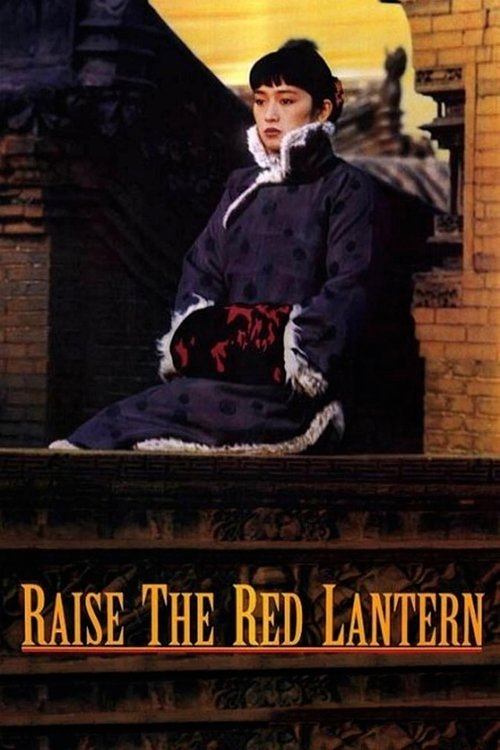
Raise the Red Lantern
1991 · Zhang Yimou
For when you want a film to chew on for days — a stately, gorgeous tragedy that rewards patience and leaves a bruise. This is challenge, not comfort, though the images alone are worth the evening.
What it's about
Nineteen, educated, and suddenly poor after her father's death, Songlian is married off as the fourth wife of a wealthy master in 1920s China. His walled compound runs on a nightly ritual: red lanterns are lit outside the quarters of whichever wife he chooses, and with the light come privileges — servants' deference, a foot massage, control of tomorrow's menu. To survive, Songlian must learn to compete with three other wives and an ambitious maid in a household where favor is the only currency.
The experience
Hushed, formal, and slowly suffocating — the tension builds not through action but through glances, rituals, and the sound of lanterns being lit or snuffed. It's beautiful in a way that makes the cruelty land harder, and it tightens around you like the walls of the compound itself.
Performances
Gong Li is extraordinary as Songlian, charting a proud young woman's hardening into a player of the very game destroying her — much of it carried in stillness and the set of her face.
The craft
Zhang Yimou turns color into the story's engine: saturated reds against gray courtyard stone, compositions so symmetrical the house feels like a machine for trapping people. The lantern rituals give the film a hypnotic rhythm of light, shadow, and repeated ceremony. It absolutely rewards the biggest, sharpest screen you can find.
Why it matters
One of the films that brought Chinese cinema to worldwide attention in the early 1990s, it made Zhang Yimou and Gong Li international names and remains a touchstone for visually driven political storytelling.
Snapshot
Raise the Red Lantern (大红灯笼高高挂, Dà hóng dēnglong gāogāo guà) is Zhang Yimou's chamber tragedy of a young woman swallowed by a wealthy household in 1920s warlord-era China. Songlian (Gong Li), nineteen and university-educated, is married off after her father's death to become the fourth wife of the aging Master Chen. Inside his walled northern compound she discovers a sealed economy of favor and punishment: each night red lanterns are lit outside the quarters of whichever mistress the Master chooses, conferring status, a coveted foot massage, and power over the next day's menu. The four wives — and the ambitious servant Yan'er — compete, scheme, and destroy one another for a privilege that is itself a cage. The film is at once an austere art-house tragedy and a transparent political allegory; it earned Zhang an Academy Award nomination, the Silver Lion at Venice, and lasting status as one of the defining works of Chinese Fifth Generation cinema. Its visual signature — symmetrical courtyards, hanging red light, a heroine framed as a specimen — became one of the most recognizable images in early-1990s world cinema.
Industry & production
The film was a transnational co-production typical of the constrained, ingenious financing that supported ambitious mainland Chinese cinema at the turn of the 1990s. With domestic resources thin and Zhang's previous film Ju Dou (1990) already running afoul of authorities, the production drew on Taiwanese capital, principally through Era International, the Taipei company headed by Chiu Fu-sheng that had become a key backer of mainland auteur cinema. The picture is generally classed as a Chinese–Hong Kong–Taiwan co-production, and it was for this reason submitted to the Academy Awards under Hong Kong's banner rather than the People's Republic's.
That cross-strait structure was not merely financial; it reflected the precarious official standing of Zhang's work at home. Like Ju Dou, Raise the Red Lantern was suppressed in mainland China for a period after completion, its allegory of a closed, ritual-bound hierarchy read — correctly — as combustible in the years immediately following 1989. The film premiered internationally before it could circulate domestically, a pattern that made Zhang and Gong Li figures of fascination on the festival circuit while keeping them under suspicion at home.
The shoot took place largely at the Qiao Family Compound (Qiao Jia Dayuan) in Qi County, Shanxi province, a genuine Qing-era merchant courtyard complex whose gray-brick symmetry and stacked rooflines supplied the film its architecture of confinement. The adaptation derives from Su Tong's acclaimed 1990 novella Wives and Concubines (妻妾成群); the screenplay is credited to Ni Zhen, a scholar-screenwriter associated with the Beijing Film Academy generation that produced Zhang and his peers. Precise budget figures are not reliably documented in English-language sources and should not be invented here, but the production's scale was modest and concentrated — a single principal location, a small principal cast, and a tightly bounded narrative world.
Technology
Technologically the film is conventional for its moment and milieu: 35mm color photography, location-based natural and practical lighting heavily supplemented by the motivated source that drives the whole picture — the red lanterns themselves. There is no technological novelty being demonstrated; rather, the film's interest lies in how disciplined, almost theatrical control of color temperature and practical light is wrung from ordinary means. The lanterns function simultaneously as plot mechanism, set dressing, and lighting instrument, so that the production's "special effect" is in essence the orchestration of warm tungsten-range glow against cold gray stone. The reliance on a real historical compound rather than built sets also shaped the technical approach, committing the production to working within fixed, unyielding spatial geometry rather than the flexible flats of a studio.
Technique
Cinematography
Photographed by Zhao Fei, the film is built on a rigorously frontal, geometric visual grammar. Compositions are repeatedly organized around the compound's symmetry: corridors recede to a vanishing point, rooflines bracket the frame, and Songlian is placed dead center, pinned by the architecture like an insect on a board. The camera is markedly static and patient, favoring held wide and medium shots over coverage, so that characters appear small within enclosing masses of gray masonry and open sky.
Color is the film's most discussed formal element. The palette is keyed to a cold gray-blue base — the perpetual stone of the courtyards — punctured by saturated red: the lanterns, the wedding silks, the lining of the curtained beds. Red here is never simply festive. It signifies sexual selection, surveillance, and the artificial warmth of favor, and its extinguishing (lanterns being covered with black hoods when a mistress falls from grace) is among the film's most chilling images. Crucially, the lighting design treats the red glow as both seductive and clinical: it warms the women's faces while marking them as objects under inspection.
Editing
The editing, credited to Du Yuan, is deliberately unhurried, matching the film's ritualized rhythm. Rather than dramatizing through pace, the cutting lets scenes settle into stillness, holding on tableaux until their oppressive symmetry registers. The film's structure is itself a kind of montage of repetition: it is partitioned by intertitles into seasons — Summer, Autumn, Winter, and then a return — and within each the same nightly ritual recurs (the lantern-lighting, the foot massage, the announcement of the menu). This calendrical, cyclical organization is the editorial spine, converting plot into liturgy and making the eventual rupture of the cycle land with tragic force.
Mise-en-scène / staging
Mise-en-scène is where the film concentrates its meaning. The Chen compound is staged as a closed system of thresholds, rooftops, and identical courtyards in which movement is always observed and rarely free. Blocking is frontal and frieze-like; characters are arranged in formal, almost ceremonial groupings during the lantern ritual and the communal meals where rivalry simmers. The fatal rooftop chamber — a small structure where, it is whispered, women of the house have been killed for transgression — looms as the spatial limit of the heroine's world, the one place that promises escape and delivers death. Master Chen is a brilliant negative presence: he is kept at the edge of frame or shot from behind, his face withheld, so that patriarchal authority registers as a faceless function rather than a man. The household's customs — the lanterns, the foot-tapping massage — are largely the film's (and source novella's) invention rather than documented historical ritual, and this stylization is precisely the point: it abstracts feudal domesticity into an allegorical machine.
Sound
The score is by Zhao Jiping, Zhang's frequent collaborator and one of the most significant film composers of the Fifth Generation. The music threads Chinese operatic and folk idioms through the film — notably a recurring female chorus and the high, keening line of Peking opera, the latter motivated by the third mistress Meishan's former life as an opera singer. Diegetic sound is exploited with great precision: the rhythmic clack of the foot-massage hammers becomes an aural emblem of pleasure-as-conditioning, a Pavlovian percussion that Songlian comes both to crave and to despise. Silence and the muffled acoustic of the stone courtyards are used to underline isolation. Like much Fifth Generation work the film treats sound design as expressive rather than naturalistic, with select sounds amplified into motifs.
Performance
Gong Li's Songlian anchors the film and ranks among the signature performances of 1990s world cinema. She charts a precise arc from the guarded, faintly contemptuous composure of an educated girl who believes she can master the game, through calculation and false pregnancy, to disillusion and finally madness. Gong's performance is interiorized and watchful, built on micro-shifts of expression within the static frames; the camera's stillness throws her face into relief. The supporting wives are sharply differentiated — the falsely maternal, "Buddha-faced" second mistress Zhuoyun and the defiant, doomed Meishan especially — and the servant Yan'er embodies the tragedy's cruelest rung, an aspirant who internalizes the very hierarchy that crushes her. The ensemble plays the household as a closed theater of surveillance in which everyone performs for an absent master.
Narrative & dramatic mode
The dramatic mode is tragedy in a near-classical sense: a bounded world, a fall driven by both circumstance and character, and an ending of madness rather than catharsis. The narrative is structured by season, lending it the inevitability of a cycle that cannot be broken from within. Causation is built from intrigue — rumor, false pregnancy, betrayal, the discovery of adultery — but the film consistently subordinates suspense to ritual, so that events feel less like a thriller's escalation than like the turning of a wheel. The closing return of a new fifth mistress, with Songlian reduced to a mad figure haunting the courtyards, seals the structure: the system simply absorbs its victims and continues. This refusal of resolution is central to the film's allegorical reading.
Genre & cycle
Generically the film sits at the intersection of period melodrama, art-house tragedy, and political allegory. It belongs to a distinct early-1990s cycle of Zhang Yimou–Gong Li collaborations set in a stylized historical China and centered on women crushed by patriarchal and feudal structures — Red Sorghum (1987), Ju Dou (1990), and Raise the Red Lantern form a loose thematic trilogy, with Ju Dou and Lantern especially paired as opulent, color-saturated chamber tragedies of female confinement that both earned Oscar nominations and both met official disfavor at home. More broadly the film is a flagship of the "ethnographic" or internationally legible art cinema that mainland directors produced in this period, sometimes criticized as catering to Western festival appetites for an exoticized China — a charge the film's defenders counter by pointing to the rigor and political bite beneath its surfaces.
Authorship & method
Zhang Yimou came to directing through cinematography — he shot Chen Kaige's landmark Yellow Earth (1984) before directing Red Sorghum — and that photographic origin is everywhere in Lantern's composed, color-driven design. His method here is one of formal compression: a single location, a quartet of women, a repeating ritual, all marshaled toward allegory. The collaboration with Gong Li, his star and at the time his partner, is inseparable from the film's achievement; she is the expressive center around which his geometry organizes itself.
The key collaborators form a recognizable Fifth Generation cohort. Cinematographer Zhao Fei executed the symmetrical, red-against-gray visual scheme. Composer Zhao Jiping supplied the operatic, chorus-laced score that would also define Farewell My Concubine and other major works of the era. Editor Du Yuan shaped the film's seasonal, ritual rhythm. Screenwriter Ni Zhen adapted Su Tong's novella Wives and Concubines, and the source author's coolly ironic vision of domestic predation underlies the film's allegorical clarity. The result is less a single auteur's signature than a tightly aligned creative unit working at the height of a movement.
Movement / national cinema
The film is a central document of the Fifth Generation — the cohort of directors who graduated from the Beijing Film Academy after it reopened post–Cultural Revolution, including Chen Kaige and Tian Zhuangzhuang alongside Zhang. That generation reacted against socialist-realist convention with bold visual stylization, allegorical historical settings, and an ambivalent, often critical relationship to Chinese tradition and authority. Raise the Red Lantern exemplifies the movement's international breakthrough phase, when its films became fixtures at Venice, Cannes, and Berlin and brought mainland Chinese cinema sustained global attention for the first time. The film's troubled domestic status — celebrated abroad, suppressed at home — also typifies the movement's fraught negotiation with the Chinese state in the early 1990s.
Era / period
Set in the 1920s, during the fragmented warlord period between the fall of the Qing and the consolidation of Nationalist rule, the film uses its historical moment to frame a society in suspension — modernity (Songlian's university education) pressing against entrenched feudal household structures. Yet the period setting is also a screen. Made and released in 1991, in the shadow of the events of 1989, the film's depiction of a sealed compound governed by arbitrary favor, surveillance, enforced ritual, and lethal punishment was widely and plausibly read as an allegory of contemporary authoritarian power. The decision to set oppression safely "in the past" was a familiar Fifth Generation strategy for speaking about the present.
Themes
The film's governing theme is the oppression of women within a patriarchal order that survives by setting its victims against one another. The lantern ritual literalizes how a system manufactures complicity: the wives compete fiercely for a favor that confirms their own subjugation, and the servant Yan'er dies still believing in the hierarchy's promise. Surveillance and performance recur throughout — everyone is watched, everyone performs for an unseen master — anticipating the film's reading as a parable of totalitarian control. Ritual and custom are exposed as instruments of domination, their arbitrariness (these "rules" are largely invented) underscoring that tradition's authority is a fiction maintained by power. Madness and the impossibility of escape close the thematic circuit: the only exits from the compound are death or insanity, and the cycle resumes regardless. Color itself carries theme — red as the dangerous warmth of favor, gray as the permanent condition of the institution.
Reception, canon & influence
Critically the film was received internationally as a major achievement and remains among the most acclaimed Chinese films of its era. It won the Silver Lion at the 1991 Venice Film Festival and was nominated for the Academy Award for Best Foreign Language Film at the 64th ceremony, submitted under Hong Kong owing to its co-production status — Zhang's second consecutive nomination after Ju Dou. Western critics singled out its visual rigor, Gong Li's performance, and its allegorical power, while some scholars debated whether its ravishing surfaces amounted to self-exoticization for festival audiences, a debate that itself testifies to the film's prominence.
Looking backward, the film draws on a deep well of influences: Su Tong's novella supplies its narrative and ironic temperature; the traditions of Chinese opera shape its sound and one of its central characters; and Zhang's own background in still-composed, color-forward cinematography (and the broader Fifth Generation aesthetic) provides its formal language. Its tragic chamber structure and theatrical staging resonate with classical tragedy and with melodrama's long concern with confined women.
Looking forward, Raise the Red Lantern helped consolidate the international template for prestige mainland Chinese cinema and confirmed the Zhang–Gong Li partnership as one of world cinema's defining director–star collaborations of the decade. Its imagery — the hanging red lanterns, the symmetrical gray courtyard, the centered, trapped heroine — entered the global visual vocabulary and is among the most cited in discussions of color in film. The film was later adapted by Zhang himself, in collaboration with the National Ballet of China, into a stage ballet, extending its life across media. Within Zhang's own career it stands as the apex of his early tragic-allegorical mode, against which his later turns toward wuxia spectacle (Hero, House of Flying Daggers) and large-scale national pageantry are frequently measured. Its standing in the canon of the 1990s and of Chinese cinema generally is secure.
A Deleuzian reading
The black cloth comes down over the lanterns.
The full Deleuzian reading of Raise the Red Lantern →
Reception
It arrived as an instant international sensation — Silver Lion at Venice, an Oscar nomination — while being banned in mainland China itself, only screening there after the ban was lifted a couple of years later; today it's settled comfortably into the world-cinema canon as a peak of China's Fifth Generation.
How Raise the Red Lantern was received, from release to now →
Influences: the films it descends from and the films it influenced
- Yellow Earth (1984) — Zhang shot this himself, developing the static, frontally-composed wide frame that treats land and architecture as an oppressive subject larger than the people inside it — the compositional grammar he carried into directing.
- Red Sorghum (1987) — His debut established saturated red as a charged emotional field rather than decoration, and installed Gong Li as the expressive human center around which his color geometry organizes.
- Ju Dou (1990) — The immediate predecessor: color-blocked architectural confinement (the dye-mill), a sexually withheld/impotent patriarch, and a trapped woman framed within rigid interior geometry — Lantern refines this same template.
- Cries and Whispers (1972) — Nykvist's red-saturated chamber drama uses an enveloping crimson interior as a psychological field for confined, suffering women — the prototype for color-as-emotion in a sealed domestic space.
- Sansho the Bailiff (1954) — Static, distanced long-take compositions stage women crushed by feudal patriarchy, withholding close-ups so the architecture and social order dominate the frame — Zhang's tragic-mode staging descends from this.
- The Conformist (1970) — Storaro's symmetrical, architecturally-framed compositions carry political allegory through built space itself — the model for using rigorous geometry as ideological statement, not just beauty.
- Written on the Wind (1956) — Technicolor melodrama deploys saturated hues and oppressive domestic decor to externalize women's entrapment in a wealthy patriarchal household — the color-coded melodrama of female confinement Zhang inherits.
- Last Year at Marienbad (1961) — Frozen, symmetrical compositions within a labyrinthine architecture turn an estate into a formal prison and ritual into a recurring trap — a precedent for the courtyard-as-cage.
- Farewell My Concubine (1993) — Same Fifth Generation cohort sharing composer Zhao Jiping's operatic, chorus-laced score and Gong Li; uses Chinese opera as both sonic texture and structuring metaphor exactly as Lantern does.
- To Live (1994) — Reworks the seasonal/episodic chapter structure into a tragic historical chronicle, again centering Gong Li as the enduring witness inside a deterministic, era-marked timeline.
- Crouching Tiger, Hidden Dragon (2000) — Painterly, balanced compositions frame female desire suppressed by Confucian patriarchal order, marrying festival-prestige visual rigor to a Chinese tragic-romantic mode in the same international template Lantern helped set.
- Hero (2002) — Extends the saturated-color principle into a structural system, assigning each narrative chapter a single dominant hue — the logical maximalist evolution of Lantern's red-against-gray scheme.
- Curse of the Golden Flower (2006) — Returns to symmetrical palatial courtyards, color-maximalist saturation, and Gong Li trapped within a surveilling patriarchal household — Lantern's confinement allegory scaled up to imperial pageantry.
- The Assassin (2015) — Static, symmetrical compositions screened through silk and lantern-light frame a woman immobilized inside court patriarchy, inheriting the withheld camera and architectural-confinement staging in a more austere register.
- The Handmaiden (2016) — Ravishingly colored, rigorously composed interiors of an estate stage women under patriarchal surveillance-and-performance, extending the architectural-confinement-as-theater device into erotic thriller form.
- House of Flying Daggers (2004) — Establishes Zhang's signature of subordinating every department to a unifying chromatic design per space, color as primary expressive material later scaled up to landscape action.
- Memoirs of a Geisha (2005) — Lantern-lit, symmetrical low-key interiors and the ritualized daily movement of cloistered women — lighting and costume operating as character — supplied the Gong Li / Zhang Ziyi-era visual grammar Memoirs imports wholesale.
- Lust, Caution (2007) — Template for female repression rendered through confined, ritualized domestic interiors and games of position among women — a staging logic Lee transposes onto the mahjong table as a battlefield of surveillance and status.
- In the Mood for Love (2000) — Doyle's saturated palette and cramped, repeated domestic geometry stage repressed desire and performed propriety in confined interiors — a parallel use of color and tight architecture to express what cannot be spoken.
- The Joy Luck Club (1993) — Sibling in enclosure-blocking of women within courtyard/household architecture and a saturated era-differentiated palette dramatizing female confinement, the contemporaneous Chinese-language women's cinema alongside which Wang worked.
Similar films
- To Live (1994) — influence & lineage · same viewing thread
- Farewell My Concubine (1993) — influence & lineage · often watched together
- In the Mood for Love (2000) — influence & lineage
- The Handmaiden (2016) — influence & lineage
- Crouching Tiger, Hidden Dragon (2000) — influence & lineage
- Hero (2002) — influence & lineage
- The Assassin (2015) — influence & lineage
- A City of Sadness (1989) — same viewing thread · often watched together
All the films related to Raise the Red Lantern →
Watch it with: curated runs of related films
- Sinophone Slow Cinema — A run of Chinese-language films — Taiwan's New Wave and its mainland and Bi Gan heirs — where time pools and city, family, and memory recur; watch them near each other, from A Brighter Summer Day to An Elephant Sitting Still, for how they rhyme on drift and the weight of the past.