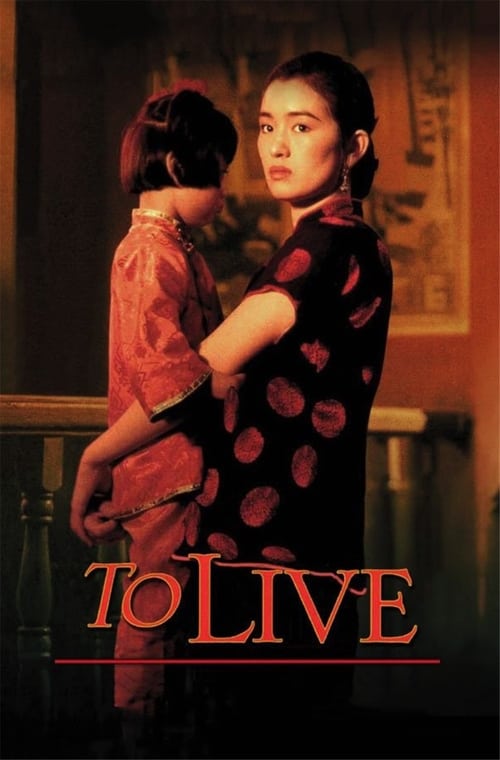
To Live
1994 · Zhang Yimou
For when you want a film that makes you feel the full weight of ordinary lives — a good cry earned honestly, ending in something like grace. Emotionally demanding but deeply humane; watch it when you have the evening to give it.
What it's about
Fugui is a rich man's son who gambles away his family's fortune on the eve of China's civil war — a disaster that, in the strange arithmetic of the times, may be what keeps him alive. With his wife Jiazhen and their children, he weathers four decades of upheaval as an ordinary family: the war, the Great Leap Forward, the Cultural Revolution. Their only ambition is the film's title — simply to live.
The experience
Warm, wrenching, and quietly funny in ways that make the sorrows land harder. It moves like a family album, decade by decade, and by the end you feel you've lived alongside these people; it will likely make you cry, but it never wallows.
Performances
Ge You won Best Actor at Cannes for his Fugui, a man hollowed out and rebuilt by history, and Gong Li matches him as Jiazhen with a performance of enormous quiet strength.
The craft
Zhang Yimou trades the hothouse visuals of his earlier films for something plainer and more generous, letting history register through kitchens, streets, and faces rather than spectacle. The recurring shadow-puppet theater — Fugui's trade in hard times — gives the film one of its loveliest and saddest motifs, and the period detail across the 1940s through '60s is immaculate.
Why it matters
It took the Grand Prix at Cannes in 1994 and was banned in mainland China, with Zhang reportedly barred from filmmaking for a time — a film whose suppression became part of its meaning. It stands among the defining works of 1990s Chinese cinema.
Snapshot
To Live (活着, Huózhe) is Zhang Yimou's adaptation of Yu Hua's 1993 novel, a family chronicle that carries the gambler-turned-peasant Xu Fugui and his wife Jiazhen from the twilight of Nationalist China through the Civil War, the Great Leap Forward, and the Cultural Revolution. Where Zhang's earlier features were sealed, hothouse melodramas of dye vats and lantern-lit courtyards, To Live opens onto four decades of national history and asks a deliberately modest question: not how to master fate, but how to survive it. Ge You's Fugui — hollowed by the loss of his fortune, then of both his children — became the film's moral center and won Best Actor at Cannes; the film took the Grand Prix (the festival's runner-up prize) in 1994. It was also banned in mainland China, and Zhang was reportedly barred from filmmaking for a period afterward for submitting it abroad without approval. The result is one of the defining works of the Fifth Generation's early-1990s reckoning with Maoist history, and among the most humane films in Zhang's body of work.
Industry & production
To Live was a cross-strait co-production, financed largely through Taiwan- and Hong Kong-based capital — Chiu Fu-Sheng's ERA International — in partnership with the Shanghai Film Studio, the arrangement by which many mainland Fifth Generation films of the period reached international budgets and audiences. This model, pioneered on Zhang's own Ju Dou and Raise the Red Lantern, let politically sensitive material be made on the mainland while insulating financing from domestic gatekeepers, but it also sharpened the friction with censors: a film could be completed and shown at Cannes before Beijing had cleared it. That is essentially what happened here. Submitted to the 1994 festival without final official sanction, To Live was banned domestically, and Zhang faced professional sanction — commonly reported as a roughly two-year restriction, though accounts of its exact scope vary and the record is not perfectly precise. The ban is itself part of the film's meaning: a movie about ordinary people enduring the state's convulsions became a casualty of the state.
The production reunited Zhang with Gong Li, then the most internationally recognized Chinese star and his longtime creative and personal partner; To Live falls near the end of that collaboration. Yu Hua adapted his own novel with the veteran screenwriter Lu Wei, who had just written Chen Kaige's Farewell My Concubine — a pairing that placed To Live squarely within the same wave of prestige historical epics.
Technology
To Live was shot photochemically on 35mm in the early-1990s idiom of the Chinese studio system, with no unusual technical apparatus; its ambitions were dramatic and pictorial rather than mechanical. The most consequential "technology" in the film is diegetic and pre-industrial: the shadow-puppet theater (piying), the leather-and-lamplight folk medium that Fugui takes up to earn a living after losing his house. The film treats the puppet screen as its own small cinema — a backlit rectangle of moving figures — and stages several passages around the lantern, the translucent hides, and the singing that accompanies them. When the troupe's puppets are finally burned as feudal relics during the Cultural Revolution, the film registers the destruction of an entire vernacular image-making tradition, a pointed meta-commentary from a director acutely conscious of what regimes do to pictures.
Technique
Cinematography
The cinematography is by Lü Yue, and it marks an audible tonal shift from the saturated, near-operatic palettes Zhang had built with Gu Changwei and Zhao Fei. To Live is warmer, dustier, and more naturalistic — earth tones, lamplight, the ochre of provincial towns — a register suited to a story about people worn down to their essentials rather than lacquered figures in a symbolic prison. Zhang, himself trained as a cinematographer (he shot Chen Kaige's Yellow Earth), plainly shaped this restraint. Interiors are lit to feel lived-in; the camera favors patient compositions and the domestic middle distance over the ravishing overhead symmetries of Raise the Red Lantern. The shadow-puppet sequences supply the film's most stylized images — glowing screens, silhouettes — a controlled eruption of theatrical light within an otherwise grounded visual world.
Editing
Structurally the film is episodic, partitioned by intertitles that announce the decades — the 1940s, 1950s, 1960s, and after. This chaptering does enormous narrative work, compressing a national history into a family's serial losses and letting the film leap across years between title cards. The cutting within scenes is largely classical and unobtrusive, subordinated to performance and to the accumulating weight of event; the film's rhythm is one of recurrence — reunions, meals, small ceremonies — punctuated by sudden catastrophe. Editing credit is generally attributed to Du Yuan.
Mise-en-scène / staging
Zhang stages the film around thresholds and rooms that change meaning as the regime changes: the ancestral mansion Fugui gambles away (and whose loss ironically saves his life), the town square, the backyard steel furnaces of the Great Leap Forward, the hospital where the Cultural Revolution has emptied the wards of competent doctors. Objects carry the history: the puppet chest, a Party-issued certificate, the buns bought for a starving professor. The staging is legible and humane rather than emblematic — people cook, argue, and grieve in continuous domestic space — which makes the intrusions of the political (a conscription, a denunciation, an accident) feel like weather breaking over a household.
Sound
The score is by Zhao Jiping, the composer most identified with Fifth Generation cinema, who also scored Raise the Red Lantern and Farewell My Concubine. His music here leans on Chinese instrumentation — strings and the plangent erhu — and is braided with the sung, percussive idiom of the shadow-puppet opera, so that the film's folk-performance motif also becomes its sonic signature. The soundscape otherwise favors the ambient textures of village and town life; music is deployed sparingly, most tellingly around loss.
Performance
The film rests on Ge You's Fugui, a performance of diminishing gestures: the reckless young wastrel gradually shed until only a survivor's watchful humility remains. Ge You — a great comic actor working against type — modulates from foolishness to a grief so contained it barely moves, and the Cannes Best Actor prize recognized exactly this restraint. Gong Li's Jiazhen is his counterweight, the moral spine of the family, playing endurance rather than the fierce entrapment of her earlier Zhang roles. The supporting ensemble — the son-in-law Wan Erxi, the friend-turned-official Chunsheng whose truck kills the couple's son — gives the historical machinery a human face, so that catastrophe arrives through people, not abstractions.
Narrative & dramatic mode
To Live is a picaresque of endurance turned tragic chronicle. Its dramatic engine is irony of survival: Fugui gambles away the family estate to the schemer Long'er, an act of ruin that later spares him, because it is Long'er — now the landlord of record — who is executed when the Communists redistribute property. That structural irony recurs. The certificate proving Fugui once served (however unwillingly) the People's Liberation Army becomes a shield; the puppets that feed the family become contraband; the hospital that should save his daughter has purged the doctors who could. The film's mode is neither the melodrama of doomed passion nor didactic history but something closer to folk tragedy — a story in which the characters survive precisely by wanting nothing more than to survive, and are punished anyway. Crucially, the film is gentler than its source: Yu Hua's novel is remorseless, killing nearly everyone, whereas the film leaves Fugui, Jiazhen, and their grandson alive at a table, a muted survival that some read as consolation and others as the bleakest ending of all.
Genre & cycle
The film belongs to the early-1990s cycle of Chinese historical epics that trace private lives across the traumas of the Maoist century. Its closest siblings are Chen Kaige's Farewell My Concubine (1993) and Tian Zhuangzhuang's The Blue Kite (1993): three films, all by Beijing Film Academy classmates, all spanning the Civil War through the Cultural Revolution, and all snagged by censorship — Tian's most severely. Against that trio, To Live is the most domestic and least operatic, trading the theater world of Concubine for a peasant household. It also sits within Zhang's own genre progression, marking his pivot from the enclosed female-centered allegories of Ju Dou and Raise the Red Lantern toward the broader social realism he would pursue in The Story of Qiu Ju and Not One Less.
Authorship & method
To Live is a signal work of Zhang Yimou's second phase, in which the flamboyant colorist of the 1980s deliberately cooled his palette toward observed ordinary life. Zhang's method here foregrounds the folk-performance frame — the shadow theater is a purely cinematic addition to the material, a lens through which the film thinks about spectacle, survival, and the fate of images under ideology. He worked with an unusually strong slate of collaborators. Cinematographer Lü Yue supplied the film's grounded warmth. Composer Zhao Jiping furnished the erhu-and-opera score binding the puppet motif to the soundtrack. Novelist Yu Hua, adapting with screenwriter Lu Wei, softened and reshaped his own harrowing book, adding the puppetry and altering the manner of the family's losses. And Gong Li, in one of the last of her formative collaborations with Zhang, anchored the household. The film's authorship is thus genuinely shared between a literary sensibility (Yu Hua's fatalism) and a directorial one (Zhang's humanism), and much of its power comes from the tension between them.
Movement / national cinema
To Live is a landmark of the Fifth Generation — the cohort of directors who graduated from the reopened Beijing Film Academy around 1982 and remade Chinese cinema through Yellow Earth, Red Sorghum, and their successors. By 1994 that movement had matured from the mythic, landscape-driven allegories of its debut into feature-length engagements with living historical memory, and To Live is among its most direct confrontations with the Mao era's human cost. It is also a case study in the political economy of that cinema: made with cross-strait money, garlanded abroad, and forbidden at home, it exemplifies the double life Fifth Generation films led — celebrated on the festival circuit as the face of Chinese art cinema while remaining, for their own domestic audiences, effectively invisible.
Era / period
The film spans roughly the 1940s through the years after the Cultural Revolution, and its historical texture is exact where it matters. The Great Leap Forward supplies one of its central catastrophes — the backyard steel-smelting furnaces and the mobilization that leaves the exhausted son Youqing to be killed in a schoolyard accident. The Cultural Revolution supplies another: the purging of "reactionary" hospital professors that leaves only untrained student staff to attend the daughter Fengxia, who bleeds to death in childbirth. The film reads these upheavals from the bottom up, through what they do to a single family's meals, marriages, and burials, rather than through the leadership or the slogans. As a portrait of the period it is precise about mechanism — how a campaign becomes a death — while remaining, in the last analysis, a film about domestic love enduring under history's weather.
Reception, canon & influence
To Live premiered at the 1994 Cannes Film Festival, where it won the Grand Prix, the Best Actor award for Ge You, and the Ecumenical Jury Prize; the Palme d'Or that year went to Pulp Fiction. Internationally it was widely praised as one of Zhang's finest and most emotionally direct works and it remains a fixture in surveys of Chinese and world cinema. At home its reception was the ban itself — a suppression that both certified its political charge and, over the following decades, gave it a durable underground and diasporic afterlife.
Its influences run backward to two sources above all: Yu Hua's novel, whose fatalism and generational sweep the film inherits and tempers, and the broader Fifth Generation project of reading national trauma through allegory and family — a lineage reaching back to Yellow Earth. The shadow-puppet motif draws on a genuine folk tradition rather than any cinematic precedent. Looking forward, To Live stands with Farewell My Concubine and The Blue Kite as a template for the "individual across Maoist history" film that later Chinese-language cinema would return to, and it consolidated Ge You's transformation from comic star to dramatic actor of the first rank. For Zhang himself it confirmed the more grounded, socially observant register that would shape the middle of his career before his turn to the wuxia spectacle of Hero. Precise data on its commercial performance is limited by its banned domestic status, and I won't invent figures; its canonical standing rests less on box office than on the Cannes recognition and its enduring place in the critical literature on Chinese cinema.
A Deleuzian reading
A lamp behind a sheet of stretched hide.
The full Deleuzian reading of To Live →
Reception
Won the Grand Prix at Cannes in 1994 while being banned outright in China, where it has never had an official release — the rare film whose suppression at home and acclaim abroad happened simultaneously, and whose reputation has only grown into consensus-masterpiece status since.
How To Live was received, from release to now →
How to watch To Live: what to notice on a first viewing
- Watch the puppet chest travel with Fugui from town to town. After he loses everything, the shadow-puppet chest becomes the one object he carries through every decade, opened and packed away again and again. The chest is the thread holding one man's whole life together.
- Notice the shadow-puppet screen glow differently than everything else. Zhang lights the puppet passages as a small cinema of their own, a bright rectangle and silhouettes, while the rest of the film stays warm, dusty, and plain. The film keeps a second, stylized screen glowing inside its own ordinary one.
- Watch Ge You's posture change as the decades pass. He plays Fugui as a reckless young wastrel who is gradually sanded down into a watchful, quiet survivor, the change carried entirely in bearing rather than dialogue. You can read the whole century's weight in how a man learns to stand and bow.
- Notice intertitles naming each new decade as it arrives. The film breaks into chapters marked by decade, the 1940s, the 1950s, the 1960s, and leaps across years between them without transition. A family's ordinary life becomes the measure of a whole national history.
- Track how often the family sits down to eat together. Reunions, meals, and small ceremonies recur throughout, the ordinary rhythm the film keeps returning to between its historical disruptions. The everyday, not the history, is what the film treats as the real subject.
The whole guide to watching To Live, with the keys for a rewatch →
Influences: the films it descends from and the films it influenced
- Yellow Earth (1984) — Zhang Yimou shot it as cinematographer, establishing the Fifth Generation grammar of low-horizon, earth-toned wide compositions and folk-song (here folk-opera) as the film's emotional register that To Live carries forward.
- Red Sorghum (1988) — Zhang's directorial debut founded the Gong Li collaboration and the staging of peasant folk-ritual as spectacle — the ceremonial-performance frame that To Live abstracts into the shadow-puppet motif.
- Raise the Red Lantern (1991) — Its rigorously blocked, continuous domestic staging inside a single walled compound — the household as arena where history intrudes — is the spatial method To Live loosens into the family's lived-in interiors.
- The Story of Qiu Ju (1992) — Zhang's deliberate cooling of his 1980s color palette toward hidden-camera documentary naturalism and observed ordinary life is the register To Live inherits directly.
- The Human Condition (1959) — Its model of one ordinary man's stoic endurance dragged across successive phases of national catastrophe, structured as chaptered historical passage, prefigures Ge You's survival-through-restraint arc.
- Bicycle Thieves (1948) — Italian neorealism's patient observation of small people crushed by forces beyond them supplies the humanist-observational ethic beneath Zhang's second-phase style.
- The Last Emperor (1987) — It set the template of a single private life swept through the full arc of 20th-century Chinese political upheaval — the 'individual across Maoist history' epic To Live compresses to one household.
- Farewell My Concubine (1993) — Shares To Live's exact device of reading Maoist-era trauma through a traditional performance art (Peking opera vs. shadow puppetry) and shares composer Zhao Jiping's opera-inflected score.
- Not One Less (1999) — Extends To Live's second-phase naturalism to its limit with nonprofessional actors and unadorned rural observation, the socially observant register To Live consolidated.
- The Road Home (1999) — Continues Zhang's warm, grounded naturalism (Lü-Yue-style earth tones) and the theme of durable love enduring political time, told again as memory framed against Maoist history.
- Platform (2000) — Tracks ordinary provincial lives across shifting historical epochs through a state-sanctioned performance troupe, secularizing To Live's performance-frame-plus-generational-sweep into long-take realism.
- Devils on the Doorstep (2000) — Applies To Live's bleak irony-of-survival — the peasant who endures history only to be undone by it — to wartime village life, sustaining the same tragicomic tonal control.
- Coming Home (2014) — Zhang's late return to Cultural Revolution material reunites him with Gong Li for another study of endurance and familial loss under ideology, revisiting To Live's restraint in old age.
- So Long, My Son (2019) — A decades-spanning chronicle of one couple's accumulated losses under successive state policies, extending To Live's 'family measured against Maoist history' template with elliptical, chaptered time.
- One Second (2020) — Sets a Cultural-Revolution story around the fate of a film reel, reprising To Live's meta-concern with the survival of images and spectacle under ideology that the shadow puppets embody.
- My Father and My Son (2005) — Refracts decades of national political upheaval through one family's generational grief, the technique of letting sweeping state history register only as accumulated private loss around a domestic hearth.
- Xiu Xiu: The Sent-Down Girl (1998) — Shot by Lü Yue himself: this is where he honed the muted-palette, landscape-and-recent-history grammar that he imports wholesale into Xiu Xiu, mapping decades of political upheaval onto controlled, unshowy frames.
- Red Cliff (2008) — DP Lü Yue's Fifth Generation cinematography here — its controlled palette and compositional gravity — is the visual sophistication he imports directly into Red Cliff's lensing.
- The Blue Kite (1993) — Chronicles a single Beijing family serially dismantled across named political campaigns, using the same era-partitioned, chaptered structure that organizes To Live's intertitles.
- In the Heat of the Sun (1994) — Renders the Cultural Revolution from inside ground-level domestic and neighborhood experience rather than as official history, a ground-eye vantage parallel to To Live's.
Similar films
- Raise the Red Lantern (1991) — influence & lineage · same viewing thread
- So Long, My Son (2019) — influence & lineage · same viewing thread
- In the Heat of the Sun (1994) — influence & lineage · same viewing thread
- Farewell My Concubine (1993) — influence & lineage
- The Last Emperor (1987) — influence & lineage
- The Time to Live and the Time to Die (1985) — same viewing thread
- Yi Yi (2000) — same viewing thread
- Flowers of Shanghai (1998) — same viewing thread
All the films related to To Live →
Watch it with: curated runs of related films
- Sinophone Slow Cinema — A run of Chinese-language films — Taiwan's New Wave and its mainland and Bi Gan heirs — where time pools and city, family, and memory recur; watch them near each other, from A Brighter Summer Day to An Elephant Sitting Still, for how they rhyme on drift and the weight of the past.