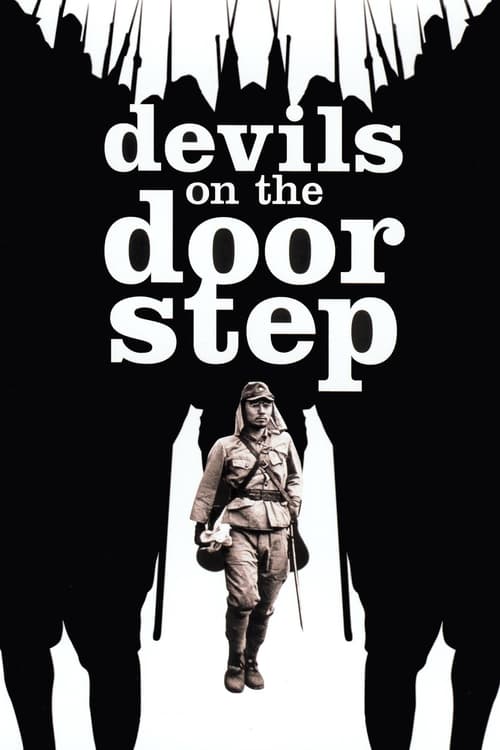
Devils on the Doorstep
2001 · Jiang Wen
For when you want a film to chew on for days — one that makes you laugh and then makes you ashamed you laughed. This is a challenge, not comfort viewing, and it's worth it.
What it's about
In a North China village during the last months of the Japanese occupation, a peasant named Ma Dasan is forced one night by an unseen figure to hide two prisoners — a fanatical Japanese soldier and his jittery Chinese interpreter — until they're collected. Nobody comes back for them, and the villagers are left holding a problem that could get them all killed, arguing endlessly about what to do with it.
The experience
It plays as riotous farce for long stretches — overlapping arguments, botched schemes, absurd translations — while dread builds steadily underneath. The comedy and the horror aren't separate registers; each makes the other land harder, and the film ultimately hits with real force.
Performances
Jiang Wen directs himself as Ma Dasan and gives a tremendous physical performance — a decent, indecisive man being ground down by an impossible situation, funny and heartbreaking in the same breath.
The craft
Shot in stark black-and-white with restless handheld energy, it treats occupation not as a war-movie spectacle but as a chamber farce about ordinary people and impossible choices. The dialogue scenes — village councils, mistranslated interrogations — are structured like comedy routines that keep curdling.
Why it matters
It won the Grand Prix at Cannes and was then banned in mainland China, effectively sidelining Jiang Wen as a director for years — a scandal that only cemented its reputation as one of the bravest Chinese films about the war.
Snapshot
Devils on the Doorstep (鬼子来了, Guǐzi lái le, literally "The Devils Are Coming") is Jiang Wen's second feature as director, a ferocious black-and-white tragicomedy set in a North China village during the final months of the Japanese occupation in 1945. Adapted from You Fengwei's novel Survival, it follows Ma Dasan, a peasant who is coerced one night by an unseen figure into holding two captives — a captured Japanese soldier and his Chinese interpreter — until they can be collected. What begins as a farce of rural indecision curdles, over a New Year's cycle, into a study of complicity, cowardice, and slaughter. The film premiered at the 2000 Cannes Film Festival, where it won the Grand Prix, the festival's second prize. It was also, notoriously, banned in mainland China and effectively cost Jiang Wen several years of his directing career. It stands today as one of the most formally aggressive and politically uncompromising Chinese films of its era — a war picture that refuses every consolation of the national epic.
Industry & production
The film emerged from the still-fluid production landscape of late-1990s Chinese cinema, when established studios coexisted with newly assertive independent producers and directors were beginning to court international festivals directly. Jiang Wen, already a major star as an actor (Red Sorghum, Hibiscus Town) and celebrated for his 1994 directorial debut In the Heat of the Sun, mounted the project with the clout of a bankable name and the ambitions of an auteur. The screenplay was developed from You Fengwei's fiction, with You among the credited writers alongside Jiang Wen and collaborators.
The production's defining crisis, however, was not financial but political. Chinese films at the time required the approval of the State Administration of Radio, Film and Television before being exhibited abroad. Devils on the Doorstep was submitted to and screened at Cannes without that authorization. The film bureau responded by banning the film domestically and reprimanding Jiang Wen; he was subsequently barred from directing for a period widely reported as several years, not returning to the director's chair until The Sun Also Rises (2007). The stated objections centered on the film's portrayal of the Chinese villagers — deemed insufficiently heroic, even craven — and its treatment of the Japanese, which authorities read as failing the didactic requirements of a patriotic war narrative. The ban means the film has circulated internationally and among cinephiles far more than it has been officially seen at home, a fact that has shaped its reputation as a suppressed masterwork.
Technology
Devils on the Doorstep was shot on 35mm film in black and white, a choice with both aesthetic and rhetorical weight in a period when color was the default. The monochrome photography evokes the newsreel and archival textures associated with the war it depicts, lending the fiction a documentary gravity while also allowing Jiang Wen to reserve color for a single, devastating rupture: the film's final sequence, in which the image bursts into red at the moment of decapitation. This shift from black-and-white to color is the picture's most conspicuous technological gesture, using the very grammar of the film stock as a dramatic and moral punctuation mark. Beyond this, the production relied on conventional celluloid technique of its moment; it is not a film that foregrounds novel apparatus so much as one that exploits the expressive properties of black-and-white cinematography with unusual deliberateness.
Technique
Cinematography
The photography is the film's most immediately arresting quality. Shot in high-contrast black and white, it favors a restless, largely handheld camera that crowds into the villagers' faces, canting and swooping through cramped interiors and the mud-lanes of the hamlet. The cinematography is credited to Gu Changwei, one of the leading Chinese cinematographers of the era (known for Red Sorghum and Farewell My Concubine), and the imagery bears the marks of a master working against his own reputation for lyricism: here the compositions are jostling, close, and deliberately unbeautiful, pressing the viewer into the physical and moral congestion of the community. Faces are shot in tight, often grotesque proximity; group scenes become churning masses of bodies. The eventual eruption of color at the climax lands with such force precisely because the preceding two hours have so rigorously withheld it.
Editing
The film's rhythm is propulsive and comic in its first movements, cut to sustain the accelerating panic of villagers who cannot decide what to do with their captives, then slackening and darkening as the narrative turns toward atrocity. The editing sustains long comic set-pieces — interrogations, negotiations, a botched execution — through overlapping dialogue and quick reactive cutting among the crowd, before the final act adopts a starker, more merciless tempo. Precise below-the-line editing attribution is not something I can confirm from memory, and I will not invent a name; what is clear on screen is a cutting strategy that treats farce and horror as points on a single continuum rather than as separated registers.
Mise-en-scène / staging
Staging is the film's dramaturgical engine. Jiang Wen composes the village as a claustrophobic theater of collective indecision: council meetings crammed into low-ceilinged rooms, the two prisoners bound and stashed in a sack or a cellar, the whole community perpetually assembling to deliberate and failing to act. The captured Japanese soldier, Hanaya, and the interpreter, Dong, are kept literally at the threshold of the peasant home — the "doorstep" of the title — a spatial figure for the film's central problem of what a community will admit, harbor, or expel. The staging repeatedly emphasizes crowds, thresholds, and the mechanics of hiding, so that geography itself dramatizes complicity.
Sound
Sound is used pointedly, especially in the friction between languages: the comedy of mistranslation between the Japanese captive and his interpreter, who deliberately softens the soldier's curses into pleasantries, is one of the film's richest veins and depends entirely on the audience hearing what the villagers cannot understand. The soundtrack also mobilizes the martial music of the occupier — Japanese military songs and marches — as an ironic counterpoint, and the film's aural world moves from the boisterous din of the village to the mechanized order of the Japanese garrison. I am not able to confirm the composer credit with certainty and will not attribute one; the salient point is the score's ironic, often militaristic register rather than any single authorial signature.
Performance
Performance is broad, physical, and calibrated to the film's tonal risk. Jiang Wen himself plays Ma Dasan, the hapless peasant whose ordinary decency and cowardice make him the film's tragic center, and his performance moves from bumbling farce to a final, terrible clarity. The Japanese soldier Hanaya is played by Kagawa Teruyuki, whose escalating derangement — from terrified prisoner demanding death to raging nationalist — anchors the film's darkest turns. The ensemble of villagers is played in a deliberately grotesque, near-operatic key, their squabbling and posturing pitched to expose collective self-deception. The interpreter, whose survival depends on lying to both sides, is one of the era's great studies in comic desperation.
Narrative & dramatic mode
The film's dramatic mode is tragic farce: it begins as a comedy of rural procrastination and ends as a horror. Its structure is organized around a deferred obligation — hold the prisoners "until New Year" — that the villagers can neither fulfill nor escape, and the plot advances through a series of failed resolutions: interrogations that yield nothing, a hired executioner who cannot kill, a bargain with the Japanese garrison that appears to promise deliverance and instead delivers massacre. The mode is fundamentally ironic; the audience, positioned to understand the mistranslations and misjudgments the characters cannot, watches an ordinary community reason its way step by step into catastrophe. The famous final movement — the surrender of Japan, the arrival of Nationalist forces, and Ma Dasan's own execution — inverts every expectation of vindication, using the very moment of national liberation as the occasion for the protagonist's death.
Genre & cycle
Nominally a war film and a period drama, Devils on the Doorstep is best understood as an anti-war film that systematically dismantles the conventions of the Chinese war-resistance genre. Mainland cinema had long cultivated the "anti-Japanese" war narrative as a vehicle for heroism and national unity; Jiang Wen's picture belongs to that cycle only to subvert it, replacing partisans and martyrs with frightened, self-serving villagers and denying the audience the catharsis of righteous victory. In its fusion of slapstick, grotesquerie, and atrocity it also participates in a broader international tradition of tragicomic war cinema that treats absurdity as the truest register of wartime experience. Within Chinese cinema specifically, it is a landmark instance of a filmmaker using genre against itself.
Authorship & method
The film is unmistakably an auteur work, bearing Jiang Wen's signature appetite for tonal excess, historical provocation, and performative energy. As director, co-writer, and star, he shaped the project at every level, and its refusal of official pieties is continuous with the willful, ironic sensibility of his debut In the Heat of the Sun. His method here is confrontational: he stages history as a chaos of ordinary human failing rather than a pageant of heroes, and he trusts black-and-white photography and a barreling handheld camera to make that chaos visceral. Among his key collaborators, cinematographer Gu Changwei is the most consequential creative partner, translating Jiang Wen's vision into images of deliberate ugliness and force. The screenplay's grounding in You Fengwei's novel Survival supplies the narrative armature, while the ensemble cast — Jiang Wen, Kagawa Teruyuki, and the crowd of village players — realizes the film's theatrical, near-choral conception of community. Where individual below-the-line credits (editor, composer) are concerned, I would rather flag the limits of what I can verify than assign names I cannot confirm.
Movement / national cinema
Devils on the Doorstep occupies a distinctive place in Chinese cinema, adjacent to but not neatly inside the familiar taxonomies. Jiang Wen belongs generationally to the cohort that followed the internationally celebrated Fifth Generation (Zhang Yimou, Chen Kaige) and overlapped with the emergent Sixth Generation of urban independents, yet his work fits neither camp cleanly. The film's use of a Fifth Generation cinematographer, its rural historical setting, and its monochrome grandeur gesture toward the earlier movement's concerns, even as its raucous irony and political defiance set it apart. Its fate — celebrated at Cannes, banned at home — also makes it a paradigmatic case of the tension between the international festival circuit and domestic state control that defined Chinese art cinema at the turn of the millennium. As a work of national cinema, it is inseparable from the question of what stories the Chinese state would and would not permit about the nation's own wartime conduct.
Era / period
The film is set in 1945, in the closing months of the Second Sino-Japanese War and the Japanese occupation, in a village in the North China countryside. This historical specificity matters: by locating its action at the very hinge between occupation and liberation, the film can stage the collapse of the Japanese empire and the arrival of Chinese Nationalist authority as consecutive shocks, and can make its protagonist's death coincide with the moment of national deliverance. Produced and released at the turn of the twenty-first century, the film also speaks to its own era — a moment of intense national self-narration in China — by insisting on the messiness and moral ambiguity that official memory tended to smooth away.
Themes
At its core the film is about complicity and the ordinary mechanics of survival under occupation. Its villagers are neither heroes nor villains but people trying to stay alive, and it is precisely their reasonable, self-protective calculations that lead to horror — a vision of atrocity as the sum of small evasions rather than the work of monsters. Language and (mis)translation form a second major theme: the interpreter's deliberate mistranslations, comic at first, become an emblem of how meaning is manipulated between enemies and how understanding fails. The film interrogates nationalism and the reliability of collective memory, refusing the redemptive arc that patriotic narrative demands. And it dwells on cowardice, hospitality, and the fatal ambiguity of the "guest" who is also a captive — the devil on the doorstep whom the household can neither keep nor kill. The final turn to color and the image of the severed head crystallize the film's insistence that liberation and slaughter can arrive in the same instant.
Reception, canon & influence
Internationally, the film was received as a major achievement, its Grand Prix at Cannes 2000 confirming Jiang Wen's stature as a director of the first rank and drawing sustained critical attention to its audacity of tone and its political nerve. Domestically, its banning ensured that its reception in China was clandestine and contested, and the episode became a touchstone in discussions of censorship and the Chinese film bureaucracy. Over time the film has entered the canon of essential post-1990 Chinese cinema and is frequently cited among the strongest anti-war films of its generation.
Looking backward, the film draws on the tradition of tragicomic and absurdist war cinema, on the visual heritage of the Fifth Generation (channeled through Gu Changwei's cinematography), and directly on You Fengwei's source novel; its monochrome, quasi-documentary texture also invokes the archival imagery of the war itself. Looking forward, its influence is felt less through direct imitation than through the example it set: a demonstration that a Chinese filmmaker could treat the sacred subject of the anti-Japanese war with irony, ambiguity, and formal violence. For Jiang Wen personally it marked a turning point, its aftermath forcing a hiatus that reshaped his career before his return with The Sun Also Rises. Its most durable legacy is as a permission-giving work — proof that the war-resistance genre could be turned inside out — and as a byword for the collision between artistic ambition and state control in Chinese cinema.
Reception
Banned in China on release — Jiang Wen took it to Cannes without censor approval, and it has never had an official Chinese release — yet it's since become one of the most revered Chinese films ever, sitting near the top of Douban's all-time rankings entirely on the strength of bootlegs and word of mouth.
How Devils on the Doorstep was received, from release to now →
How to watch Devils on the Doorstep: what to notice on a first viewing
- Watch how close and unsteady the camera crowds into villagers' faces. Gu Changwei shoots in high-contrast black and white with a restless handheld camera that cants and swoops through cramped rooms and muddy lanes. The camera puts you inside the village's physical crowding, not watching it from a comfortable distance.
- Watch where the two prisoners are kept relative to the doorway. They are held literally at the threshold of the peasant home, a spatial figure for what this community can admit, harbor, or expel. The staging keeps asking a question the villagers themselves can't answer: are these men inside or outside?
- Listen for what the interpreter actually says versus what's said to him. The interpreter deliberately softens the Japanese soldier's curses into pleasantries, and the film lets you hear the gap the villagers can't. You understand more than anyone inside the story does, which is where the comedy and the dread both come from.
- Notice the deadline the villagers keep failing to meet. Everything is organized around holding the captives 'until New Year,' an obligation the village can neither fulfill nor escape through interrogation after failed interrogation. The deferred deadline is what keeps turning indecision into its own kind of trap.
- Watch the villagers' council meetings crammed into low-ceilinged rooms. The ensemble plays these scenes in a deliberately grotesque, near-operatic key, squabbling and posturing that exposes collective self-deception. You are watching a community talk itself in circles instead of ever actually deciding anything.
The whole guide to watching Devils on the Doorstep, with the keys for a rewatch →
Influences: the films it descends from and the films it influenced
- In the Heat of the Sun (1994) — Jiang's own debut established the desaturation-to-monochrome coda as a device of ironic historical distance, which this film inverts into its climactic black-and-white-to-color rupture.
- Red Sorghum (1987) — Shares cinematographer Gu Changwei, whose physically aggressive, earth-level camera and expressionist contrast are the direct method-debt behind this film's images of deliberate ugliness.
- Farewell My Concubine (1993) — Gu Changwei's operatic staging of bodies-in-crowds here supplies the choreographic template for Jiang Wen's threshold-and-throng compositions.
- Come and See (1985) — The barreling handheld camera locked to a subjective face as ordinary village life escalates into occupation atrocity is the immersive war-horror grammar this film adopts.
- La Grande Illusion (1937) — Renoir built captor/captive drama on the friction of untranslated languages; this film industrializes that into mistranslation as the engine of both comedy and death.
- To Be or Not to Be (1942) — Pioneers occupation-as-farce timing, where comic tension is generated by characters misreading and impersonating the enemy across a language and power gap.
- Dr. Strangelove (1964) — Models the ironic deployment of martial/patriotic music against catastrophe and the controlled escalation of farce into apocalyptic horror.
- Rashomon (1950) — The high-contrast black-and-white and grotesquely theatrical ensemble performing moral ambiguity, plus the Japanese performance idiom, feed the film's near-choral village players and Kagawa Teruyuki.
- The Battle of Algiers (1966) — Supplies the newsreel/archival monochrome grain that lets staged occupation read as recovered documentary footage.
- MASH (1970) — Overlapping-cacophony ensemble sound and gallows farce as the structuring anti-war device prefigure this film's tragic-farce tonal architecture.
- To Live (1994) — Applies To Live's bleak irony-of-survival — the peasant who endures history only to be undone by it — to wartime village life, sustaining the same tragicomic tonal control.
- The Sun Also Rises (2007) — Jiang's post-hiatus return extends the barreling tempo and tonal-excess auteur method, now inverting the monochrome scheme into full chromatic saturation.
- Let the Bullets Fly (2010) — Weaponizes the farce-to-violence editing tempo and grotesque-operatic ensemble energy into a fully realized signature style.
- City of Life and Death (2009) — Adopts the high-contrast black-and-white, quasi-documentary handheld texture and a humanized Japanese-soldier POV on occupation atrocity.
- Underground (1995) — A contemporaneous carnivalesque of grotesque ensemble and ironic brass-band scoring driving farce that curdles into war tragedy.
- No Man's Land (2001) — Same-year war black-comedy where enemies trapped together and mutual incomprehension generate the identical absurdist farce-to-atrocity mechanism.
- Inglourious Basterds (2009) — Builds extended set-pieces where language competence and mistranslation generate suspense and comedy before erupting into violence, with the same farce-to-horror whiplash.
- Jojo Rabbit (2019) — Tunes occupation comedy so the farce collapses precisely at the moment violence becomes literal, echoing this film's editing pivot from comic tempo to horror.
Similar films
- Grand Illusion (1937) — influence & lineage
- In the Heat of the Sun (1994) — influence & lineage
- Dragon Inn (1967) — shared sensibility
- Funny Games (1997) — shared sensibility
- The Devil (1972) — shared sensibility
- A City of Sadness (1989) — shared sensibility
- The Quiet Family (1998) — shared sensibility
- Xiu Xiu: The Sent-Down Girl (1998) — shared sensibility