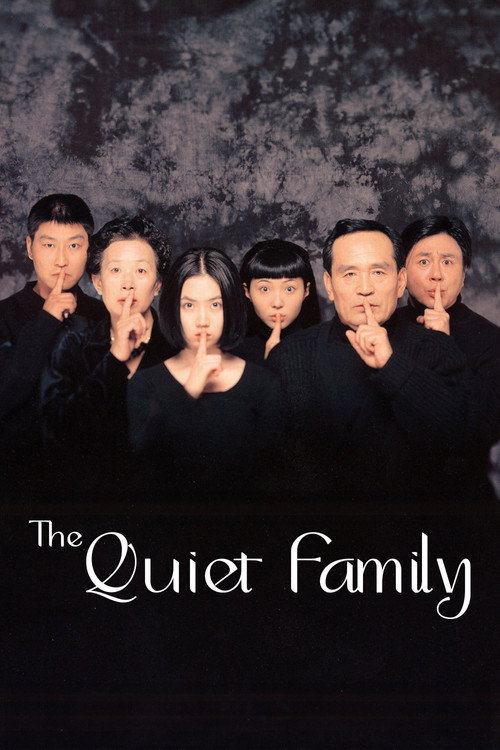
The Quiet Family
1998 · Kim Jee-woon
For when you want your horror with a grin — a midnight-movie pick for viewers who like their comedy mean and their corpses plentiful. Dark but sprightly; closer to a good time than an ordeal.
What it's about
The Kang family sinks its savings into a remote mountain lodge on a hiking trail, then watches in mounting panic as their guests start dying — beginning with a suicide they decide to quietly bury rather than scare off future business. Every cover-up breeds a bigger problem, and the family's scramble to protect their investment curdles into something much darker. It's a small-business nightmare played as farce.
The experience
Pitch-black and genuinely funny — a snowballing comedy of errors where each grave dug makes you laugh and wince at once. The tone walks a wire between slapstick and the macabre, and the escalation never lets up.
Performances
Song Kang-ho and Choi Min-sik share the screen here just before both became giants of Korean cinema, and watching their comic timing bounce off each other inside one doomed household is half the fun.
The craft
Kim Jee-woon's first feature already shows the genre-blender he'd become: tight farce plotting, sudden tonal swerves played with total control, and a confined lodge setting milked for every escalating absurdity. The comedy is built on structure — each cover-up logically producing the next catastrophe.
Why it matters
A founding film of the New Korean Cinema boom, it launched Kim Jee-woon, paired two future stars early, and proved a Korean genre film could be stylish, exportable, and strange — it was later famously reworked abroad.
Snapshot
The Quiet Family (Joyonghan gajok) is Kim Jee-woon's first feature. It is a pitch-black farce about the Kangs, a family who sink their savings into a mountain lodge beside a hiking trail and then watch their guests die, one after another, in ways that seem to threaten the business. The family hides each body to protect the lodge's reputation. Each cover-up makes things worse, until the family is no longer just hiding corpses but producing them. The film came out in the spring of 1998, as South Korea was going through the Asian financial crisis. It holds a key place in the early history of the "New Korean Cinema." It launched a director who became one of the leading genre stylists of his generation. It put Song Kang-ho and Choi Min-sik together on screen shortly before both became stars. It also showed that a Korean film could mix horror, crime and slapstick without settling on any one of them. Internationally it is best known as the source for Takashi Miike's musical remake The Happiness of the Katakuris (2001). It deserves attention in its own right as a deliberate study in tonal instability, and as an early sign of the genre-mixing that defined Korean commercial cinema in the decade that followed.
Industry & production
The film was made during a period of deep change in the South Korean film industry. In the mid-1990s the chaebol conglomerates (Samsung, Daewoo, Hyundai and others) had moved into film financing. The old censorship regime was being dismantled. A new generation of producers, many of them from film-culture and marketing backgrounds rather than the old Chungmuro studio system, began building projects around packaging, concept and target audiences. The Quiet Family was produced by Myung Film, the company run by Shim Jae-myung and Lee Eun. Myung Film was among the most important of these new producer-led outfits, and its 1990s slate (which also includes The Contact, 1997) is often cited as a model of the "planned film": a project developed around a clear concept and a marketable mix of genre and star.
Kim Jee-woon came to the project with no filmmaking résumé. His background was in theatre, as an actor and stage director, and he entered film by winning screenplay competitions in the mid-1990s. Accounts agree that this success is how he got the chance to direct, though sources differ on the details of which scripts won which prizes. Hiring a first-time director with no film-school or assistant-director path was itself typical of the period, when producers were actively looking for new voices.
The film opened in April 1998, months after the International Monetary Fund bailout of December 1997. Domestic investment was contracting and audiences were hard-pressed. Contemporary accounts describe the film as a modest commercial success and a clear critical one. Reliable admissions figures are not consistently reported in English-language sources, so this dossier gives none.
Technology
The Quiet Family is a conventionally made 35mm feature of its time. It was shot on location and on interior sets, with no notable technical innovation in camera, stock or sound recording. Its technical interest lies in how standard tools are used. A mobile camera, a mix of wide-angle distortion and tight framing, and controlled lighting of the lodge interiors are used to switch quickly between registers. The effects work, mostly practical body-and-blood work plus some weather and night-exterior staging, is modest by later standards. That suits a comedy in which the horror comes from the situation more than from spectacle. English-language documentation of specific equipment and laboratory choices is thin.
Technique
Cinematography
The visual style sets up the conflict the film is built on: a cheerful, rustic family-business surface over a growing nightmare. Daytime exteriors of the lodge and the mountain present the setting almost as a postcard, the dream of a quiet rural enterprise. Night scenes, especially the burials and attempts to dispose of bodies on the hillside, turn to darkness, rain and isolating light that belong to horror. The camera often frames the family as a group packed into one shot, so that their collective panic becomes a visual joke. It also uses low angles and close, slightly distorted framings to make the characters look grotesque. Kim's later reputation as a careful visual stylist (A Tale of Two Sisters, A Bittersweet Life) is anticipated here in a rougher form. Already there is a strong sense of the frame as a designed space, and a willingness to let the image comment ironically on the action.
Editing
The comedy depends on timing, and the cutting follows the logic of farce: setup, escalation, reversal. Scenes often end on a sharp cut to the consequence of a decision, such as a new body or a new witness, before the family can recover. The pace speeds up as the body count rises, so that the second half feels like the family running out of time. Cross-cutting between the lodge's "front of house" (guests, appearances) and its "back of house" (the hidden graves) builds the double structure that drives the suspense. Sources do not credit a specific editing approach to a named collaborator in detail, so this account stays with what is visible on screen.
Mise-en-scène / staging
The lodge is the film's central object. It is a small family business set up as a dream of stability, sitting on land that turns into a burial ground. Much of the humour comes from staging. Family members are packed into doorways, they argue over a body in a cramped room, and they show smiling faces to guests while a corpse lies just out of view. The surrounding mountain, which was meant to bring hikers and income, instead becomes what keeps swallowing the family's secrets. Kim stages violence and death with a deadpan flatness that lets the absurd and the horrible exist side by side. Props, bodies and the land itself become running gags whose repetition is part of the joke.
Sound
The soundtrack contributes much of the tonal irony. Music and ambient sound often work against what is on screen: a bright or jaunty cue over a grisly task, or rural quiet broken by panic. The title itself, The Quiet Family, is ironic, since the family is anything but quiet among themselves while depending entirely on keeping quiet in public. Storms, night sounds and the hush of the mountain take on horror-film functions in the burial sequences. English-language sources say little about the score or its composer, so this dossier does not attribute it.
Performance
The ensemble is the film's most widely praised asset and its most historically significant one. Park In-hwan and Na Moon-hee, both well-established veterans, play the parents. They give the family a recognizable base of everyday middle-aged anxiety that makes the escalating absurdity land. Song Kang-ho plays the son. He was then known from supporting turns, notably in Lee Chang-dong's Green Fish (1997) and Song Neung-han's No. 3 (1997), and here he refines the comic style that made him famous: twitchy, overconfident, physically loose, and capable of switching to sudden menace or pathos. Choi Min-sik plays the uncle, a sullen, hulking presence whose intensity points toward the much darker roles that later made him internationally known. Ko Ho-kyung plays the elder daughter. The performers play the material largely straight, reacting to absurd events with the urgency of people protecting their livelihood, and that is where the comedy comes from. The film was among the first to show Song and Choi as part of a new generation of actors able to move across genres. Both later worked with Kim again: Song in The Foul King (2000) and The Good, the Bad, the Weird (2008), Choi in I Saw the Devil (2010).
Narrative & dramatic mode
The narrative follows the escalation logic of farce. An initial accident (a guest's suicide) leads to a cover-up, and each further cover-up adds more risk. The structure is episodic and cumulative. Each new guest or visitor brings a fresh crisis, and every crisis is "solved" by more concealment. The plot moves from bad luck (deaths the family did not cause) to complicity (deaths they help bring about), and this moral slide is the film's real dramatic curve. Its dramatic mode is black comedy in the strict sense: death and moral collapse are played for laughs, but the laughter is uneasy and recognizes the horror. The ending keeps the instability going rather than resolving it neatly. Accounts of its exact final beats differ in detail, and viewers are best served by the film itself rather than a paraphrase.
Genre & cycle
The film is a deliberate genre hybrid, and the label "horror comedy crime" is accurate. Its closest genre relatives are Western black comedies about inconvenient corpses and amateur criminals. These range from Hitchcock's The Trouble with Harry (1955) and the stage-and-screen tradition of Arsenic and Old Lace to more recent dark crime farces such as Danny Boyle's Shallow Grave (1994) and the work of the Coen brothers. These are better described as affinities than as documented sources. Kim has spoken generally about his love of genre cinema, but the record does not support claims that he was copying a specific model.
Within Korean cinema, the film belongs to the first wave of the late-1990s genre revival, in which young directors and new producers took up horror, thriller and comedy forms that the industry had long treated as low or exhausted. Whispering Corridors (1998) revived school horror the same year. Kang Je-gyu's Shiri (1999) changed the blockbuster model soon after. The Quiet Family is an early and distinctive example of the genre-mixing (bokhap jangeureu) that critics would later see as a hallmark of 2000s Korean commercial cinema.
Authorship & method
Kim Jee-woon wrote and directed the film, and it already shows several features of his later work. He treats genre as something to rework, and makes a different kind of genre film almost every time (sports comedy in The Foul King, family ghost story in A Tale of Two Sisters, noir in A Bittersweet Life, a "kimchi Western" in The Good, the Bad, the Weird, revenge thriller in I Saw the Devil). He has a strong interest in visual design and set-piece construction. He is drawn to characters whose ordinary lives are overturned by violence. His theatre background is visible in the ensemble blocking and the stage-farce rhythm of the lodge scenes.
Producers Shim Jae-myung and Lee Eun of Myung Film deserve authorial credit for the project's concept-driven development and its casting gamble on actors not yet established as leads. English-language sources do not reliably document the other key below-the-line collaborators (cinematographer, editor, composer) in enough detail to support specific claims about their contributions, so this dossier does not name them. Kim's later long-running partnerships, for example with cinematographer Kim Ji-yong and other regular collaborators, mostly come from later in his career and should not be read back onto this debut.
Movement / national cinema
The Quiet Family is part of the New Korean Cinema that emerged between roughly 1996 and 2000. Directors in this movement included Hong Sang-soo, Lee Chang-dong, Hur Jin-ho, Kim Ki-duk, Park Chan-wook (whose breakthrough Joint Security Area came in 2000) and Bong Joon-ho (whose debut Barking Dogs Never Bite also came in 2000). The movement combined democratization-era freedom, new corporate and venture-capital money, a growing cinephile culture (film magazines such as Cine21 and Kino, the Busan International Film Festival from 1996), and the screen-quota system that protected domestic exhibition. Within this broad wave, Kim belongs to the strand of commercial-auteur genre filmmakers, alongside Park and Bong, rather than to the minimalist art-cinema strand represented by Hong. The Quiet Family is one of the earliest films in that strand. Its taste for grotesque comedy and violence happening to ordinary people anticipates much of what international audiences later came to associate with "Korean genre cinema."
Era / period
The film's release coincided with the IMF crisis, which brought mass layoffs, failed small businesses and a national mood of humiliation and insecurity. The film was conceived and largely made before the crisis peaked, so it should not be read as a direct allegory of it. Still, its premise lands hard in that context: a family that stakes everything on a small business, sees it threatened by forces outside its control, and gives up its morality to keep it afloat. The late 1990s were also the years when Korean cinema began to win back its domestic audience from Hollywood, a shift confirmed by Shiri's record-breaking run in 1999. The Quiet Family is part of the build-up to that turn. It showed that local genre films with young talent could find an audience.
Themes
- The family as business, the business as family. The Kangs' unity is economic. The lodge is their shared future, and protecting it requires a collective silence that both binds them together and corrupts them. The film satirizes familism, the idea of the family as a unit of loyalty and sacrifice that runs through Korean social life and melodrama.
- Appearance and concealment. The public face of the welcoming country lodge is kept up by an ever-growing hidden underside. The earth around the lodge is literally full of what the family cannot admit.
- Moral slide. The plot traces how decent, frightened people become accomplices, then perpetrators, through a series of small "reasonable" decisions. The comedy works because each step seems understandable.
- Precarity and aspiration. The dream of escaping to the countryside and running one's own business, and how fragile that dream is, gives the film a social edge under its farce.
- Death as an absurd intrusion. The guests' deaths are random, unearned and often ridiculous. The film treats mortality as something that wrecks plans instead of giving them meaning, and in this it is close to the tradition of black comedy.
Reception, canon & influence
Critical reception. Korean critics welcomed the film as an assured and original debut. Its ensemble acting and its confident handling of mixed tones were singled out for praise. It played at international festivals in the late 1990s and found a following among Western fans of Asian genre cinema, though it was never widely distributed abroad in theatres. In later critical writing, both Korean and international, it is usually treated as a key early text of New Korean Cinema and as an important beginning for both Kim and Song Kang-ho. English-language scholarship has generally covered it within broader surveys of the period rather than in standalone studies.
Influences on the film (backward). These include the Western tradition of corpse farce and black comedy (The Trouble with Harry, Arsenic and Old Lace, and 1990s examples such as Shallow Grave), the conventions of the isolated-house horror film, and the stage-farce timing that comes from Kim's theatre background. These are affinities seen by critics. The record does not document a detailed line of influence from any one source.
Legacy (forward). The film's most direct descendant is Takashi Miike's The Happiness of the Katakuris (2001). That remake turned the premise into a surreal musical with claymation sequences, and it introduced the story to a large international cult audience, often one unaware of the Korean original. Within Korean cinema, the film helped make genre hybridity and grotesque comedy acceptable approaches for commercial films. It also served as an early showcase for Song Kang-ho and Choi Min-sik, two actors who would anchor the international breakthrough of Korean cinema. Song went on to work with Park Chan-wook and Bong Joon-ho, culminating in Parasite (2019). Choi went on to Oldboy (2003). Looking back, the film's mix of family, class anxiety, concealment in a building's hidden spaces and tonal whiplash invites comparison with later Korean genre films, Parasite among them. Those comparisons are critical connections drawn after the fact, not documented lines of direct influence. For Kim Jee-woon himself, The Quiet Family set up the approach of his career: each film a new genre experiment, held together by visual control and a black sense of humour.
Influences: the films it descends from and the films it influenced
- Arsenic and Old Lace (1944) — Sets up the domestic corpse farce: a respectable household hides bodies in its own house, and the comedy comes from cutting between polite visitors in front and the concealment going on just out of sight.
- The Trouble with Harry (1955) — A body that keeps getting buried and dug up again, played in deadpan against sunny postcard landscapes; the model for the film's bright-day look and its farcical, repeated reburials.
- The Ladykillers (1955) — Ensemble black comedy confined to one cramped house, where each new attempt to cover up a killing produces the next body, the same chain-reaction structure the lodge plot runs on.
- The Housemaid (1960) — The Korean source for horror inside the family home: grotesque framing of a household's stairs and hidden spaces, used to satirise a striving family's ambition and its dependence on keeping up appearances.
- Psycho (1960) — The isolated roadside lodging as a death trap, with an innkeeper household cleaning up and sinking cars and bodies; Kim's mountain lodge works from this setup but plays it for farce.
- Motel Hell (1980) — A rural family business that turns its guests into its trade, staged as broad horror-comedy; an early version of the film's joke that hospitality can become homicide.
- Eating Raoul (1982) — A deadpan couple fall into killing and then keep doing it to save a small business, played with straight faces; the template for a moral slide into complicity driven by money trouble.
- Blood Simple (1984) — An escalating cover-up in which each character's misreading of who killed whom produces another body; the cut-to-consequence timing of a corpse that won't stay disposed of.
- Delicatessen (1991) — Grotesque wide-angle close framing and choreographed ensemble gags in a building that hides a family business's murders behind a shopfront; very close to Kim's visual approach.
- Shallow Grave (1994) — A 1990s debut in which a household's disposal of a body breaks down its loyalties, cut with sharp, stylised black-comic rhythm; critics name it directly as one of the film's affinities.
- The Foul King (2000) — Kim's next film reuses Song Kang-ho's hapless, straight-played everyman and the debut's habit of dropping an ordinary life into an unlikely genre, this time a sports comedy.
- Barking Dogs Never Bite (2000) — A Korean black comedy set in an apartment block's basements and hidden spaces, mixing slapstick, cruelty and class precarity in the same mixed-genre register the film helped make commercially acceptable.
- The Happiness of the Katakuris (2001) — The direct remake: it keeps the family guesthouse, the guests who keep dying and the chain of burials, and swaps the original's farce timing for musical numbers and claymation.
- Save the Green Planet! (2003) — Pushes the Korean genre mix further, jerking between sci-fi, torture horror and comedy, and depends on the tonal whiplash and grotesque comedy the film made bankable.
- A Tale of Two Sisters (2003) — Kim goes back to the family home as a site of horror, now played straight, with the same tight production design and a camera that treats the house's rooms and cupboards as places where things are hidden.
- The Host (2006) — A struggling family running a small snack business, led by Song Kang-ho, swings between slapstick and terror; a later form of the film's precarious family-business ensemble caught up in a genre disaster.
- Parasite (2019) — A family plot that hides people in a house's secret basement and runs a front-of-house versus back-of-house farce until it turns violent; a link critics have drawn after the fact, anchored by Song Kang-ho.
- Fargo (1996) — A near-contemporary cover-up farce built on deadpan performances and a straight-faced attitude to absurd violence, set against a blank landscape; a parallel black comedy of economic desperation.
Similar films
- A Tale of Two Sisters (2003) — influence & lineage · same viewing thread
- Parasite (2019) — influence & lineage · same viewing thread
- The Host (2006) — influence & lineage · same viewing thread
- Save the Green Planet! (2003) — influence & lineage · same viewing thread
- Whispering Corridors (1998) — same viewing thread
- Exhuma (2024) — same viewing thread
- Funny Games (1997) — same viewing thread
- No Other Choice (2025) — same viewing thread
All the films related to The Quiet Family →
Watch it with: curated runs of related films
- New Korean Cinema — Watch these in a run and you feel one national cinema flip between monster movie, revenge thriller, gothic horror, and slow-burn procedural without ever loosening its grip on class, history, and family.
- When Everyone Finally Snaps — A run of films where an ordinary scene — a birthday dinner, a small town, a quiet house, a man at the end of his patience — gets pushed past its breaking point until the whole social order detonates.