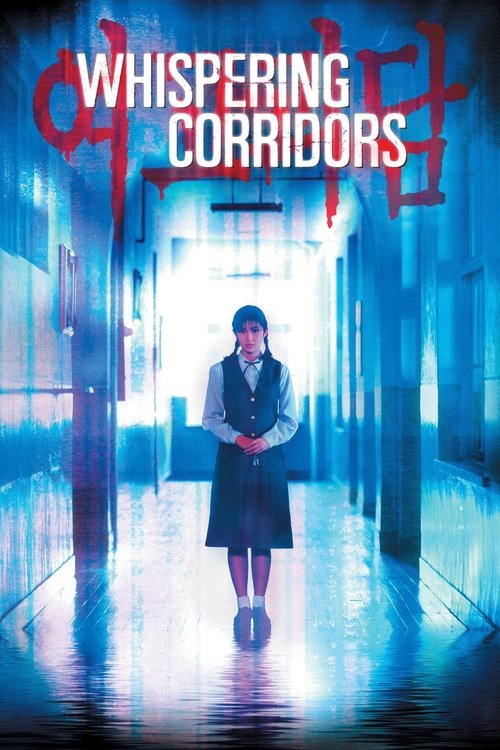
Whispering Corridors
1998 · Park Ki-hyung
For a quiet, moody night when you want a ghost story with a conscience — atmosphere and sadness over jump-scare bombardment. Gentle enough for horror newcomers, with enough bite to stay with you.
What it's about
A teacher is found hanged at an all-girls high school in Korea, and a former pupil returns to the same school as its new art teacher, drawn back toward a classmate who died there years before. As students pair off into uneasy friendships and the faculty's deaths begin, the question becomes what the school itself has been hiding. The real horror is the institution — the rankings, the beatings, the favoritism — and the ghost that lingers in its corridors.
The experience
More sorrowful than shrieking: a creeping, melancholy dread built from empty hallways at dusk and the everyday cruelty of teachers. The scares are patient, and what lingers is the ache underneath them — you come away angry at the school as much as frightened of it.
The craft
Park Ki-hyung turns a school building into the monster: long corridors, fluorescent light, and classroom ritual do most of the frightening, with the supernatural used sparingly. The restraint is the point — the film trusts silence and institutional detail, and its scares grow out of situations any former student will recognize.
Why it matters
It revived Korean horror at the end of the 1990s, launched one of the country's longest-running film franchises, and set the template of the schoolgirl ghost story as social critique that a generation of Asian horror followed.
Snapshot
Whispering Corridors (Korean title Yeogo goedam, roughly "Girls' High School Ghost Story") is the film that revived Korean horror at the end of the 1990s and started one of the longest-running franchises in Korean cinema. A teacher is found hanged at an all-girls high school. Soon after, a former pupil, Eun-young, returns to the school as its new art teacher. She is drawn back into a past she shared with Jin-ju, a classmate who died there years earlier. In the present, the student Ji-oh grows close to the withdrawn Jae-yi, and the school's teachers begin to die one by one. The answer to the mystery is less a single villain than the school itself. The film shows a system of class rankings, corporal punishment, favouritism and sexual intimidation that crushes the girls inside it, and the ghost is its residue.
The film came out a year after the 1997 financial crisis and only shortly after the courts ended state pre-censorship of film. It was a commercial hit, and it was also a public controversy, because it showed teachers as abusive and corrupt. Its importance in the record has two sides. It showed a domestic industry rebuilding its commercial genres that horror could sell. And it set the template of the "school horror" cycle: female adolescence, institutional cruelty and friendship turned into ghost story.
Industry & production
The film was produced by Cine 2000, the company of producer Lee Choon-yeon. Lee kept the Yeogo goedam name as an anthology brand, and later films in the series shared the girls'-school setting but not the characters or directors. This was a debut feature for Park Ki-hyung. Cine 2000's approach, which continued through the sequels, was to hand the series to first-time or early-career directors. The series became a known proving ground for new filmmakers.
The production context matters. Korean cinema in the mid-1990s was being reorganized. Large conglomerates (chaebol) had entered film financing earlier in the decade and then pulled back during the 1997 IMF crisis. Venture capital and newer production houses filled the space they left. The screen quota system was still protecting domestic exhibition. Horror had been commercially marginal in Korea since the decline of the low-budget ghost films of the 1960s–80s. A modestly budgeted genre film with a young, largely unknown cast was therefore a calculated risk. Its success helped convince investors that genre filmmaking aimed at a teenage and young-adult audience was viable. Reliable budget and admissions figures are not consistently documented in English-language sources, and this dossier does not give numbers. The record clearly establishes that the film was a significant box-office success for its year and for its genre.
The cast drew heavily on young newcomers. Lee Mi-yeon, already an established actress, played Eun-young. The students were played by actresses at or near the start of their careers: Choi Kang-hee, Kim Gyu-ri (credited at the time as Kim Min-sun), Park Jin-hee and Yoon Ji-hye. Several of them went on to substantial careers. As a result, the film is often remembered as a launching pad.
Technology
The film was shot on 35mm with conventional photochemical post-production. Digital intermediate grading and CGI-heavy effects had not yet reached ordinary Korean genre production. Its effects are almost entirely practical and editorial: makeup, lighting, blood effects and, above all, cutting. The restraint was partly economic, but it also shaped the film's style. With no budget for spectacle, the horror comes from architecture, framing and the timing of the cut. That choice became part of the school-horror cycle's identity.
Technique
Cinematography
The camera treats the school building as the film's main landscape. Long corridors are framed for depth, with receding lines of windows, doors and lockers, so that the far end of the frame becomes a place where something might appear. Interiors are often underlit, and the drab institutional palette of the classrooms gives way to deep shadow at night. The camera often watches students from a distance or through doorways and windows. This sets up the film's concern with surveillance: students are always observed, ranked and judged. Daylight scenes are flat and ordinary, and the night scenes turn the same spaces strange. The film depends on that contrast.
Editing
The film's most famous device is editorial. In the climactic sequence, the ghost moves down a corridor toward the camera in a series of jump cuts. Each cut brings her abruptly closer, and the continuous movement between cuts is removed. The figure seems to cover space without crossing it. This disrupts the ordinary film grammar of walking toward camera, and it is among the most cited and imitated images in Korean horror. Elsewhere, the editing is patient rather than frantic. The investigation unfolds through dialogue and flashback, and the film generally relies on accumulating dread rather than frequent shock cuts. Flashbacks to Eun-young's and Jin-ju's school years are cut into the present-day story. They gradually rebuild what happened and blur the line between past and present inside the building.
Mise-en-scène / staging
The setting is the argument. The school is staged as a closed institution, with uniforms, regulation hair, rows of identical desks, posted class rankings and the art room as one of the few spaces for self-expression. The art room and its paintings give Eun-young a way to connect to the past. The corridors, stairwells and classrooms are staged as places of confrontation between teachers and students. They are also where the supernatural intrudes. Blood is used sparingly but pointedly. A key piece of the mystery hinges on yearbook-style records showing the same student apparently enrolled across many years, which turns school paperwork into evidence of haunting. The repetition of uniforms and faces lets the ghost hide among the living students. That logic depends entirely on the sameness the institution imposes.
Sound
The soundtrack makes the most of the building's acoustics: footsteps in empty halls, echoing voices, school bells, and the silence of a school at night. In these scenes, quiet carries as much weight as the score. The English title points to whispers and to sound travelling through corridors. The record available in English sources is thin on the composer and on specific choices in the score, so this dossier does not attribute the music.
Performance
Performances are naturalistic, especially among the students. Their banter, rivalries and private loyalties are played with an ease that reads as convincing adolescence rather than genre caricature. Lee Mi-yeon's Eun-young is reserved and burdened, an adult who has returned to a place she never fully escaped. The teachers are pitched more broadly. They are known to the students by derisive nicknames (the dead teacher is "Old Fox", another teacher "Mad Dog"), and they are played as figures of petty tyranny, sometimes close to grotesque. This deliberate imbalance between sympathetic students and caricatured teachers was central to both the film's appeal and the controversy around it. Choi Kang-hee's performance as the isolated Jae-yi carries much of the film's ambiguity and its eventual revelation.
Narrative & dramatic mode
The film is built as a mystery in a horror frame. A death opens the story, and a returning outsider who is also an insider (the alumna now on staff) investigates. Two linked timelines unfold, the present at the school and the past friendship between Eun-young and Jin-ju, and they converge in a revelation about who among the students is not what she seems. The drama is as much melodrama as horror. It is about friendship, loneliness, and the cost of being singled out in a system built on competition. The ghost is not motiveless evil. It is a wronged girl, and her anger is aimed at the adults and the structures that failed her. The film largely invites sympathy for it. The ending gives a cathartic confrontation but no comfort. The school continues, and the implication is that its harms will too.
Genre & cycle
Whispering Corridors draws on an older Korean ghost-story mode centred on the wonhon, the vengeful spirit, often a wronged young woman, whose grievance must be addressed before she can rest. That figure ran through Korean horror of the 1960s and 70s. The film moves it from rural houses and period settings into the most familiar modern institution of Korean youth: the high school under examination pressure. It also sits alongside a wider East Asian interest in school ghost stories. Japan had its Gakkō no kaidan ("school ghost stories") films in the mid-1990s, drawn from playground folklore, and the Korean title follows the same "school + ghost story" formula. Hideo Nakata's Ringu came out in Japan in 1998, the same year. The two films are best understood as parallel developments in a regional horror revival, not as influence in either direction.
Within Korea, the film started the Yeogo goedam series: Memento Mori (1999, Kim Tae-yong and Min Kyu-dong), Wishing Stairs (2003, Yun Jae-yeon), Voice (2005, Choi Equan), A Blood Pledge (2009, Lee Jong-yong) and The Humming (2021, Lee Mi-young). Each new entry reworked the girls'-school setting with different emphases: same-sex desire in Memento Mori, competition and ambition in Wishing Stairs, sound and memory in Voice. Together they make one of the more coherent genre franchises in Korean cinema. The first film also helped start the broader K-horror boom of the early 2000s.
Authorship & method
Park Ki-hyung made his feature debut with this film, and it remains the work for which he is best known. He also worked on the screenplay. English-language sources credit the script variously, and a fully reliable full writing credit is not given here. His later features include Secret Tears (2000) and Acacia (2003). Both stay with supernatural or uncanny material inside domestic or intimate settings, which suggests a consistent interest in horror as a vehicle for social and familial unease rather than spectacle.
Detailed, well-sourced accounts of the film's other key collaborators (cinematographer, editor, composer) are thin in the English-language record, and this dossier does not name them rather than risk misattribution. The producer, Lee Choon-yeon of Cine 2000, is firmly established as a shaping force. His decision to treat the title as an anthology brand, refreshed by new directors, may have mattered as much to the film's legacy as any single creative choice.
Movement / national cinema
The film belongs to the early phase of what is often called New Korean Cinema or the Korean film renaissance of the late 1990s. That period saw a major domestic success in Shiri (1999), a revival of commercial genres, and the arrival of a generation of directors who had grown up on international genre cinema. Several conditions made Whispering Corridors possible. The Constitutional Court's 1996 ruling against pre-censorship weakened the state's power to suppress content. A rising young audience wanted locally made genre films. A production sector was willing to fund newcomers.
The controversy around its release is telling. Teachers' organizations and others in the education establishment objected to the film's depiction of teachers as violent, corrupt and predatory. That such a portrayal could reach theatres and become a hit marks how much the limits of permissible social criticism in popular Korean film had shifted. Genre gave the film cover. Harsh criticism of the education system arrived inside a ghost story, and that became a recurring strategy in Korean cinema.
Era / period
The late 1990s in South Korea brought the 1997 Asian financial crisis, the IMF bailout and severe economic anxiety, all within the larger arc of democratization since 1987. The education system was a pressure point: intensely competitive, organized around the college entrance exam, and widely experienced as punishing. The film's posted rankings, its top students driven toward despair, and its teachers who take bribes from parents and favour wealthier students all reflect that period's anxieties about meritocracy, fairness and the price of competition. In the cinema itself, this was the moment just before Korean genre films began reaching international audiences. Whispering Corridors arrived early enough to be counted as a forerunner rather than part of the wave it helped create.
Themes
- The institution as haunted house. The school, not a mansion or a graveyard, is the site of horror. Its routines, hierarchies and records are what produce the ghost and what hide her.
- Competition and ranking. The film keeps returning to grades and class standing, and to how ranking turns classmates into rivals and defines a student's worth.
- Adult authority and abuse. Corporal punishment, verbal humiliation, sexual harassment and corruption are shown as routine features of the teachers' power, not exceptions to it.
- Female friendship and its loss. The emotional centre is the bond between girls: Eun-young and Jin-ju in the past, Ji-oh and Jae-yi in the present. The film presents the failure or breaking of these bonds as a central wound.
- Invisibility and repetition. A student who can return year after year without being noticed is a pointed image of how the system sees its pupils: as interchangeable bodies in uniform.
- Memory and return. Eun-young's homecoming makes the school a place of unfinished business. The past is not over, and returning adults can carry its injuries as well as the young.
Reception, canon & influence
Critical reception. The film was a popular success, and its release drew public argument over its portrayal of teachers. Korean critics and later scholars have generally treated it as a landmark: the work that revived domestic horror and the first instalment of a significant franchise. Its social critique is often praised more than its craft as a mystery, and some commentators find the plotting uneven next to the strength of its atmosphere and central images. In English-language scholarship on Korean cinema and Asian horror, it is regularly discussed as a foundational text of the K-horror cycle and as an example of genre carrying social commentary. Specific critical quotations are not reproduced here.
Influences on the film (backward). The film draws on the Korean wonhon tradition of the vengeful female ghost. It also draws on the folklore of school ghost stories found across East Asia, with Japan's Gakkō no kaidan films as the nearest parallel. More broadly, it follows the international model of the institutional horror film, in which a closed community hides a secret. Its socially critical portrait of schooling also belongs to a Korean tradition of realist and critical films about education. Direct, documented statements from the director about specific influences are scarce in English sources, so connections beyond these broad traditions should be treated as interpretive.
Legacy (forward). The film's legacy is substantial and well documented:
- The franchise. It led directly to the Yeogo goedam series, which ran from Memento Mori (1999) to The Humming (2021). The series has been a showcase for new directors, and Memento Mori in particular is widely regarded as a high point of Korean genre filmmaking.
- The K-horror boom. It opened the market for the wave of Korean horror in the early 2000s, including Phone (2002) and A Tale of Two Sisters (2003), the period when Korean horror became internationally visible next to J-horror.
- The school-horror template. It set the conventions that later Korean school-horror films and television drew on: the girls'-school setting, the ghost as victim of institutional cruelty, the rankings board as an object of dread, and friendship as both refuge and wound.
- Casting legacy. Several of its young actresses, including Choi Kang-hee, Kim Gyu-ri and Park Jin-hee, went on to prominent careers. That added to the series' reputation as a starting point for new talent.
- The jump-cut ghost. The corridor sequence, in which the ghost advances in abrupt cuts, became one of the most recognizable images in Korean horror and has been widely echoed and referenced.
In the atlas of influence, Whispering Corridors sits at a junction. Older Korean ghost-story traditions and the regional school-folklore cycle feed into it. From it run a franchise, a national horror boom, and a lasting way of using genre to expose the pressures of Korean adolescence.
Influences: the films it descends from and the films it influenced
- The Housemaid (1960) — Kim's tightly bounded set, organised around a staircase, makes a single building into a pressure system of class and sexual menace; Park adopts this spatial method by treating the school's corridors and stairwells as the architecture of oppression.
- A Public Cemetery of Wol-ha (1967) — It sets the classic Korean wonhon structure, in which a wronged woman's spirit returns to expose the people and system that destroyed her, and Whispering Corridors moves that grievance plot into a modern school.
- Les Diaboliques (1955) — Clouzot's boarding school, with its staff conspiracy, empty after-hours halls and a body hidden in the institution, sets the model for the school as a closed community keeping a secret that the investigation must dig out.
- Suspiria (1977) — Its all-female academy, where the teaching staff are the hidden source of horror, sets up the institution-as-haunted-house staging and the grotesque, exaggerated faculty against vulnerable students.
- Picnic at Hanging Rock (1975) — Weir's uniformed girls'-school ensemble uses sameness of dress to blur identity and make disappearance uncanny, which Park turns into a mystery device: a dead girl can be concealed among identical students.
- Gakkō no Kaidan (1995) — It turned East Asian playground ghost lore into a commercial feature set inside an after-hours school building, the closest regional precedent for making schoolyard legend a film genre.
- Memento Mori (1999) — The first franchise sequel turns the found-evidence device (enrollment records become a shared diary) into its whole structure and expands the interwoven flashback timelines into an elliptical, nonlinear account of a love between two girls.
- Ju-on: The Grudge (2002) — Shimizu builds his set pieces on a ghost that appears in abrupt, discontinuous jumps through ordinary rooms, carrying the jump-cut ghost approach into the domestic J-horror cycle.
- Phone (2002) — One of the boom films this film's success opened the market for, it rebuilds a schoolgirl wonhon's backstory through investigation and flashbacks that steadily reveal hidden adult wrongdoing.
- A Tale of Two Sisters (2003) — It takes the K-horror boom's interwoven-timeline structure, in which a reveal reorders earlier scenes, to a new level of refinement, and uses long empty-house acoustics and deep framing through doorways to hold its dread.
- Wishing Stairs (2003) — The third Yeogo goedam film moves the rankings board to an arts-school ballet competition, keeping the original's plot engine: rivalry over one ranked slot kills a friendship and produces the ghost.
- Voice (2005) — The fourth instalment makes the original's empty-building acoustics its central idea, a ghost that exists only as a voice heard in the deserted school's echoing spaces.
- Death Bell (2008) — It literalises the exam-ranking theme as a horror mechanic, killing top-ranked students in a locked school during an exam-prep session, and takes the rankings board from Whispering Corridors as its object of dread.
- A Blood Pledge (2009) — The fifth franchise film rebuilds the original's template, a girl's death treated as suicide and a ghost exposing a friendship betrayal, through flashbacks interleaved with the present-day haunting.
- The Silenced (2015) — It carries over the girls'-school staging, with uniformed students who can't be told apart, cruel staff and a ranking system, and moves it to a 1938 colonial sanatorium-school, keeping the idea that the institution itself is the monster.
- The Humming (2021) — The sixth Yeogo goedam film keeps producer Lee Choon-yeon's anthology brand of a new director each time, returns to the school haunted by a buried student death, and uses an investigation of school records alongside past-timeline flashbacks.
- R-Point (2004) — Starts the modern Korean horror cycle with a dead girl hidden among the living roll call of a closed institution, the same uncounted extra body that R-Point moves into a military unit.
- Ring (1998) — In the same year it built its climax on a female ghost's unnatural, stuttering approach toward the camera, a parallel solution to Whispering Corridors' jump-cut corridor advance, and the two films together defined the halting-ghost grammar of Asian horror.
Similar films
- A Tale of Two Sisters (2003) — influence & lineage · same viewing thread
- Memento Mori (1999) — influence & lineage
- Ju-on: The Grudge (2002) — influence & lineage
- Ring (1998) — influence & lineage
- The Quiet Family (1998) — same viewing thread
- Exhuma (2024) — same viewing thread
- Memories of Murder (2003) — same viewing thread
- R-Point (2004) — same viewing thread
All the films related to Whispering Corridors →
Watch it with: curated runs of related films
- New Korean Cinema — Watch these in a run and you feel one national cinema flip between monster movie, revenge thriller, gothic horror, and slow-burn procedural without ever loosening its grip on class, history, and family.