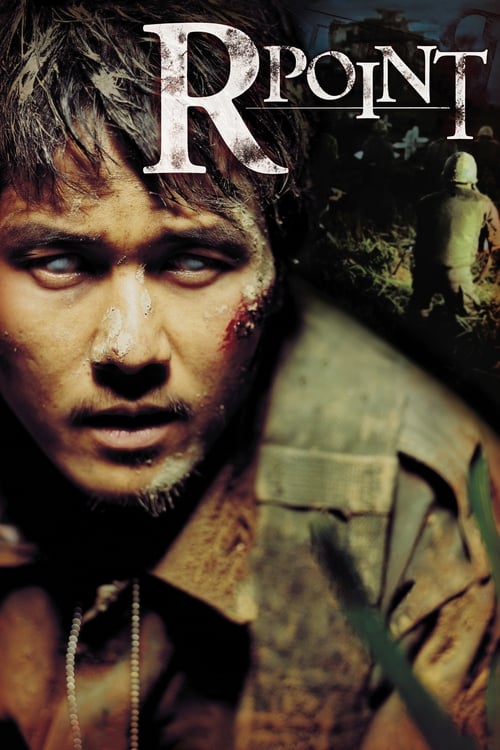
R-Point
2004 · Kong Su-chang
For when you want atmosphere and unease over gore — a foggy, headphones-on, lights-off watch for viewers who like their horror ambiguous and their war films haunted. More challenge than comfort; it asks you to stay oriented as the squad loses its grip.
What it's about
Vietnam, January 1972: a South Korean base picks up radio transmissions from a platoon that vanished six months earlier and was written off as dead. A nine-man squad is sent into the jungle to an area called Romeo Point to find out what happened, passing a stone marker that warns those with blood on their hands won't return. Out in the grass and the fog, the mission dissolves into questions — how many men are really in the squad, and whose voices are on the radio.
The experience
Humid, disorienting dread rather than jump scares — the jungle itself seems to close in, and the paranoia between the men becomes as frightening as anything supernatural. It's a slow unraveling that rewards attention and leaves a lingering chill.
The craft
Kong Su-chang shoots the jungle as a character — tall grass, rain, radio static — and builds fear from military procedure breaking down. The sound design does heavy lifting: disembodied transmissions and roll calls that don't add up are the film's scariest weapons, and it plays best loud, in the dark.
Why it matters
One of the few Korean films of its era to confront Korea's own role in the Vietnam War, it fused war movie and ghost story in a way that gave Korean horror a new setting and gave the genre one of its most quietly influential entries.
Snapshot
R-Point (알포인트) is a South Korean war-horror film written and directed by Kong Su-chang, his first feature as director. In January 1972 the South Korean field command at Nha Trang picks up radio calls from a platoon that disappeared six months earlier and has been presumed dead. Lieutenant Choi Tae-in (Kam Woo-sung) leads a nine-man squad into the jungle to an area called "Romeo Point" to find out what happened. Near the start they pass a stone marker whose inscription warns that those with blood on their hands will not return. From then on the mission turns into a slow ghost story about how many men are actually in the squad, who is still alive, and whose voices are coming over the radio.
The film matters for two reasons. It was one of the few Korean features of its time to face Korea's own role in the Vietnam War, and it moved the Korean horror cycle of the late 1990s and early 2000s out of the schoolgirls' corridors and haunted apartments where it usually lived. Instead of a haunted house it gives us a haunted war, and the national past that Korean cinema had mostly kept quiet about becomes the source of the haunting.
Industry & production
R-Point belongs to the commercial expansion of South Korean cinema after the late-1990s reforms. Large, vertically integrated companies were financing and distributing domestic features at scale, and genre films (thrillers, horror, period spectacle) were a big part of what they made. Horror had a reliable summer slot in the Korean release calendar, and R-Point was released in summer 2004 as a seasonal horror title. It was pitched as a high-concept mix of war film and ghost story.
The production is known for shooting on location in Cambodia, which stood in for 1970s South Vietnam. Shooting abroad in real tropical terrain was unusual and logistically difficult for a Korean genre film then, and it gives the film a physical texture of mud, rain, heat and overgrowth that studio work could not have matched. Detailed figures for the budget, the shooting schedule and the box office are not reliably documented in the English-language sources available to me, so this dossier gives none. The film is generally described as a solid domestic release rather than a blockbuster, and it found a lasting second audience abroad through festivals, home video and cult reputation.
Technology
The film was shot on 35mm film. Its technical character comes mostly from location work, not from digital effects. It came out when Korean productions were adopting digital intermediate grading and modest CGI, but R-Point keeps its supernatural effects deliberately minimal. Most of its scares come from staging, darkness, sound design and in-camera ambiguity, not from visible apparitions. The radio is the film's key piece of technology, both as a prop and as a dramatic device. The squad's field transmitter and its static-filled exchanges with base drive the plot, and the film treats the radio as a channel to the dead as much as a military tool. That choice fits a wider strand of Asian horror around 2000 that made communications media (videotape, telephones, mobile phones) the carriers of hauntings.
Technique
Cinematography
The images move between two registers. In daylight the film uses the language of the war film: long views of tall grass, paddies and ruined colonial buildings, with the squad strung out across open ground in loose patrol formation. At night and in fog the frame closes in, and torchlight, muzzle flashes and lanterns pick figures out of near-black. The palette leans toward desaturated greens and greys, which gives the jungle a washed-out, embalmed look rather than lush abundance. Fog matters a great deal. It flattens depth, so figures at the edge of the frame read as uncertain, and that suits a film whose central question is whether a given soldier is really there. Who exactly shot the film is not something I can confirm reliably, and it is left unattributed here.
Editing
The film is cut for slow build-up rather than shocks. Long stretches of patrol, waiting and argument run at an even, slightly sluggish pace, and that pace makes the occasional ruptures (a sudden figure, a burst of gunfire, a radio voice that should not exist) land harder. The film also works deliberately with gaps in continuity, such as head-counts that don't add up, a man who seems to have been present one moment and gone the next, or events that appear to repeat. The editing does not always explain these gaps. It lets the viewer's own count go wrong along with the squad's, so the cutting itself creates the uncertainty.
Mise-en-scène / staging
The central location is an abandoned French colonial plantation house standing in the jungle, which the squad takes over as its base. It is a strong choice. The building carries a further layer of history (French colonialism) underneath the American war and Korea's part in it, and it gives the film the haunted-house setting of classic horror inside a war-film landscape. Inside, the staging relies on corridors, doorways, stairs and dim rooms where figures can appear in the background, often unnoticed by the characters.
The stone marker and the backstory it implies, a site of earlier atrocity where the dead were buried and a shrine or temple built over them, places the location in a long history of violence. The squad has wandered into that history, not caused it. Several images stay with you: soldiers crossing open grassland under a low sky, a lone figure in the mist, and a photograph that seems to show more men than are actually there.
Sound
Sound is arguably the film's most important tool. The radio channel carries static, distorted voices and call signs that should not be possible. In the jungle, insects, rain and wind build a dense ambient bed, and the film often drops it out suddenly to signal danger. The supernatural threat is often heard before it is seen, or heard and never seen at all. The score is generally restrained and atmospheric, without the heavy stingers of more commercial horror, though the film does use some. I cannot reliably confirm the composer, so the credit is left open here.
Performance
Kam Woo-sung plays Lieutenant Choi as a tired, inward officer, already shaped by earlier service and a reluctant commander of a mission he does not believe in. The film's tension depends as much on ensemble friction as on the supernatural. Son Byung-ho plays the hardened sergeant Jin, a counterweight to Choi's authority, and the squad includes a soldier played by the young Lee Sun-kyun before he became a leading man. The cast plays the soldiers as distinct types: the cynic, the joker, the superstitious man, the frightened youngster. Their bickering and bravado give the film a grounded, barracks-like naturalism that the horror then wears away. The acting stays mostly in a realist mode, and the performers rarely signal fear theatrically. That restraint keeps the ghost-story elements believable.
Narrative & dramatic mode
Structurally the film is a mission narrative, with a briefing, a deployment, a series of objectives and a deadline for extraction. Over that sits a slowly widening supernatural mystery. The squad has a fixed number of days to search the area before they will be picked up, and the countdown provides the forward pressure. The dramatic mode moves from war-film procedure to paranoid ensemble horror and finally to something close to tragedy. Order breaks down, the men turn on one another, and the line between the missing platoon and the rescue squad blurs.
The film is deliberately elliptical and does not explain its mythology in full. Viewers and critics have often said the plot is hard to follow or reconstruct, and some take that as a flaw while others see it as the film's main strength. The thematic logic is clear even where the plot is not. The warning on the stone marker works as a moral law, the war itself breaks it, and so no one can come back whole.
Genre & cycle
R-Point belongs to several genre lines at once:
- The Korean horror cycle of the late 1990s and 2000s. This cycle began in its modern form with Whispering Corridors (1998) and reached a peak around 2003 with films such as A Tale of Two Sisters and Into the Mirror. Like many films in the cycle, R-Point uses vengeful ghosts and history the characters have repressed. Its military setting and all-male cast set it apart from a cycle often centred on young women.
- War horror. It belongs alongside films that place the supernatural on a battlefield or in a military unit. The British Deathwatch (2002), set in the First World War trenches, is a near-contemporary parallel, though whether R-Point drew on it directly is not established.
- The Vietnam War film. It inherits the jungle-patrol iconography of the American Vietnam cycle (Apocalypse Now, Platoon), especially the descent into a landscape that gets the better of the men sent into it.
- The "lost patrol" story. This is a long-standing structure in which a small unit is isolated and picked off one by one.
Authorship & method
Kong Su-chang came to directing from screenwriting. He is credited among the writers of Tell Me Something (1999), Chang Youn-hyun's stylish serial-killer thriller, and R-Point was his first feature as director, from his own script. His later directing work confirms an interest in the military as an enclosed, pressurised space. His second feature, GP506 (2008), is set at a guard post in the Korean Demilitarized Zone and again mixes a military mission and investigation with dread and contagion. Together the two films sketch a small but coherent body of work centred on Korean soldiers in isolated postings, where institutional procedure meets something it cannot handle.
From the films themselves, his method seems to favour slow build-up over shock, ensemble ambiguity over a single protagonist's point of view, and history and moral transgression as the source of horror. The key collaborators are not documented reliably enough in my sources for me to name them with confidence:
- cinematographer
- composer
- editor
- producers and any co-writers
Readers should check these against the Korean Film Archive or KMDb records.
Movement / national cinema
The film is part of the "Korean New Wave" or Hallyu-era expansion of South Korean cinema. In that period domestic films regularly competed with Hollywood at the home box office, and genre filmmaking was one of the main vehicles for addressing national history. Its particular contribution is the subject. South Korea sent roughly 300,000 troops to Vietnam between 1964 and 1973, and the war was a major national experience that brought economic and diplomatic benefits. The atrocities Korean units were accused of committing against Vietnamese civilians were barely discussed in Korean public life until journalism and activism around the turn of the 2000s pushed the issue into view.
Korean cinema had touched the war before. The most notable earlier example is Chung Ji-young's White Badge (1992), which deals with veterans' trauma. But few films had placed the audience in the war itself. R-Point does so through genre. Its ghosts are not named victims of any particular documented incident, and the film keeps its history at an allegorical distance. Still, its central idea, that blood shed in Vietnam marks the men who shed it, puts the film inside the period's wider national reckoning. It was followed by other films that revisited Korea's Vietnam involvement, such as Lee Joon-ik's Sunny (2008).
Era / period
The film was made in 2004, at the height of what is often called the golden age of contemporary Korean genre cinema. That was the period of Memories of Murder (2003), Oldboy (2003), A Tale of Two Sisters (2003) and Taegukgi (2004). In those years Korean filmmakers routinely reworked national trauma (the Korean War, the dictatorship years, rapid industrialisation) through popular genres. R-Point's story time, early 1972, falls in the late phase of Korea's involvement in Vietnam, when withdrawal was approaching. The film's sense of a war already spent and a mission without purpose fits that historical moment. Korea's Vietnam force had its field headquarters at Nha Trang, which is where the film's opening is set.
Themes
- Guilt and moral contamination. The stone marker's inscription is the film's thesis. Killing marks a man, and the war's violence comes back on the people who carried it out. Read nationally, this becomes an allegory of what Korea's participation in an overseas war cost it in conscience.
- History in layers. The site holds sediment from earlier violence: an older massacre, the French colonial house, the American war, the Korean presence. The haunting is the accumulated weight of all these histories, not a single event.
- Identity, doubling and the unstable head-count. The missing platoon and the rescue squad mirror each other. Repeated counts that don't add up and figures who should not be in the frame make a horror of the military's basic accounting of who is present, alive or dead.
- Communication with the dead. The radio connects the living and the dead, base and field, and in doing so questions the military's faith in command, control and information.
- The collapse of institutional order. Rank, procedure and comradeship break down under fear, suspicion and violence inside the unit. It anticipates the concerns of GP506.
- The soldier as both victim and perpetrator. The men are sympathetic, ordinary conscripts, but the film does not let them off. They are pawns of the state and agents of its violence at the same time.
Reception, canon & influence
Critical reception. At home and abroad, the film was generally received as an unusually ambitious and atmospheric genre piece. Critics praised its locations, its sustained mood and its daring choice of subject. Common criticisms were that the plot is confusing, the mythology underexplained, and the ending opaque. Since then its reputation has grown among horror fans and scholars of Korean cinema. It is often named as one of the stronger and more distinctive Korean horror films of its decade, and often described as underseen. I cannot reliably confirm specific festival awards or box-office rankings, so none are claimed here.
Influences on the film (backward).
- The American Vietnam War film supplies its jungle iconography and its sense of a fruitless mission into a hostile, almost metaphysical landscape. Apocalypse Now is the obvious ancestor.
- The East Asian ghost cycle around 2000 (Japanese J-horror and its Korean counterparts) supplies the vengeful dead, the haunted communication device and the preference for implication over display.
- The lost-patrol and ensemble-paranoia structure has precedents ranging from war adventure to The Thing (1982)-style mutual suspicion. Any specific debts here are inferred from the structure, not documented.
- Within Korean cinema, White Badge had already opened the subject of Korea's Vietnam experience, though in a realist register.
Legacy (forward).
- R-Point showed that Korean horror could take on national, political history, not only domestic or school-based trauma, and that the military could serve as a horror setting.
- Kong Su-chang developed that template directly in GP506 (2008).
- The film kept discussion of Korea's role in Vietnam alive in popular culture, alongside later works such as Sunny (2008).
- In the wider war-horror subgenre it is regularly cited as a key non-Western example, set beside Deathwatch and similar films.
- Its international cult following has grown steadily, carried by home-video releases and retrospective writing on Korean genre cinema.
- Later Korean films that mix military settings with genre horror and use them to examine institutional violence are part of the same broad lineage. R-Point was one of the first and boldest of them, though direct lines of influence beyond Kong's own work are not well documented.
Influences: the films it descends from and the films it influenced
- The Lost Patrol (1934) — Sets the structure in which an isolated squad is picked off one by one by an enemy the camera almost never shows, so the empty landscape itself becomes the threat.
- Apocalypse Now (1979) — A deniable mission sent upriver to recover men already presumed lost, with a radio chain of command that fades as the jungle gets more unreal, is the template for R-Point's search for a missing platoon.
- Southern Comfort (1981) — A Vietnam allegory moved to a swamp: a lost patrol is punished by a landscape and people it wronged, and the shot design keeps the hunters out of sight among wet greenery.
- The Thing (1982) — Locks an isolated military-style unit into suspicion over which member is no longer human, the same uncertainty R-Point builds into its unstable head count.
- Predator (1987) — Turns the jungle combat-patrol film into a horror structure, in which an elite squad's tactics and radio procedure fail against a presence that hides in the foliage itself.
- Platoon (1986) — Shot on Southeast Asian jungle locations with an ensemble of underplayed, interchangeable grunts and an atrocity at a village at its moral centre, the realist grounding that R-Point's restrained ensemble acting inherits.
- Jacob's Ladder (1990) — A Vietnam horror film built on elliptical cuts that blur whether the soldiers are alive or dead, with a reveal that recasts the whole narrative as an afterlife.
- White Badge (1992) — The first major Korean film about Korea's own Vietnam deployment. It frames the war as unspoken blood guilt carried by Korean soldiers, which R-Point turns into a literal haunting.
- Whispering Corridors (1998) — Starts the modern Korean horror cycle with a dead girl hidden among the living roll call of a closed institution, the same uncounted extra body that R-Point moves into a military unit.
- Ringu (1998) — Makes an everyday communication technology the channel through which the dead reach the living, the J-horror move R-Point applies to its field radio.
- Tell Me Something (1999) — Kong co-wrote this film. Its dense, under-explained plotting and deliberately unresolved ending are the screenwriting habits he carried into R-Point's opaque mythology.
- GP506 (2008) — Kong's direct follow-up moves the R-Point template to a DMZ guard post: an investigating unit, missing men, a roster that keeps changing, and institutional procedure breaking down under contagion.
- Ghosts of War (2020) — Repeats the R-Point structure: a WWII squad on a mission occupies a haunted building tied to an atrocity, and a final reveal changes what the soldiers' status has been all along.
- Pulse (2001) — Builds dread through ghosts placed quietly in the background of wide, desaturated frames, ambient sound that suddenly drops out, and transmissions from the dead, the same staging and sound grammar R-Point uses in the fog.
- The Bunker (2001) — A trapped squad of soldiers is haunted on the site of a buried massacre, using the war-horror device of a place that remembers what the soldiers' side did there.
- Deathwatch (2002) — Its lost squad, stranded in a WWI trench, gets radio contact that cannot be trusted and turns out to be already dead, the closest Western parallel to R-Point's twist about the platoon's status.
- Below (2002) — A sealed military crew is haunted by a covered-up killing, and the vessel's listening equipment (sonar and phonograph) carries the ghost, much as R-Point's radio carries the dead platoon's calls.
- A Tale of Two Sisters (2003) — From the same Korean golden-age horror moment, it uses gaps in editing continuity and a cast member whose existence is in doubt, asking the viewer to recount who is really present.
Similar films
- Whispering Corridors (1998) — influence & lineage · same viewing thread
- A Tale of Two Sisters (2003) — influence & lineage · same viewing thread
- Platoon (1986) — influence & lineage
- Pulse (2001) — influence & lineage
- Apocalypse Now (1979) — influence & lineage · same viewing thread
- The Thing (1982) — influence & lineage · same viewing thread
- Tae Guk Gi: The Brotherhood of War (2004) — same viewing thread
- Joint Security Area (2000) — same viewing thread
All the films related to R-Point →
Watch it with: curated runs of related films
- New Korean Cinema — Watch these in a run and you feel one national cinema flip between monster movie, revenge thriller, gothic horror, and slow-burn procedural without ever loosening its grip on class, history, and family.
- Into the Heart of Darkness — A run of grueling journeys into hostile country — jungle, ice, desert, occupied forest — where the ordeal strips men down to something primal, hallucinatory, and often unrecoverable.