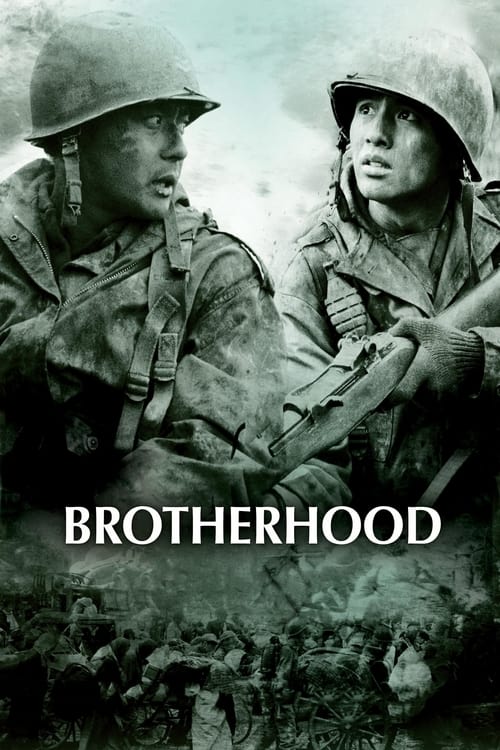
Tae Guk Gi: The Brotherhood of War
2004 · Kang Je-kyu
For when you want a big war epic that's really a story about family — when you need a good cry and want it earned through spectacle and sacrifice rather than sentimentality alone. This is a commitment, not a casual watch.
What it's about
Seoul, 1950: two devoted brothers — one a shoemaker working to put the other through school — are swept off the street and conscripted when the Korean War erupts. The elder makes a desperate bargain with himself: if he volunteers for the most dangerous missions and wins enough glory, maybe he can get his younger brother sent home. The war has other plans, and the bond between them is tested by everything the conflict throws at a divided country.
The experience
An emotional sledgehammer — enormous, harrowing battle sequences alternate with full-hearted family melodrama, and the film is unashamed of making you feel all of it. It's long, loud, and devastating; bring tissues and don't plan anything after.
Performances
Jang Dong-gun burns through the film as the elder brother, charting a transformation that's as frightening as it is heartbreaking, while Won Bin gives the younger brother a wounded decency that anchors the whole story.
The craft
Kang Je-kyu stages combat on a Hollywood scale — visceral, chaotic, close to the ground — and the production's sheer scope was groundbreaking for Korean cinema. The battle scenes demand the biggest screen and best sound you have; the intimate scenes are what you'll remember.
Why it matters
One of the defining blockbusters of the Korean film renaissance, it proved domestic epics could beat Hollywood imports at the Korean box office and helped announce Korean cinema's arrival as a global force.
Snapshot
Tae Guk Gi: The Brotherhood of War (Korean title Taegukgi hwinallimyeo, "Waving the Korean Flag") is a Korean War epic that filters the geopolitical catastrophe of national division through the intimate register of two brothers torn apart by conscription and ideology. Directed by Kang Je-kyu, who had already reengineered the scale and ambition of Korean commercial cinema with Shiri (1999), the film pairs Hollywood-caliber combat spectacle with a melodramatic family tragedy rooted specifically in the fratricidal logic of the 1950–53 war. It became one of the defining blockbusters of the Korean cinema renaissance, drawing an audience in the multiple millions of admissions and confirming that domestically produced spectacle could rival imported Hollywood product at the Korean box office. Its central conceit — an older brother who volunteers for suicidal missions in the belief that decoration will win his younger sibling a discharge — converts battlefield heroism into a study of how war deranges love into violence.
Industry & production
The film arrived at the crest of the Korean film industry's turn-of-the-millennium boom. Kang produced it through his own outfit, Kang Je-kyu Film, and it was released by Showbox, one of the newly muscular distributor-financiers that were then consolidating the Korean market. It was widely reported at the time as one of the most expensive Korean productions ever mounted, with budget figures commonly cited in the low tens of millions of U.S. dollars — an extraordinary sum for the national industry, and a bet that only made sense in the wake of Shiri's demonstration that a homegrown blockbuster model could work. (Precise budget and admissions figures circulate in several slightly different forms; the safe claim is that it was among the costliest Korean films of its era and among the most-attended, ranking prominently in the "ten-million admissions" tier that Korean exhibitors track as a marker of blockbuster status.)
The production's scale is legible on screen in the sheer number of extras, the reconstructed period Seoul and battlefields, and the sustained large-unit combat sequences. Casting doubled as a marketing engine: Jang Dong-gun and Won Bin were among the most bankable male stars in Korea and across the broader "Korean Wave" (Hallyu) that was then expanding Korean media's reach into Japan and greater East Asia. That star pairing, combined with a nationally resonant subject, gave the film unusually broad four-quadrant appeal at home.
Technology
Made in the early-to-mid 2000s, the film sits at the tail end of the photochemical era for large-scale productions, and its combat spectacle depends primarily on physical, in-camera effects — squibs, pyrotechnics, dust, prosthetic wounds, and large coordinated stunt work — supplemented by digital effects for scale augmentation and impact enhancement rather than replaced by them. This tactile, practical-effects foundation is central to the film's sensory strategy: the violence reads as weighty and material rather than weightless. The picture is very much of a post–Saving Private Ryan (1998) technological moment, applying that film's vocabulary of visceral, close-quarters combat rendering to a Korean subject, and doing so with production resources that had previously been out of reach for the national industry.
Technique
Cinematography
The film's visual signature is immersive, kinetic combat photography: handheld and shoulder-mounted camerawork that plunges into the middle of infantry assaults, trench fighting, and urban street battles, with the frame constantly jostled, obscured by smoke and debris, and denied a stable overview. This aesthetic — chaotic, subjective, embedded with the soldiers rather than surveying them from a commander's remove — is the film's most conspicuous formal debt to the late-1990s American war film, translated to Korean terrain. Against those gray, ash-toned battle sequences, the pre-war Seoul passages are shot warmer and softer, so that the visual palette itself charts the story's fall from domestic intimacy into the desaturated hell of the front. (Reliable, verifiable crew attributions for the film's below-the-line departments are thinner in the widely available record than for its stars and director; where I cannot confirm a specific credit, I describe the work on screen rather than assign a name.)
Editing
The cutting alternates between two rhythms. In combat, the editing is rapid, fragmentary, and disorienting, matching the handheld camerawork to produce a sense of overwhelming sensory chaos in which the audience, like the characters, cannot fully parse the space. In the dramatic passages — the family scenes, the brothers' arguments, the sequences of moral collapse — the film slows and lingers, giving its melodrama room to breathe. The film's largest structural device is its framing flashback: a present-day prologue at a Korean War remains-excavation site opens onto the long central flashback, and the return to the present provides the tragedy's coda. This wraparound structure recasts the entire war narrative as an act of memory and mourning.
Mise-en-scène / staging
Kang stages the war at two contrasting scales. The battle set-pieces are built around massed bodies moving through reconstructed period environments — bombed streets, hillsides, river crossings — with staging that emphasizes the anonymity and expendability of soldiers within the churn. Against this, the human drama is staged in tight, domestic, or one-on-one configurations. The production design commits to period reconstruction of early-1950s Korea, from the working-class Seoul of the brothers' shoeshine-and-noodle livelihood to the improvised misery of refugee columns and front-line encampments. The recurring image of the taegukgi (the South Korean flag) itself functions as a staging motif, its meaning inverting as the film questions what the flag demands of those made to fight under, and against, it.
Sound
The soundscape of the battle sequences is aggressive and enveloping — layered gunfire, artillery concussion, and the cries of the wounded — deployed to keep the viewer inside the disorientation of combat. Against this, the score (composed by Lee Dong-jun, Kang's collaborator from Shiri) works in a sweeping, emotive, symphonic idiom that underlines the melodrama's peaks: the brothers' bond, its betrayal, and the final sacrifice. The tension between brutal combat sound and lyrical scoring is characteristic of the film's larger method of yoking spectacle to sentiment.
Performance
The film rests on its two leads. Jang Dong-gun carries the more demanding arc as the elder brother Jin-tae, whose progress from protective, self-sacrificing sibling to medal-hungry killer to broken defector requires him to make a coherent tragic figure out of a series of escalating derangements; the performance has to sell heroism curdling into monstrousness without losing the audience's grief for the man. Won Bin, as the younger Jin-seok, plays the film's moral center and audience surrogate — the one who watches his brother's transformation with mounting horror. Lee Eun-ju, as Jin-tae's fiancée Young-shin, anchors the home-front thread whose destruction is one of the story's decisive cruelties; her performance carries added poignancy in retrospect given the actress's death not long after the film's release.
Narrative & dramatic mode
Structurally the film is a memory-flashback tragedy; tonally and generically it is a war-melodrama, and it is important to take the "melodrama" seriously as a mode rather than a pejorative. The film organizes the vast, impersonal history of the Korean War around a single, legible emotional engine — a brother's love — and then watches that love become the instrument of catastrophe. The governing irony is exquisitely melodramatic: Jin-tae's every act of heroism, undertaken to save his brother, drives the brothers apart and ultimately toward opposite sides of the line. The dramatic mode trades in extremity, coincidence, and heightened emotional confrontation, and it is unembarrassed about seeking tears. What keeps this from mere sentimentality is the historical horror it is harnessed to: the melodrama's excess becomes a way of registering a national trauma too large to be narrated directly.
Genre & cycle
The film is a war epic first, but it fuses several genre traditions: the combat film's spectacle, the family melodrama's emotional architecture, and the historical-national epic's ambition to speak for a collective past. Within Korean cinema it belongs to the early-2000s cycle of big-budget "well-made" films that followed Shiri — pictures that engaged the still-raw politics of national division with blockbuster production values. It sits alongside works such as Joint Security Area (2000) in treating the North–South divide not as simple anticommunist morality play but as shared tragedy. Internationally it participates in the post–Saving Private Ryan wave of visceral, soldier's-eye war films that reshaped the combat genre worldwide at the turn of the century.
Authorship & method
Kang Je-kyu is the film's decisive author, credited as director and as the principal creative force behind the screenplay, and working within his own production company. His method, established with Shiri and extended here, is the deliberate marriage of Hollywood-scale technical spectacle to specifically Korean historical and emotional material — an approach that made him a central architect of the Korean blockbuster. Where Shiri used the espionage thriller to dramatize division, Tae Guk Gi uses the war epic; both films locate national trauma inside a personal bond (there, lovers on opposite sides; here, brothers). His most notable identified collaborator on this film is composer Lee Dong-jun, whose symphonic scoring is integral to the film's emotional design and who had already shaped the sound of Shiri. Kang would return to the war epic with the transnational My Way (2011). The film's other key craft contributions — cinematography, editing, production design — are essential to its achievement, but I flag that fully reliable individual attributions for those roles are less consistently documented in readily available sources than the marquee credits, and I decline to assign names I cannot verify.
Movement / national cinema
The film is a landmark of the Korean cinema renaissance (often discussed alongside the "Korean New Wave") that made South Korea one of world cinema's most dynamic film cultures from the late 1990s onward. That renaissance combined liberalized post-authoritarian creative conditions, a maturing exhibition and distribution infrastructure, aggressive local investment, and a wave of ambitious filmmakers. Tae Guk Gi represents the commercial-epic wing of that movement — the proof that Korean cinema could produce spectacle at a scale to hold its own domestic market against Hollywood, a market-share achievement that underwrote the industry's continued growth. It is also a signal artifact of the Hallyu (Korean Wave) moment, both in its star casting and in its export ambitions across East Asia.
Era / period
Two periods are in play. The film depicts the Korean War era (1950–53) and the immediately preceding peacetime of a divided but not-yet-warring Korea, reconstructing the working-class Seoul of 1950 and the war's rapid, brutal reversals of fortune. It also belongs unmistakably to its own moment of production, the early 2000s — a period when South Korea was simultaneously reckoning with its twentieth-century traumas through popular culture and asserting new cultural-industrial confidence. The film's willingness to depict atrocities committed by the South Korean side as well as the North reflects a post-democratization openness to a more complicated national memory than earlier, more strictly anticommunist Korean war films had permitted.
Themes
The film's governing theme is the fratricidal nature of the Korean War itself — a war in which a single people, and sometimes a single family, were split by an externally imposed and internally enforced ideological line. The brothers literalize this: by the climax they face each other across the front, one having been driven into the Northern ranks by grief and rage. From this flow the film's other concerns: the perversion of love into violence, as Jin-tae's protective devotion becomes the mechanism of his moral destruction; the arbitrariness and coercion of allegiance, as ordinary people are conscripted, purged, or executed on the basis of accusations they cannot control; and the injustice visited on civilians, dramatized through the fate of Young-shin and the anticommunist purges of the home front, which the film pointedly refuses to exempt the South from. Underlying all of it is a theme of memory and mourning — the framing device insists that the war's dead remain literally unburied and unaccounted for, and that the nation's obligation is to keep exhuming and remembering them.
Reception, canon & influence
Domestically the film was a phenomenon, one of the standout box-office successes of Korean cinema in its era and a key entry in the informal canon of Korean blockbusters that draw audiences in the millions. Critically it was broadly well received as a technical and emotional achievement, though some critics — particularly abroad — noted its heavy debt to the American combat film's post–Saving Private Ryan aesthetic and found its melodramatic pitch and coincidence-driven plotting overwrought. That double reading — technically formidable, emotionally maximalist — has largely defined its reputation.
Its influences flowing in are clear: the visceral combat grammar of late-1990s Hollywood war cinema, the epic-melodrama tradition, and, within Korea, the blockbuster template that Kang himself had established with Shiri. Its legacy flowing out is equally significant. Tae Guk Gi helped consolidate the Korean War epic and, more broadly, the historically-themed Korean blockbuster as a durable commercial form, one that later films — from division-and-war dramas to sweeping historical melodramas of national suffering — would continue to work. It reinforced the industrial confidence that Korean spectacle could command the home market and travel across Asia, contributing to the trajectory that would eventually carry Korean cinema to global prominence. Within Kang Je-kyu's own body of work it stands as the fullest realization of his signature project: the fusion of imported blockbuster scale with the intractable, still-open wound of Korea's division.
Reception
A monster event-movie in 2004 Korea — it smashed the admissions record Silmido had just set — and it's since settled into history as the peak of the early-2000s Korean blockbuster boom, the film that proved Korea could out-Hollywood Hollywood on spectacle.
How Tae Guk Gi: The Brotherhood of War was received, from release to now →
Influences: the films it descends from and the films it influenced
- Saving Private Ryan (1998) — Supplies the film's core combat grammar — desaturated palette, shoulder-mounted handheld coverage, and altered-shutter staccato motion that renders explosions and shrapnel as disorienting sensory assault rather than legible action.
- Shiri (1999) — Kang's own prototype for the Korean blockbuster, locating national division inside an intimate bond and pairing Hollywood-scale set pieces with Lee Dong-jun's symphonic scoring — the exact template Tae Guk Gi enlarges.
- Platoon (1986) — Models the immersive grunt-POV infantry film in which the unit's moral schism is personified in two opposed men, a structure Tae Guk Gi transposes onto literal brothers.
- The Deer Hunter (1978) — Establishes the home→war→ruined-homecoming three-movement melodrama anchored to a male fraternal bond, the dramaturgical skeleton of Jin-tae and Jin-seok's arc.
- Ran (1985) — Choreographs massed-extra battle through color-coded banners sweeping across the frame — the epic staging of armies-as-flag-fields that Tae Guk Gi echoes in its flag motif and hillside charges.
- Come and See (1985) — Pioneers the war film built on a single innocent face aging and hollowing under atrocity, the subjective-transformation device Tae Guk Gi rides through Jin-tae's descent into a killing machine.
- Doctor Zhivago (1965) — The civil-war epic in which private love is ground up by ideological division beneath a wall-to-wall orchestral score, the lush historical-melodrama register Tae Guk Gi operates in.
- Gone with the Wind (1939) — Founds the epic-melodrama that couples a nation's fratricidal war to an intimate relationship at symphonic scale, the maximalist emotional pitch Tae Guk Gi inherits and is criticized for.
- Welcome to Dongmakgol (2005) — Extends the Korean War 'enemy soldiers as brothers' reconciliation drama with a sweeping symphonic score, softening Tae Guk Gi's fratricidal premise into pastoral fable.
- Assembly (2007) — Imports the Saving Private Ryan / Tae Guk Gi handheld-desaturated combat grammar wholesale into the Chinese civil-war epic, proving the aesthetic had become the pan-Asian standard for the form.
- 71: Into the Fire (2010) — Reworks the Korean War infantry spectacle around student-soldiers, reprising the desaturated shrapnel-storm battle staging and elevated melodramatic pitch of its model.
- The Front Line (2011) — Takes Tae Guk Gi's fratricidal thesis to a contested hill traded endlessly between North and South, using the same grimy desaturated combat coverage to stage war's absurd attrition.
- My Way (2011) — Kang's own return to the transnational war epic, reapplying the fusion of blockbuster-scale combat spectacle and fraternal-bond melodrama across multiple national armies.
- Ode to My Father (2014) — Carries forward the sweeping national-suffering melodrama scaled to a single family across decades of Korean history, deploying Tae Guk Gi's coincidence-driven, tear-maximizing emotional design.
- The Admiral: Roaring Currents (2014) — The record-breaking heir to Tae Guk Gi's historically-themed national-heroism blockbuster, building period-reconstruction battle spectacle explicitly engineered to dominate the domestic box office.
- Joint Security Area (2000) — Contemporaneous division-trauma blockbuster that dramatizes the border through cross-line male fraternity and reconstructs its tragedy via an investigative flashback frame — the same memory-and-mourning framing device.
- Silmido (2003) — The immediate multiplex sibling that proved Cold War / division trauma could command millions of home admissions as spectacle, consolidating the industrial confidence Tae Guk Gi shared and extended.
Similar films
- Joint Security Area (2000) — influence & lineage · same viewing thread
- Saving Private Ryan (1998) — influence & lineage
- 12.12: The Day (2023) — same viewing thread
- Memories of Murder (2003) — same viewing thread
- The Handmaiden (2016) — same viewing thread
- Oldboy (2003) — same viewing thread
- A Tale of Two Sisters (2003) — same viewing thread
- The Host (2006) — same viewing thread
All the films related to Tae Guk Gi: The Brotherhood of War →
Watch it with: curated runs of related films
- New Korean Cinema — Watch these in a run and you feel one national cinema flip between monster movie, revenge thriller, gothic horror, and slow-burn procedural without ever loosening its grip on class, history, and family.