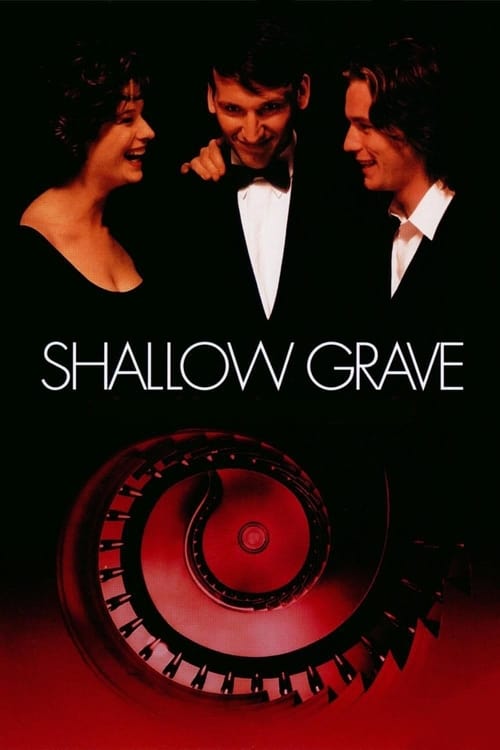
Shallow Grave
1994 · Danny Boyle
When you're craving something wicked — a tight, mean, mischievous thriller for a night when you want your pulse up and your sympathies compromised. A challenge, not a comfort.
What it's about
Three smug young professionals — a doctor, an accountant, a journalist — share a grand Edinburgh flat and amuse themselves by humiliating prospective roommates. The tenant they finally accept promptly turns up dead with a suitcase full of cash, and they decide to keep the money and dispose of the body themselves. What follows is the slow, gleeful corrosion of a friendship as suspicion, guilt, and greed move into the flat with them.
The experience
Fast, nasty, and blackly funny — a thriller that tightens like a fist while openly enjoying its own cruelty. The dread ratchets scene by scene, and it dares you to keep rooting for people who deserve none of it.
Performances
Early, live-wire work from Ewan McGregor as the flip journalist, Christopher Eccleston as the accountant whose unraveling becomes the film's dark center, and Kerry Fox holding the cold middle ground between them.
The craft
Danny Boyle's debut is all velocity and angle — saturated color, wide lenses, and cutting that makes a single flat feel like a trap slowly closing. John Hodge's script is ruthlessly economical, wasting nothing on the way from windfall to catastrophe.
Why it matters
The film that jolted 1990s British cinema awake — a modest Channel Four production that announced the Boyle–Hodge–Macdonald team and set the template for the decade's brash, stylish British filmmaking to come.
Snapshot
Shallow Grave is the film in which British cinema of the 1990s found its nerve. Three young professionals sharing a grand Edinburgh flat — a doctor, an accountant, a journalist — take in a fourth tenant who promptly dies on his bed beside a suitcase of cash. They keep the money, dismember and bury the body, and are then eaten alive by what they have done. Danny Boyle's debut feature, written by John Hodge and produced by Andrew Macdonald, converted a chamber premise and a modest Channel Four budget into something that looked and moved like nothing else in the British films of its moment: saturated, fast, wide-angled, unsentimental, and openly delighted by its own cruelty.
Its historical importance is double. It is a superbly built genre machine — arguably the most efficient British neo-noir of the decade — and it is the seed crystal for the Boyle/Macdonald/Hodge partnership that produced Trainspotting two years later and, through that film, reshaped what a British film was allowed to look like commercially. It also launched Ewan McGregor and gave Christopher Eccleston and Kerry Fox career-defining screen roles. If Trainspotting is the explosion, Shallow Grave is the detonator, and it remains the tighter, meaner film.
Industry & production
The production is a textbook case of the Channel 4 model working as designed. John Hodge was a junior hospital doctor in Edinburgh, writing on the side; he met Andrew Macdonald — grandson of Emeric Pressburger, and so an heir to one of British cinema's great production lineages — and the two developed the script largely outside the established development system. Boyle came to it from theater and television rather than from film: he had been a leading figure at the Royal Court, had produced Alan Clarke's Elephant (1989) for BBC Northern Ireland, and had directed episodes of Inspector Morse and the BBC serial Mr Wroe's Virgins (1993). None of the three principals had made a feature.
Financing came principally through Channel Four Films, under David Aukin's drama department, with the newly established Glasgow Film Fund contributing what is generally recorded as its first investment — a sum in the region of £150,000. Total budget figures vary across sources; the commonly cited range is around £1 million, and precise accounting for the picture is not well documented in the public record. What matters structurally is that the money was small enough to permit total creative control and large enough to build a set. Macdonald's Figment Films served as the production company.
The production's defining practical decision was geographic sleight of hand: the film is set unmistakably in Edinburgh, but the flat — the film's entire world — was built as a set in a Glasgow warehouse, with Edinburgh used for exteriors. This is why the Glasgow Film Fund is in the credits, and it is also why the apartment behaves in ways no real apartment could: the walls come out, the ceilings open, the camera flies.
The film played the 1994 festival circuit, including Edinburgh, and opened in British cinemas in January 1995, where it became a substantial commercial success — dramatically so relative to its cost — and a genuine cultural event of a kind British films of that budget class had not managed for years. Gramercy Pictures handled the United States release. It was recognized by BAFTA as an outstanding British film, and its success is what made Channel 4 willing to back the same team on Trainspotting.
Technology
Technically the film is unremarkable and deliberately so: 35mm spherical photography, 1.85:1, photochemical finish, made a decade before digital intermediate grading became standard. Its visual signature was therefore achieved in-camera and on the floor rather than in post — wide-angle lenses, hard practical color in the production design, and lighting choices that push emulsion toward primary saturation rather than a grade that arrives later.
The consequential technology here is architectural rather than optical. Kave Quinn's flat was engineered as a shooting instrument: a set with removable walls and a demountable ceiling, laid out so that the camera could crane above the partitions and travel from room to room without cutting, and so that the loft space above the ceiling could be photographed as a real, occupiable volume. Crane and Steadicam work do the rest. This is the low-budget filmmaker's oldest and best trade — spend the money once, on the space, and then extract every possible movement from it — and it is the reason a single-location picture never once feels stage-bound.
Technique
Cinematography
Brian Tufano, already a veteran (his credits include Radio On and Quadrophenia, both 1979), shoots the film as if it were a comic panel: deep, unmixed colors — arterial reds, cold blues, bilious greens and yellows — wide lenses that bow the flat's corridors outward, and a camera that is almost never static. Low angles make the three flatmates loom; high angles, especially the recurring overhead glides across the tops of the walls, reduce them to specimens in a maze. The apartment is lit for graphic effect rather than plausibility, which is precisely the point: this is a stylized space in which behavior, not architecture, is being observed.
Tufano's contribution to the Boyle style is foundational — he went on to shoot Trainspotting and A Life Less Ordinary, and later East Is East and Billy Elliot — and Shallow Grave is where the grammar is set: aggressive lens choice, movement as punctuation, color as emotional weather.
Editing
Masahiro Hirakubo's cutting is the film's engine and the beginning of another long collaboration (he cut Boyle's next three features). Two modes dominate. The first is the montage of compressed time and social cruelty — most famously the flatmate interviews, in which prospective tenants are humiliated in rapid-fire succession, a sequence that establishes the trio's shared sadism in under two minutes and then pays off structurally when their victim-selection turns out to have been a fatal act of vanity. The second is a suspense grammar of accelerating, slightly over-cut action in the film's later stretches, where the rhythm itself becomes unstable as the characters do.
Crucially, Hirakubo also knows when to stop. The dismemberment is handled largely by ellipsis and sound, and the film's worst act is registered through its aftermath in Eccleston's face rather than through explicit spectacle.
Mise-en-scène / staging
The flat is the film's true protagonist and its moral diagram. Its scale — high ceilings, long hallway, multiple doors — encodes the characters' class position: this is bourgeois Edinburgh space, inherited privilege as real estate. As the plot advances the space is progressively colonized and perverted: the bathroom becomes an abattoir, the attic becomes David's fortress and observation post, holes are bored through the ceiling so that he can watch the others from above. That last move is the film's central staging idea. Money turns a shared home into a panopticon, and the man who was introduced as the meekest of the three becomes the one with the gaze.
Costume and objects follow the same logic: the suitcase, the hacksaw, the drill, the newspaper. Boyle stages the trio in tight triangular compositions early on — inseparable, interchangeable — and then systematically breaks the triangle into unstable pairs.
Sound
Simon Boswell's score carries a specific and revealing pedigree: Boswell built his reputation in Italian genre cinema, scoring for Dario Argento, Lamberto Bava and Michele Soavi, and later for Richard Stanley. That horror inheritance is audible here in the way the music refuses to behave like thriller underscore — it swells operatically, then turns synthetic and pulsing, treating a flatshare quarrel with the sonic weight of a giallo murder. The mismatch is the joke, and also the threat.
Around the score sits a pop strategy that Boyle would refine into a signature. Leftfield contributed a track written for the film, tying it to the contemporary British dance underground, while Andy Williams's "Happy Heart" supplies the ironic sweetness that frames the story. Sound design does the film's dirtiest work: the drill, the saw, the floorboards, the breathing in the loft — the horror is auditory precisely so the images can stay stylish.
Performance
Christopher Eccleston gives the film its tragic spine. His David begins as a stooped, muttering accountant, the group's designated butt, and Eccleston plays the transformation not as a switch but as a hollowing — the voice flattens, the posture straightens, the eyes stop moving. It is a study in how humiliation converts into authority once someone has done the unspeakable thing nobody else would do.
Kerry Fox's Juliet is the film's most modern element: a woman written and played without the reassurance of interiority. Fox withholds. Her Juliet is legible only through tactics, which makes the ending land as revelation rather than betrayal. Ewan McGregor's Alex is glib, verbal, cowardly and enormously likeable — the performance that made him a star, and one that understands that charm is the film's most reliable predator. Around them, Keith Allen's Hugo is a five-minute apparition of pure menace, Ken Stott's detective supplies dry institutional pressure, and Peter Mullan appears as one of the criminals tracking the money, a small role in a film that arrived just before Mullan's own emergence as a major Scottish director.
Narrative & dramatic mode
Hodge's screenplay is a model of compression: one location, four principals, one object of desire, and a clean escalation in which every step is both rational and catastrophic. The mode is black comedy hardening into noir tragedy. For roughly its first act the film plays as satire of a particular kind of young professional smugness; the moment the body is cut up, the comedy does not stop but is no longer safe.
The dramatic engine is the division of labor. The three cannot share the crime equally, so they draw for it, and David does the work. That asymmetry — one person carrying the moral cost while the others keep their hands clean — is what converts a caper into a psychological siege. Hodge structures the second half as a triangle collapsing into shifting alliances, with the loft as a vertical axis of power.
Alex's voiceover frames the film at both ends, and the closing movement executes a classic noir reversal: the survivor who appears to have lost has in fact won, and the film's last image locates the money under the floorboards while the woman who took the case drives away with paper. It is a punchline that retroactively re-reads every friendship in the film as a negotiation.
Genre & cycle
Shallow Grave is neo-noir in the specific 1980s–90s idiom of the "ordinary people find money" film, a cycle whose modern template is the Coen brothers' Blood Simple (1984) and whose antecedents run back through Kubrick's The Killing (1956) to Huston's The Treasure of the Sierra Madre (1948). It crosses that with the single-apartment psychological thriller — Hitchcock's Rope (1948), Polanski's apartment films, Losey and Pinter's The Servant (1963), whose inversion of domestic hierarchy is a close cousin to David's ascent.
Its release position within the post-Reservoir Dogs (1992) wave is important but frequently overstated. Shallow Grave was made before Pulp Fiction (1994) reached British screens; the shared attributes — verbal violence, pop-scored brutality, structural playfulness — reflect a common moment rather than direct imitation. The same caution applies downstream: Sam Raimi's A Simple Plan (1998) derives from Scott Smith's 1993 novel, so the premise convergence is parallel evolution within a cycle, not descent.
Authorship & method
The authorship here is genuinely triangular. Boyle, Macdonald and Hodge functioned as a unit across four features, and the method is visible in the work: a tightly engineered script from Hodge, a producer who protected budget discipline as an aesthetic asset, and a director who imported theater-derived rehearsal and television-derived speed. Boyle's stated approach — energy over decorum, movement over composure, music as co-narrator — is fully formed in this first film.
The collaborators matter as much as the trio. Brian Tufano's photography, Masahiro Hirakubo's editing, Kave Quinn's production design and Simon Boswell's score are not service work; they are the constituent elements of what would be called "the Boyle style," and three of the four carried directly into Trainspotting. It is a useful corrective to auteurist shorthand that Boyle's visual identity is legible in his first feature precisely because he assembled a crew whose instincts were already anti-naturalist.
Movement / national cinema
The film belongs to the Scottish cinematic renaissance of the 1990s, and it defines that movement partly by negation. Where Bill Forsyth's Gregory's Girl (1981) and Local Hero (1983) had offered whimsical Scotland, and where 1995 would deliver the heritage-tartan spectacle of Braveheart and Rob Roy, Shallow Grave presents an Edinburgh scrubbed of all national picturesque: Georgian interiors as generic bourgeois real estate, characters whose accents and professions are contemporary and unmarked, and an opening that explicitly refuses local specificity by insisting the city could be any city.
This refusal is what made it usable as a founding text. The infrastructure — the Glasgow Film Fund, the Scottish Film Production Fund, Channel 4's national remit — was building toward a Scottish cinema that could be urban, genre-literate and commercial. Shallow Grave, then Trainspotting, then Peter Mullan's Orphans (1998) and Lynne Ramsay's Ratcatcher (1999), mark out the range that followed.
More broadly it sits inside the mid-1990s recovery of British film production, driven by Channel Four Films, PolyGram Filmed Entertainment and, from 1995, National Lottery funding — the same conjuncture that produced Four Weddings and a Funeral (1994) and the "Cool Britannia" export moment.
Era / period
The film is a document of post-Thatcher, Major-era Britain: the acquisitive 1980s have curdled, but the appetite has not gone away. Its three protagonists are not gangsters but credentialled professionals — medicine, accountancy, journalism, the three trades built on public trust — and the film's coldest observation is that their professional competence is exactly what equips them to dispose of a corpse and launder a windfall. The money is not transformative wealth; it is enough to matter, which is worse.
The moment is also a specific media-cultural one: Britpop, the British dance underground, a generation of graduates in shared flats with more style than security. Shallow Grave reads that generation's clannishness with unusual clarity, understanding the flatshare as a social form built on shared contempt for outsiders.
Themes
Greed as solvent. The money does not corrupt the friendship so much as reveal that the friendship was a coalition. Nothing in the film's ending contradicts what the opening interviews already showed.
Cruelty as intimacy. The trio's bond is expressed almost exclusively through mockery. The film argues that groups constituted by shared derision will turn that derision inward the moment an outsider is unavailable.
The gaze and the panopticon. David's holes in the ceiling convert the flat into a surveillance apparatus. Watching, in this film, is the true form of power — more than the knife, more than the cash.
The body as a problem of labor. The dismemberment is staged as work: tools, planning, a division of tasks, exhaustion. This is where the film touches Edinburgh's own literary and criminal inheritance — Stevenson's Jekyll and Hyde, Deacon Brodie, Burke and Hare — the city of respectable facades with bodies underneath. The film never states the connection, and it does not need to.
Deniability. Almost every character's moral position depends on someone else having done the thing. That is the film's most durable political idea.
Reception, canon & influence
Reception in Britain was strong and, unusually for a debut, both critical and popular. Reviewers seized on the film's velocity, its design, and its refusal of British social-realist convention; the Coens' Blood Simple was the near-universal comparison, alongside Hitchcock. A real strand of dissent existed and is worth preserving in the record: a number of critics found the film slick, heartless and adolescent in its misanthropy — an objection that is less a misreading than a difference of taste, since the coldness is the design. It was honored by BAFTA as an outstanding British film and did business far out of proportion to its cost.
Backward. The lines in are clear: the Coens' first film for the low-budget stylized crime thriller; Rope and the Polanski apartment tradition for the single-space guilt chamber; The Servant for domestic power inversion; The Treasure of the Sierra Madre and The Killing for the moral arithmetic of found money; Italian genre scoring, via Boswell, for the score's operatic excess; and — through Boyle's own history as producer of Alan Clarke's Elephant — a British television tradition of formal aggression and unblinking violence that has little to do with Channel 4's social-realist reputation.
Forward. The most direct consequence is Trainspotting (1996), which the same team made with substantially the same crew and which would not have been financed as it was without this film's success; the pair together, plus A Life Less Ordinary (1997) and The Beach (2000), constitute one of the most consequential producer-writer-director partnerships in modern British film. Domestically, Shallow Grave helped license the late-1990s British crime-comedy boom that ran through Face (1997) and Lock, Stock and Two Smoking Barrels (1998), though most of those films took the swagger without the structural rigor. It made stars of McGregor and Eccleston, and it established a visual and musical grammar — wide lenses, kinetic camera, needle-drop scoring, hyper-saturated design — that Boyle carried into 28 Days Later (2002) and Slumdog Millionaire (2008), and that a generation of British directors absorbed as default.
Its subtler legacy is the demonstration itself: that a British film could be made cheaply, on one built set, in a national context with no genre infrastructure, and be internationally legible as a thriller rather than as a report from Britain. That proposition, more than any individual stylistic tic, is what Shallow Grave bequeathed.
A Deleuzian reading
A man lies in the dark above his own ceiling, eye to a hole he drilled himself, watching his two best friends move around the lit flat below.
The full Deleuzian reading of Shallow Grave →
Reception
A genuine hit on release — one of the most successful British films of its year and a BAFTA winner for Best British Film — it was almost immediately eclipsed by Trainspotting, and now gets rediscovered as 'the one Danny Boyle made first,' usually to cries of 'why does nobody talk about this?'
How Shallow Grave was received, from release to now →
How to watch Shallow Grave: what to notice on a first viewing
- Watch the camera glide above the walls of the flat. Kave Quinn built the apartment in a Glasgow warehouse with removable walls and a ceiling that lifts off, so the crane could travel room to room without cutting. It looks down constantly. The film is watching these three from above before any of them thinks of watching each other.
- Watch the color: arterial red, cold blue, bilious green. Brian Tufano lights the flat for graphic effect rather than plausibility, and he did it on the floor in 1994, a decade before anyone could grade color afterward. Color is the weather in this film. It tells you the mood of a room before the dialogue starts.
- Watch the flat-hunting interviews in the first two minutes. Masahiro Hirakubo cuts applicant after applicant being mocked and dismissed at speed. The three flatmates are funny, fast, and cruel, and the sequence tells you what this friendship is made of. A group built on shared contempt for outsiders will aim that contempt inward once outsiders run short.
- Listen to the tools: drill, saw, floorboards, breathing. Boyle keeps the worst work mostly off screen and puts it in the mix. Simon Boswell, who scored for Argento and Bava, treats a flatshare argument with the weight of a giallo. The horror arrives through your ears so the pictures can stay stylish. Listen and you will flinch.
- Count how often the three stand in a tight triangle. Boyle blocks them early as one inseparable unit, interchangeable in the frame. Then the triangle keeps breaking into pairs, and the person left outside the pair changes from scene to scene. You can read the alliances off the composition. The blocking reports each shift before anyone admits it.
The whole guide to watching Shallow Grave, with the keys for a rewatch →
Influences: the films it descends from and the films it influenced
- Blood Simple (1984) — The template Boyle and Tufano work from: Barry Sonnenfeld's low-mounted wide-angle camera prowling a confined crime scene, plus the structural engine of a body that refuses to stay buried and turns co-conspirators into a paranoia machine — comedy and dread generated by disposal logistics rather than by plot revelation.
- Rope (1948) — The single-apartment guilt chamber built as a wild set with removable walls so the camera can travel where an actual flat would forbid, with the corpse concealed in the furniture and the whole film's suspense generated by proximity to it.
- Repulsion (1965) — Gilbert Taylor's wide-angle lensing that bows walls and stretches corridors as tenancy curdles into psychosis — the exact grammar of Eccleston's attic sequence, where lens distortion, not performance, reports the breakdown.
- Knife in the Water (1962) — Three-hander blocking in which every shift of alliance is staged as a change in triangular geometry — two bodies close, one excluded in depth — so the power struggle is legible as composition before it is spoken.
- The Servant (1963) — Domestic power inversion rendered through architecture: Douglas Slocombe's deep-focus wide staging, stairwells and mirrors turning a single house into a surveillance instrument where whoever controls the sightline controls the room.
- The Treasure of the Sierra Madre (1948) — The moral arithmetic of found money as dramatic method — partners forced into recurring scenes of division and guard duty, where each recalculation of shares is a scene-level structural unit that converts greed into blocking.
- The Killing (1956) — Cash as an object with physics: the suitcase treated as a prop with weight, fasteners and hiding places, and the ellipsis-heavy cutting that shows consequence rather than act — the elided violence and jump-forward logic Hirakubo uses on the dismemberment.
- A Clockwork Orange (1971) — Anti-naturalist interiors in hyper-saturated primaries, fisheye-adjacent wide lenses on faces, and music deployed as ironic co-narrator rather than emotional underscore — Kave Quinn's designed flat and Boswell's operatic cues both descend from this refusal of documentary texture.
- Phenomena (1985) — Direct collaborator lineage — Simon Boswell scored it, and imports the giallo idiom of stabbing string clusters over pulsing synth ostinato, music that announces a murder set-piece as spectacle rather than accompanying it as tragedy.
- Elephant (1989) — Boyle produced it: Clarke's unblinking Steadicam walk-ups to killings, withholding motive and psychology and holding on the body afterward, is the British-television formal aggression behind Shallow Grave's affectless violence and its refusal of social-realist explanation.
- Trainspotting (1996) — The same unit — Hodge, Macdonald, Tufano, Hirakubo, Quinn — scaling the identical toolkit: overhead crane glides down onto a supine body, primary-saturated designed rooms standing in for real ones, and needle-drops cut as narrative argument rather than period dressing.
- A Life Less Ordinary (1997) — The trio's third feature pushes the found-money thriller's cash-and-triangle mechanics into fantasy while retaining the house style — wide-lens kineticism, chromatic interior design, and a pop score that comments on the action from outside it.
- 28 Days Later (2002) — Boyle carries the first film's proposition — cheap format as aesthetic asset — into DV: the rapid-montage attack grammar and elliptical violence perfected on the loft floor become the strobing, under-cranked infected assaults.
- Lock, Stock and Two Smoking Barrels (1998) — Takes the surface Shallow Grave licensed — heavily gelled saturated interiors, wide-angle low-angle framing of criminals in flats, and a wall-to-wall pop needle-drop track carrying exposition — applied to a bag-of-money plot but without its single-set structural rigor.
- Face (1997) — The immediate British successor in the split-the-take mode: a robbery crew's shares recounted in cramped rooms, shot handheld and cut to contemporary tracks, proving the found-money thriller could be staged in Britain as genre rather than as social report.
- A Simple Plan (1998) — The same found-money calculus run cold — a trio bound by a discovered bag, each subsequent scene a renegotiation of trust and custody, with escalating cover-up murders staged as practical problem-solving rather than as moral crisis.
- Bound (1996) — Debut neo-noir built on one apartment floor plan with wild walls, extreme-wide overhead and floor-level camera moves passing through architecture, and a suitcase of cash as the object every character's geometry orients toward.
- Panic Room (2002) — The apartment-as-panopticon taken to its endpoint: a dwelling built to be seen through, with impossible continuous camera glides across floors and through keyholes that make the audience the surveilling party — the crane-down-through-the-flat idea industrialized.
- Panchatanthiram (2002) — Flatmates concealing a corpse and the money it comes with, with paranoia and mistrust escalating among co-conspirators — the darker cousin of the same cover-up-farce structure.
Similar films
- Trainspotting (1996) — influence & lineage
- 28 Days Later (2002) — influence & lineage
- Lock, Stock and Two Smoking Barrels (1998) — influence & lineage
- Rope (1948) — influence & lineage
- The Servant (1963) — influence & lineage
- Saltburn (2023) — shared sensibility
- Naked (1993) — shared sensibility
- Following (1999) — shared sensibility