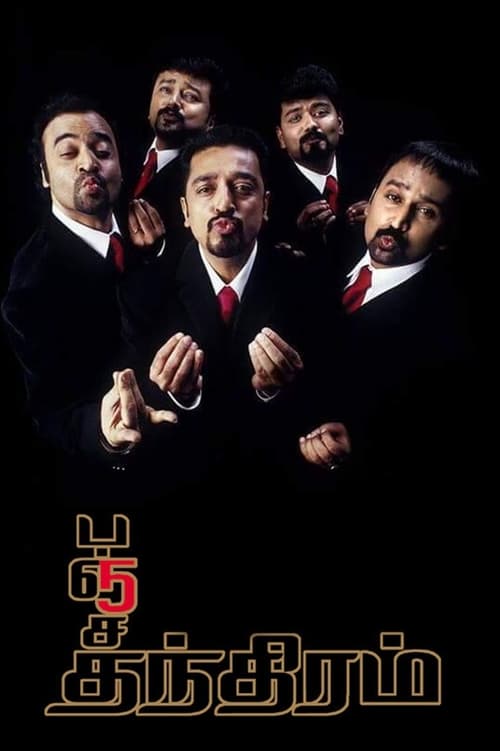
Panchatanthiram
2002 · K. S. Ravikumar
For a group hangout or a family movie night when everyone just wants to laugh — zero homework, maximum silliness. Comfort viewing through and through, especially if you love watching a scheme go magnificently wrong.
What it's about
Ram's marriage has collapsed under his wife's mistaken belief that he's a philanderer, so his four closest friends cook up a scheme to cheer him up — hiring Maggie, a call girl, for a boys' trip. Then Maggie turns up dead, and the five friends spiral into an increasingly desperate, increasingly ridiculous cover-up while wives, suspicions, and coincidences close in from every side.
The experience
Pure escalating farce — wordplay flying at machine-gun speed, lies stacking on lies, every fix making things worse. It's the kind of comedy where you laugh at the audacity of the plotting as much as the jokes.
Performances
Kamal Haasan leads a crack ensemble with the timing of a man who co-wrote his own trap, playing panic and false innocence with equal relish.
The craft
The engine is Crazy Mohan's dialogue — dense, punning, built for repeat viewing — grafted onto a screenplay that treats a morbid premise with clockwork farce logic. Director K. S. Ravikumar keeps the ensemble spinning so the complications never sag.
Why it matters
A beloved entry in the long Kamal Haasan–Crazy Mohan comic partnership, it's one of the Tamil comedies people can still quote line for line decades later.
Snapshot
Panchatanthiram — a Tamil title that puns on the ancient Panchatantra fable collection while translating roughly as "five ruses" or "five stratagems" — is a 2002 Tamil-language comedy built around Kamal Haasan and a tight ensemble of his friends. Directed by K. S. Ravikumar from a story by Kamal Haasan, with a screenplay the two shared and dialogue by the humorist Crazy Mohan, the film takes a morbid premise and plays it for farce: a man estranged from a wife who wrongly suspects him of infidelity, a group of well-meaning friends whose scheme to cheer him up goes catastrophically wrong, and the death of a call girl named Maggie that the friends must then frantically conceal. Released on 28 June 2002, it is best understood as a late entry in one of Tamil cinema's most productive comic partnerships — Kamal Haasan and Crazy Mohan — and as a domesticated, laughter-forward reworking of a dark Hollywood template. It is a star vehicle, a friendship comedy, and a machine for verbal jokes, more than it is a thriller about a body.
Industry & production
The film was produced by P. L. Thenappan, a Chennai producer of the period, rather than by Kamal Haasan's own Raaj Kamal Films International, which situates it within the mainstream commercial Tamil industry ("Kollywood") rather than as a pure auteur passion project. That said, Kamal Haasan's authorial fingerprints are all over it: he supplied the story and co-wrote the screenplay, and the project reunited a creative unit he had cultivated across the late 1990s. The early 2000s were a commercially buoyant, star-driven moment for Tamil comedy, and a Kamal Haasan comedy carried both bankability and prestige. The picture is pitched at an affluent, cosmopolitan milieu — a circle of upwardly mobile friends — and the granular record of specific shooting schedules and locations is not something I can state with confidence; I will not invent itineraries or budget figures where the reliable record is thin.
Technology
Panchatanthiram was made on 35mm film in the conventional manner of a 2002 mainstream Tamil production, before the industry's wholesale migration to digital acquisition later in the decade. Post-production, song picturization, and the standard apparatus of playback singing and location-plus-studio shooting all follow the norms of its moment. There is no evidence that the film was a technological showcase in the way some of Kamal Haasan's other projects (with their appetite for prosthetics, effects, and format experiments) explicitly were; its ambitions are comic and performative rather than technical. Any claim that it pioneered a specific tool or process would be unsupported, so I make none.
Technique
Cinematography
Photography is credited to Arthur A. Wilson, a busy Tamil cinematographer of the era. The visual approach a film like this demands is essentially functional and bright: clean, well-lit compositions that keep faces legible and give comic performers room to work, with the glossier, more saturated palette expected of song sequences. The camera in this mode of Tamil comedy serves the joke and the ensemble rather than asserting an independent visual argument; framing tends to prioritize the group, the reaction, and the timing of an entrance or a discovered body over expressive stylization.
Editing
Editing is credited to Thanigachalam. In a comedy whose engine is escalation — a bad situation compounding into a worse one — cutting rhythm is load-bearing: reaction shots, the beat before a punchline lands, and the accelerating tempo of a farcical cover-up all live in the edit. The film's reputation as a picture where, as one contemporary account put it, "the jokes never stop coming," implies an editorial pace tuned to sustain momentum across a long ensemble runtime.
Mise-en-scène / staging
The staging logic is that of farce: contained spaces, a body that must be hidden and repeatedly nearly discovered, and groups of characters working at cross-purposes within the same frame. The comedy of the premise — friends improvising ever more elaborate concealments — depends on clear spatial geography so the audience always knows who knows what, and where the danger is. The upscale settings function as both aspirational backdrop and comic pressure-cooker.
Sound
Music is by the composer Deva, one of the most prolific Tamil film composers of the 1990s and early 2000s, working here in his idiom of melodic, mass-friendly songs and functional background score. Beyond the songs, the film's true "sound" is verbal: Crazy Mohan's dialogue, delivered at speed, is the dominant sonic texture, and the picture's comedy is inseparable from its wordplay, puns, and rhythmic exchanges. I cannot reliably enumerate the individual song titles or playback singers here and will not guess at them.
Performance
Performance is the film's center of gravity. Kamal Haasan anchors the ensemble as Ram, the man his wife wrongly believes to be a philanderer, and the surrounding cast is stacked with capable comic and character actors — Jayaram, Ramesh Aravind, Sriman, and Yugi Sethu among the friends, with Simran and Ramya Krishnan in prominent roles and veterans such as Urvashi and the great Nagesh among the supporting players. The comic mode is ensemble-driven: reactions, timing, and the friction between differently anxious characters generate most of the laughs. Kamal Haasan, an actor of enormous range, here operates in a lighter register, playing straight man and instigator by turns within a group dynamic he helped author.
Narrative & dramatic mode
The dramatic mode is black comedy tipped decisively toward farce. The armature is grim — a wrongful suspicion of adultery, a hired companion, an accidental death, a corpse to dispose of — but the film consistently converts dread into laughter rather than letting the darkness accumulate. Structurally it is a comedy of escalation and concealment: an initial well-intentioned lie metastasizes into a chain of increasingly desperate cover-ups, each solution breeding a larger problem. This is a classic farce architecture (the more the characters try to fix things, the worse they get), overlaid on a friendship narrative in which the real subject is loyalty — how far friends will go, and how absurd they will become, for one another. The marital misunderstanding at the premise's root supplies both the initiating engine and the eventual sentimental resolution the mainstream form expects.
Genre & cycle
The film sits at the intersection of comedy, romance, and family drama, but its operative genre is the ensemble black comedy. Within Tamil cinema it belongs to a specific cycle: the Kamal Haasan–Crazy Mohan comedies, a run of films across the 1990s and early 2000s (including the cross-dressing hit Avvai Shanmughi and the K. S. Ravikumar-directed Thenali) in which Kamal's star persona is bent toward high-verbal, situation-driven laughter. It also participates, at a remove, in the international cycle of "dead body" farces and bachelor-party-gone-wrong comedies. Where those Western examples often lean into transgression and cruelty, Panchatanthiram pulls the material back toward the reassurances of mainstream Tamil comedy: friendship, marriage restored, and jokes over gore.
Authorship & method
The authorship here is genuinely shared, and unusually legible. K. S. Ravikumar, the director and co-writer, was by 2002 an established maker of mass-audience entertainers with a strong feel for ensemble staging and commercial rhythm; his prior collaborations with Kamal Haasan gave the partnership a shorthand. Kamal Haasan, as story author, co-writer, and star, is the film's presiding intelligence — this is a project shaped to his conception and his performance, part of his long practice of authoring his own vehicles. Crazy Mohan, the dialogue writer, is arguably the most important single collaborator for the film's identity: a playwright and humorist whose partnership with Kamal Haasan defined a whole strain of Tamil verbal comedy, and whose puns and rapid-fire exchanges are the film's signature texture. Rounding out the key craft credits are cinematographer Arthur A. Wilson, editor Thanigachalam, and composer Deva. The method, then, is collaborative star-comedy: a Hollywood premise reconceived by Kamal Haasan, structured and staged by Ravikumar, and made to speak in Crazy Mohan's voice.
Movement / national cinema
Panchatanthiram is a product of Tamil-language cinema, centered in Chennai, one of the largest of India's regional film industries and a distinct tradition with its own star system, comic idioms, and audience expectations. It does not belong to any avant-garde or art-cinema movement; it is squarely commercial popular cinema. Its interest within that national frame lies in how the Kamal Haasan comedies negotiated between a globally circulating pop-cultural sensibility — including a willingness to draw on Hollywood premises — and the specific, deeply local pleasures of Tamil verbal wit and star charisma. It is a film that looks outward for its plot and inward for its jokes.
Era / period
Arriving in mid-2002, the film belongs to the last phase of the analog, star-and-song-driven Tamil mainstream before digital workflows and a new generation of directors reshaped the industry later in the 2000s. It is also near the end of the classic Kamal Haasan–Crazy Mohan comedy run, giving it a valedictory quality in retrospect. Deva's involvement likewise marks it as belonging to a particular sonic era of Tamil film music that would soon give way to other composers' dominance. As a period artifact it captures an early-2000s aspirational, cosmopolitan comic sensibility.
Themes
Beneath the farce, the film's persistent themes are loyalty and male friendship — the lengths to which a close-knit group will go for one another, even into criminal absurdity — and marital trust and misunderstanding, since the entire catastrophe is set in motion by a wife's mistaken belief that her husband is unfaithful. There is a recurrent tension between appearance and truth: almost every crisis stems from something misread or misrepresented, and almost every "solution" is a further deception. The title's invocation of the Panchatantra — a canonical cycle of instructive fables — winks at this, framing the friends' escalating schemes as a kind of comic moral tale about cleverness that outsmarts itself. Guilt, concealment, and the comedy of respectable people forced into disreputable improvisation run throughout.
Reception, canon & influence
Contemporary and retrospective Tamil-language commentary has treated Panchatanthiram affectionately as one of the reliably funny Kamal Haasan–Crazy Mohan collaborations, a film praised above all for its relentless joke density and ensemble chemistry rather than for dramatic weight; retrospective pieces single it out as a picture "where the jokes never stop coming." I do not have verified box-office figures or a comprehensive critical ledger to cite, and I will not fabricate specific grosses, ratings, or review quotations.
On the backward axis of influence, the film's most clearly documented debt is to Peter Berg's 1998 American black comedy Very Bad Things, whose premise of a bachelor celebration derailed by an accidental death and a panicked cover-up Panchatanthiram loosely adapts — while deliberately softening the source's nihilistic tone into mainstream Tamil comedy and grafting on the marital-misunderstanding frame and the local idiom of Crazy Mohan's wordplay. Behind that lies the deeper tradition of dead-body and cover-up farce.
On the forward axis, its legacy is best measured within Tamil comedy itself: it consolidated the reputation of the Kamal Haasan–Crazy Mohan partnership as a benchmark for verbal, situation-driven humor, and it remains a frequently revisited title in fan retrospectives and rankings of that collaboration. Claims that it directly shaped later specific films would go beyond what the reliable record supports, so I frame its influence as that of a well-loved node in an ongoing comic tradition rather than a documented turning point.
Reception
A comfortable hit in 2002, it has since climbed into 'comfort classic' territory — the rare comedy whose reputation grew purely through reruns and rewatches, even as newer viewers increasingly squirm at its gender politics.
How Panchatanthiram was received, from release to now →
How to watch Panchatanthiram: what to notice on a first viewing
- Watch where each friend stands when a new problem lands on them. The film keeps the whole group in frame together as they improvise ever more elaborate concealments, so the audience always knows who knows what. Clear spatial geography is what lets the farce escalate without confusing the viewer about who is hiding what.
- Watch the friends' faces the instant a new lie is proposed. Reaction and timing between differently anxious characters generate most of the comedy, with Kamal Haasan shifting between straight man and instigator. The ensemble's panic, not any single joke, is what the film is actually staging.
- Listen for the beat the film holds before a punchline lands. Reaction shots and a steadily accelerating tempo are timed to Crazy Mohan's rapid dialogue as each cover up compounds the last. The editing rhythm is what keeps a long ensemble runtime feeling like it never stops moving.
- Listen for how fast and dense the dialogue comes. Crazy Mohan's puns and wordplay arrive at speed and never really let up between the songs. The verbal texture, not the plot mechanics, is the film's real comic engine.
- Notice how bright and evenly lit every scene stays. The photography favors clean, legible framing that keeps faces readable for the group and the joke rather than for mood. A functional, bright visual style keeps the comedy legible across a large ensemble cast.
The whole guide to watching Panchatanthiram, with the keys for a rewatch →
Influences: the films it descends from and the films it influenced
- Very Bad Things (1998) — Direct plot template: a bachelor celebration derailed by an accidental death and a panicked disposal that snowballs into further cover-up, which Panchatanthiram adapts beat-for-beat while detoxifying the nihilism into mainstream comedy.
- The Trouble with Harry (1955) — Codified the recurring-corpse engine in which a single body must be repeatedly hidden, dug up, and relocated as each new arrival threatens exposure — the structural motor of dead-body farce.
- Weekend at Bernie's (1989) — Perfected the corpse-as-prop gag, physically puppeteering a dead body through social scenes so onlookers believe it is alive — the escalating-concealment set piece Panchatanthiram inherits.
- Arsenic and Old Lace (1944) — Accelerating door-slamming stage farce built on concealed bodies and a protagonist's spiraling panic to keep newcomers from discovering them, modeling the 'farce geography' of a single pressurized space.
- The Ladykillers (1955) — Ealing black-comedy template in which a criminal scheme collapses into escalating body-disposal problems and mutual destruction, tuning dark subject matter to a genial comic register.
- A Fish Called Wanda (1988) — Ensemble black-comedy timing where crossed intentions among greedy schemers escalate through precise entrance/exit choreography, a benchmark for comic ensemble geometry.
- Michael Madana Kama Rajan (1990) — Established the Kamal Haasan–Crazy Mohan house style — rapid pun-driven dialogue and mistaken-identity/multi-role comic performance — that gives Panchatanthiram its signature verbal texture.
- Sathi Leelavathi (1994) — Crazy Mohan's dialogue applied to a marital-suspicion-and-misunderstanding plot, prefiguring the wife's-mistrust frame grafted onto Panchatanthiram's cover-up spine.
- Vasool Raja MBBS (2004) — Directly extends the Kamal Haasan–Crazy Mohan verbal-comedy partnership — dense punning exchanges and situation reversals — cementing the collaboration Panchatanthiram consolidated.
- Naduvula Konjam Pakkatha Kaanom (2012) — A wedding derailed by a mishap (amnesia) that a tight friend-group must conceal, escalating through farce geography and secrecy in the Tamil situation-comedy tradition Panchatanthiram exemplified.
- Soodhu Kavvum (2013) — Tamil black comedy where a botched scheme spirals via accidental death and frantic cover-up, carrying forward the escalation-and-concealment engine in a modern indie register.
- Avvai Shanmughi (1996) — Same Ravikumar–Kamal–Crazy Mohan team staging sustained disguise-and-concealment comedy at commercial tempo, rehearsing the escalation-through-secrecy mechanics.
- Kadhala Kadhala (1998) — Kamal Haasan–Crazy Mohan ensemble caper of lies compounding lies, driving comedy through the escalation-and-concealment engine rather than gags alone.
- Thenali (2000) — The immediately prior Ravikumar–Kamal–Crazy Mohan collaboration, refining the situation-comedy machine and verbal-wordplay rhythm Panchatanthiram runs on.
- Shallow Grave (1994) — Flatmates concealing a corpse and the money it comes with, with paranoia and mistrust escalating among co-conspirators — the darker cousin of the same cover-up-farce structure.
- Death at a Funeral (2007) — Single-location ensemble farce in which a death triggers a cascade of concealed secrets and accidents, extending the escalation-and-concealment tempo internationally.
Similar films
- Michael Madana Kama Rajan (1990) — influence & lineage
- Soodhu Kavvum (2013) — influence & lineage
- Virumaandi (2004) — shared sensibility
- Mahanadhi (1994) — shared sensibility
- Anbe Sivam (2003) — shared sensibility
- Vikram (2022) — shared sensibility
- Kishkindha Kaandam (2024) — shared sensibility
- Vikram Vedha (2017) — shared sensibility