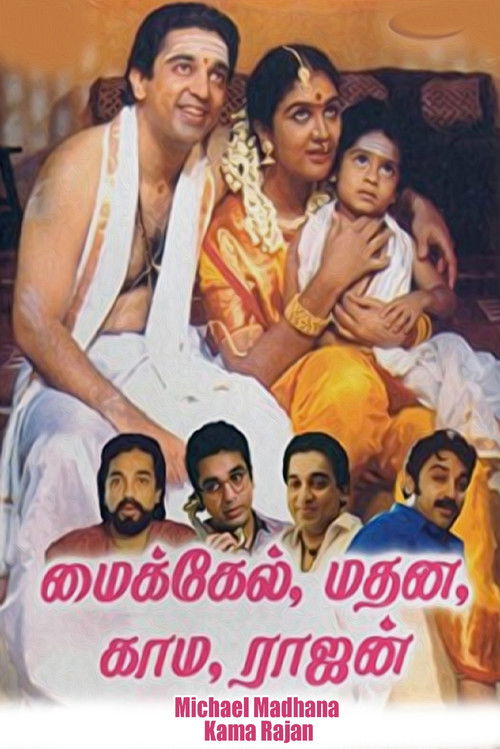
Michael Madana Kama Rajan
1990 · Singeetam Srinivasa Rao
For when you need a proper laugh — a big, generous, crowd-pleasing farce best watched with family or friends. Pure comfort, zero homework.
What it's about
Quadruplets separated at birth — a gangster's enforcer, a polished business heir, a fussy Brahmin cook, and an earnest fireman — grow up unaware of each other until adulthood throws them into the same orbit. What follows is a full-tilt comedy of errors: mistaken identities, swapped lives, and four men played by one actor, Kamal Haasan, colliding across every social register of South India.
The experience
Fast, dense, and relentlessly funny — the wordplay comes in waves, the confusion compounds by the scene, and the whole thing runs on a showman's delight in its own audacity. It's the kind of comedy that rewards full attention and repeat viewings.
Performances
Kamal Haasan plays all four brothers, giving each a distinct body, voice, and dialect so complete that you stop seeing the trick — a legendary showcase of comic range and one of the most celebrated star turns in Tamil cinema.
The craft
Director Singeetam Srinivasa Rao engineers the technical stunt of putting four versions of one star in the same frame — remarkable for 1990 — while keeping the farce machinery ticking with precision. The script is famously pun-saturated, a layer of verbal comedy stacked on top of the physical one.
Why it matters
It settled into the Tamil canon as one of the most beloved comedies ever made there, still quoted line-for-line decades later and held up as the gold standard for the multi-role star performance.
Snapshot
Michael Madana Kama Rajan is a Tamil-language farce built around a single audacious conceit: Kamal Haasan playing quadruplets, separated in infancy, whose paths cross in adulthood to generate a spiraling comedy of errors. The title itself is a roll-call of the four men — Michael, a Bombay gangster's enforcer; Madan (Madana), the polished heir raised by the brothers' biological father; Kameshwaran (Kama), a fastidious Palakkad Iyer cook; and Raju (Rajan), an earnest fireman. Directed by the genre-agnostic veteran Singeetam Srinivasa Rao and driven by Kamal Haasan's own story and performance, the film married a spectacular technical stunt — four versions of one star sharing the frame — to a dense, pun-saturated comic script. It has since settled into the Tamil canon as one of the most beloved comedies the industry has produced, and Kameshwaran in particular became an iconic figure in Kamal Haasan's gallery of characters.
Industry & production
The film emerged from one of the most productive creative partnerships of late-1980s South Indian cinema. Singeetam Srinivasa Rao and Kamal Haasan had already collaborated on the wordless comic fable Pushpaka Vimana (Pushpak, 1987) and the multi-role thriller Apoorva Sagodharargal (1989), in which Kamal played a vengeful dwarf. Michael Madana Kama Rajan extended that experimental streak, pushing the "one actor, many roles" premise from two figures to four. Kamal Haasan is credited with the story and served as the film's creative engine and star; the specific corporate producing arrangements and budget are not something I can state with confidence, so I will not invent figures.
The project sat within the commercial mainstream of Tamil cinema — a star vehicle with songs, romance and set-piece comedy — but its ambition lay in execution rather than novelty of plot. The "separated siblings reunited" structure was a well-worn masala staple; the industry gamble here was whether audiences would sustain interest across four parallel storylines held together by one performer, and whether the technical apparatus of the era could convincingly place multiple Kamals in a shared shot.
Technology
The film's headline technical challenge was compositing multiple instances of the same actor into single frames. In 1990, well before digital compositing was available to Indian productions, this was achieved through optical and in-camera techniques: locked-off cameras with split-screen (matte) photography, careful frame division so that two or more Kamals could occupy the same shot, and body doubles shot from behind or in soft focus for over-the-shoulder exchanges. Continuity of eyeline, lighting and blocking across separately filmed passes had to be planned meticulously, since any drift would betray the seam. The production built directly on lessons from Apoorva Sagodharargal, where similar dual-role compositing had been executed the year before. Where the exact optical laboratory methods are concerned the published record is thin, and I will not overstate specifics, but the achievement is broadly recognized as a demanding feat of pre-digital trick photography for its moment in Tamil cinema.
Technique
Cinematography
The film was photographed by P. C. Sreeram, among the most influential cinematographers of the Tamil new wave and a key figure in modernizing the industry's visual grammar. Sreeram's task was doubly complex: to service a broad commercial comedy with bright, legible staging, and to engineer the split-frame shots that let four Kamals coexist. The multi-role sequences demanded rigorous control of camera position and lighting so that separately captured performances would read as a single continuous space. Beyond the trick work, the film carries the clean, well-modelled lighting associated with Sreeram's output of the period; his song picturizations in particular tend toward warm, carefully sculpted images rather than flat television-style coverage.
Editing
Editing is central to a multi-role comedy of this kind, because the humor depends on precise timing — on cutting between the four men's storylines and on the rhythm of reaction within scenes. The comic payoff of mistaken identity relies on the edit withholding and revealing information at exactly the right beat. I am not able to confirm the editor's name from memory with certainty, and rather than attribute it incorrectly I will simply note that the cutting is disciplined in service of the wordplay and the escalating confusions, letting gags land without over-cutting.
Mise-en-scène / staging
Each of the four Kamals is given a distinct visual world — the gangster's milieu, the wealthy household, the Iyer kitchen and domestic sphere, the fireman's everyday register — so that costume, décor and social setting do much of the work of keeping the brothers legible to the audience. Blocking is engineered around the compositing: characters are frequently arranged so that the seam between two performances can be hidden by furniture, doorframes or the geometry of the set. The staging of the farce culminates, as the genre demands, in scenes where the wrong brother is taken for another, and the physical arrangement of bodies in a room becomes the source of comedy.
Sound
Ilaiyaraaja composed the score and songs, and his contribution is inseparable from the film's texture. The soundtrack includes numbers that have endured in Tamil popular memory — the duet "Sundari Kannaal Oru Sethi" is among the best remembered. Ilaiyaraaja's orchestration supports both the romantic interludes and the comic momentum, and the songs function as set-pieces distributed across the brothers' parallel romances. As with much of his early-1990s work, the arrangements blend melodic Tamil film idiom with his characteristic instrumental detailing. Dialogue delivery — crucial in a film this verbal — is foregrounded in the mix, since the comedy lives in puns and in the clash of dialects.
Performance
The film is, above all, an actor's showcase. Kamal Haasan differentiates the quadruplets not through makeup gimmickry but through calibrated shifts in voice, posture, dialect and rhythm. Kameshwaran, the Palakkad Iyer cook, is the standout: a fussy, garrulous figure whose Brahmin-inflected, Malayalam-tinged Tamil becomes a comic instrument in itself. Michael carries a coiled, swaggering physicality; Raju is open and guileless; Madan is smooth and urbane. That an audience can track four men played by one face, and find each immediately distinct, is the performance's central accomplishment. Among the ensemble, Urvashi and Khushbu feature as leading women opposite the brothers, and Urvashi's comic partnership with the Kameshwaran strand is frequently singled out; the wider supporting cast fills out the farce, though I will avoid attributing specific roles I cannot verify.
Narrative & dramatic mode
The dramatic mode is farce — specifically the comedy of errors, in which the engine of the plot is mistaken identity and the audience's superior knowledge of who is really who. The screenplay establishes four separated brothers, keeps their storylines running in parallel, and then engineers the collisions in which each is taken for another, compounding misunderstandings until they resolve. This is a very old structure, descending ultimately from Plautus's Menaechmi and Shakespeare's The Comedy of Errors, refracted through the "lost and found" conventions of Indian popular cinema. What distinguishes Michael Madana Kama Rajan within that lineage is the density of its verbal comedy: the film is as much about language — puns, malapropisms, dialect friction — as about the mechanics of disguise, so the dramatic mode is farce laced with a near-constant stream of wordplay.
Genre & cycle
The film belongs to the multi-role star-vehicle comedy, a sub-cycle of Indian commercial cinema in which a single leading actor plays several parts. It sits downstream of the "separated siblings" masala tradition of the 1970s — films in which brothers scattered at birth reunite after divergent upbringings — but repurposes that melodramatic template for pure comedy rather than for the sentimental or action registers those earlier films favoured. Within Kamal Haasan's own filmography it forms a clear cycle with Apoorva Sagodharargal before it and, much later, the ten-role Dasavathaaram (2008): a recurring project of using multiplicity of character as both technical spectacle and acting challenge.
Authorship & method
The film is best understood as a convergence of several strong authorial hands. Singeetam Srinivasa Rao, the director, was among the most versatile filmmakers in South India — working across Telugu, Tamil and Kannada, and moving between forms as different as the silent comedy Pushpak, the dance film Mayuri and the Telugu science-fiction adventure Aditya 369. His method favoured formal experiment inside popular structures, which made him an ideal collaborator for Kamal Haasan's high-concept ambitions.
Kamal Haasan authored the story and anchored the film as its quadruple star; the project reflects his career-long interest in transformation and in cinema as a vehicle for actorly range. Crazy Mohan wrote the comedy dialogue, and this film marks the flowering of what became one of Tamil cinema's most celebrated writer–star partnerships: Mohan's pun-driven, rapid-fire wordplay found its perfect delivery vehicle in Kamal Haasan, and the two would go on to collaborate repeatedly through the 1990s and 2000s on comedies such as Avvai Shanmughi, Panchathanthiram and others. Much of the film's enduring quotability traces to Mohan's dialogue.
P. C. Sreeram (cinematography) and Ilaiyaraaja (music) round out a group of first-rank collaborators, each near the height of their reputations at the turn of the 1990s. The editor's contribution, as noted above, I will not attribute by name without confidence. The collective method is one of top-tier technical craft placed in service of a comedy that could easily have been treated as disposable — and it is precisely that seriousness of craft applied to farce that gives the film its lasting stature.
Movement / national cinema
The film is a product of Tamil cinema (often termed Kollywood) at a moment of technical and creative modernization. The late 1980s and early 1990s saw a cohort of filmmakers and technicians — Mani Ratnam, cinematographers like P. C. Sreeram, and star-auteurs like Kamal Haasan — raising the visual and structural sophistication of mainstream Tamil films. Singeetam Srinivasa Rao's pan-South Indian career also situates the film within the broader ecosystem of South Indian cinema, where talent and formats circulated across Tamil, Telugu and Kannada industries. Michael Madana Kama Rajan exemplifies the "quality commercial film" of this milieu: unabashedly popular in its aims, but executed with a craft ambition that distinguished the better Tamil productions of the era.
Era / period
1990 places the film at the cusp between the analogue-craft cinema of the 1980s and the changes of the following decade. It is a pre-digital work whose spectacle depends entirely on optical and performance-based ingenuity, and its comic sensibility — verbal, character-driven, rooted in dialect and social type — belongs to a period when Tamil comedy was moving toward the writer-led, pun-centric style that Crazy Mohan would help define. The film thus reads as a hinge between an older masala inheritance and a newer, more self-aware comic idiom.
Themes
Beneath the farce, the film plays with identity and social milieu: four men, biologically identical, shaped into utterly different persons by the accident of where they were raised. The comedy of mistaken identity carries a quiet implication that character is a product of upbringing and environment as much as birth — the gangster, the gentleman, the pious cook and the working fireman are the same raw material sorted by circumstance. Language and community are a second running theme: the friction between Kameshwaran's Iyer Tamil and the world around him mines humor from India's dense weave of caste, region and dialect. And, as in most reunion narratives, there is the underlying pull of restored family — the scattered brothers drawn back together — though the film treats this sentiment lightly, as scaffolding for the jokes rather than as melodrama.
Reception, canon & influence
Michael Madana Kama Rajan is widely regarded as one of the finest comedies in Tamil cinema and has enjoyed a durable afterlife as a cult favorite, endlessly quoted and revisited. Its critical standing rests on the combination of Kamal Haasan's four-fold performance, Crazy Mohan's dialogue and Singeetam Srinivasa Rao's assured handling of a difficult structure. I am not able to verify specific award wins or box-office figures with confidence, and so will not assert them; the more secure claim is reputational — the film's place in the popular and critical canon of Tamil comedy is firmly established.
Looking backward, the film draws on the ancient comedy-of-errors tradition and on the Indian "lost and found" masala template of the 1970s, while its immediate technical parentage is Kamal Haasan and Singeetam Srinivasa Rao's own Apoorva Sagodharargal (1989). Looking forward, it cemented the multi-role Kamal Haasan brand, a line that culminates in Dasavathaaram (2008). It also inaugurated the Kamal Haasan–Crazy Mohan comedy partnership that shaped a generation of Tamil screen humor, and it established Kameshwaran as one of the most enduring characters in the star's career. The film is regularly cited within Tamil popular culture as a benchmark for ensemble comic writing and for the multi-role stunt done with genuine craft rather than novelty alone — its clearest legacy being the proof that technical spectacle and dense verbal comedy could be fused without either diluting the other.
Reception
A hit on release — it ran 175 days for a silver jubilee — but decades of TV reruns and quote-along rewatches have elevated it from 'successful comedy' to arguably THE Tamil comedy, the genre's gold standard.
How Michael Madana Kama Rajan was received, from release to now →
Influences: the films it descends from and the films it influenced
- Apoorva Sagodharargal (1989) — Direct technical parent: the same Singeetam–Kamal team worked out here the split-screen compositing and seam-hiding blocking that lets a lone actor share a frame with himself, then scaled it from two roles to four in MMKR.
- Pushpak (1987) — Singeetam's dialogue-free comedy trained the precise physical blocking and choreographed comic geometry that MMKR reuses to keep four identical bodies legible in space before a single pun lands.
- Ram Aur Shyam (1967) — Codified the 'one actor, swapped doubles' masala engine — timid and brash men switched by fate — whose mistaken-identity mechanics MMKR inherits and multiplies to a quadruple swap.
- Seeta Aur Geeta (1972) — Perfected the separated-at-birth pair built on maximally contrasted temperament rather than plot alone, the same characterization-by-opposition MMKR uses to differentiate Michael, Madan, Kameshwaran and Raju.
- Angoor (1982) — Adapted Shakespeare's Comedy of Errors twin-pairs into Indian farce driven by verbal cross-wiring, supplying the comedy-of-errors architecture and pun-misunderstanding logic Crazy Mohan later weaponizes.
- The Great Dictator (1940) — Chaplin's split of one face into two morally opposed men, distinguished purely by gait, posture and vocal register, is the performance grammar MMKR extends to four.
- The Parent Trap (1961) — Its optical-printer split-screen letting one performer act opposite herself is the pre-digital trick-photography lineage MMKR pushes to multi-figure compositing with matched eyelines.
- Half Ticket (1962) — Kishore Kumar's single-actor disguise-and-dialect farce established the star-vehicle idea that a comic performer's protean voice-play, not just plot, is the attraction MMKR builds on with Kameshwaran's cook-dialect.
- Avvai Shanmughi (1996) — Extends the Kamal–Crazy Mohan verbal-comedy partnership seeded by MMKR, now fusing the rapid pun-dialogue with a single-actor prosthetic transformation into an old woman.
- Panchathanthiram (2002) — A pure Crazy Mohan escalating-misunderstanding farce that carries forward MMKR's clockwork comedy-of-errors plotting and pun-driven dialogue mix foregrounding the spoken gag.
- Indian (1996) — Extends the Kamal multi-role brand MMKR cemented, using age-prosthetics and split-screen so the star plays father and son opposite himself in-frame.
- Dasavathaaram (2008) — The explicit culmination of the multi-role Kamal vehicle begun with MMKR, scaling four faces to ten via prosthetic makeup layered over digital compositing.
- Anniyan (2005) — Carries the multi-personality single-star vehicle forward, differentiating three identities within one actor through costume, voice and posture in the MMKR characterization tradition.
- Uttama Villain (2015) — A late Kamal self-authored dual-register vehicle whose film-within-a-film doubling and actor-as-multiplicity conceit descend directly from the transformation-as-craft ethos MMKR proved commercial.
- Panchatanthiram (2002) — Established the Kamal Haasan–Crazy Mohan house style — rapid pun-driven dialogue and mistaken-identity/multi-role comic performance — that gives Panchatanthiram its signature verbal texture.
- Sathi Leelavathi (1995) — Same Kamal–Crazy Mohan writing engine of situational wordplay and character-cross farce, confirming MMKR launched a repeatable comic-writing method rather than a one-off.
- Aditya 369 (1991) — Singeetam applying the same appetite for formal trick-photography spectacle inside a popular structure, here time-travel effects rather than self-multiplication, from the same directorial method.
Similar films
- Panchatanthiram (2002) — shared sensibility
- Mahanadhi (1994) — shared sensibility
- Nayakan (1987) — shared sensibility
- Nadodikkattu (1987) — shared sensibility
- Virumaandi (2004) — shared sensibility
- Maharaja (2024) — shared sensibility
- Iruvar (1997) — shared sensibility
- Kireedam (1989) — shared sensibility