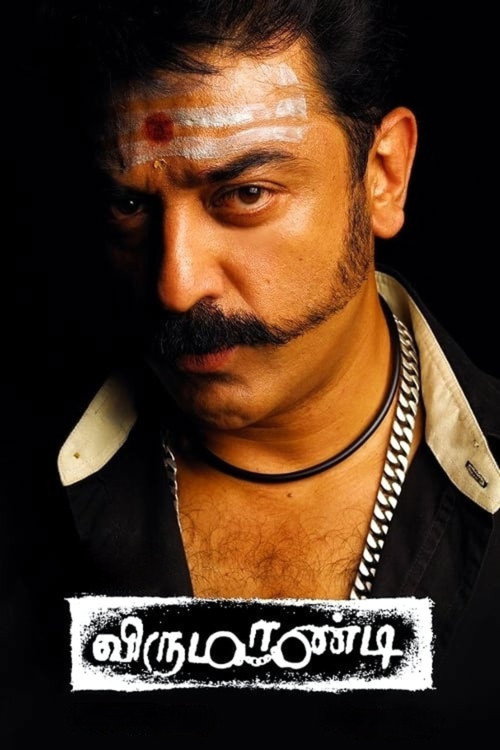
Virumaandi
2004 · Kamal Haasan
For when you want a meaty, full-blooded drama that entertains and argues at the same time — an intense evening's watch that leaves you debating whose story you trusted and why.
What it's about
A civil-rights advocate filming a documentary on the death penalty interviews two condemned men in the Madras Central Prison: Virumaandi, a hot-blooded young farmer, and Kothaala Thevar, a village strongman. Both were sentenced for their part in a massacre that ended a feud between two clans in the dry interior of southern Tamil Nadu — and each tells her a completely different version of how it happened. As their contradictory stories unspool, tensions inside the prison itself begin to boil.
The experience
Muscular and gripping, with the pulse of a rural action saga and the itch of a puzzle — you keep re-weighing who to believe as the same events replay from opposing mouths. It builds to a ferocious final stretch while quietly pressing its case against capital punishment.
Performances
Kamal Haasan gives Virumaandi a raw, guileless charm, but Pasupathy is the revelation as Kothaala Thevar — a coiled, calculating strongman whose version of events is as compelling as it is suspect.
The craft
Haasan writes, produces, directs, and stars, structuring the film as dueling testimonies so the same massacre is staged twice with different meanings. The village world is rendered with dusty, sweat-and-blood physicality, and the prison sequences tighten like a fist.
Why it matters
A landmark of 2000s Tamil cinema that fused the rural feud saga with a public argument against the death penalty, and further proof of Kamal Haasan's ambitions as a complete filmmaker.
Snapshot
Virumaandi is a Tamil-language drama-thriller written, produced, directed by, and starring Kamal Haasan — a rural revenge saga that doubles as an argument against capital punishment. The film uses a framing device borrowed from courtroom and documentary traditions: Angela Kathamuthu (Rohini), a civil-rights advocate compiling a documentary on the death penalty, interviews two condemned prisoners at the Madras Central Prison. From these interviews the film reconstructs, twice over, the story of a feud between two clans in the arid, faction-riven interior of southern Tamil Nadu. Virumaandi (Kamal Haasan), a hot-blooded but essentially guileless young farmer, and Kothaala Thevar (Pasupathy), a village strongman, offer contradictory accounts of the same catastrophic events — a massacre of two dozen people — and the film stages both versions in turn, forcing the viewer to weigh testimony rather than accept a single omniscient truth. The picture is best known for its multi-perspective structure, its unusually raw depiction of rural caste-adjacent factionalism, and the off-screen controversy over its original title. It stands among the more ambitious entries in Kamal Haasan's directorial and authorial output, a body of work defined by formal experiment and social provocation.
Industry & production
Virumaandi was produced under Kamal Haasan's own banner, Raaj Kamal Films International, the vehicle through which he financed and controlled his most personal projects. This self-production model is central to understanding the film: it allowed Kamal to pursue material — rural violence, the ethics of state execution, a deliberately unresolved narrative — that a risk-averse studio system built around star vehicles and romance might have resisted.
The film became a cause célèbre before release over its title. It was originally announced as Sandiyar, a word carrying connotations tied to a specific caste identity in the Tamil social landscape; the announcement drew objections from caste and political organizations who read the title as inflammatory or as appropriating a community's name. Amid the protests, Kamal Haasan changed the title to Virumaandi, the name of the protagonist. The episode is well documented as a public controversy and is frequently cited in discussions of the film; the precise sequence of negotiations and the full roster of groups involved are matters where accounts vary, and I will not manufacture specifics beyond the established fact of the retitling.
On the commercial and reception side, the film's exact box-office figures are not something I can state reliably, and I will not invent numbers. It is generally regarded as a critically respected work that did not become one of Kamal's largest popular hits, consistent with its demanding structure and grim subject.
Technology
Virumaandi was produced in the early-2000s Tamil industry, a period still overwhelmingly rooted in 35mm photochemical film capture and cutting over to digital-intermediate and non-linear editing workflows. The film was shot on film stock, with its look built around natural rural exteriors, hard sunlight, and the dust-and-stone textures of the interior countryside. The specific camera systems and lab processes are not details I can attest to with confidence, so I will not assign particular equipment to the production. What is safe to say is that the film belongs to the transitional moment in Indian cinema when sound design and mixing were increasingly handled in dedicated digital environments, allowing the layered, echoing prison-interview audio and the dense village-crowd soundscapes that the film relies on. The technological ambition here is less about novel gadgetry than about marshaling conventional film craft in service of a complex temporal structure.
Technique
Cinematography
The film's visual grammar is organized around a contrast between two spaces: the confined, hard-surfaced interiors of the prison, where the framing narrative unfolds in interview and confrontation, and the wide, sunbaked rural exteriors where the remembered story plays out. The countryside is photographed for heat and openness — long sightlines across fields, wells, and stone thresholds — which the film exploits both for lyricism and for the sudden eruption of violence into open ground. Because the narrative is delivered as competing testimonies, the cinematography also carries an epistemological burden: it must render "the same" events twice while letting the viewer sense whose account is being visualized. The film's handling of the climactic massacre and the prison-riot sequences is often singled out in discussion for its scale and chaos.
Editing
Editing is arguably the film's defining craft dimension, because the entire architecture depends on the intercutting of frame and flashback, and on the juxtaposition of two irreconcilable versions of one history. The cut is where the film's argument lives: by returning to the prison interview and then re-entering the past from a different mouth, the editing continually reminds the viewer that what they are watching is testimony, not fact. This structure invites the audience to become a kind of juror, comparing sequences that overlap in incident but diverge in blame. The film sustains this without collapsing into confusion, which is a considerable editorial achievement given the density of characters and the scale of the concluding violence.
Mise-en-scène / staging
The staging is grounded in a specifically rural, agrarian world — village compounds, communal gathering spaces, fields, the physical apparatus of feud and honor. Kamal Haasan's approach to the milieu is textural and unglamorous; the film wants the audience to feel the parched materiality of the setting and the social density of clan life, where every relationship is freighted with obligation and grievance. Within the prison, the staging turns claustrophobic and frontal, organized around the act of listening — Angela with her recording apparatus, the prisoner as narrator. The contrast between the crowded, mobile village stagings and the fixed, contained prison stagings reinforces the film's structural split between story-as-lived and story-as-recounted.
Sound
Sound serves the double narrative. Music by Ilaiyaraaja underscores the rural saga with an idiom rooted in Tamil folk and classical traditions, lending the past its emotional weight, while the prison sequences lean on ambient hardness — echo, footsteps, the murmur of incarcerated men. The soundscapes of crowd and combat in the massacre and riot sequences are built for density and disorientation. Ilaiyaraaja's involvement is notable in itself, given the composer's monumental standing in Tamil cinema and his long, storied association with Kamal Haasan.
Performance
Performance is the film's connective tissue. Kamal Haasan plays Virumaandi as an impulsive, physically expressive young man whose innocence is precisely what the two-testimony structure keeps in doubt — the role asks the actor to be sympathetic while leaving open whether that sympathy is earned or manipulated. Opposite him, Pasupathy as Kothaala Thevar delivers a performance widely praised as a career landmark, a coiled, imposing presence who embodies the film's other version of the truth. Rohini's Angela functions as the audience's surrogate and moral conscience, the outsider whose documentary frame gives the film its investigative posture. Napoleon and Abhirami feature among the ensemble that populates the feuding world. The film is, in large part, a showcase for the way strong character actors can hold a morally ambiguous structure together.
Narrative & dramatic mode
The dominant mode is the multi-perspective testimony narrative — a structure most famously associated in world cinema with the "same event, different accounts" tradition, and one that Virumaandi deploys in a specifically Tamil register. The film is built as a frame narrative (the prison documentary) enclosing dueling flashbacks (Virumaandi's account and Kothaala's account). This makes it a work about the unreliability of narration and the difficulty of arriving at justice on the basis of testimony — a thematically loaded choice given that the frame is explicitly about the death penalty. The dramatic engine is the feud: a spiral of honor, retaliation, and escalation that culminates in mass killing and in the condemnation of the two narrators. The film's refusal to grant the viewer a single authoritative version is not a gimmick but the point; it dramatizes how the machinery of judgment, including capital judgment, operates on contested and partial accounts.
Genre & cycle
Virumaandi sits at the intersection of the rural revenge drama, the action film, and the social-issue picture. Tamil cinema has a durable tradition of "rural" or "village" films centered on land, caste, honor, and factional violence, and Virumaandi belongs recognizably to that lineage while complicating it through its formal ambition. It is also, in its interview frame and its explicit engagement with the death penalty, an issue film — a work of advocacy cinema wrapped inside a genre package. Within Kamal Haasan's own filmography it belongs to a cycle of formally and thematically restless projects in which he used star power and self-production to push Tamil popular cinema toward denser structures and more uncomfortable subjects.
Authorship & method
Virumaandi is emphatically an auteur project. Kamal Haasan wrote, produced, directed, and starred in it, concentrating authorship to a degree few figures in any national cinema command. His method here is consistent with his broader career: use the leverage of stardom to finance experiment, and treat popular genre as a delivery system for formal risk and social argument. The choice to build a mainstream feature around an anti-death-penalty thesis and a deliberately unresolved double narrative is characteristic of his willingness to subordinate straightforward audience gratification to ideas.
Among his key collaborators, the composer Ilaiyaraaja is the most historically weighty — one of the towering figures of Indian film music, whose scoring gives the rural saga its emotional and cultural grounding. The performances of Pasupathy and Rohini are essential to the film's design, with Pasupathy's turn often credited as a breakout. On the specific identities of the film's cinematographer and editor I do not have reliable, verifiable information at hand, and rather than attach names speculatively I will flag that the record, as available to me, is thin on those precise credits; readers should consult the film's authoritative credits for those attributions. This is a case where honesty about the limits of my knowledge is preferable to invention.
Movement / national cinema
The film is a product of Tamil cinema (Kollywood), the Chennai-centered, Tamil-language industry that is one of the major pillars of Indian film. Tamil cinema carries a distinctive relationship between screen and society — a long history in which film stardom and regional politics have been deeply entangled, and in which caste, class, and rural life have been recurring, contested subjects. Virumaandi's pre-release title controversy is itself a symptom of that entanglement: in the Tamil context, the naming of a film can become a genuine political event. The film also belongs to a broader current in early-2000s Indian cinema in which established stars used their clout to back more personal, socially pointed work, and in which the "realist" rural film gained renewed prominence against the backdrop of the industry's more escapist mainstream.
Era / period
Arriving in 2004, Virumaandi sits in the early-2000s Tamil industry, a moment poised between the celluloid tradition and the digital workflows that would soon reshape production and exhibition, and a moment when a new generation of directors was pushing rural realism and darker social themes into the popular mainstream. The film reflects the period's appetite for grittier, more morally complicated storytelling, and it anticipates the harder-edged rural dramas that would become a significant strand of Tamil cinema in the following decade. Its subject — state execution — also resonates with contemporaneous public debate in India over the death penalty, giving the film a topical charge in its moment.
Themes
The film's central theme is the unreliability of truth and the peril of judgment based on testimony — a theme it fuses with a direct critique of capital punishment. If a court, or a society, must condemn on the basis of accounts as contradictory as Virumaandi's and Kothaala's, the film asks, how can the irreversible act of execution ever be just? Around this core sit the film's other preoccupations: the destructive logic of honor and feud, in which retaliation begets retaliation until it consumes a whole community; the entrenchment of caste and clan identity in rural life; the corrosive interplay of land, loyalty, and violence; and the position of the outsider-observer (Angela, the documentarian) whose attempt to extract truth becomes entangled in the very story she records. The film's insistence on two versions is, finally, a moral and epistemological argument in structural form.
Reception, canon & influence
Critically, Virumaandi has been received as one of the more serious and ambitious works in Kamal Haasan's directorial career, admired for its structural daring, its unflinching rural realism, and its performances — Pasupathy's in particular is frequently singled out as a landmark. It is generally treated as a significant, respected film rather than a blockbuster, its demanding form and grim material limiting its mass appeal even as they secured its reputation among cinephiles and critics. I will not attach specific awards or figures to it beyond noting that reliable specifics of its commercial performance are not something I can confirm.
Looking backward, the film's influences are legible: the multi-perspective, contested-testimony structure connects it to a venerable world-cinema tradition of narratives that stage a single event through irreconcilable accounts, and its rural-feud subject draws on Tamil cinema's own long lineage of village dramas centered on honor and factional violence. Kamal Haasan's authorial fingerprints — the fusion of popular form with formal experiment and social argument — link it to the rest of his self-produced work.
Looking forward, Virumaandi is often cited as a touchstone for the wave of hard, realist rural Tamil dramas that gained prominence in the years after it, films that treat caste, land, and violence with comparable seriousness and a comparable refusal of easy moral resolution. It also stands as a reference point in discussions of Pasupathy's rise as a character actor and of Kamal Haasan's status as an actor-director willing to marshal stardom in the service of difficult ideas. Its most durable legacy may be as proof of concept: evidence that Tamil popular cinema could carry a genuinely complex narrative architecture and a pointed social thesis without abandoning the register of the mainstream feature.
Reception
Released for Pongal 2004 under a cloud of protest — it had to shed its original title before it even hit screens — and earned strong reviews but only decent business; two decades on it's routinely ranked among Kamal Haasan's finest hours as a director and one of the great Tamil films of the 2000s.
How Virumaandi was received, from release to now →
How to watch Virumaandi: what to notice on a first viewing
- Notice the film return to the prison interview between village scenes. Each time the story returns to Angela's recording session, a new voice picks up the same history from a different angle. The structure keeps reminding you that everything you are seeing is someone's account, not settled fact.
- Watch how open and sunbaked the village looks against the tight prison. The countryside is shot for heat and long sightlines across fields and wells, while the prison stays confined and hard surfaced. The visual contrast marks the difference between story as lived and story as recounted.
- Notice how crowded the village looks next to the prison's frontal setup. Village life is staged as mobile and communal, while the prison scenes are organized around one person speaking and one person recording. The staging itself splits the film into a world of action and a world of testimony about that action.
- Watch Pasupathy's stillness compared to Kamal Haasan's more volatile physicality. Kothaala is coiled and imposing where Virumaandi is impulsive and expressive, two very different bodies telling two different versions of the same events. The contrast in physical register helps you track whose account you are inside at any given moment.
- Listen for how the score changes between rural flashbacks and prison scenes. Ilaiyaraaja's folk and classical idiom carries the past, while the prison relies on echo and ambient hardness instead of music. The sound design marks the boundary between remembered story and present confinement without needing a cut to tell you.
The whole guide to watching Virumaandi, with the keys for a rewatch →
Influences: the films it descends from and the films it influenced
- Rashomon (1950) — Supplies the core architecture Virumaandi rebuilds — a single act of violence replayed through mutually contradictory sworn testimonies, so that truth is dissolved into competing narrators rather than resolved by the camera.
- Citizen Kane (1941) — Models the framing device of an interviewer assembling a man's story from serial, partial accounts, with the investigation itself becoming the film's structural spine.
- A Short Film About Killing (1988) — Precedent for embedding an anti-capital-punishment thesis into form itself — juxtaposing a killing with a state execution so the argument is delivered by structure, not speeches, exactly the rhetorical move Virumaandi makes through its condemned-prisoner frame.
- 16 Vayathinile (1977) — Founded the Tamil practice of shooting the rural drama on real village locations in hard, unfiltered daylight, the agrarian-realist visual grammar Virumaandi inherits for its exterior feud sequences.
- Mullum Malarum (1978) — Establishes the Ilaiyaraaja idiom of folk instrumentation fused with classical structure to ground a rural saga, the same scoring approach carried directly into Virumaandi by the composer himself.
- Thevar Magan (1992) — Kamal Haasan's own earlier self-written star vehicle set in a village honor-feud, prototyping his method of using his stardom to carry caste-and-land violence with tragic seriousness.
- Nayakan (1987) — Kamal-as-actor in an ambitious auteur crime saga proving that a Tamil star could anchor a morally complex, formally daring feature — the actor-director alliance Virumaandi extends by consolidating all authorship in Kamal himself.
- Hey Ram (2000) — Kamal's immediately prior self-produced auteur project, likewise built on frame flashback and the fallibility of a single man's memory, sharing Virumaandi's habit of subordinating audience gratification to structural risk.
- Paruthiveeran (2007) — Leads the post-Virumaandi wave of hard rural realism — location-shot caste feud, coarse dialect, and a refusal of romantic or moral resolution in its violence.
- Subramaniapuram (2008) — Carries forward the grim agrarian-town realism and factional-loyalty-betrayal cycle, ending in unredeemed tragedy in the same anti-consolatory register Virumaandi legitimized.
- Aadukalam (2011) — Builds its drama from a rural agrarian milieu (cockfighting sub-culture) and an honor-and-betrayal cycle staged with the layered crowd-and-conflict soundscapes Virumaandi pioneered locally.
- Visaranai (2015) — Inherits Virumaandi's social-issue thesis film mode, turning custodial violence into a structural critique of state justice with the same unflinching, procedural realism.
- Pariyerum Perumal (2018) — Sustains the tradition of the caste-feud social-issue film that refuses easy resolution, treating rural violence as systemic rather than as a personal grudge to be settled.
- Asuran (2019) — Marshals a major star inside a flashback-structured land-and-caste revenge cycle, the exact combination — stardom in service of a difficult social argument told out of chronological order — that Virumaandi proved viable.
- Karnan (2021) — Stages caste-feud violence in a hard-sunlit agrarian landscape scored with folk instrumentation, continuing Virumaandi's fusion of rural realism with a pointed social thesis.
- Talvar (2015) — Independently deploys the same contested-testimony method — reconstructing one crime through several incompatible official versions — to indict the machinery of justice, the Rashomon logic Virumaandi applies to the death penalty.
- Aaranya Kaandam (2011) — Extends Virumaandi's appetite for non-linear, intercut construction into Tamil neo-noir, treating chronology as something to be fractured and reassembled rather than delivered straight.
- Anbe Sivam (2003) — Kamal's self-authored humanist thesis (against capital punishment) delivered through Rashomon-style talky, multi-perspective moral debate — the same talk-driven didacticism.
Similar films
- Nayakan (1987) — influence & lineage
- Asuran (2019) — influence & lineage
- Aadukalam (2011) — influence & lineage
- Hey Ram (2000) — influence & lineage
- Aaranya Kaandam (2011) — influence & lineage
- Pariyerum Perumal (2018) — influence & lineage
- Mahanadhi (1994) — shared sensibility
- Viduthalai: Part I (2023) — shared sensibility