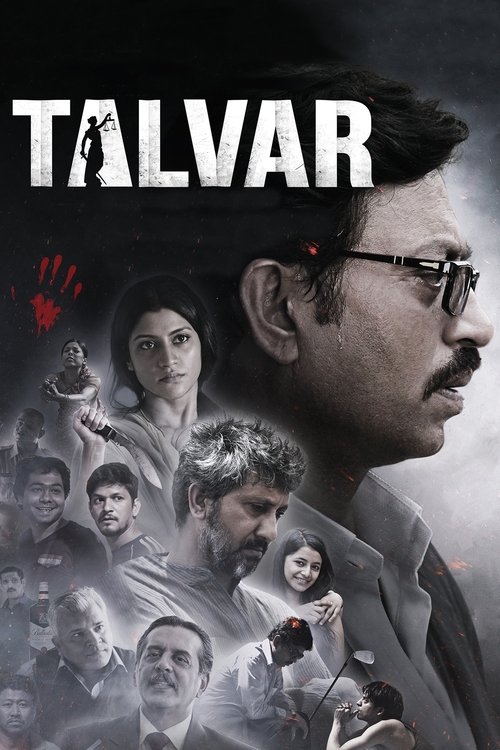
Talvar
2015 · Meghna Gulzar
For when you're in a true-crime mood but want intelligence instead of sensationalism — a film to argue about over dinner afterward.
What it's about
A teenage girl and the family's live-in servant are found murdered in a middle-class apartment near Delhi, and the parents become the prime suspects. An investigator from a central agency takes over from the bungling local police and reconstructs the night — but every team that touches the case builds a different version of the truth. Drawn from one of India's most notorious real murder cases.
The experience
A cool, gripping procedural that plays like a puzzle box: you watch the same night reassembled several ways and feel your certainty dissolve each time. It's tense without being lurid, and it leaves you angry in a productive way.
Performances
Irrfan Khan carries the film as the investigator — dry, watchful, mordantly funny, letting exhaustion and disgust seep through a professional mask. It's a masterclass in doing more with less.
The craft
Vishal Bhardwaj's screenplay is the star machinery: competing reconstructions of one night, staged and restaged so that the investigation itself becomes the subject. Meghna Gulzar directs with restraint, refusing tabloid heat, and a late roundtable scene between rival investigators is a small marvel of writing and cutting.
Why it matters
It reframed a media-circus murder case as a study of institutional failure and became one of the most respected Hindi films of its year — a benchmark for how mainstream Indian cinema can handle true crime responsibly.
Snapshot
Talvar is a Hindi-language crime procedural that dramatizes one of independent India's most notorious unsolved crimes: the 2008 killings, in a middle-class Noida apartment, of a teenage girl and the family's live-in domestic worker — the case known in the press as the Aarushi–Hemraj murders. Directed by Meghna Gulzar from a screenplay by Vishal Bhardwaj, the film reframes a sensational tabloid saga as a study in institutional failure, presenting the investigation itself, rather than the crime, as its subject. Its formal signature is the multiplication of narratives: the film lays out competing reconstructions of the same night — the bungled first response of the local police, and the divergent conclusions of two successive teams of the central investigating agency — inviting the viewer to watch not "what happened" but how truth is manufactured, discarded, and overwritten by the machinery meant to find it. The title, meaning "sword," puns on the family's surname (fictionalized in the film) and on the sword of justice, and the irony is the whole point: the blade cuts arbitrarily. Anchored by Irrfan Khan as a weary, sardonic investigator and by Konkona Sen Sharma and Neeraj Kabi as the accused parents, Talvar is compact, controlled, and quietly furious — a work that trusts procedure and performance over melodrama.
Industry & production
Talvar emerged from a specific corner of the Hindi film industry: the space, opened in the late 2000s and consolidated in the 2010s, where mid-budget "content-driven" cinema could find backing alongside the mainstream. It was produced under Vishal Bhardwaj's banner in partnership with Junglee Pictures (the film arm of the Times group), a pairing that gave a difficult, star-light, real-case subject both an auteur's credibility and corporate distribution muscle. Bhardwaj — himself an established writer-director-composer — took the roles of writer, producer, and music director, effectively acting as the film's creative guarantor, while Gulzar directed. This division of labor is central to reading the film: it is a Bhardwaj script realized through Gulzar's more restrained, less baroque sensibility.
The project also marked a decisive return for Gulzar, whose earlier features had made limited impact; Talvar re-established her as a serious director and set the template for the fact-based, socially engaged films that would define her subsequent career. The film premiered internationally at the Toronto International Film Festival in September 2015 before its Indian theatrical release that October, a festival-then-home rollout increasingly typical of prestige Hindi productions of the period. Because the underlying case was still in active legal appeal, the production fictionalized names and framed events as dramatization — a legal and ethical hedge that also shaped the film's careful, non-accusatory posture toward the still-living real individuals involved.
Technology
Talvar belongs to the era of digital-capture Hindi cinema, and its aesthetic is built around a plain, unglamorous image: naturalistic interiors, the fluorescent flatness of police stations and government offices, the cramped geometry of a middle-class flat. The film's technical ambition is directed inward — toward continuity, controlled restaging, and the seamless repetition of scenes shown from different investigative viewpoints — rather than toward spectacle. Its most demanding technical requirement is not effects but exactitude: the same physical spaces (the girl's bedroom, the terrace, the stairwell) must be reconstructed and re-shot so that competing versions of the night register as variations on an identical stage. Beyond these observable qualities, the detailed record of the specific camera and post-production packages used is thin in accessible sources, and I will not invent particulars; what matters critically is that the film uses its tools for suppression of style, not display of it.
Technique
Cinematography
Pankaj Kumar — the cinematographer of Ship of Theseus, Haider, and later Tumbbad — shoots Talvar in a deliberately undecorated register. Compositions favor the observational: medium shots that hold characters within institutional spaces, framings that let the drab architecture of Indian bureaucracy do expressive work. The camera is patient and largely unshowy, refusing the frenetic coverage of the television-news idiom the film critiques. Crucially, the cinematography must be complicit in the screenplay's structure — the crime scene and its environs are lit and framed to be recognizable across multiple retellings, so that when a later version contradicts an earlier one, the viewer feels the dissonance spatially. The visual restraint is a moral choice: by declining to aestheticize the crime, the film denies the audience the voyeuristic gratification the real case's media coverage supplied.
Editing
Editing is arguably Talvar's decisive craft, and it is handled by A. Sreekar Prasad, one of India's most decorated editors. The film's Rashomon-derived architecture lives or dies in the cut: the same events must be presented in incompatible versions, and the editing has to make each version internally coherent while keeping the contradictions legible. The film accumulates a procedural rhythm — interrogations, reconstructions, briefings — and reserves its most bravura passage for a late sequence in which the two rival investigative teams argue their theories in a single room, the cutting turning bureaucratic dispute into something close to farce and tragedy at once. The editing controls the film's information economy with precision, doling out and withholding certainty so that the audience experiences the investigation's own instability.
Mise-en-scène / staging
The staging is rigorously domestic and institutional. The apartment where the killings occurred is rendered with unsettling ordinariness — the mundane detail of a professional urban family's home becomes the crucible of horror. Government offices, court corridors, and police stations are staged to convey overcrowding, indifference, and procedural drift. A recurring formal device is the re-enactment: characters physically walk through reconstructions of the night, and the mise-en-scène foregrounds how each authority literally re-choreographs the bodies and the space to fit its preferred conclusion. Nothing is baroque; the horror is in the banality.
Sound
As composer, Vishal Bhardwaj scores the film with restraint unusual for mainstream Hindi cinema, which typically leans on song sequences. Talvar largely forgoes the conventional song-and-dance apparatus, using music sparingly to underline tension and grief rather than to provide interludes. The sound design privileges the textures of procedure — the murmur of offices, the clamor of media scrums, the silences of interrogation — and the relative musical austerity reinforces the film's documentary seriousness.
Performance
The performances are calibrated to the film's low-key realism. Irrfan Khan, as the investigator, supplies the film's spine: dry, wounded, self-aware, carrying a subplot of marital breakdown (with Tabu as his estranged wife) that quietly mirrors the film's larger theme of relationships strained past legibility. Konkona Sen Sharma and Neeraj Kabi, as the accused parents, resist easy sympathy or condemnation — their grief is opaque in ways the film insists we sit with rather than resolve. A deep bench of character actors — including performers cast as police officials, agency officers, and functionaries — gives the institutional world density and specificity. The ensemble's refusal of histrionics is essential to the film's argument: it withholds the melodramatic cues by which audiences (and the real public) rushed to judgment.
Narrative & dramatic mode
Talvar operates in the mode of the investigative procedural crossed with the multiple-perspective (Rashomon) structure. Its dramatic engine is epistemological rather than suspenseful in the conventional sense — we are less concerned with catching a culprit than with the impossibility of stable knowledge once institutions, egos, and prejudices intervene. The film presents conflicting reconstructions without fully arbitrating among them, though its sympathies clearly lean toward the incompetence-and-rush-to-judgment reading and away from the theory that convicted the parents. This is docudrama with a thesis: it uses the apparatus of realism to indict process. The dramatic irony is structural — the audience watches multiple authorities each certain of a different truth, and the certainty itself becomes the horror.
Genre & cycle
The film sits within a distinct 2010s cycle of Hindi "true-crime" and issue-driven realist cinema — films that took actual scandals, crimes, and social controversies as material for mid-budget, performance-led dramas aimed at urban, discerning audiences. Within crime cinema broadly, Talvar belongs to the procedural/anti-whodunit tradition rather than the action-thriller lineage; its closest structural ancestor is the multiple-perspective mystery, and its tonal register is closer to sober European and American investigative dramas than to masala crime spectacle. It also participates in a specifically Indian genre of the "media trial" critique, films skeptical of the sensational television-news culture that flourished after the 2000s.
Authorship & method
The film is a genuine dual authorship. Meghna Gulzar — daughter of the poet-lyricist-filmmaker Gulzar and actress Raakhee — directs with a restraint and clarity that distinguish her from her father's lyrical romanticism; Talvar announced her mature method of grounded, research-driven, socially conscious storytelling. Vishal Bhardwaj, as writer-producer-composer, brings the moral seriousness and structural ambition familiar from his Shakespeare adaptations (Maqbool, Omkara, Haider), though here in a spare, journalistic key rather than a tragic-operatic one; his screenplay was recognized with the National Film Award for Best Adapted Screenplay. Pankaj Kumar contributes the film's austere visual language; A. Sreekar Prasad shapes its intricate comparative structure in the cut. The method throughout is one of subtraction — stripping away the melodramatic conventions of the industry to let procedure, contradiction, and performance carry the weight.
Movement / national cinema
Talvar is a product of the "New Bollywood" or Hindi independent-adjacent current of the 2010s: films made within or beside the mainstream industry that embraced realism, real subjects, and restrained form, enabled by corporate studio backing, multiplex audiences, and festival routes. It reflects a national cinema in transition, negotiating between the song-driven commercial tradition and a globally legible realist idiom. Its engagement with a specific Indian social reality — the anxieties of the urban professional middle class, the fault lines of class and domestic labor, the failures of policing and the excesses of news media — roots it firmly in the concerns of contemporary Indian society even as its Rashomon structure signals its dialogue with world cinema.
Era / period
Released in 2015, the film is contemporary to its making, but it reconstructs the India of 2008 and the years of legal and media aftermath. The period texture it evokes is that of late-2000s urban India: the boom of 24-hour news channels, the culture of televised speculation, and the specific milieu of Noida's aspirational middle class. The film is acutely a work of its moment in another sense — it entered public conversation while the real case remained under judicial appeal, giving it an unusual charge as an intervention into an unresolved present rather than a settled history.
Themes
The film's governing theme is the unreliability of institutional truth — how policing, forensic process, bureaucratic rivalry, and media pressure between them produce "facts" that serve narrative convenience over reality. Closely tied is the theme of class: the differential treatment of the family and the domestic worker, and the assumptions about servants and employers that shape the competing theories, expose the caste and class prejudices embedded in Indian investigation and public opinion. A third strand is the media trial — the film is a sustained critique of sensationalist journalism that convicts in advance of evidence. Underlying all of these is grief and its illegibility: the film refuses to tell us how the bereaved "should" look, and it makes that refusal a rebuke to a public that read the parents' composure as guilt. The investigator's own failing marriage threads a quieter theme of the general difficulty of ever truly knowing another person's interior.
Reception, canon & influence
Critically, Talvar was widely acclaimed on release, praised for its screenplay, its editing, the ensemble's control, and its refusal of easy answers; it was frequently cited among the strongest Hindi films of its year. Its most significant formal recognition came in Vishal Bhardwaj's National Film Award for Best Adapted Screenplay. (I note that detailed commercial figures should be treated with caution and I will not cite specific box-office numbers.)
Looking backward, the film's clearest influence is Akira Kurosawa's Rashomon and the broader tradition of multiple-perspective crime narrative; it also draws on the international lineage of the sober investigative procedural and docudrama, and on India's own strain of socially conscious realist cinema. Its most immediate source, of course, is journalistic and legal — the vast public record of the real case, which Bhardwaj's screenplay distilled and reframed.
Looking forward, Talvar is best understood as a keystone of the 2010s Hindi true-crime and issue-drama wave, helping to legitimize the treatment of real, unresolved, ethically fraught cases in mainstream-adjacent cinema and demonstrating that a star-light, realism-driven film on a grim subject could achieve both prestige and reach. For Meghna Gulzar personally it was foundational, establishing the method she carried into subsequent fact-based work. The real case itself continued after the film — the accused parents, convicted in the lower court before the film's release, were acquitted on appeal by the Allahabad High Court in 2017 — a development that retroactively strengthened the film's skeptical thesis and has kept Talvar in circulation as a reference point in discussions of media, justice, and wrongful conviction in India. Its lasting contribution is a template: how to turn a sensational tragedy into a rigorous, unsentimental interrogation of the systems that failed it.
Reception
Acclaimed on arrival (it premiered at TIFF 2015) but shadowed by accusations of taking sides, it gained an eerie afterlife in 2017 when the Allahabad High Court acquitted the real-life parents — suddenly the film read less like advocacy and more like prophecy.
How Talvar was received, from release to now →
How to watch Talvar: what to notice on a first viewing
- Track how many times the same night gets reenacted. The film keeps returning to the crime scene through different investigators' reconstructions, each version slightly different from the last. You start watching how a story gets built, not just what happened.
- Notice the camera hold steady on ordinary office rooms. Pankaj Kumar shoots in patient medium shots, refusing the frantic cutting of television news, so bureaucratic spaces get the same plain treatment as the crime scene. The plainness keeps you from being pulled into sensational feeling the real case's coverage supplied.
- Listen for how rarely music enters a scene. Bhardwaj withholds the song-and-dance sequences typical of Hindi cinema and uses score sparingly, only to underline tension or grief. The quiet keeps the film feeling like reporting rather than melodrama.
- Watch investigators physically walk through the crime scene again. Characters reenact the night by moving through the actual rooms, and each team re-choreographs the same bodies and doorways to fit its own theory. You can see each authority literally staging its preferred version of events.
- Watch the parents' faces for what the film refuses to explain. Konkona Sen Sharma and Neeraj Kabi play grief without the melodramatic cues an audience expects, resisting easy sympathy or condemnation. The film withholds the exact signals a courtroom or a crowd would use to decide guilt.
The whole guide to watching Talvar, with the keys for a rewatch →
Influences: the films it descends from and the films it influenced
- Rashomon (1950) — Supplies the contradictory-testimony architecture Talvar adopts wholesale — a single crime replayed as mutually exclusive accounts, so the cut between versions, not a detective's deduction, becomes the film's engine of doubt.
- The Thin Blue Line (1988) — Pioneers the stylized re-enactment of divergent witness statements to dismantle a wrongful conviction; Talvar's re-staged versions of the murder night and its comparative montage descend directly from Morris's method of filming testimony as competing reconstructions.
- Zodiac (2007) — Models the information-economy procedural about an unsolved case — an accreting ledger of contradictory detail, timestamps, and dead ends that withholds any named culprit, the exact discipline of restraint Sreekar Prasad's cut imposes.
- Memories of Murder (2003) — Establishes the true-crime procedural whose real subject is institutional incompetence — sloppy, coercive policing rendered with tonal control and no closure — the template for Talvar's dueling investigative agencies.
- All the President's Men (1976) — Turns bureaucratic procedure — phone logs, file rooms, corridor waits — into suspense, the observational rendering of institutional banality Talvar uses to make CBI briefings and paperwork carry dramatic weight.
- Z (1969) — The political docudrama that reconstructs a real case to indict an institutional cover-up, using investigation as an instrument to expose the machinery of the state rather than to comfort the audience with justice.
- In Cold Blood (1967) — The austere, monochrome reconstruction of an actual murder that founds the true-crime docudrama's ethic of documentary sobriety over sensational melodrama.
- A Separation (2011) — Perfects the epistemological drama in which every party's account is partial and self-serving, staged inside legal and class friction, with the film itself declining to issue a verdict — the exact moral posture Talvar assumes.
- Ardh Satya (1983) — The Indian parallel-cinema police procedural that stripped song-and-dance melodrama for a grounded, socially conscious realism, providing Talvar's native lineage of institutional critique and anti-melodrama performance.
- No One Killed Jessica (2011) — The immediate Hindi precursor: a real, verdict-fraught murder treated as docudrama with the media trial foregrounded, demonstrating that a fact-based crime case could be dramatized for a mainstream-adjacent audience.
- Shahid (2013) — The fact-based issue-drama about wrongful prosecution that legitimized the low-key, research-driven realist register — the anti-melodramatic performance economy Talvar's ensemble extends.
- Haider (2014) — Bhardwaj's writer-composer method — structural moral seriousness plus a controlling musical hand — carries into Talvar inverted: the operatic score of his Shakespeare cycle becomes deliberate sonic austerity here.
- Raazi (2018) — Gulzar carries forward Talvar's research-driven, restraint-first method of adapting real events, subordinating star charisma to procedural credibility and controlled performance.
- Article 15 (2019) — Extends the 2010s Hindi issue-drama-procedural Talvar helped legitimize — using the police investigation of a real-feeling crime as a vehicle for caste critique and an indictment of institutional truth.
- Delhi Crime (2019) — Adopts Talvar's observational, star-light procedural realism for a documented case, building tension from institutional texture — shift rosters, jurisdiction, exhaustion — rather than melodrama.
- Chhapaak (2020) — Gulzar's continuation of the fact-based, unsentimental issue film she inaugurated with Talvar, again interrogating the systems that fail a victim rather than sensationalizing the crime.
- Court (2014) — Films the legal-institutional machine as tedious, dehumanizing process through fixed observational framing, sharing Talvar's staging of institutional banality even as it strips procedure to near-documentary flatness.
- Virumaandi (2004) — Independently deploys the same contested-testimony method — reconstructing one crime through several incompatible official versions — to indict the machinery of justice, the Rashomon logic Virumaandi applies to the death penalty.
- Drishyam (2013) — Shares the naturalistic-procedural realism and the thesis that an investigation's 'truth' is a narrative that gets constructed and reconstructed by how evidence is sequenced and disclosed.
- Drishyam (2015) — Released weeks after Drishyam and built on the same editing device — the same night replayed with competing reconstructions — while sharing its thesis that police procedure is a class instrument, with the middle-class family's account weighed against the investigating officer's need for a story.
Similar films
- Haider (2014) — influence & lineage
- Memories of Murder (2003) — influence & lineage
- Drishyam (2015) — shared sensibility
- Dhurandhar (2025) — shared sensibility
- Vikram Vedha (2017) — shared sensibility
- Drishyam (2013) — shared sensibility
- Visaranai (2016) — shared sensibility
- Homebound (2025) — shared sensibility