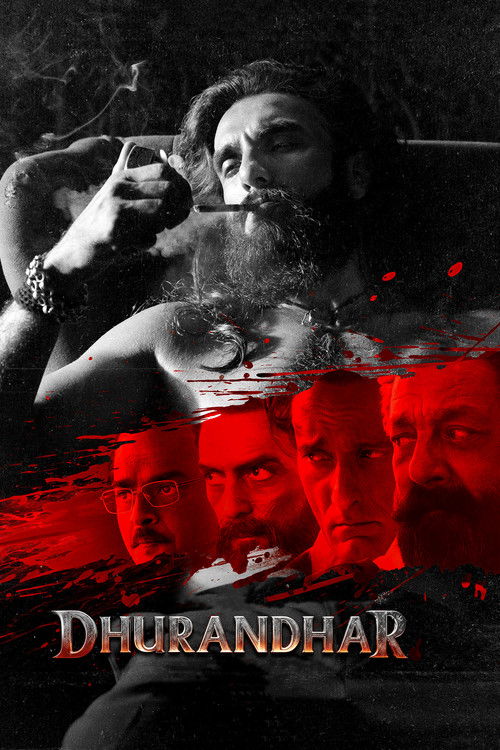
Dhurandhar
2025 · Aditya Dhar
When you want a heavy, immersive underworld thriller to disappear into — tense, violent, morally murky. This is a challenge watch, not a comfort one; know that the intensity and the politics both run hot.
What it's about
In the early 2000s, an Indian deep-cover operative is planted inside Karachi's criminal underworld, working his way into an inner circle where gangland power interlocks with Pakistan's security apparatus. The mission is to dismantle a violent nexus from within — which means becoming, convincingly and for years, one of the people he's there to destroy.
The experience
Long, dark, and punishing — this is espionage as endurance, with graphic violence and a constant hum of paranoia rather than gadget-thriller gloss. It grips like a crime novel: slow infiltration, sudden brutality, the dread of a cover one mistake from collapsing.
The craft
Aditya Dhar follows his breakout Uri: The Surgical Strike with something more novelistic — a years-spanning infiltration built as a large-scale star vehicle, trading the single-operation structure for a slow descent through a criminal economy. It's mounted big: dense production design, hard-hitting action, sound and scale that reward a theater-grade setup.
Why it matters
It sits at the center of the 2020s wave of Hindi nationalist action-thrillers — commercially potent, politically charged, and controversial for exactly that reason — and confirms Dhar as that movement's defining director.
Snapshot
Dhurandhar is Aditya Dhar's second feature as director, arriving seven years after Uri: The Surgical Strike (2019) made him the most commercially consequential new voice in Hindi nationalist action. Where Uri dramatised a single, publicly acknowledged military operation across a compressed timeline, Dhurandhar reaches for something longer, dirtier and more novelistic: an undercover operative planted inside the criminal economy of Karachi in the 2000s, rising through a gangland whose upper reaches interlock with the Pakistani state's security apparatus. The title is a Sanskrit-derived word — literally the bearer of the yoke or axle, idiomatically the one who carries the decisive burden, the champion — and the film takes it seriously as a description of what a deep-cover agent is asked to be.
The picture is built as a star ensemble around Ranveer Singh, with Sanjay Dutt, R. Madhavan, Akshaye Khanna and Arjun Rampal occupying the poles of the Karachi story — enforcement, handling, intelligence, and the gang itself — and Sara Arjun in the principal female role. It was produced by Jio Studios with Dhar's own B62 Studios and released theatrically in December 2025 at a runtime well beyond three hours, an extreme length even by the maximalist standards of contemporary Indian commercial cinema.
Two things make it worth a dossier entry beyond its commercial scale. First, it is the point at which the post-2019 Hindi nationalist-action cycle absorbs the grammar of the international crime epic — Donnie Brasco, Infernal Affairs, Gomorrah — rather than that of the war film. Second, it is a film whose entire setting is a place its makers categorically cannot visit: a Karachi built from research, production design and digital extension, which raises questions about verisimilitude that the film's own claims to fact make unavoidable.
A note on sourcing: this is a very recent release, and the granular production record — camera package, location breakdown, edit-room history, the division of scoring labour — is not yet documented with the reliability a dossier should demand. Where that is the case below, it is said plainly rather than filled in.
Industry & production
Dhurandhar belongs to a specific industrial formation that did not exist before roughly 2019: the Hindi studio-financed, star-led, fact-adjacent action film whose commercial logic is national-event cinema. Jio Studios, the Reliance-backed production and distribution arm that became one of the most prolific Hindi financiers of the 2020s, backed the film alongside B62 Studios, the company Dhar established with Lokesh Dhar after Uri. That structure — a director-owned label operating inside a conglomerate's slate — is the dominant shape of ambitious Hindi production now, and it is how Dhar retained authorship over a project of this budget class.
The context of the release matters. The Hindi theatrical market spent 2020–2023 in crisis, losing its middle to streaming and its event business to Telugu and Kannada imports. The recovery from 2023 onward ran almost entirely through spectacle at scale and through hard-R-adjacent star vehicles. A December release — the year-end corridor that has historically carried the largest Hindi openers — signalled the studio's confidence.
It also arrived into a charged political moment. India and Pakistan had been through a military exchange earlier in 2025, and any Hindi film set inside Pakistan now enters public discussion pre-politicised. The project's development long predates that flashpoint, and it would be a category error to read the film as a response to it; but its reception cannot be separated from it.
The film drew pre-release legal attention, reported at the time, from parties connected to real Pakistani figures whose lives appear to have informed its characters, seeking to restrain the release on personality-rights and defamation grounds. Indian courts have generally declined to enjoin such releases, and the film went out on schedule. The precise procedural history is the sort of detail that hardens only with time, and it is offered here as reported rather than settled.
Technology
The most consequential technological fact about Dhurandhar is a political one: no Indian production can shoot in Karachi. The film's entire world is therefore a reconstruction — built through production design, plausible-analogue locations elsewhere, and digital environment work that extends sets into a city skyline, a port, and the dense low-rise sprawl the narrative requires. This is a longstanding condition of Indian films set in Pakistan, from Veer-Zaara (2004) onward, but the standards have changed: audiences who have seen Gomorrah and City of God expect a lived-in, granular urban texture, not a backlot. Meeting that expectation without access to the referent is a genuine technical achievement and also the film's central verisimilitude risk.
The broader technological baseline is the one now standard for Hindi tentpoles: large-sensor digital capture with heavy in-camera lensing character, an extensively graded digital intermediate that carries much of the period signalling, and a Dolby Atmos theatrical mix designed for the multiplex. The specific camera and lens package has not been reliably documented in accessible sources, and is left open here rather than guessed at.
One further technological dimension is distributional. The film's pre-release visibility was driven by teaser and trailer material circulating on YouTube and short-video platforms, and by music released as standalone units ahead of the picture. This is now the primary marketing technology of Hindi cinema, and it shapes the films themselves: sequences are increasingly constructed to yield a self-contained, vertically croppable, thirty-second unit. Dhurandhar's most discussed passages before release were exactly such units.
Technique
Cinematography
The film's visual register is the grimed, desaturated-to-amber palette that the international crime epic standardised and that Hindi cinema absorbed through Gangs of Wasseypur (2012) and Sacred Games (2018–19): low-key interiors, practical-source motivation, handheld coverage in the violence, and a wide-lens proximity that keeps faces close and the environment legible behind them. Against that, the film uses the scale registers of the nationalist-action cycle — controlled crane and drone moves that convert a street into a battlefield geography, and the hero-introduction grammar of the star vehicle.
The tension between those two modes is the film's central formal problem. Deep-cover drama wants observational flatness, the camera as a compromised witness; star spectacle wants the camera to celebrate. Dhurandhar does not fully resolve this, and the seam is visible.
The cinematographer of record has not been consistently documented in reliable sources available for this entry; Dhar's Uri was shot by Mitesh Mirchandani, whose cool, handheld, low-contrast approach to the night raid is an obvious point of comparison, but continuity of that collaboration should not be assumed here.
Editing
The runtime — beyond three hours — is the editorial signature. This is a deliberate choice with a clear lineage: RRR (2022), Animal (2023), Kalki 2898 AD (2024) and the Telugu event films re-established the long form as a marker of scale rather than indulgence, reversing two decades of Hindi tightening toward the 150-minute multiplex norm. Length in this cycle functions as a value proposition.
Structurally, an infiltration narrative supports length better than most: it requires accumulated time to make an assumed identity feel earned, and the genre's canonical works (Donnie Brasco, 1997; Infernal Affairs, 2002) are precisely about duration wearing down a self. The risk is the opposite one — that spectacle set pieces arrive at studio-mandated intervals and interrupt the slow corrosion the drama depends on.
Shivkumar V. Panicker cut Uri, and his rhythmic, percussive assembly there was central to that film's effect. Whether the collaboration continued on Dhurandhar is not something this entry can confirm.
Mise-en-scène / staging
The production design carries an unusual load, since it is doing the work of a city that cannot be photographed. The recurring spaces — the gang's interior world, the police station, the safe house, the street — must establish a social order visually, because the film's politics are legible mostly through who occupies which room and on what terms.
The action staging belongs to the post-Animal, post-Kill (2024) Hindi mode: close-quarters, weight-forward, blunt-instrument violence staged in confined geography rather than the wire-assisted balletic style of the War/Pathaan spy universe. The choice is meaningful. The Yash Raj Spy Universe stages its violence as glamour; Dhurandhar stages it as labour and damage, which is the correct register for a film about a man who has to become the thing he is destroying.
Sound
Shashwat Sachdev has been Dhar's composer of record since Uri, where his martial, electronic-percussive score was inseparable from the film's cultural impact — that film's rhythmic signature entered the national vocabulary in a way few Hindi scores have. Hindi commercial practice typically divides score and songs among multiple hands, and the exact attribution of Dhurandhar's music is not something this entry will assert. What is clear is that the film's pre-release music circulated as an independent cultural event, in line with how Hindi soundtracks now function.
The mix design in this genre does specific ideological work: gunfire is given weight and locality, ambient Karachi is built as a continuous sonic field to compensate for the fabricated image, and the score's absence in the infiltration sequences is as important as its presence in the set pieces.
Performance
Ranveer Singh's casting is the film's most interesting performance decision. Singh built a persona on maximalist extroversion — Gunday, Bajirao Mastani, Padmaavat, Simmba — and an undercover role inverts that instrument entirely: the part requires a man whose whole craft is suppression. The most successful passages of this kind of performance are the ones where the performer's natural charge is visibly held down.
Akshaye Khanna, for two decades Hindi cinema's most precise minimalist and most consistently underused major actor, is the ensemble's counterweight; his register of quiet, unhurried menace is the film's most-discussed performance element. Sanjay Dutt brings a physical authority whose real-world biography inevitably inflects any role on the criminal side of a law-and-order story, and R. Madhavan supplies the film's institutional conscience. Arjun Rampal's gang-boss work extends a late-career turn toward hardened character parts.
Narrative & dramatic mode
The film operates in the infiltration mode, whose dramatic engine is not plot but ontology: the agent's cover identity begins as a tool and becomes, over accumulated time, an alternative self. Every canonical example is organised around the same question — what remains of the man when the mission ends. Donnie Brasco answers it with loss of family; Infernal Affairs with the erasure of the record that proves who you were; Raazi (2018) with moral ruin.
Dhurandhar layers this onto a second mode: the rise-through-the-ranks gangster chronicle, which supplies the film's forward momentum and its period sweep. The combination is productive, because the two modes want opposite things from the protagonist — the gangster narrative wants him to succeed, the spy narrative wants his success to be a form of self-destruction. The film's dramatic mode also includes a third element characteristic of its cycle: the institutional-briefing frame, in which handlers articulate the operation's stakes in explicitly national terms. This is where the genre's rhetoric lives, and where it is least ambiguous.
Genre & cycle
Dhurandhar sits at the intersection of three identifiable cycles.
The first is the post-2016 Hindi nationalist-action cycle — Uri (2019), Kesari (2019), Shershaah (2021), Article 370 (2024), Fighter (2024) — which converted military and intelligence events into mainstream spectacle, and which Uri effectively inaugurated as a commercial category.
The second is the Hindi spy film's longer arc: Agent Vinod (2012), Ek Tha Tiger (2012), D-Day (2013), Phantom (2015), Baby (2015), Raazi (2018), and the Yash Raj Spy Universe from Tiger through Pathaan (2023) and War 2 (2025). D-Day and Baby are the closest structural antecedents — both concern Indian operatives working inside Pakistan, both weigh procedural grit against star spectacle. Raazi, directed by Meghna Gulzar, remains the mode's artistic high-water mark and its ethical conscience.
The third is the ultraviolent Indian star vehicle of the 2020s — KGF (2018/2022), Animal (2023), Kill (2024), Marco (2024) — which normalised graphic brutality, extended runtime and morally unredeemed protagonists in mainstream Indian release. Dhurandhar's violence is legible only against this cycle; a decade earlier it would have been unreleasable in this form.
Authorship & method
Aditya Dhar's authorship is best understood as a method rather than a style. Uri demonstrated the template: take a recent, publicly known event; research it to the point where procedural detail carries conviction; structure it in chapters; give it a percussive score and a chant-like verbal hook; and cast a star willing to be physically remade. Dhar won the National Film Award for Best Direction for Uri, and then, notably, stepped back from the chair — writing and producing Article 370 (2024) rather than directing it — which suggests a filmmaker consolidating a production identity as much as a directorial one.
Dhurandhar tests whether that method survives its own expansion. The Uri template depends on a documented event that supplies a spine; an infiltration chronicle spanning years has no comparable public record, and the film must therefore invent where Uri could reconstruct. That is the central authorial gamble, and it is why the film's relationship to its real-world models — figures from the Karachi gang wars and from Pakistan's security services — became a live question before release rather than after.
Dhar writes his own material, and the writing carries his recurring preoccupations: institutional competence as a moral value, the operative as a person whose interiority is a professional liability, and the nation as the only entity whose claims outrank the personal. As noted above, the technical collaborators on this film are not documented with sufficient reliability to attribute confidently; readers should consult the film's own credits rather than this entry for cinematography, editing and music attribution.
Movement / national cinema
The film is a Hindi-language Bombay production, and belongs to the phase of that industry's history defined by two pressures: the loss of its pan-Indian dominance to Telugu and Kannada cinema after 2018, and the increasing alignment of its most commercial output with a nationalist cultural politics. Dhurandhar responds to both — borrowing the Southern industries' scale grammar and runtime economics while working material that is specifically North Indian in its political address.
It also belongs, uncomfortably, to a subcontinental cinema of the border. Indian and Pakistani cinema have spent seventy years representing each other almost entirely without contact, and the ban on cross-industry collaboration that hardened after 2016 means films like this one are made with no Pakistani participation whatsoever. The result is a body of work in which one nation's cinema imagines another's cities, police, and criminals from the outside. That condition is a formal fact about the film, not merely a political one.
Era / period
Set principally in the 2000s, the film reconstructs a decade in which Karachi's Lyari district and the wider city were the site of a prolonged, publicly documented gang conflict entangled with political patronage and policing, and in which the relationship between Pakistan's security establishment and non-state armed actors was the defining question of South Asian security discourse — before, through, and after the 2008 Mumbai attacks.
The period setting does real work. It places the story before the smartphone, which is a precondition for a deep-cover narrative to function at all: an operative's isolation, the delay in communication, the impossibility of verification are all products of that technological moment. It also places the film safely in history, which is the standard mechanism by which politically volatile material becomes commercially releasable.
Themes
The film's governing theme is the cost of instrumentality — what it does to a person to be used well. The infiltration genre's oldest insight is that a successful cover is indistinguishable from a transformation, and that the institution which sent the agent has no mechanism for bringing him back.
Beneath that runs a theme of institutional legitimacy: the film's Karachi is a place where the line between the state and the criminal order has collapsed, and the drama depends on the audience accepting that the Indian institution sending the protagonist is categorically different. Whether the film examines that asymmetry or simply asserts it is the question on which critical assessments of it divide.
A third theme, characteristic of Dhar's work, is professional competence as an ethic. Uri was fundamentally admiring of procedure — the planning, the rehearsal, the execution. Dhurandhar extends that admiration into a domain where procedure requires the agent to do genuinely terrible things, which is a more interesting moral position and a more uncomfortable one.
Reception, canon & influence
Critical reception. The film opened to strong commercial performance and to divided criticism, splitting along predictable and substantive lines: praise for its ambition, its ensemble, and particularly for Akshaye Khanna's controlled work, against objections to its length, the intensity and quantity of its violence, and its politics. Reviewers sympathetic to it treated it as the Hindi crime epic finally achieving international scale; unsympathetic ones read it as the nationalist cycle's escalation into brutality for its own sake. Specific box-office figures and aggregate critical scores are omitted here deliberately, since reliable consolidated data for a release this recent is not available to this entry.
Influences on the film (backward). The undercover lineage runs through Donnie Brasco (Mike Newell, 1997), Infernal Affairs (Lau/Mak, 2002) and its remake The Departed (Scorsese, 2006), and Zero Dark Thirty (Bigelow, 2012) for the intelligence-procedural register. The gangland-chronicle texture derives from City of God (2002) and Gomorrah (2008), and within Indian cinema from Anurag Kashyap's Gangs of Wasseypur (2012), Ram Gopal Varma's Satya (1998) and Company (2002) — the films that made the Bombay underworld cinematically serious — and from Vishal Bhardwaj's and Kabir Khan's Pakistan-set operations. Raazi (2018) is the direct domestic antecedent for the infiltration premise. Dhar's own Uri supplies the chapter structure, the research-forward method and the score-as-hook strategy.
Legacy and what it shapes (forward). It is too early to assess this with any rigour, and this entry will not pretend otherwise. What can be said is directional. Dhurandhar consolidates the merger of two Hindi cycles that had been separate — the nationalist operation film and the ultraviolent gangster vehicle — and its commercial performance makes that merger a template others will follow. It further normalises the three-hour-plus Hindi runtime, which had been a Southern-industry signature. And it continues the reconstruction of Ranveer Singh's persona away from exuberance toward hardened interiority, a repositioning that will shape his casting for years.
Reports around the release indicated the story was built to continue in a further film. Those plans should be treated as provisional until confirmed by release, and this entry makes no claim about them.
Reception
It arrived in December 2025 under a cloud of 'can Ranveer Singh still open a film?' skepticism after his flop run — and answered by becoming the highest-grossing Hindi film of 2025, crossing the ₹1,000-crore mark worldwide. Barely a year old, it's already treated less as a movie than as the moment Bollywood's event-film mojo came back.
How Dhurandhar was received, from release to now →
Influences: the films it descends from and the films it influenced
- Donnie Brasco (1997) — Supplies the vouching-chain structure Dhurandhar runs on — every rung the operative climbs is underwritten by the mentor who sponsored him, so advancement and betrayal are the same act, and the handler debriefs are cut in as intrusions that feel like the disloyalty rather than the cover.
- Infernal Affairs (2002) — The mole-thriller's signature cross-cut — two men in separate rooms working the same signal, intercut on matched eyelines so the audience holds information neither character has — plus tight over-the-shoulder coverage that keeps a face fully lit while it lies.
- The Departed (2006) — Donates the overlapping, profane ensemble dialogue of the gang-side scenes and the cramped handler-office two-hander in which the operative's identity is treated as an administrative file problem — a register Dhurandhar reproduces in its intelligence-desk scenes.
- Goodfellas (1990) — The rise-through-the-ranks chronicle built as a chain of arrivals across years, narrated from inside, with violence that detonates mid-conversation before the score arrives — Dhurandhar's ascent sequences copy the withheld-cue timing.
- Zero Dark Thirty (2012) — The intelligence-procedural grammar: place-and-date title cards, briefing scenes blocked flat around a conference table in unglamorous practical light, and an operative whose interiority is legible only through procedure.
- Sicario (2015) — The briefing frame in which the protagonist is deliberately told less than the room knows, married to aerial crane-and-drone descents onto hostile geography scored to a low percussive pulse — the exact combination Dhurandhar uses for its Karachi approaches.
- City of God (2002) — The desaturated hot-amber grade over a multi-year gangland chronicle, shot handheld on wide glass held inches from faces so alley geography warps around them, with character-named chapter cards organising the sprawl.
- Gomorrah (2008) — Stages killings at observational distance with no musical preparation and no coverage of the reaction, treating the criminal enterprise as logistics — the anti-operatic counterweight to Dhurandhar's crane work.
- Satya (1998) — Established the Hindi underworld film's naturalist toolkit — an outsider absorbed by a crew, handheld coverage on real Bombay locations, live-sound dialogue over chawl ambience — the grammar Dhurandhar's close-quarters scenes still speak.
- Company (2002) — Wide-angle canted framing in cramped interiors plus the crime firm rendered as an org chart, with orders traced down a chain of command across cities — the structural template for Dhurandhar's gang hierarchy scenes.
- Gangs of Wasseypur (2012) — Won the Hindi crime film its permission to run past three hours as a generational chronicle, and replaced the item number with regional-idiom songs used as chapter punctuation over ellipses — Dhurandhar's runtime and music placement inherit both.
- Raazi (2018) — The direct domestic antecedent for the premise: an Indian plant inside a Pakistani military household, with tradecraft dramatised as domestic routine — a hidden transmitter, a bathroom, a servant's schedule — rather than as action.
- Article 370 (2024) — Written and produced by Dhar, it perfects the institutional-briefing frame he reuses here: policy and intelligence rooms carry the exposition load, with named officials talking across desks in place of dramatised event.
- Animal (2023) — The contemporary Hindi ultraviolent star vehicle at 200-plus minutes, with blunt close-quarters weapon violence held well past the conventional cut point — the commercial proof Dhurandhar's staging and runtime depend on.
- KGF: Chapter 2 (2022) — The Southern-industry package Dhurandhar imports northward: a near-monochrome amber-and-ash grade, crane and drone moves that rise off massed extras to establish scale, and the three-hour-plus runtime as a mark of event status rather than indulgence.
- Mission Majnu (2023) — Runs the same deep-cover premise — an Indian agent living a fully fabricated Pakistani civilian life, with the cover's domestic detail (trade, marriage, neighbours) doing the tension work that surveillance scenes usually do.
Similar films
- Uri: The Surgical Strike (2019) — influence & lineage
- Kill (2024) — same viewing thread
- Gangs of Wasseypur - Part 1 (2012) — same viewing thread
- Maharaja (2024) — same viewing thread
- Vikram (2022) — same viewing thread
- Asuran (2019) — same viewing thread
- Pudhupettai (2006) — same viewing thread
- The Furious (2026) — same viewing thread
All the films related to Dhurandhar →
Watch it with: curated runs of related films
- Elegant Savagery — A run of sleek, merciless thrillers where vengeance arrives in tailored suits and is paid in broken bone — watch these when you want beauty and brutality in the same frame.
- Blood Feuds and Broken Men — A run of Indian films about ordinary men swallowed by violence, vendetta, and moral compromise — watch these together when you want fate, murky righteousness, and gunpowder sharing the same frame.