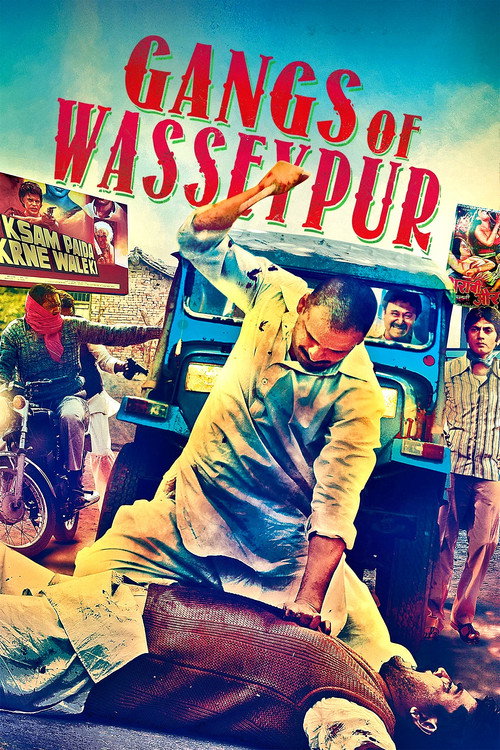
Gangs of Wasseypur - Part 1
2012 · Anurag Kashyap
When you want to sink into a big, blood-soaked family epic and come out quoting it — a full-meal binge for a night when a ninety-minute movie won't cut it. Bold, loud, and unapologetically excessive; not one for the squeamish.
What it's about
In the coal-mining belt of Dhanbad, a blood feud burns across three generations, beginning in the 1940s when a defiant laborer named Shahid Khan crosses the wrong man. Decades later his son Sardar Khan builds himself into a local gangster with one purpose — revenge on the politician-strongman who destroyed his father — while coal money, muscle politics, and family appetite pull everyone deeper into the fire.
The experience
Sprawling, profane, and ferociously entertaining — a crime saga that swings between shocking violence and laugh-out-loud domestic comedy, driven by a soundtrack that turns folk songs into gangster anthems. It's dense with characters and decades but never stops moving.
Performances
Manoj Bajpayee is magnetic as Sardar Khan — vain, funny, terrifying, and ruled by appetite — one of the great gangster performances in Indian cinema, with Tigmanshu Dhulia coolly chilling as his patient adversary.
The craft
Anurag Kashyap fuses world-crime-cinema grammar with the texture of small-town Bihar and Jharkhand: real locations, decades of period detail, narration that spans generations, and an inventive soundtrack that comments on the action like a wicked chorus. The film's energy comes from that collision of epic structure and earthy, gossipy specificity.
Why it matters
Premiering in the Directors' Fortnight at Cannes in 2012, it became a landmark for independent-minded Hindi cinema and a cult phenomenon whose dialogue and characters are still quoted constantly.
Snapshot
Gangs of Wasseypur - Part 1 is the first half of Anurag Kashyap's sprawling crime saga tracing three generations of feuding families in the coal-mining belt of Dhanbad, in what is now Jharkhand, across roughly the 1940s to the early 1990s. Conceived and shot as a single continuous film running over five hours, it was split into two parts for theatrical release; Part 1 covers the rise of the Khan family patriarchs — the martyred Shahid Khan and his vengeful son Sardar Khan — while Part 2 carries the vendetta into the age of Sardar's sons. The film premiered at the 2012 Cannes Film Festival in the Directors' Fortnight (Quinzaine des Réalisateurs) sidebar, and became a landmark for a certain strain of Indian independent-minded cinema: a gangster epic that fuses the grammar of world crime cinema with the specific textures, dialects, folk music, and political history of the Hindi coal heartland. It is at once an homage to and a subversion of Bollywood, saturated with references to the films its characters watch even as it refuses their glamour.
Industry & production
The film sits at the intersection of Bollywood's mainstream apparatus and the independent, director-driven cinema that emerged in India in the late 2000s. It was produced by Anurag Kashyap Films alongside partners including Viacom18 Motion Pictures, the Indian arm of the Viacom–Network18 venture that was then aggressively financing distinctive commercial-independent projects. Kashyap by 2012 had become the central node of a new-wave ecosystem: a director, producer, and mentor whose company incubated younger filmmakers and whose name signaled a break from star-vehicle formula.
The production's defining logistical fact is that it was conceived as one enormous film and cut into two parts for distribution — a decision driven by the impossibility of releasing a five-hour-plus feature in Indian multiplexes. Part 1 was released theatrically in June 2012; Part 2 followed in August. The film relied substantially on location shooting in and around the Dhanbad–Wasseypur region and on a large ensemble of actors, many drawn from theater and from India's pool of character performers rather than from the star firmament, which kept the budget within the ambitious-but-modest range of independent-leaning production. Precise budget and box-office figures circulate in secondary reporting but should be treated cautiously; the film's commercial performance was respectable rather than blockbuster, and its true significance was critical and cultural. I cannot verify specific grosses with confidence and will not cite numbers.
Technology
Gangs of Wasseypur was shot digitally, a choice consonant with the economics and aesthetics of the movement Kashyap represented: digital capture enabled long takes, extended shooting ratios, run-and-gun coverage in cramped and uncontrolled locations, and the roving, handheld immediacy that characterizes the film's visual style. The move away from film stock lowered the cost of the massive amount of footage a two-part epic required and suited the semi-documentary texture Kashyap sought in the coal-belt exteriors and interiors. The soundtrack's technological ambition lay less in hardware than in curation and design — a dense assembly of diegetic and non-diegetic music that leans on regional folk idioms and pointed pop appropriations. Beyond these general facts, I would be inventing to specify camera models or post-production pipelines, so I leave them unstated.
Technique
Cinematography
The cinematography, by Rajeev Ravi — himself a director and one of the most distinctive image-makers of the new Indian cinema — is grounded, mobile, and unglamorous. Ravi favours available and naturalistic light, handheld camerawork, and a palette dominated by the grimy earth tones of coal country: soot-blacks, dust-browns, the sickly fluorescent greens and yellows of cheap interiors. The camera behaves like an embedded observer, moving through crowds, markets, and railway yards, catching violence at oblique or sudden angles rather than choreographing it for spectacle. This visual register deliberately refuses the polished, star-flattering lighting of mainstream Bollywood; faces are allowed to be ordinary, sweaty, and specific. The result is a texture closer to reportage than to genre glamour, even as the film's structure is operatically epic.
Editing
Editing is central to the film's identity, and it was cut by Shweta Venkat (credited as Shweta Venkat Mathew). The two-part structure is itself the largest editorial gesture — the taming of a five-hour narrative into consumable halves. Within scenes, the cutting alternates between patient, dialogue-driven duration and abrupt, jolting violence: killings arrive without the usual build-up, often ending a scene before the viewer has braced for it. The film also uses montage and elliptical time-jumps to compress decades, frequently deploying music-and-image sequences to leap across years of the feud. This rhythm — long conversational stretches punctuated by sudden, almost throwaway brutality — is a defining stylistic signature and a deliberate deflation of the operatic violence of conventional gangster cinema.
Mise-en-scène / staging
The mise-en-scène is dense with lived-in specificity: crowded lanes, coal depots, butcher shops, modest concrete homes, political rallies, and the paraphernalia of small-town north Indian life. Kashyap stages the world so that the criminal economy is inseparable from its social and political fabric — coal mafias, union politics, communal fault lines, and electoral machinery all share the frame. Costume, dialect, food, and décor are used to mark period and class with precision. The staging of violence is anti-heroic: it is often clumsy, ugly, or comic, undercutting the balletic cool of the genre.
Sound
Sound is arguably the film's most celebrated craft dimension. The music — with songs and score associated with composer Sneha Khanwalkar and lyricist/writer Varun Grover, among others — draws on regional folk forms, earthy and often ribald vernacular lyrics, and field-recorded vocal textures rather than glossy playback convention. Khanwalkar's approach of sourcing voices and idioms from the regions the film depicts gave the soundtrack an ethnographic vitality unusual in Hindi cinema. The songs function as ironic and structural commentary, and the sound design foregrounds the ambient life of place. The film's use of music to punctuate violence and to bridge time is inseparable from its editing.
Performance
The performances form one of the film's great legacies. Manoj Bajpayee anchors Part 1 as Sardar Khan, giving the vengeful patriarch a mix of menace, appetite, swagger, and unexpected comedy. The ensemble — including Richa Chadha as Sardar's formidable wife Nagma, Tigmanshu Dhulia as the antagonist coal baron and politician Ramadhir Singh, Piyush Mishra (who also contributed to writing and narration), Jaideep Ahlawat as Shahid Khan, and Huma Qureshi and Nawazuddin Siddiqui in roles that flower more fully in Part 2 — is uniformly grounded in a naturalistic, dialect-driven register. The acting style rejects declamatory Bollywood convention for something rooted, regional, and behavioral, and it launched or elevated the careers of several performers who became central to the following decade of Indian cinema, most famously Nawazuddin Siddiqui.
Narrative & dramatic mode
The dramatic mode is the multigenerational revenge epic told as social history. Structured around a voiceover chronicle and organized as a chain of vendettas, the narrative treats the feud between the Khans and Ramadhir Singh as the engine that drives decades of accumulating bloodshed. The mode is maximalist and digressive: it braids family melodrama, black comedy, political intrigue, and sudden violence, and it is unafraid of tonal whiplash — a scene of domestic bickering can pivot into murder and back to farce. Part 1 is essentially the tragedy of Sardar Khan, whose oath of vengeance both defines and consumes him. The film's overarching dramatic irony is generational: the sins of fathers are visited relentlessly on sons, and revenge is figured not as catharsis but as a self-perpetuating machine that no one escapes.
Genre & cycle
Formally the film is a gangster saga, and it consciously converses with the international canon of the form — the dynastic sweep of the mob epic, the coal-town crime chronicle, the outlaw-family melodrama. But it belongs equally to a specifically Indian cycle: the "small-town" or heartland crime film that flourished in the 2000s and 2010s, trading Bollywood's metropolitan gloss and NRI fantasy for the dust, dialect, and dysfunction of provincial north India. Kashyap's own earlier work and that of contemporaries such as Tigmanshu Dhulia (himself acting here) helped define this cycle. The film also operates as a meta-genre object: its characters are shaped by the movies they watch, and the narrative repeatedly stages Bollywood fandom as a force in ordinary life, making the film a commentary on the genre it inhabits.
Authorship & method
The film is a signal statement of Anurag Kashyap's authorship. Kashyap's method — evident across earlier works like Black Friday and Gulaal — combines a fascination with real Indian violence and politics, a magpie cinephilia that quotes global and Hindi cinema alike, and a commitment to vernacular authenticity over sanitized spectacle. His directorial signature here is the fusion of epic ambition with grounded, semi-documentary texture, and the use of irony, folk music, and dark comedy to reframe the gangster form.
Authorship is genuinely collaborative. The screenplay was developed with a writing team including Zeishan Quadri (who drew on knowledge of the region and also appears in the film), Akhilesh Jaiswal, Sachin Ladia, and Kashyap himself, with Varun Grover and Piyush Mishra contributing lyrics and, in Mishra's case, narration and writing. Cinematographer Rajeev Ravi supplied the film's grounded visual grammar; composer Sneha Khanwalkar its ethnographic sound; editor Shweta Venkat its rhythm and structure. The casting of theater-trained and character actors over stars is itself a methodological choice central to the film's realism. This distribution of authorship across a tight collaborative ensemble is characteristic of the Kashyap workshop model.
Movement / national cinema
The film is a flagship of the Indian new wave — sometimes called "Hindie" or Indie Hindi cinema — that emerged around the turn of the 2010s as an alternative to mainstream Bollywood, enabled by digital production, multiplex distribution, and new corporate financiers willing to back distinctive voices. Kashyap was the movement's most visible figure, and Gangs of Wasseypur became its most ambitious statement: proof that an independent-minded, regionally rooted, formally adventurous film could achieve epic scale and international festival visibility. Its Cannes Directors' Fortnight selection situated it within world cinema's art-house circuit while its subject matter and idiom were emphatically local. In relation to national cinema, the film is notable for decentering Bollywood's Mumbai-and-diaspora imaginary toward the coal belt of eastern India, its dialects, and its buried political histories.
Era / period
Made in 2012, the film belongs to a moment when digital tools, corporate independent financing, and a hunger for grittier, more authentic storytelling converged in Hindi cinema. Diegetically, Part 1 spans from the pre- and post-Independence 1940s through the following decades of the coal-belt feud, using its historical sweep to narrate India's political and economic transformations — the nationalization of coal, the entanglement of crime with union and electoral politics, and the communal and caste tensions of the region — as the backdrop and cause of its violence. The film thus functions as a period chronicle: its gangster story is simultaneously a folk history of Dhanbad and, by extension, of post-Independence India's underbelly.
Themes
Its central theme is revenge as inheritance — a curse passed from father to son that promises justice but delivers only more death. Around this spine cluster several concerns: the inseparability of crime from politics and capital, dramatized through the coal mafia and its collusion with power; masculinity, patriarchy, and the appetites (for food, sex, power, and blood) that drive its men, counterpointed by the sharp, often ruthless agency of its women; the role of cinema itself in shaping the aspirations and self-image of ordinary people; and communal and regional identity in a stratified society. Underlying all of it is a bleak view of cyclical violence as a self-sustaining system, deflated repeatedly by black comedy so that the epic never curdles into mythologizing heroism.
Reception, canon & influence
Critically, Gangs of Wasseypur was widely acclaimed both in India and internationally following its Cannes premiere, praised for its ambition, its sound and music, its ensemble performances, and its fusion of pulp energy with social realism; it has since been frequently ranked among the most important Indian films of the 2010s and has attracted a strong afterlife on streaming platforms, reportedly finding new international audiences years after release. I attribute no specific quotations or awards tallies here, as the precise record is best confirmed against primary sources.
Looking backward, the film's influences are eclectic and openly worn: the international gangster and crime-epic tradition; the multigenerational vendetta narrative; the textures of world realist cinema; and, crucially, Bollywood itself, which the film quotes, parodies, and loves throughout. Kashyap's own filmography — its interest in real crime, politics, and vernacular violence — is the most direct lineage.
Looking forward, the film's legacy is substantial. It helped consolidate the heartland-crime idiom that would define much subsequent Indian cinema and, especially, the streaming-era boom in gritty Indian crime series — most visibly through the careers and creative networks it launched. Nawazuddin Siddiqui's ascent to leading-man status is closely tied to it; several of its writers and actors, including Zeishan Quadri and Vineet Kumar Singh, went on to shape the genre; and its regional-realist, dialect-rich, morally gray template became a reference point for later long-form crime storytelling in India. As both a critical touchstone and a template, Gangs of Wasseypur stands as one of the pivotal Indian films of its decade.
Reception
Only a modest theatrical performer in India in 2012 and too profane for some at home, it snowballed via word of mouth into a certified cult epic — by 2019 The Guardian was ranking it among the best films of the 21st century, and it's now the default 'start here' for Indian cinema recs.
How Gangs of Wasseypur - Part 1 was received, from release to now →
How to watch Gangs of Wasseypur - Part 1: what to notice on a first viewing
- Notice how suddenly killings happen without any warning or buildup. The editing alternates patient, dialogue-driven scenes with jolting violence that ends a scene before you've braced for it. The abruptness refuses the operatic buildup other gangster films give their violence.
- Watch the handheld camera move through crowds, markets, and railway yards. Rajeev Ravi shoots like an embedded observer, catching violence at oblique or sudden angles rather than choreographing it for spectacle. The camera behaves like it's reporting on this world, not glamorizing it.
- Listen for folk melodies and regional voices threading through the score. Sneha Khanwalkar draws on field-recorded vocal textures and regional folk forms instead of glossy playback convention. The music roots the saga in the specific place it depicts rather than a generic Bollywood sound.
- Notice the grimy earth tones: soot black, dust brown, sickly interior light. The palette stays deliberately unglamorous, refusing the polished, star-flattering lighting of mainstream Bollywood cinema. The look keeps insisting this is a real place, not a genre backdrop.
- Watch how ordinary and unpolished the actors' faces are allowed to look. The ensemble plays in a naturalistic, dialect-driven register that rejects declamatory convention for something rooted and behavioral. The plainness of the performances makes the eventual violence land as real rather than staged.
The whole guide to watching Gangs of Wasseypur - Part 1, with the keys for a rewatch →
Influences: the films it descends from and the films it influenced
- City of God (2002) — Supplies the template of handheld, available-light kinetic realism married to a first-person voiceover chronicle that narrates a poor neighborhood's criminal generations across decades.
- Goodfellas (1990) — Model for wall-to-wall voiceover chronicle plus needle-drop diegetic music as ironic commentary on violence, and the rise-and-fall gangster arc punctuated by abrupt, matter-of-fact killings.
- Once Upon a Time in America (1984) — Establishes the elliptical, decade-spanning time-jump architecture of a crime epic that folds childhood, ascent and reckoning into a non-linear memory structure.
- The Godfather (1972) — Founding form of the multigenerational family crime dynasty in which vendetta and business are literally inherited from father to son as the epic's engine.
- Sholay (1975) — The Hindi 'curry-western' revenge-and-dacoit template — the wronged man, the coal-and-dust badlands, the iconic villain — that Gangs openly quotes, parodies and inverts.
- Deewaar (1975) — Source of the angry-young-man iconography and Bollywood-star mythology the film cites as metacinema, with characters watching and modeling themselves on Hindi-film archetypes.
- Satya (1998) — Pioneered the vernacular Indian underworld realism that casts theater-trained character actors over stars and grounds gangsterism in grimy, dialect-specific local texture.
- Black Friday (2004) — Kashyap's own docudrama method rehearsed here first — real-crime research, handheld available-light shooting, sprawling character-actor ensemble and elliptical chronicle structure.
- Pulp Fiction (1994) — Blueprint for the tonal whiplash that yokes dark comedy and pop-culture-riffing dialogue to sudden, shockingly casual bursts of violence.
- Sacred Games (2018) — Carries the dialect-rich, morally-gray, voiceover-chronicle crime template into streaming long-form, reusing Nawazuddin Siddiqui and Sneha Khanwalkar's ethnographic sound design.
- Mirzapur (2018) — Directly extends the Uttar Pradesh heartland-crime idiom — inherited-mafia revenge, guns-and-gaali vernacular, character-actor ensemble — into a serialized franchise.
- Sonchiriya (2019) — Applies the same dialect-authentic realism to the Chambal dacoit world, using Bundelkhandi speech, available-light landscapes and a naturalistic ensemble over stars.
- Mukkabaaz (2018) — Kashyap continues the heartland vernacular-realism method — caste politics, small-town dialect, naturalistic performance — while elevating Gangs alumnus Vineet Kumar Singh to lead.
- Gomorrah (2008) — Parallel practice of regional-dialect crime realism shot in documentary-style available light with non-professional locals, refusing gangster glamour for ethnographic texture.
- Vada Chennai (2018) — Builds a Tamil multigenerational gangster epic on the same elliptical time-jump structure and dense character-actor ensemble drawn from a specific regional locality.
- Angamaly Diaries (2017) — Shares the sprawling regional ensemble of non-star locals, folk-textured food-and-community detail and kinetic handheld staging of abrupt gang violence.
Similar films
- Sholay (1975) — influence & lineage · same viewing thread
- Vada Chennai (2018) — influence & lineage · same viewing thread
- Satya (1998) — influence & lineage
- The Godfather (1972) — influence & lineage
- Dhurandhar (2025) — same viewing thread
- Pudhupettai (2006) — same viewing thread
- Asuran (2019) — same viewing thread
- Nayakan (1987) — same viewing thread
All the films related to Gangs of Wasseypur - Part 1 →
Watch it with: curated runs of related films
- Blood Feuds and Broken Men — A run of Indian films about ordinary men swallowed by violence, vendetta, and moral compromise — watch these together when you want fate, murky righteousness, and gunpowder sharing the same frame.